
BAR-254 · Lesson 2 of 12 · 20 min
Eligibility, education, deadlines and fees
▶ Video coming soon A video version of this lesson is on the way.
In early October 2026, Nilda Ocasio cleared a corner of the firm's conference table and handed Camila a printout of the Board's regulation with a dozen pages flagged. 'Every year somebody who knows the law cold loses a sitting because a certificate expired or the payment did not go through,' she said. 'Read the requirements before you read another case.' Camila built a checklist from the regulation and the Board's most recent edict, and Marchetti asked her to share it with the group, because the discipline of a written checklist works in every jurisdiction.
This lesson covers who is eligible to sit the general reválida, what education is required, how and when to apply, what documents go with the application and what the exams cost. Lesson 3 covers character and fitness. Everything here is drawn from the Board's regulation, the Reglamento de la Junta Examinadora, as amended, and the edict for the September 2026 sitting. The Board can amend its regulation and each edict sets the dates for that sitting, so a candidate should always read the current versions on the Judicial Branch website.
The requirements in Rule 4.1.1
Rule 4.1.1 of the regulation lists the requirements for admission to the practice of law. An applicant must be older than 21; hold a law degree from a law school approved by the American Bar Association or by the Supreme Court of Puerto Rico; have a good reputation; pass the general reválida; and have completed a bachelor's degree before law school, or, for applicants educated outside the United States and Puerto Rico, an equivalent university program the Board accepts.
The law degree requirement has two branches. A degree from any ABA-approved law school qualifies, wherever the school is located. A degree from a school approved by the Supreme Court of Puerto Rico also qualifies, which is why NCBE's chart notes that an ABA-approved J.D. is not strictly required in Puerto Rico. In practice, most candidates graduate from one of the island's law schools, including those of the University of Puerto Rico, the Inter American University and the Pontifical Catholic University. Graduates of stateside ABA-approved schools sit the reválida every year, often after returning home to the island.
Applicants educated abroad
Rule 4.2.1 deals with applicants whose education took place outside the United States and Puerto Rico. They must meet the age, reputation, exam and prior education requirements, have their studies validated, and earn a law degree from a law school approved by both the ABA and the Court. The supporting evidence goes with the application. The effect is that a law degree from another country, even one from a civil law country with a code similar to Puerto Rico's, does not by itself make a candidate eligible. NCBE's chart reflects this by listing foreign law graduates as ineligible.
Two sittings a year
Rule 5.2.2 requires the Board to give the reválidas twice a year, at least six months apart within the same calendar year. In practice the sittings are in March and September. Before each sitting, the Board publishes an edict, an official public notice, setting the dates of the general and notarial exams, the place, the application deadline and the method of filing. The edict also lists the subjects that may be tested and points to any recent changes, such as the amended specification tables the Board adopted by resolution on May 19, 2026.
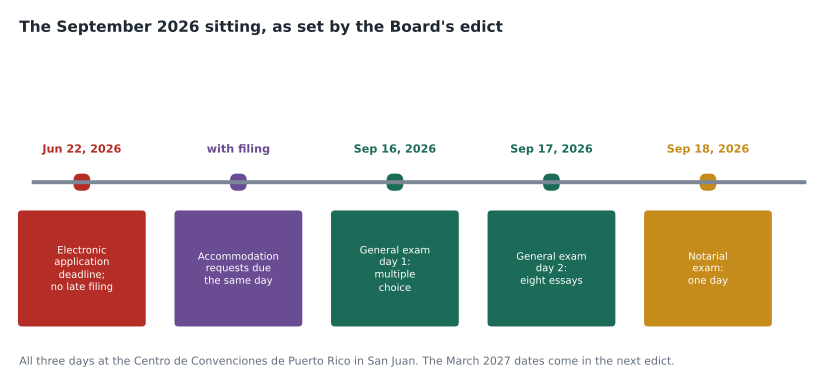
For the September 2026 sitting, the edict set these dates: the general reválida on Wednesday and Thursday, September 16 and 17, 2026; the notarial reválida on Friday, September 18, 2026; all at the Puerto Rico Convention Center, the Centro de Convenciones de Puerto Rico, in San Juan. Applications for both exams were due on Monday, June 22, 2026. The March 2027 dates and deadline are set by the next edict, so Camila added a weekly reminder to check the Board's page.
Filing: electronic and on time
Applications are filed electronically through the Judicial Branch's electronic admission application portal. The edict for September 2026 stated that applications filed after the deadline would be rejected outright. There is no late filing period with a higher fee, as some states offer. A candidate who misses the date waits for the next sitting.
The application must be complete when filed, with all the documents the regulation requires. The duty to keep it accurate continues after filing: under Rule 6.3.1, an applicant must update the information until the oath. A change of address, a new job, a traffic case or a new court filing all belong in an update. Lesson 3 explains why candor matters so much.
The documents
Rule 6.2.1 lists what goes with an application to the general reválida. The most important items are a sworn statement by the applicant, in the form the Board provides; a certificate of criminal record from the Puerto Rico Police issued within 90 days before the application; certificates from other jurisdictions for any applicant who lived or studied outside Puerto Rico for six or more consecutive months during the previous ten years; evidence of the law degree and the prior bachelor's degree; and payment of the fee.
The 90-day rule for the police certificate catches people every sitting. A certificate requested in February and filed in June is too old. Camila put two dates on her checklist: the day the next edict appeared and the day, about 60 days before the deadline, when she would request her certificate so that it would still be fresh when she filed. Because she had spent a semester abroad during law school, she also checked whether that period triggered the foreign certificate rule. It did not: the semester was shorter than six consecutive months.
| Item | Rule | What to watch |
|---|---|---|
| Sworn statement | 6.2.1(a) | Complete every question; disclose everything asked |
| Puerto Rico Police criminal record certificate | 6.2.1(d) | Issued within 90 days before the application |
| Foreign certificates | 6.2.1(d) | If you lived or studied abroad six or more consecutive months in the last ten years |
| Law degree and bachelor's degree | 4.1.1 | Law school approved by the ABA or the Supreme Court |
| Fee | 5.7.1 | Paid electronically or with Internal Revenue stamps |
| Accommodation request, if any | Edict | Filed the same day and the same way as the application |
Fees
Rule 5.7.1 sets the exam fees: 250 dollars for the general reválida and 200 dollars for the notarial reválida. The fee may be paid electronically or with Internal Revenue stamps, the sellos de Rentas Internas that Puerto Rico uses for many government fees. For the September 2026 sitting, the edict directed payment through the electronic application by credit card. After passing the general exam, a candidate pays for the certificate that accompanies admission with 15 dollars in stamps under Rule 6.2.2(b).
Other fees appear later in the process. A candidate who wants copies of her essay answers pays 20 dollars for the general exam or 10 dollars for the notarial exam, plus 15 dollars for the grading guidelines, under Rule 10.2.1. Those copies matter to a candidate who failed narrowly and is considering reconsideration, which Lesson 4 explains. Compared with many states, where filing fees run to several hundred or more than a thousand dollars, Puerto Rico's fees are modest, but they are fixed by the regulation and the edict, so a candidate should check both before paying.
Testing accommodations
A candidate with a disability who needs accommodations, such as extra time or a separate room, must request them on the same date and through the same procedure as the application. The September 2026 edict allowed the supporting medical certification, Form 62-J, to be filed later, but the request itself had to be filed on time or it would be denied as late. A candidate who thinks she may need accommodations should start gathering medical documentation well before the edict appears.
The notarial prerequisites
Although Camila would not sit the notarial reválida until she was a lawyer, she checked its academic prerequisites early, because they depend on law school courses. Rule 7.1.1(c) requires credits in specific subjects: three credits each in substantive notarial law, succession, mortgage law, family law, and obligations and contracts, plus five credits in practical notarial law. A footnote in the regulation provides that students admitted to law school before August 2021 need only a passing notarial law course. Camila's transcript met the requirements. A graduate of a stateside law school usually does not have those credits and must plan to earn them before seeking admission to the notarial practice.
A checklist that worked
By mid-October Camila's checklist fit on one page. It listed the regulation's requirements with a box for each, the date to start watching for the March 2027 edict, the date to request the police certificate, the fee and payment method, the deadline for accommodations and a reminder to update her application whenever anything changed. Marchetti told the group that Camila's page was the best example of the habit she wanted from all of them: write down every requirement in the rules' own words, then attach a date to each one.
Worked problem
Will the application be accepted?
Ivelisse Báez, a classmate of Camila's, planned to file for the March 2027 sitting. She requested her police certificate on November 20, 2026, intending to file in January 2027. Assume the edict sets a filing deadline in mid-December 2026 and Ivelisse files on the last day. She also spent seven consecutive months working in Madrid in 2023.
Show solution
- The police certificate will be about four weeks old on filing, so it satisfies the 90-day rule.
- Her seven consecutive months in Madrid fall within the last ten years and exceed six months, so she needs a certificate from Spain as well.
- If she had waited until January to file, the application would have been late; the edict deadline controls and late applications are rejected.
- She must pay the 250-dollar fee through the method the edict specifies and update the application if anything changes before the oath.
Answer: The application can be accepted if she files by the edict deadline with both the Puerto Rico and the Spanish certificates. Her original January plan would have missed the sitting.
Common mistakes
MistakeA late application can be filed with a late fee.
InsteadThe September 2026 edict rejected late applications outright; there is no late period.
MistakeAny police certificate will do.
InsteadThe Puerto Rico Police certificate must be issued within 90 days before the application.
MistakeAccommodation requests can be filed after the application deadline.
InsteadThey must be filed on the same date and in the same way as the application, though the medical form may follow.
MistakeA foreign law degree qualifies if the country uses a civil code.
InsteadRule 4.2.1 requires a law degree from a school approved by the ABA and the Court.
MistakeThe notarial credits can be ignored until after admission.
InsteadThey come from law school courses, so a candidate should check them early.
Choosing a sitting
Because the reválida is offered only in March and September, the choice of sitting shapes a candidate's whole year. A May graduate who sits in September has about four months to prepare, but the application deadline arrives only a few weeks after graduation, so the documents must be gathered during the last semester of law school. A candidate who waits until March gains time and can work while studying, as Camila did, but delays admission by six months. Neither choice is wrong. What matters is choosing deliberately, with the deadline and the six-attempt limit in mind, rather than drifting into a sitting without enough preparation.
Candidates who graduated from law schools in the states face a further question: language. Reading 184 questions and eight fact patterns in legal Spanish at exam speed is a skill, and a stateside graduate who grew up speaking Spanish at home may still need months of practice with the Civil Code and the Court's opinions in Spanish. Some such candidates choose the later sitting for that reason alone.
Keeping proof
Every step of the application leaves a record, and a candidate should keep all of it: the electronic filing confirmation, the payment receipt, the date and copy of the police certificate, any foreign certificates, the accommodation request and every update filed under Rule 6.3.1. If a document goes missing in the system or a question arises about timeliness, the candidate's own records are her best protection. Camila saved a copy of each item in a folder named for the sitting and kept a printed list of filing dates on her desk.
When something goes wrong
Problems do arise: a certificate that cannot be obtained in time, a payment that fails, an illness that interferes with the exam. The regulation addresses some of them directly, such as the medical emergency rule for attempts. For others, the right course is to contact the Board promptly, in writing, explain the problem and ask what the rules permit. Waiting and hoping is the one approach that never helps.
Summary and key terms
- Rule 4.1.1: over 21, a bachelor's degree, a law degree from an ABA- or Court-approved school, good reputation and a passing general reválida.
- The Board gives two sittings a year, in March and September, each announced by an edict that sets the dates and deadline.
- Applications are electronic and late applications are rejected; the police certificate must be issued within 90 days.
- Fees under Rule 5.7.1: 250 dollars for the general exam and 200 for the notarial exam.
- The notarial practice requires specific law school credits under Rule 7.1.1(c).
- 0
- edict (edicto)
- 1
- Internal Revenue stamps
- 2
- sworn statement
- 3
- criminal record certificate
- 4
- Form 62-J
- 5
- practical notarial law
Practice problems
Work each problem on paper first, then reveal the answer to check.
When were applications due for the September 2026 sitting?
Show answer
Monday, June 22, 2026, filed electronically.
How recent must the Puerto Rico Police certificate be?
Show answer
Issued within 90 days before the application.
What is the fee for the general reválida under the regulation?
Show answer
250 dollars.
Who must file foreign criminal record certificates?
Show answer
An applicant who lived or studied outside Puerto Rico for six or more consecutive months during the last ten years.
Which law school credits does the notarial practice require?
Show answer
Three credits each in substantive notarial law, succession, mortgage law, family law and obligations and contracts, plus five in practical notarial law.
Lesson quiz · 5 questions
Score 60% or more to complete this lesson.
Create a free account to save your progress, take quizzes and earn a certificate.