
BAR-254 · Lesson 1 of 12 · 20 min
Becoming a lawyer in Puerto Rico
▶ Video coming soon A video version of this lesson is on the way.
Camila Ortiz Rivera joined Hollis Marchetti's online study group in September 2026 with a problem none of the other members shared. Dana was studying for Texas, Ngozi for New York, Sofia for California and Eddie for Louisiana, and every one of them would meet the Multistate Bar Examination in some form. Camila would not. The Puerto Rico bar exam, which everyone on the island calls the reválida, is written in Spanish by Puerto Rico's own Board of Bar Examiners and tests Puerto Rico law. There is no MBE, no Multistate Essay Examination, no Multistate Performance Test and no Uniform Bar Examination score to earn. On her first evening, Marchetti asked her to explain the system to the group. 'Start with who decides,' she said. 'Then tell us what you have to do and in what order.'
Camila had graduated in May 2026 from a law school in San Juan and had started work as a law clerk at Ocasio & Mattei, a four-lawyer firm in Caguas. Her supervising partner, Nilda Ocasio Sostre, is both a lawyer and a notary, which in Puerto Rico are two different professional titles with two different exams. Camila had decided to sit the general reválida in March 2027 rather than rushing into the September 2026 sitting, and she planned to take the notarial reválida after that. This course follows her preparation. It explains how admission works in Puerto Rico, what the two exams test, and the parts of Puerto Rico law that set the island apart from every state.
A jurisdiction with its own exam
Puerto Rico is a United States territory with its own constitution, its own Supreme Court and a legal system that blends two traditions. Its private law, the law of persons, property, obligations, contracts, family and succession, comes from the Spanish civil law tradition and is codified in the Civil Code, most recently the Civil Code of 2020. Its public law, procedure and evidence owe a great deal to the common law of the United States. Federal law applies on the island, and the United States District Court for the District of Puerto Rico sits in San Juan.
That mix explains why Puerto Rico writes its own bar exam. NCBE's jurisdiction page for Puerto Rico shows an exam drafted by the jurisdiction itself, with no legacy UBE and no NextGen exam. Puerto Rico does not require the Multistate Professional Responsibility Examination, does not accept transferred UBE or NextGen scores, does not accept transferred MBE scores and has no rule for admission on motion. A lawyer licensed in Florida or New York who moves to San Juan must sit the reválida like anyone else.
Who decides
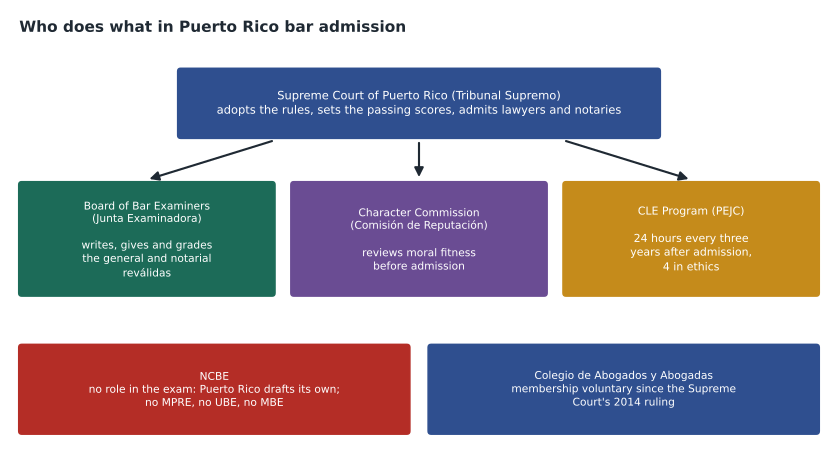
The Supreme Court of Puerto Rico, the Tribunal Supremo, has the final word on who may practice law. The Court regulates the profession under its inherent power over the practice of law: it adopts the rules on admission, sets the passing scores on the recommendation of its Board, admits applicants who qualify, adopts the rules of professional conduct and disciplines lawyers and notaries. When the Court changed the passing score in 2022, and when it adopted new Rules of Professional Conduct in 2025, it did so by resolution.
The Board of Bar Examiners, in Spanish the Junta Examinadora de Aspirantes al Ejercicio de la Abogacía y la Notaría, prepares, gives and grades both exams under a regulation the Court approves. The Board receives applications, publishes an edict announcing each sitting, decides which subjects and specification tables apply, trains the lawyers who grade the essay answers, issues the results and decides requests for reconsideration. Its mailing address in San Juan is listed on NCBE's chart, and its documents, manuals and regulation are on the Judicial Branch website, poderjudicial.pr.
Character and moral fitness are reviewed with the Character Commission, the Comisión de Reputación, which works with the Board to evaluate whether each applicant has the good reputation the rules require. Lesson 3 explains that process. After admission, the Continuing Legal Education Program, known by its Spanish initials PEJC, administers the continuing education every active lawyer must complete; Lesson 11 covers it.
Two professional titles: lawyer and notary
In most states a notary public is a clerk who witnesses signatures. In Puerto Rico, as in other civil law systems, the notary is a lawyer and a public officer who drafts and authorizes public instruments: deeds of sale, mortgages, wills, powers of attorney, marriage settlements and many other documents that must be executed before a notary to be valid or to be recorded in the property registry. The notary gives faith, fe pública, that the parties appeared, that they had capacity and that they consented with full information. Because the stakes are so high, Puerto Rico licenses notaries separately.
The result is two admissions. To practice law, an applicant passes the general reválida, the Reválida de Derecho General, and is sworn in as a lawyer. To practice as a notary, a lawyer admitted in Puerto Rico must also pass the notarial reválida, the Reválida de Derecho Notarial, and be admitted to the notarial practice. The notarial exam has its own passing score, its own structure and its own academic prerequisites. Lesson 6 covers it in detail.
The basic requirements
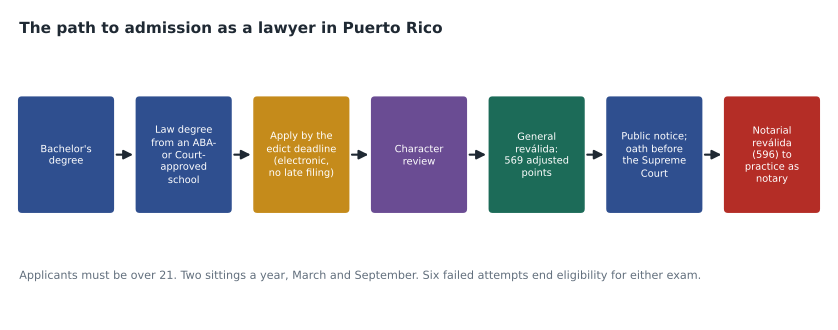
The Board's regulation sets out the requirements for admission as a lawyer. Under Rule 4.1.1, an applicant must be older than 21, hold a law degree from a law school approved by the American Bar Association or by the Supreme Court of Puerto Rico, have a good reputation, pass the general reválida and hold a prior bachelor's degree. Applicants educated abroad must still meet those requirements and must earn a law degree from a school approved by the ABA and the Court. NCBE's chart lists foreign-trained lawyers as ineligible, which is consistent with that rule: a foreign law degree alone does not qualify.
The exam is given twice a year. The regulation requires two administrations a year at least six months apart, and in practice they are held in March and September. For the September 2026 sitting, the Board's edict set the general exam for September 16 and 17, 2026 and the notarial exam for September 18, 2026, all at the Puerto Rico Convention Center in San Juan, with an electronic application deadline of June 22, 2026. Lesson 2 covers the calendar, fees and documents.
The language of the exam
The reválida is given in Spanish. Rule 5.2.1 of the Board's regulation allows candidates to answer in Spanish or in English, so a candidate who writes better in English may do so. Reading is another matter. Every question, every fact pattern and every multiple-choice option is in Spanish, and the law tested is written in Spanish: the Civil Code, the Rules of Civil Procedure, the Notarial Law and most decisions of the Supreme Court. A candidate who is not comfortable reading legal Spanish at speed should treat that as part of the preparation.
Language matters after admission too. The local courts work mainly in Spanish, while the federal district court works in English. Most lawyers in Puerto Rico move between the two languages every day. Throughout this course, the main Spanish terms appear in italics or quotation marks with an English translation, because a candidate needs to recognize them on the exam.
How the exam is scored
The general reválida has two parts. The first day is multiple choice, 184 questions in two sessions. The second day is discussion, eight essay questions in two sessions. Each part is calibrated to a common scale and weighted equally, and the result is a single adjusted score. Since the Court's resolution of June 9, 2022, the passing score has been 569 adjusted points. The notarial reválida passes at 596 adjusted points. Lessons 4 to 6 explain the formats, the scoring and the history of those numbers.
A limit on attempts
Puerto Rico limits how many times a candidate may fail. Under Rule 5.8.1 of the regulation, a candidate who has failed six times, counting from September 1983, may not sit either exam again. Starting an exam counts as an attempt, although the Board may decide not to count it if a medical emergency prevented the candidate from finishing and a medical certificate is filed within 48 hours. Camila's view, which Nilda Ocasio shared, was that the rule was another reason to sit only when ready.
Membership in the Colegio
For decades, every lawyer in Puerto Rico had to belong to the Colegio de Abogados de Puerto Rico. That changed in 2014, when the Supreme Court held that compulsory membership as a condition of practicing law could not be required. Membership in the Colegio, now the Colegio de Abogados y Abogadas de Puerto Rico, is voluntary. The Court's own registry of lawyers, the Registro Único de Abogados, known by its initials RUA, is what matters for practice: every lawyer has a RUA number and must keep the registry information current.
| Feature | Puerto Rico | Typical UBE state |
|---|---|---|
| Exam | Jurisdiction-drafted reválida in Spanish | UBE written by NCBE |
| Days | Two days for the general exam; a third day for the notarial exam | Two days |
| MPRE | Not required | Required, with a set score |
| Passing score | 569 adjusted points (general); 596 (notarial) | A UBE score such as 266 or 270 |
| Score transfer | None accepted | UBE scores transfer among UBE states |
| Admission on motion | Not provided | Usually available after years of practice |
| Notaries | Separate exam and admission for lawyer-notaries | Notary public is a nonlawyer clerk |
Who passes, and why preparation differs
A Puerto Rico candidate's preparation looks different from a state candidate's. There are no NCBE practice questions to buy, because NCBE does not write the exam. The Board publishes its regulation, its specification tables for each subject, its instructions manuals, a manual explaining the score report and, for some sittings, grading guides for released essay questions. Local review courses, law school bar preparation programs and study groups fill the rest. The six subjects the Board marks with an asterisk in its edict, which it says may be tested in a particular way, deserve special attention; Lesson 4 lists them.
Marchetti's contribution was method rather than law. She knew nothing about the Civil Code, but she knew how to build a study calendar, how to drill timed questions and how to grade an essay against a rubric. Nilda Ocasio supplied the Puerto Rico law. Between them, Camila had a plan by the end of September: read the regulation and the edict first, master the six asterisked subjects, drill multiple choice in timed sets of 92, and write two full essays every week, graded the way the Board grades.
Worked problem
Can these applicants sit the reválida?
Nilda Ocasio asked Camila to sort four people who had called the firm. (1) A graduate of an ABA-approved law school in Florida, age 26, with a bachelor's degree. (2) A lawyer trained and licensed in Spain, with no American law degree. (3) A lawyer admitted in New York for ten years who wants to be admitted in Puerto Rico without an exam. (4) A 2026 graduate of a Puerto Rico law school who wants to start as a notary immediately.
Show solution
- Applicant 1 meets the education, age and prior degree requirements and may apply to sit the general reválida, subject to character review.
- Applicant 2 is not eligible on a foreign degree alone; the regulation requires a law degree from a school approved by the ABA and the Court.
- Applicant 3 has no route without an exam: Puerto Rico does not provide admission on motion and does not accept transferred scores.
- Applicant 4 must first be admitted as a lawyer by passing the general reválida, and must then pass the notarial reválida and be admitted to the notarial practice.
Answer: Only the first applicant can go straight to the general reválida. Everyone else either needs a qualifying degree, must take the exam, or must become a lawyer first.
Common mistakes
MistakePuerto Rico uses the UBE with a Puerto Rico component.
InsteadPuerto Rico writes and grades its own exam; it uses no NCBE exam at all.
MistakeEvery lawyer in Puerto Rico can act as a notary.
InsteadThe notarial practice requires a separate exam and admission after admission as a lawyer.
MistakeThe exam must be answered in Spanish.
InsteadQuestions are in Spanish, but Rule 5.2.1 allows answers in Spanish or English.
MistakeAn experienced lawyer from a state can be admitted on motion.
InsteadPuerto Rico has no admission on motion and accepts no transferred scores.
MistakeMembership in the Colegio de Abogados is required to practice.
InsteadMembership has been voluntary since the Supreme Court's 2014 ruling.
Summary and key terms
- The Supreme Court of Puerto Rico regulates admission and practice; its Board of Bar Examiners writes, gives and grades the exams.
- Puerto Rico uses no NCBE exam, does not require the MPRE, accepts no transferred scores and has no admission on motion.
- Lawyers and notaries are admitted separately: the general reválida passes at 569 adjusted points and the notarial reválida at 596.
- Applicants must be over 21, hold a bachelor's degree and a law degree from an ABA- or Court-approved school, and have a good reputation.
- The exam is in Spanish, answers may be in Spanish or English, and six failures end eligibility.
- 0
- reválida
- 1
- Junta Examinadora
- 2
- Comisión de Reputación
- 3
- notary (notario)
- 4
- fe pública
- 5
- RUA
- 6
- Colegio de Abogados y Abogadas
Practice problems
Work each problem on paper first, then reveal the answer to check.
Which body writes and grades the Puerto Rico bar exam?
Show answer
The Board of Bar Examiners, the Junta Examinadora, under a regulation approved by the Supreme Court.
Does Puerto Rico require the MPRE?
Show answer
No. NCBE's chart lists no MPRE requirement for Puerto Rico.
What must a lawyer do to practice as a notary in Puerto Rico?
Show answer
Be admitted as a lawyer in Puerto Rico, pass the notarial reválida and be admitted to the notarial practice.
In what languages may a candidate answer?
Show answer
Spanish or English, under Rule 5.2.1 of the Board's regulation.
How many failed attempts end a candidate's eligibility?
Show answer
Six, counted from September 1983, under Rule 5.8.1.
Lesson quiz · 5 questions
Score 60% or more to complete this lesson.
Create a free account to save your progress, take quizzes and earn a certificate.