
BAR-254 · Lesson 4 of 12 · 20 min
The general reválida: format, scoring and the 569 passing score
▶ Video coming soon A video version of this lesson is on the way.
Marchetti's first question about any exam is always the same: what does a candidate actually do, minute by minute, on the day? For the UBE she can answer from memory. For the reválida she asked Camila to bring the Board's manual of general instructions to the group's Tuesday session in mid-October 2026, and they went through it page by page. By the end, the group understood something that surprised the state candidates: the reválida spends a whole day on essays, and its essays count for exactly as much as its 184 multiple-choice questions.
This lesson explains what the general reválida covers, how its two days are organized, how the answers are graded and scaled, what the 569 passing score means and what a candidate can do after a near miss. The sources are the Board's regulation, its manual of general instructions, its manual for interpreting the score report and the September 2026 edict.
What the exam may cover
Rule 5.4.1 of the regulation lists the subjects that may appear on the general reválida: Administrative Law, Constitutional Law, Family Law, Succession, Mortgage and Registry Law, Criminal Law, Evidence, Property Law, Professional Ethics, Obligations and Contracts, Civil Procedure, Criminal Procedure, and Extracontractual Civil Liability. The edict for each sitting repeats that the exam may cover any combination of these thirteen subjects, tested through the multiple-choice part and the discussion part.
The edict marks six subjects with an asterisk: Constitutional Law, Mortgage and Registry Law, Ethics and Professional Responsibility, Obligations and Contracts with special contracts, Civil Procedure, and Extracontractual Civil Liability. On May 19, 2026, the Board adopted a resolution amending the specification tables, the tablas de especificaciones, for those subjects on the general exam and for the notarial exam. A specification table breaks a subject into topics and shows how much weight each topic carries, so it is the closest thing a candidate has to a blueprint. Camila printed every table and used them as the outline for her notes.
| Subject | Asterisked in the edict | Where this course covers it |
|---|---|---|
| Constitutional Law | Yes | Lesson 7 in passing; study the specification table |
| Mortgage and Registry Law | Yes | Lesson 8 |
| Ethics and Professional Responsibility | Yes | Lessons 3 and 11 |
| Obligations and Contracts (special contracts) | Yes | Lesson 8 |
| Civil Procedure | Yes | Lesson 7 |
| Extracontractual Civil Liability | Yes | Lesson 9 |
| Family Law and Succession | No | Lesson 10 |
| Property, Evidence, Criminal Law and Procedure, Administrative Law | No | Study from the specification tables |
Day one: multiple choice
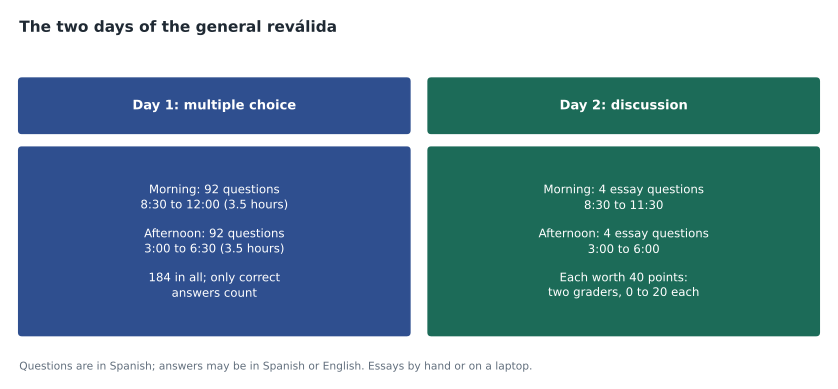
The first day is entirely multiple choice. According to the manual of general instructions, there are two sessions, each with 92 questions and each lasting three and a half hours. The morning session runs from 8:30 to 12:00 and the afternoon session from 3:00 to 6:30; candidates must arrive at 7:30 and 2:00, and the doors close for instructions at 8:15 and 2:45. That makes 184 questions in seven hours of testing, a little over two minutes a question.
The manual tells candidates to answer every question because only correct answers count. There is no penalty for a wrong answer, so a blank is simply a lost point. Answers are machine-scored by optical reading. Camila's drill plan used sets of 92 questions under a three-and-a-half-hour limit, then sets of 46 under half that time, so that the pace would feel natural.
Day two: discussion
The second day is the discussion part. There are again two sessions, each with four essay questions. The morning session runs from 8:30 to 11:30 and the afternoon session from 3:00 to 6:00, which gives a candidate about 45 minutes per question. Candidates may write by hand or use a laptop, following the Board's separate instructions for computer use, and laptop users must be seated earlier, by 8:00 in the morning and 2:30 in the afternoon.
Rule 5.3.1 of the regulation allows the Board to include performance questions as well as discussion and multiple-choice questions, and to set the proportion, number, weight and time of each according to scientific standards. A candidate should read each edict and manual for the current structure rather than assume the last sitting's format will repeat.
How essays are graded
Each essay answer is graded by two lawyers working independently. Each grader scores the answer on a scale from 0 to 20, so an answer is worth up to 40 raw points. If the two scores differ by more than one point, the graders meet in a consensus session under Rule 2.5.4.5 of the regulation. The graders work from guidelines the Board prepares for each question, which assign point values to the elements of a good answer.
Rule 2.5.4.4 lists what the graders look for: identification of the issues, statement of the applicable law, analysis, legally acceptable solutions and clear writing. That list is a template for every answer. Name the issue. State the rule, citing the article or the doctrine. Apply it to the facts, using the facts rather than repeating them. Reach a conclusion the law supports. And write so that a tired grader can follow every step.
From raw points to the adjusted score
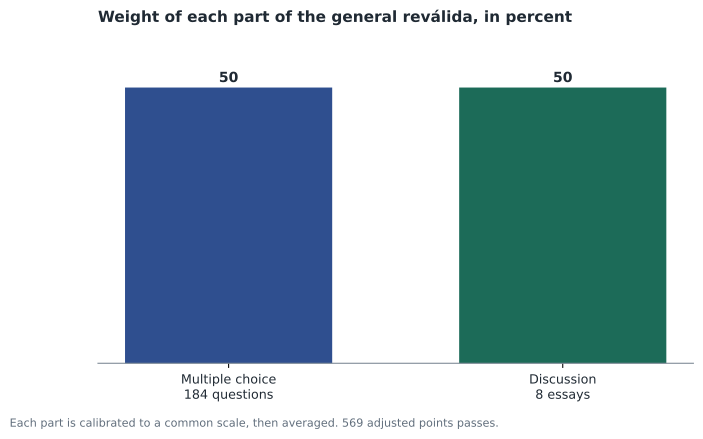
The Board's manual for interpreting the score report, in its March 2026 version, explains how the final score is built. Each essay's raw score is converted using a table that places it on a distribution with a mean of 5 and a standard deviation of 1, and the converted values for the eight essays are added together. The multiple-choice raw score is the number of correct answers. Each part is then calibrated to a common scale with a formula the Board publishes in the manual's appendix, so that scores mean the same thing from one sitting to the next even if one exam is harder than another. Rule 5.5.1 of the regulation requires that adjustment.
Finally, the two calibrated scores are combined with equal weight: one-half for multiple choice and one-half for discussion. The result is the candidate's adjusted score. A score of 569 or higher passes; anything lower does not.
What the score report shows
Every candidate receives a score report. For the general exam it shows, for each essay, the score each grader assigned and the converted value; the raw and calibrated scores for the multiple-choice and discussion parts; the weight applied to each; the final adjusted score; and a percentile for each part showing where the candidate stood relative to the other candidates. A candidate who fails can see at a glance whether the problem was the multiple choice, the essays or both, and on which essays she lost the most ground.
Automatic regrading and reconsideration
The Board builds in two protections for candidates who come close. First, according to the score report manual, an answer set from a candidate whose adjusted score falls within 10 points below the passing score is regraded automatically, and only a higher score replaces the original. Second, a candidate whose final adjusted score is within 15 points of the passing score may ask for reconsideration under Rule 11.1.1 of the regulation.
Reconsideration follows strict deadlines. The candidate first requests copies of her answers within 10 days of the result under Rule 10.3.1, and the Board sends them within 30 days under Rule 10.4.1. The request for reconsideration is then due within 20 days after the certified copies are sent, a deadline Rule 11.1.2 calls jurisdictional. A review committee of at least three members, or the full Board, considers the request. The Board's decision is final, but under Rule 12.1 a candidate may seek review in the Supreme Court by certiorari within 10 days. Rule 12.2 limits that review: the Court looks for legal errors in the grading guidelines, fraud or procedural failures, not a simple disagreement about how many points an answer deserved.
| Step | Deadline | Rule |
|---|---|---|
| Request copies of answers | Within 10 days of the result | 10.3.1 |
| Board sends certified copies | Within 30 days | 10.4.1 |
| Request reconsideration (only if within 15 points) | Within 20 days after copies are sent; jurisdictional | 11.1.1, 11.1.2 |
| Petition for certiorari to the Supreme Court | Within 10 days of the Board's decision | 12.1, 12.2 |
A method for the two days
By the end of the session, the group had turned the manual into a method. For multiple choice: answer every question, keep moving at about two minutes each, mark hard questions and return to them only if time allows. For essays: spend the first five minutes of each 45 reading and outlining, the next 35 writing in the order the graders look for, and the last five checking that every question in the call has an answer. And for both: treat the six asterisked subjects as the core, and know their articles by number.
Worked problem
Reading a score report
Osvaldo Lugo, a candidate who asked the study group for advice, received his March 2026 score report. His adjusted score was 558. His multiple-choice percentile was 61. His discussion percentile was 38, and on two essays, Mortgage and Registry Law and Civil Procedure, both graders gave him 7 out of 20.
Show solution
- 558 is 11 points below 569, so his answers were not within the 10-point band for automatic regrading.
- 558 is within 15 points of 569, so he may seek reconsideration if he requests copies within 10 days and files within 20 days after they are sent.
- The percentiles show the discussion part as the weaker one, and the two low essays point to specific subjects.
- Whatever he decides about reconsideration, his study plan for March 2027 should focus on essay writing in the asterisked subjects where he lost the most points.
Answer: Osvaldo may pursue reconsideration on the strict timetable, but the report also tells him exactly where to spend his next months of study.
Common mistakes
MistakeWrong multiple-choice answers lose points.
InsteadOnly correct answers count; every question should be answered.
MistakeThe essays are a small part of the score.
InsteadDiscussion and multiple choice are weighted equally, one-half each.
MistakeAnyone who fails can ask for reconsideration.
InsteadOnly candidates within 15 adjusted points of the passing score may ask.
MistakeThe Supreme Court will reweigh an essay score on certiorari.
InsteadRule 12.2 limits review to legal error in the guidelines, fraud or procedural failures.
MistakeThe essay deadline to request copies is flexible.
InsteadCopies must be requested within 10 days of the result, and the reconsideration deadline is jurisdictional.
Studying for the multiple-choice day
Multiple-choice questions on the reválida test whether a candidate knows the rule precisely and can apply it quickly. A good question often turns on a detail: the length of a period, the exception to a general rule, the difference between a void and a voidable contract, the effect of recording. Candidates prepare best by working through large numbers of questions and, after each set, writing down the rule behind every question they missed. Over weeks, that list becomes a personal outline of weak points. Camila kept hers by subject and reviewed it every Sunday.
Reading speed matters as well. With about two minutes per question, a candidate who reads each fact pattern twice will run short of time. Practice teaches a better approach: read the question at the end first, so that the facts are read with a purpose, then read the facts once, carefully, and choose.
Writing for two graders
Every essay is read by two lawyers who grade it independently against the same guidelines. Each needs to find the points quickly. That favors answers organized under short headings, one for each issue, with the rule stated before the analysis and the conclusion stated clearly at the end. It also favors answers that cite the article or rule by number, because applicable law is a separate criterion. Long introductions, restated facts and general discussion of the law that does not answer the question earn little.
Laptop or handwriting
The choice between a laptop and handwriting is personal. A laptop is faster for most candidates and produces answers graders can read easily, but it requires following the Board's instructions for computer use, arriving earlier and accepting the small risk of a technical problem. Handwriting avoids that risk but must be legible to two graders reading many answers. Whatever the choice, a candidate should practice in the same way she will write on the day, under timed conditions.
Summary and key terms
- The general reválida may cover any combination of thirteen subjects; six are marked with an asterisk, and their specification tables were amended on May 19, 2026.
- Day one: 184 multiple-choice questions in two sessions of three and a half hours; only correct answers count.
- Day two: eight essay questions in two sessions, each graded by two lawyers on a 0 to 20 scale.
- Each part is calibrated and weighted one-half; 569 adjusted points passes.
- Automatic regrading applies within 10 points below the passing score; reconsideration is available within 15 points on strict deadlines.
- 0
- specification tables
- 1
- adjusted score
- 2
- calibration
- 3
- consensus session
- 4
- reconsideration
- 5
- certiorari
Practice problems
Work each problem on paper first, then reveal the answer to check.
How many multiple-choice questions are on the general reválida?
Show answer
184, in two sessions of 92.
How is each essay graded?
Show answer
By two graders, each scoring 0 to 20, for up to 40 raw points; a gap of more than one point triggers a consensus session.
How are the two parts weighted?
Show answer
Equally: one-half multiple choice and one-half discussion, after calibration.
Who may request reconsideration?
Show answer
A candidate whose final adjusted score is within 15 points of the passing score.
What are the five grading criteria in Rule 2.5.4.4?
Show answer
Issue identification, applicable law, analysis, legally acceptable solutions and clear writing.
Lesson quiz · 5 questions
Score 60% or more to complete this lesson.
Create a free account to save your progress, take quizzes and earn a certificate.