
BAR-254 · Lesson 6 of 12 · 20 min
The notarial reválida and the Puerto Rico notary
▶ Video coming soon A video version of this lesson is on the way.
One afternoon in late October 2026, Nilda Ocasio called Camila into her office to watch a closing. A couple from Gurabo was buying a house from a widow, with a bank loan secured by a mortgage. There were no title agents and no escrow officers in the room. There was Nilda, the parties, a bank officer and two documents Nilda had drafted: a deed of sale and a deed of mortgage. Nilda read each deed aloud, explained every clause, asked each person whether they understood and agreed, and then had them sign. Afterward she signed, initialed every page and applied her seal. 'Those are public instruments now,' she told Camila. 'I am telling the world they are true. That is why the Court makes us take a second exam.'
This lesson covers the jurisdiction-specific component that has no counterpart in any state: the notarial reválida and the profession it opens. It explains what a Puerto Rico notary does, why the role demands a separate license, how the notarial exam is built and scored, and what a new notary must do after admission.
The notary in a civil law system
In the common law states, a notary public is usually a nonlawyer who verifies identity and witnesses signatures. Puerto Rico follows the Latin notary model of Spain and Latin America, in which the notary is a lawyer and a public officer. The notary drafts and authorizes public instruments, gives public faith that what the instrument says happened did happen, advises all parties impartially and keeps the original documents permanently.
The central concept is fe pública, public faith. When a notary authorizes a public instrument, the law presumes that the facts the notary certifies are true: that the parties appeared on the date stated, that the notary identified them, that they had legal capacity and that they gave their consent after receiving the notary's explanations. That presumption is why a deed authorized by a notary can be recorded in the property registry and why courts treat it as strong evidence. It is also why errors by notaries are treated so seriously.
What notaries do
A Puerto Rico notary's work falls into a few main categories. Public instruments, called escrituras públicas, include deeds of sale, donation, mortgage and partition, powers of attorney, corporate acts that must be recorded, marriage settlements and open wills. The notary drafts the instrument, reads it to the parties or lets them read it, explains its effects, and authorizes it with the parties' signatures. The original stays in the notary's protocol, the bound collection of originals; the parties receive certified copies.
Notaries also authenticate signatures on private documents through a testimonio, a certification that a person signed a document before the notary, and receive sworn declarations. They are responsible for keeping their protocols and registries in order and for filing the periodic reports the Notarial Law and the notarial regulation require. Their work is inspected by the Office of Notarial Inspection, which reports problems to the Supreme Court.
The notary must be impartial. Unlike a lawyer who represents one side, the notary owes duties to everyone who appears before her. She must explain the instrument's legal effects to all parties, make sure each consents freely and with knowledge, and refuse to authorize an instrument that is illegal, that she has an interest in or that would defeat the rights of third parties. The new Rules of Professional Conduct, effective January 1, 2026, integrate notarial duties into the same body of rules that governs lawyers, which signals how closely the Court ties the two roles.
Why the Court tests notaries separately
Because a notary's certifications are presumed true, a careless notary can harm people who never met her: a buyer who relies on a recorded deed, a lender who relies on a mortgage, heirs who rely on a will. The Supreme Court disciplines notaries regularly for defects such as failing to identify a party properly, letting someone sign outside the notary's presence, omitting required statements or failing to keep the protocol in order. A separate exam is the Court's way of ensuring that only lawyers who know the notarial law in detail can exercise public faith.
Who may sit and who may practice
Rule 5.4.2 of the Board's regulation provides that the notarial exam covers notarial law and may include any of the general subjects listed in Rule 5.4.1, since notarial practice draws on property, mortgage and registry law, obligations and contracts, family law and succession. To be admitted to the notarial practice, under Rules 4.3.1 and 7.1.1, a candidate must meet the general admission requirements, be admitted and sworn as a lawyer in Puerto Rico, and pass the notarial reválida.
Rule 7.1.1(c) adds academic prerequisites. A candidate must have completed three credits each in substantive notarial law, succession, mortgage law, family law, and obligations and contracts, and five credits in practical notarial law. Students admitted to law school before August 2021 need only a passing course in notarial law instead. The fee for the notarial exam under Rule 5.7.1 is 200 dollars.
How the notarial exam is built
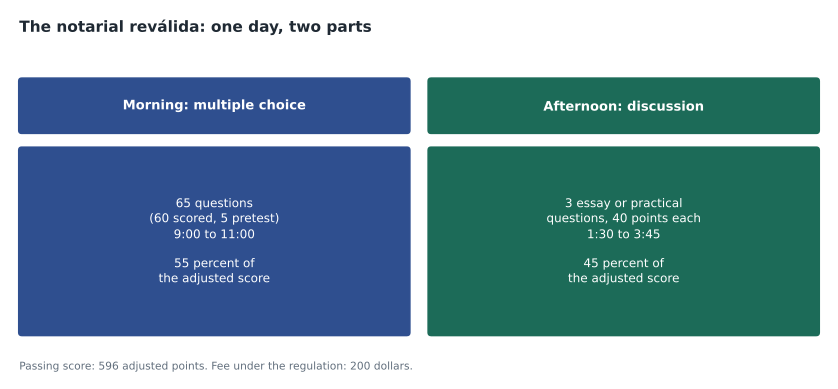
The notarial reválida takes one day. For the September 2026 sitting it was given on Friday, September 18, the day after the general exam ended, at the same convention center in San Juan. According to the manual of general instructions, the morning part is multiple choice: 65 questions, all of which must be answered, of which 5 are unscored pretest questions, leaving 60 that count. It runs from 9:00 to 11:00. The afternoon part runs from 1:30 to 3:45 and has three questions, which may be discussion questions, practical exercises or a combination. Each is worth 40 points, from two graders scoring 0 to 20.
A practical exercise on the notarial exam often asks the candidate to do what a notary does: draft all or part of a deed, identify the defects in an instrument, or explain what must be done to correct an error. A candidate who has watched closings and read deeds, as Camila was doing at Ocasio & Mattei, has an advantage.
How it is scored
The notarial exam is scored on the same principles as the general exam, with different weights. The score report manual explains that each discussion answer is converted using a table, the multiple-choice and discussion parts are calibrated with formulas the Board publishes, and the two calibrated scores are combined with weights of 55 percent for multiple choice and 45 percent for discussion. The passing score is 596 adjusted points, which the Court left unchanged when it lowered the general passing score in 2022. The same rules on reconsideration apply: a candidate within 15 points of passing may request it, on the deadlines described in Lesson 4.
| Feature | General reválida | Notarial reválida |
|---|---|---|
| Length | Two days, four sessions | One day, two sessions |
| Multiple choice | 184 questions | 65 questions, 60 scored |
| Discussion | 8 essays | 3 essay or practical questions |
| Weights | 50 percent and 50 percent | 55 percent multiple choice, 45 percent discussion |
| Passing score | 569 adjusted points | 596 adjusted points |
| Fee under the regulation | 250 dollars | 200 dollars |
After admission to the notarial practice
A new notary takes on duties that continue for as long as she practices. She must comply with the Notarial Law and the notarial regulation, keep her protocol and registries, file the required reports on time, and submit to inspection. She must also meet extra continuing education requirements: the Continuing Legal Education Program requires nine credit hours in notarial law for a lawyer whose notarial practice is active at the end of the compliance period. A notary who stops practicing as a notary must follow the procedures for ceasing practice and delivering her protocols.
Planning the two exams
Camila's plan was to pass the general reválida in March 2027 and the notarial reválida at a later sitting, once she was a lawyer. Some candidates prepare for both at once, since the subjects overlap heavily. Nilda Ocasio advised her to keep the notarial materials in view while studying for the general exam, especially mortgage and registry law, obligations and contracts and succession, which appear on both. 'Learn it once, deeply,' she said. 'Then the notarial exam is about form and practice.'
Worked problem
Spot the notarial problem
A client of the firm, Nereida Rosado, asks Nilda to notarize a deed of sale in which Nereida sells a lot to Nilda's brother. Separately, a seller tells Nilda he cannot come to the office on the day of signing and asks whether he can sign at home and send the deed back with the buyer.
Show solution
- A notary must be impartial and may not authorize an instrument in which she or a close relative has an interest; Nilda should decline the deed involving her brother and refer it to another notary.
- The parties must sign in the notary's presence for her to certify that they appeared and consented; Nilda cannot certify a signature made at the seller's home outside her presence.
- If the seller cannot come, the signing must be rescheduled, or the seller can appoint an attorney-in-fact by a properly executed power of attorney.
- Both situations show why notarial errors are treated as serious: the deed would carry public faith it did not deserve.
Answer: Nilda declines the first instrument and refuses to let the seller sign outside her presence. Both answers flow from impartiality and public faith.
Common mistakes
MistakeAny lawyer in Puerto Rico can notarize a deed.
InsteadOnly a lawyer admitted to the notarial practice after passing the notarial reválida may do so.
MistakeThe notary represents the client who pays her.
InsteadThe notary must be impartial and explain the instrument to all parties.
MistakeThe notarial exam passes at 569 like the general exam.
InsteadThe notarial passing score is 596 adjusted points.
MistakeNotarial practice needs no special courses.
InsteadRule 7.1.1(c) requires specific credits, including five in practical notarial law.
MistakeA notary's certification can be corrected informally.
InsteadThe notary's statements carry public faith; errors can lead to discipline and must be corrected by the proper procedure.
Errors the Court sees again and again
Reading the Supreme Court's notarial disciplinary opinions, Camila noticed the same kinds of problems recurring. Failing to identify a party in the way the law requires. Authorizing an instrument when a party did not appear before the notary, or appeared at a different time than the instrument states. Omitting statements the law requires in a public instrument, such as the notary's explanations to the parties. Keeping the protocol incomplete, unbound or late. Failing to file required reports on time. Authorizing instruments that benefit the notary or her relatives. Each error matters because the notary's certification carries public faith: when the certification is false or incomplete, everyone who relied on it may be harmed.
The Court's sanctions in these cases range from admonitions to suspension from the notarial practice, and in serious cases suspension from the practice of law as well. Some opinions also require the notary to correct defective instruments at her own expense. For a candidate, the lesson is that the notarial exam's emphasis on form is not pedantry. Form is how public faith is earned.
Studying for the notarial exam
The notarial exam rewards a different kind of preparation from the general exam. Candidates should read the Notarial Law and its regulation article by article, because many questions test specific requirements. They should study model instruments, such as a deed of sale, a mortgage, a power of attorney and an open will, until they can explain the purpose of every clause. They should review mortgage and registry law, obligations and contracts, family law and succession from the notary's point of view: what must the instrument contain, who must appear, and what will the registrar require before recording it. And they should practice the afternoon's practical questions by drafting under time limits.
Camila's advantage was her job. Watching Nilda prepare and authorize instruments every week, and reading the protocol under her supervision, gave her a feel for the work that no outline could provide.
Summary and key terms
- Puerto Rico follows the Latin notary model: the notary is a lawyer and public officer whose certifications carry public faith.
- Notaries draft and authorize public instruments, keep a protocol of originals and must be impartial toward all parties.
- Admission to the notarial practice requires admission as a lawyer, the law school credits in Rule 7.1.1(c) and a passing notarial reválida.
- The notarial exam has 65 multiple-choice questions (60 scored) and three discussion or practical questions, weighted 55 and 45 percent.
- The passing score is 596; active notaries need nine hours of notarial law in each continuing education period.
- 0
- Latin notary
- 1
- escritura pública
- 2
- protocol
- 3
- testimonio
- 4
- public faith
- 5
- impartiality
- 6
- practical notarial law
Practice problems
Work each problem on paper first, then reveal the answer to check.
What does a notary certify when authorizing a public instrument?
Show answer
That the parties appeared, were identified, had capacity and consented after the notary's explanations.
How many multiple-choice questions on the notarial exam count toward the score?
Show answer
60 of the 65; five are unscored pretest questions.
What are the weights on the notarial exam?
Show answer
55 percent multiple choice and 45 percent discussion.
What must a candidate be before she can be admitted to the notarial practice?
Show answer
A lawyer admitted and sworn in Puerto Rico.
How many CLE hours in notarial law must an active notary complete?
Show answer
Nine in each compliance period, if the notarial practice is active at the end of the period.
Lesson quiz · 5 questions
Score 60% or more to complete this lesson.
Create a free account to save your progress, take quizzes and earn a certificate.