
BAR-254 · Lesson 7 of 12 · 20 min
Puerto Rico courts, civil procedure and the language of practice
▶ Video coming soon A video version of this lesson is on the way.
On a Monday in early November 2026, Camila spent the morning at the Caguas judicial center with Nilda Ocasio, who had a status conference in a contract case. The hearing was in Spanish, the court's minutes were in Spanish, and the motion Nilda filed afterward was in Spanish. That afternoon, Nilda's partner, Héctor Mattei, called from the federal courthouse in Hato Rey, where he was defending a client in an employment case; there, everything was in English. 'Two court systems, two languages, two sets of rules,' Camila told the study group that evening. 'And the reválida tests the local one.'
This lesson maps the courts of Puerto Rico, introduces the Rules of Civil Procedure of 2009 that govern civil cases in the local courts, and explains how language and federal law shape practice. Civil Procedure is one of the six subjects the Board marks with an asterisk, so the second half of the lesson goes into the procedural rules a new lawyer meets first. Constitutional Law, another asterisked subject, appears where it touches the courts.
The constitutional framework
Puerto Rico's government rests on the Constitution of the Commonwealth of Puerto Rico, the Estado Libre Asociado, which took effect in 1952. It creates three branches, includes a bill of rights that in several respects protects more than the federal Constitution, and establishes a unified judicial system, the Tribunal General de Justicia. Federal law also applies: the United States Constitution, federal statutes and the decisions of the United States Supreme Court bind Puerto Rico's courts on federal questions. A candidate answering a constitutional question on the reválida should consider both the Puerto Rico Constitution and the federal one.
The Supreme Court
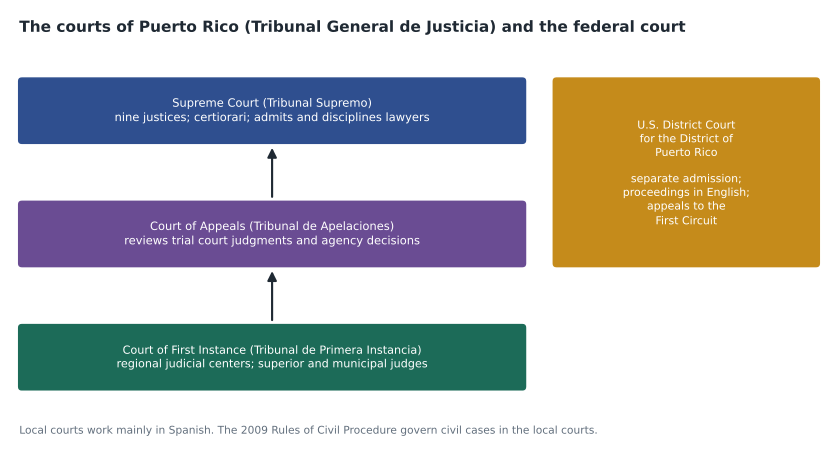
The Supreme Court of Puerto Rico sits in San Juan and has nine justices. Justices are appointed by the Governor with the advice and consent of the Senate and serve until the mandatory retirement age the Constitution sets. The Court reviews decisions of the Court of Appeals mainly by certiorari, which it grants in its discretion, and it has original jurisdiction in some matters. It also governs the legal profession: it admits and disciplines lawyers and notaries, adopts the rules of procedure and evidence for the local courts, and administers the judicial branch through the Chief Justice and the Office of Court Administration.
The Court's opinions are cited by their official report, Decisiones de Puerto Rico, abbreviated D.P.R., and, for recent cases, by their electronic citation in the form 2021 TSPR 123. The Court's decisions are binding precedent for the lower courts and are the main source for interpreting the Civil Code and the procedural rules.
The Court of Appeals
The Court of Appeals, the Tribunal de Apelaciones, is the intermediate appellate court. It sits in panels and reviews three kinds of matters: appeals from final judgments of the Court of First Instance, petitions for certiorari from interlocutory orders of that court, and petitions for judicial review of final decisions of administrative agencies. Its decisions are published on the Judicial Branch website with case numbers that identify the type of proceeding, and a candidate reading them will see the court frequently applying both the 1930 and the 2020 Civil Codes, depending on when the facts occurred.
The Court of First Instance
The Court of First Instance, the Tribunal de Primera Instancia, is the trial court. It sits in judicial regions throughout the island, each with a judicial center, and has superior judges, who hear the full range of civil and criminal cases, and municipal judges, who hear smaller matters, issue warrants and protective orders and handle preliminary stages of criminal cases. Most of a new lawyer's work happens here.
The federal court
The United States District Court for the District of Puerto Rico sits in San Juan, and appeals go to the United States Court of Appeals for the First Circuit in Boston. Federal law requires proceedings in the district court to be conducted in English, so Spanish documents must be translated. Admission to practice in the federal court is separate from admission in Puerto Rico and is governed by the court's local rules. Admission to the Puerto Rico bar does not by itself allow a lawyer to appear in federal court.
Language
Spanish and English are both official languages in Puerto Rico, but the local courts work mainly in Spanish. Pleadings, motions, hearings, judgments and the opinions of the Supreme Court are in Spanish, though the Court has published some opinions in English as well. On the reválida, the questions are in Spanish and candidates may answer in either language. In practice, a lawyer must be able to read and argue legal Spanish, and many also need to work in English for federal court, for clients from the mainland and for federal agencies.
The Rules of Civil Procedure of 2009
Civil cases in the local courts are governed by the Rules of Civil Procedure of Puerto Rico of 2009, which replaced the 1979 rules and took effect in 2010. They are modeled in large part on the Federal Rules of Civil Procedure, but they differ in numbering and in important details, so a candidate should study them as a separate body of law. The Court's decisions interpreting them are frequent exam material.
A civil action begins with a complaint, the demanda, and the issuance of a summons, the emplazamiento. The summons must be served within the period the rules set, and the Supreme Court has read that deadline strictly: if service is not made in time, the action can be dismissed. Service is ordinarily personal; service by publication is available only in the circumstances the rules allow and after a showing of diligent efforts to locate the defendant. The defendant then answers within the time the rules provide, raising defenses and any counterclaims.
Discovery follows the familiar American tools: interrogatories, requests for production, depositions, requests for admission and physical or mental examinations. The rules also provide for a pretrial conference and a pretrial report, which narrows the issues for trial. Summary judgment is available when there is no genuine dispute of material fact, and the Court has written extensively on the burdens of the moving and opposing parties and on how they must present undisputed facts.
One difference surprises lawyers from the states: there is no civil jury in the local courts. Civil cases are tried to a judge, who makes findings of fact and conclusions of law. Jury trials in the local courts are a feature of criminal cases, where the Constitution of Puerto Rico guarantees a jury in felony prosecutions.
| Stage | Spanish term | What to remember |
|---|---|---|
| Complaint | demanda | Starts the action in the Court of First Instance |
| Summons | emplazamiento | Must be served within the period the rules set; the Court reads it strictly |
| Answer | contestación a la demanda | Defenses and counterclaims within the time allowed |
| Discovery | descubrimiento de prueba | Interrogatories, production, depositions, admissions |
| Summary judgment | sentencia sumaria | No genuine dispute of material fact; strict form for the facts |
| Trial | juicio | Bench trial; no civil jury in the local courts |
| Review | apelación, certiorari | Appeal from final judgments; certiorari from interlocutory orders |
Review of judgments and orders
A party who loses a final judgment in the Court of First Instance appeals to the Court of Appeals. A party who wants review of an interlocutory order, such as a discovery ruling, must ask the Court of Appeals for a writ of certiorari, which the court may grant or deny in its discretion. The time limits for appeals and petitions are short and strictly enforced, and some are jurisdictional, meaning the court has no power to excuse a late filing. Calendaring those deadlines is one of the first habits a new lawyer must form.
Administrative agencies
Puerto Rico has many administrative agencies whose decisions affect clients directly, from permits to professional licenses to consumer complaints. Administrative Law is one of the thirteen reválida subjects. The Uniform Administrative Procedure Act of Puerto Rico governs agency rulemaking and adjudication and provides for judicial review of final agency decisions in the Court of Appeals. A good answer to an administrative law question identifies whether the agency action is final, whether administrative remedies were exhausted and what standard of review applies.
Constitutional law on the reválida
Because Constitutional Law is an asterisked subject, Camila spent a week on the Puerto Rico bill of rights. Article II of the Constitution protects, among other rights, the dignity of the person, equal protection, freedom of expression and association, privacy, protection against unreasonable searches and the rights of the accused. In several areas the Supreme Court of Puerto Rico has read those protections more broadly than the federal courts read their counterparts. She also reviewed the federal decisions that define Puerto Rico's status, including the 2016 decision in Puerto Rico v. Sánchez Valle, which held that Puerto Rico and the United States are not separate sovereigns for double jeopardy purposes. The specification table for Constitutional Law guided how deeply she went into each topic.
Worked problem
Where does the case go?
Nilda Ocasio gives Camila four files. (1) A supplier wants to sue a Caguas bakery for 45,000 dollars in unpaid invoices. (2) The firm lost a motion to compel discovery in a pending civil case and wants immediate review. (3) A client lost a final decision of a licensing board. (4) A client was fired by a company operating in San Juan and wants to sue under a federal employment statute.
Show solution
- The collection suit is filed in the Court of First Instance, in the appropriate judicial region, under the 2009 Rules of Civil Procedure.
- A discovery ruling is interlocutory, so review is by certiorari in the Court of Appeals, which may grant or deny it in its discretion.
- A final agency decision is reviewed by petition for judicial review in the Court of Appeals.
- The federal claim may be brought in the federal district court in San Juan, in English, by a lawyer admitted to that court; many federal claims can also be heard in the local courts.
Answer: Each file goes to a different place. Knowing where to go, and how fast, is the first question in every case.
Common mistakes
MistakeCivil cases in Puerto Rico are tried to juries.
InsteadThere is no civil jury in the local courts; civil cases are tried to a judge.
MistakeThe Rules of Civil Procedure are the federal rules.
InsteadThey are modeled on the federal rules but differ in numbering and detail.
MistakeAdmission in Puerto Rico includes the federal court.
InsteadAdmission to the district court is separate, under its local rules.
MistakeInterlocutory orders are appealed as of right.
InsteadReview of interlocutory orders is by discretionary certiorari.
MistakeOnly the Puerto Rico Constitution matters in a local case.
InsteadFederal constitutional law also binds the local courts.
Evidence and criminal procedure
Two other reválida subjects belong to the courts' daily work. Evidence in the local courts is governed by the Rules of Evidence of Puerto Rico of 2009, which, like the civil rules, draw heavily on their federal counterparts while differing in numbering and in some substantive choices. A candidate who studied the Federal Rules of Evidence will recognize the structure, relevance, character evidence, privileges, witnesses, hearsay and authentication, but must learn the Puerto Rico rules as written. Criminal Procedure combines the Rules of Criminal Procedure of Puerto Rico with the constitutional protections of both the Puerto Rico and the federal constitutions. The specification tables show the topics within each subject the Board emphasizes.
Deadlines in two systems
A lawyer who practices in both the local courts and the federal court must keep two sets of deadlines. The local rules and the federal rules set different periods for answering, appealing and seeking reconsideration, and they count time in different ways. Many Puerto Rico firms keep a single calendar that marks, for every case, which court and which rules apply. Camila adopted that practice in her first week at Ocasio & Mattei after watching Héctor Mattei explain to a new associate why a federal answer deadline had nothing to do with the local one.
Electronic filing
Both court systems use electronic filing. The local courts' system and the federal court's system are separate, with separate accounts, formats and notices. A lawyer must register for each, keep her contact information current and check her notifications daily, because orders and notices arrive electronically and deadlines run from them.
Summary and key terms
- The unified judicial system has a nine-member Supreme Court, the Court of Appeals and the Court of First Instance.
- The federal district court sits in San Juan, works in English, requires separate admission and is reviewed by the First Circuit.
- Civil cases follow the 2009 Rules of Civil Procedure, modeled on but different from the federal rules.
- Summons deadlines are read strictly, there is no civil jury in the local courts, and interlocutory review is by certiorari.
- Constitutional and administrative law questions require attention to both Puerto Rico and federal law.
- 0
- Tribunal General de Justicia
- 1
- Tribunal de Apelaciones
- 2
- Tribunal de Primera Instancia
- 3
- emplazamiento
- 4
- sentencia sumaria
- 5
- certiorari
- 6
- D.P.R.
Practice problems
Work each problem on paper first, then reveal the answer to check.
How many justices sit on the Supreme Court of Puerto Rico?
Show answer
Nine.
How does a party seek review of an interlocutory order?
Show answer
By petition for certiorari in the Court of Appeals.
Are civil cases tried to juries in the local courts?
Show answer
No; they are tried to a judge.
In what language are federal district court proceedings in Puerto Rico conducted?
Show answer
English.
Which court reviews final decisions of administrative agencies?
Show answer
The Court of Appeals, on petition for judicial review.
Lesson quiz · 5 questions
Score 60% or more to complete this lesson.
Create a free account to save your progress, take quizzes and earn a certificate.