
BAR-254 · Lesson 10 of 12 · 20 min
Family law and succession under the 2020 Civil Code
▶ Video coming soon A video version of this lesson is on the way.
The week before Thanksgiving, Nilda Ocasio asked Camila to sit in on two consultations. In the morning, a couple married for twelve years wanted to end their marriage without a court fight and asked whether they could divorce before a notary. In the afternoon, a widower in his seventies wanted to update his will to leave more to the niece who cared for him. 'Both of those meetings would have gone differently six years ago,' Nilda said afterward. 'The 2020 Code changed divorce, and it changed what a person can leave to whom.' Camila added both meetings to her notes for the group, because Family Law and Succession are reválida subjects and the heart of the notarial practice.
This lesson covers the main features of family law and succession under the 2020 Civil Code: marriage and the property regimes of spouses, the new divorce procedures, parental authority and support in outline, the forced share and the surviving spouse's new position, will forms and the liability of heirs. As with the other civil law subjects, the Code's articles and the specification tables define what is tested.
Marriage
Article 376 of the 2020 Civil Code defines marriage as a civil institution between two natural persons, personas naturales, using gender-neutral language consistent with Obergefell v. Hodges. Marriage requires the free consent of both spouses and compliance with the formalities the Code sets; the Code also lists impediments, such as an existing marriage or certain degrees of kinship, that prevent a valid marriage.
The spouses' property relations are governed by their economic regime. Spouses may choose their regime in a marriage settlement, capitulaciones matrimoniales, executed before a notary before the marriage. If they make no settlement, the default regime applies: the community of property known as the sociedad legal de gananciales, under which property acquired during the marriage through the spouses' work or with community funds belongs to both, while property each brought to the marriage or received by gift or inheritance remains separate. The rules on what is community and what is separate property, and on how debts are charged, are classic exam material.
Divorce under the 2020 Code
The 2020 Code made one of its largest changes in divorce. The 1930 Code required a specific ground, such as adultery, cruel treatment, abandonment or separation, or the judicially created route of mutual consent. The 2020 Code eliminated the list of fault grounds and replaced it with two procedures. Spouses may file a joint petition based on the irreparable breakdown of the marriage or on mutual consent. Or one spouse may file an individual petition based on irreparable breakdown. The new Code also allows divorce by public deed before a notary in the circumstances it provides, which is why Nilda's morning clients asked whether they could divorce in her office.
A notary who handles a divorce by deed must make sure the requirements are met, including the agreements on the division of property and on any matters the law reserves to a court, especially when there are minor children. If the conditions are not met, the case belongs in court. The rules on who may use that route, and what the deed must contain, are a natural subject for both the general and the notarial reválida.
| Topic | 1930 Civil Code | 2020 Civil Code |
|---|---|---|
| Grounds for divorce | Listed fault grounds and separation; mutual consent by case law | No fault grounds; irreparable breakdown or mutual consent |
| Procedures | Judicial | Joint petition, individual petition, or public deed before a notary where allowed |
| Definition of marriage | Man and woman (superseded by Obergefell) | Two natural persons (Article 376) |
| Spouse in succession | Usufruct share (cuota viudal) | Forced share in ownership, equal footing with descendants |
Parental authority, custody and support
Parental authority, patria potestad, belongs to both parents and includes the duties to care for, educate and represent their minor children and to administer their property. Custody, which concerns where the child lives day to day, may be shared or assigned to one parent, and the paramount consideration in every decision is the best interest of the child. Child support is owed by both parents in proportion to their means and the child's needs, under guidelines that set the amounts in most cases; the Child Support Administration, known by its Spanish initials ASUME, helps establish and enforce support. A lawyer working in family law must know both the Code and the special laws on custody and support that supplement it.
Succession: the basic structure
Succession is the transfer of a deceased person's estate to her heirs and legatees. It may be testate, governed by a will, or intestate, governed by the order of succession the Code sets when there is no valid will or the will does not dispose of the whole estate. Puerto Rico, like other civil law jurisdictions, limits freedom of testation through the forced share, the legítima: a part of the estate that the law reserves to certain heirs, the forced heirs, legitimarios, which the testator cannot take away except for the causes of disinheritance the law recognizes.
The forced share before and after 2020
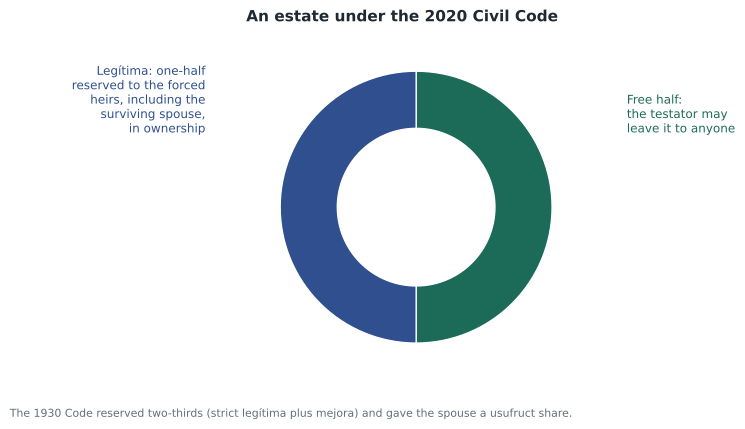
Under the 1930 Code, the estate was divided into thirds. One-third was the strict forced share for the children and descendants, one-third was the mejora, which the testator could distribute among descendants as she chose, and only one-third was freely disposable. The surviving spouse was not a forced heir in ownership; instead she received a usufruct share, the cuota viudal usufructuaria.
The 2020 Code changed that structure. The forced share is now one-half of the estate, so the testator may freely dispose of the other half. The usufruct share of the surviving spouse was abolished. In its place, the 2020 Code makes the surviving spouse a forced heir whose share is in ownership, not usufruct, on an equal footing with the descendants. The legislative statement of motives explains that the spouse's forced share is 'en propiedad y no en usufructo'. For Nilda's afternoon client, the change mattered directly: under the 2020 Code he could leave a larger part of his estate to his niece than he could have under the 1930 Code, while respecting the forced share of his children.
The Code also protects the surviving spouse in other ways. Under Article 1625, a surviving spouse may ask that the family home be assigned to her preferentially in the partition of the estate, so that she can continue living there. And under Article 1587, an heir answers for the deceased's debts, legacies and estate charges only up to the value of the property she receives from the estate, a rule that protects heirs from inheriting debts larger than the estate.
Wills
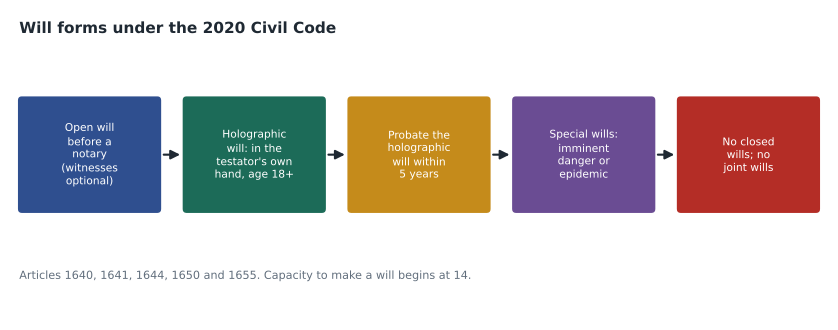
A will under the 2020 Code is a solemn, personal, unilateral and essentially revocable act. Joint wills, made by two people in the same instrument, remain prohibited under Article 1640. A person 14 or older with sufficient discernment may make a will, but a holographic will requires the testator to be 18 or older under Article 1641.
The open will, testamento abierto, made before a notary, is by far the most common form in Puerto Rico. Under Article 1644 of the 2020 Code, witnesses are no longer mandatory for an open will, a significant change from the 1930 Code, under which the absence of the required witnesses voided the will; the number of witnesses, if any, is now left to the notary and the testator. The holographic will, testamento ológrafo, must be written by the testator's own hand, a requirement Article 1650 now expresses with the word autógrafo, and it must be presented for probate within five years of the testator's death. The 2020 Code eliminated the closed will, which was rarely used, and limited special wills under Article 1655 to wills made in imminent danger of death and during epidemics, with three witnesses, no notary, and the possibility of a written or video-recorded will.
Revocation may be express, tacit or by destruction of the will. Under Article 1713, a later will revokes an earlier one tacitly only to the extent their provisions are incompatible, replacing the 1930 presumption that a later valid will revoked the earlier one entirely. Article 1714 revokes provisions in favor of a spouse when the marriage later ends in divorce or annulment, unless the will provides otherwise.
The notary's role
Almost every topic in this lesson passes through a notary's office in Puerto Rico. Marriage settlements, open wills, divorces by deed where allowed, partitions of estates, acceptances and renunciations of inheritances and transfers of inherited real estate are all done by public instrument. That is why Family Law and Succession appear among the credits required for the notarial practice and why notarial exam questions so often combine them with registry law. A candidate preparing for the general exam builds the foundation the notarial exam will test again.
Worked problem
The widower's will
Efraín Colberg, 74, is a widower with two adult children. He asks Nilda Ocasio in November 2026 to prepare an open will leaving as much as possible to his niece Zoraida, who has cared for him for three years, and the rest to his children equally. His estate is worth about 600,000 dollars.
Show solution
- The 2020 Code governs a will made now; under it the forced share is one-half of the estate.
- About 300,000 dollars is reserved to his forced heirs, here his two children, since his wife has died.
- He may leave the free half, about 300,000 dollars, to Zoraida.
- An open will before Nilda as notary does not require witnesses under Article 1644, though the notary and testator may decide to use them.
- Under the 1930 Code, only one-third would have been freely disposable, so the 2020 Code allows him to leave Zoraida more.
Answer: Efraín may leave about half of his estate to Zoraida, with the other half going to his children as forced heirs, in an open will authorized by Nilda.
Common mistakes
MistakeA Puerto Rico divorce still requires proving fault.
InsteadThe 2020 Code eliminated fault grounds; divorce rests on irreparable breakdown or mutual consent.
MistakeThe forced share is still two-thirds of the estate.
InsteadUnder the 2020 Code it is one-half; two-thirds was the 1930 rule.
MistakeThe surviving spouse receives only a usufruct.
InsteadThe 2020 Code abolished the usufruct share; the spouse's forced share is in ownership.
MistakeAn open will is void without witnesses.
InsteadUnder Article 1644, witnesses are no longer mandatory for an open will.
MistakeHeirs must pay all of the deceased's debts from their own assets.
InsteadUnder Article 1587, an heir answers only up to the value of what she receives.
Which code governs a succession
In succession, the date that usually matters is the date of death, because the succession opens at death and the heirs' rights arise then. A person who died before November 28, 2020 left an estate governed by the 1930 Code, with its forced share of two-thirds and the surviving spouse's usufruct share, even if the estate is partitioned years later. A person who died afterward left an estate governed by the 2020 Code. Many estates handled in Puerto Rico offices today still involve deaths before 2020, so a candidate must be ready to apply either code and to say why.
The community property comes first
When a married person dies, the community of property, the sociedad legal de gananciales, ends. Before the estate can be divided, the community must be liquidated: its assets and debts are identified, and what remains is divided between the surviving spouse and the deceased's estate. The surviving spouse's half of the community property belongs to her by her own right, not as an heir. Only the deceased's half of the community, together with the deceased's separate property, forms the estate to which the forced share and the will apply. Confusing the spouse's community half with an inheritance is a classic error on essays and in practice.
Partition and the Registry
Until the estate is partitioned, the heirs hold it together in a community of heirs. Partition assigns specific property to each heir, and when the estate includes real property, the heirs' rights and the partition must be documented in instruments that the registrar will accept before the property can be recorded in their names. Notaries prepare many of those instruments, which is why succession and registry law appear together so often on the notarial exam.
Summary and key terms
- Article 376 defines marriage as an institution between two natural persons; the default property regime is the community of acquests unless the spouses agree otherwise before a notary.
- The 2020 Code replaced fault grounds with irreparable breakdown or mutual consent and allows divorce by public deed where its conditions are met.
- The forced share is one-half of the estate; the surviving spouse is a forced heir in ownership, and the usufruct share was abolished.
- Open wills before a notary no longer require witnesses; holographic wills require age 18 and probate within five years; closed wills were eliminated.
- Heirs answer for the deceased's debts only up to the value of what they receive, and a surviving spouse may ask for preferential assignment of the family home.
- 0
- sociedad legal de gananciales
- 1
- capitulaciones matrimoniales
- 2
- patria potestad
- 3
- legítima
- 4
- legitimarios
- 5
- testamento abierto
- 6
- testamento ológrafo
- 7
- cuota viudal usufructuaria
Practice problems
Work each problem on paper first, then reveal the answer to check.
What are the bases for divorce under the 2020 Code?
Show answer
Irreparable breakdown of the marriage or mutual consent, by joint or individual petition, or by public deed where allowed.
What fraction of the estate is the forced share under the 2020 Code?
Show answer
One-half.
How does the surviving spouse share in the forced share under the 2020 Code?
Show answer
As a forced heir in ownership, on an equal footing with the descendants.
Does an open will require witnesses under the 2020 Code?
Show answer
No; under Article 1644 witnesses are not mandatory.
For how much of the deceased's debts is an heir liable?
Show answer
Only up to the value of the property received from the estate, under Article 1587.
Lesson quiz · 5 questions
Score 60% or more to complete this lesson.
Create a free account to save your progress, take quizzes and earn a certificate.