
BAR-254 · Lesson 8 of 12 · 20 min
The civil law tradition: obligations, contracts and the property registry under the 2020 Civil Code
▶ Video coming soon A video version of this lesson is on the way.
Eddie Boudreaux, the group's Louisiana candidate, was delighted when Camila presented obligations and contracts in early November 2026. 'Consent, object, cause,' he said, reading her slide. 'That is my code too.' Louisiana and Puerto Rico are the two American jurisdictions whose private law descends from the civil law tradition, Louisiana from French and Spanish sources and Puerto Rico from the Spanish Civil Code of 1889. The other members found the vocabulary foreign at first. By the end of the session they agreed that the logic was clear: in a civil law system, the answer starts with an article of the code.
This lesson introduces the civil law method and covers two of the six asterisked subjects: Obligations and Contracts, including special contracts, and Mortgage and Registry Law. It describes the structure and principles of the 2020 Civil Code rather than every article, because the specification tables, not this lesson, define the exact scope tested. A candidate must still learn the articles themselves, in Spanish and by number.
Thinking like a civil lawyer
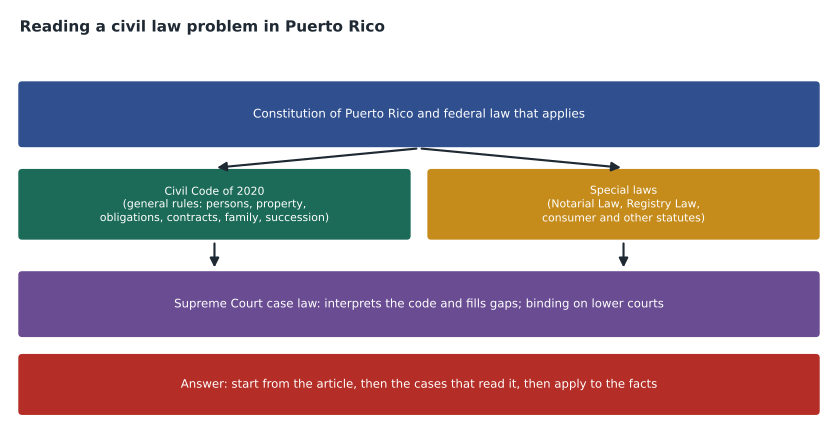
In a common law state, a lawyer often starts with cases and extracts a rule. In Puerto Rico's private law, a lawyer starts with the Civil Code. The Code states general rules in short, carefully drafted articles organized from the general to the particular: general provisions on obligations apply to every contract, general provisions on contracts apply to every special contract, and the article on a particular contract adds or modifies rules for that contract. The Supreme Court's decisions interpret the articles, fill gaps and apply them to new situations, and they bind the lower courts. Legal scholarship, the doctrina, carries real weight in explaining the Code.
For an exam answer, that method suggests an order: identify the institution (a contract of sale, a solidary obligation, a mortgage), state the governing article or articles, add the Supreme Court's interpretation, and apply the rule to the facts. Graders reward an answer that cites the right provision and explains it, because applicable law is one of the five grading criteria.
The 2020 Civil Code
The Civil Code of 2020, Act No. 55 of June 1, 2020, took effect on November 28, 2020 and replaced the Civil Code of 1930, which itself was a revision of the Spanish Code extended to Puerto Rico in 1889. The 2020 Code kept the civil law structure and many of the old rules but reorganized them, modernized the language, codified doctrines the Supreme Court had developed and changed several areas, especially family law and succession. It is divided into books covering, among other subjects, persons and family, property, obligations and contracts, and succession.
Two cautions apply on the exam. First, article numbers changed completely, so a candidate must cite the 2020 numbering for current facts. Second, as Lesson 5 explained, the 1930 Code still governs facts that occurred before November 28, 2020.
Obligations
An obligation is a legal bond under which one person, the debtor, must give something, do something or refrain from doing something for another, the creditor. Obligations arise from the sources the Code recognizes, among them the law, contracts and acts or omissions that cause damage. The Code classifies obligations in ways that matter on the exam. An obligation may be pure, conditional or subject to a term. It may be divisible or indivisible. When there are several debtors or creditors, it may be joint, mancomunada, so that each owes or is owed only a share, or solidary, solidaria, so that each debtor may be required to perform the whole. Solidarity is not presumed in contractual obligations; it must arise from the agreement or the law.
Performance extinguishes an obligation, and so do other causes the Code lists, such as payment, loss of the thing owed, remission, merger, compensation and novation. When a debtor fails to perform, the Code's rules on default, mora, and on liability for fraud, dolo, or fault, culpa, determine what the creditor may recover. A debtor who acts in bad faith answers for more than a debtor who was merely negligent.
Contracts: the essential requirements
A contract exists when two or more persons consent to be bound to give something or render a service. The civil law tradition requires three essential elements: consent, a lawful and possible object, and a lawful cause. Consent must be free and informed; it is vitiated by error, violence, intimidation or fraud. The object must be within commerce, possible and determinate or determinable. The cause is the reason the law recognizes for the obligation, such as the price in a sale or the liberality of a gift.
Freedom of contract is the starting point. Parties may agree to any terms that are not contrary to law, morals or public order, and the contract binds them as if it were law. Contracts must be performed in good faith, and good faith obliges the parties not only to what they expressly agreed but also to the consequences that follow from the nature of the contract. The Supreme Court has also recognized the rebus sic stantibus doctrine in narrow circumstances, allowing a court to adjust a contract when an extraordinary and unforeseeable change makes performance excessively burdensome.
Most contracts require no particular form. Some do: certain contracts must be executed in a public instrument before a notary to be valid or to be recorded, which is one reason notaries matter so much in Puerto Rico. A contract that lacks an essential element is void, nulo, and produces no effects. A contract whose consent was vitiated, or that was made by a person lacking full capacity, is voidable, anulable, and stands until annulled in a timely action.
| Element | Spanish term | Defect and its effect |
|---|---|---|
| Consent | consentimiento | Error, violence, intimidation or fraud: voidable |
| Object | objeto | Impossible, unlawful or indeterminate: void |
| Cause | causa | Unlawful or absent: void |
| Form, where required | forma | Missing public instrument where the law requires it: the contract may be void or unrecordable |
Special contracts
The asterisk on Obligations and Contracts extends to special contracts, the particular contracts the Code regulates individually. The most important for practice and the exam are the contract of sale, compraventa; lease, arrendamiento; loan; mandate, which underlies powers of attorney; deposit; partnership; donation; and suretyship, fianza. For each, a candidate should know the parties' principal obligations, the rules on risk and warranties, and how the contract ends.
In a sale, the seller must deliver the thing and warrant the buyer against eviction and hidden defects, and the buyer must pay the price. In a lease, the lessor must deliver the property and maintain it in a condition fit for its use, and the lessee must pay the rent and use the property with care. In suretyship, a third person, the surety, promises to perform if the debtor does not; Article 1485 of the 2020 Code allows the surety to raise both her own defenses and those that belong to the debtor. Questions often combine a special contract with the general rules on breach and damages.
Mortgage and registry law
Mortgage and Registry Law is another asterisked subject and the heart of real estate practice. The Property Registry, the Registro de la Propiedad, is a public registry of rights in real property organized by property. Its rules come mainly from the Registry Law of 2015, the Ley del Registro de la Propiedad Inmobiliaria, and its regulations. The registrars, who are lawyers, examine each document presented and decide whether it may be recorded.
The Registry operates on a set of principles a candidate must be able to name and apply. Under the principle of petition, rogación, the registrar acts only when someone presents a document. Under priority, prioridad, the first document presented has preference over later ones dealing with the same property. Under successive tract, tracto sucesivo, a transfer can be recorded only if the transferor's own right is recorded. Under legitimation, legitimación, recorded rights are presumed to exist and to belong to the recorded owner. And under registry public faith, fe pública registral, a third party who acquires a right in good faith and for value from the recorded owner, relying on the Registry, and records her own right, is protected against claims that do not appear in the Registry.
A mortgage is a real right that secures an obligation with real property, allowing the creditor to have the property sold if the obligation is not paid. In Puerto Rico a mortgage must be constituted in a public instrument and recorded in the Registry; recording is not merely a way of giving notice but a requirement for the mortgage to exist as a real right. The mortgage follows the property into the hands of later owners, and foreclosure, ejecución de hipoteca, proceeds under the rules of the Registry Law and the Rules of Civil Procedure.
| Principle | Spanish term | Meaning |
|---|---|---|
| Petition | rogación | The registrar acts only on a presented document |
| Priority | prioridad | First presented, first in right |
| Successive tract | tracto sucesivo | The transferor's right must already be recorded |
| Legitimation | legitimación | Recorded rights are presumed to exist as recorded |
| Registry public faith | fe pública registral | A good faith, for-value third party who records is protected |
How these subjects appear on the exam
A typical essay combines the subjects: a seller who sold the same property twice, one buyer recording first; a buyer who discovers a hidden defect after closing; a surety who wants to raise the debtor's defenses; a mortgage presented for recording after an attachment. The answer identifies the institutions involved, states the rules from the Code and the Registry Law, and resolves the conflict, often by applying priority or registry public faith. Camila practiced by writing short answers to each of those patterns until she could produce them in fifteen minutes.
Worked problem
A double sale
Efraín Colberg sold a lot in Caguas to Panadería La Ceiba, Inc., by a deed authorized on May 3, 2024, but the bakery never presented the deed to the Registry. On June 10, 2024, Efraín sold the same lot to Ángel Rosario, who checked the Registry, found Efraín as the recorded owner, paid the price, knew nothing of the earlier sale and recorded his deed on June 20, 2024.
Show solution
- Both sales are contracts governed by the 2020 Code, because the facts occurred after November 28, 2020.
- Under registry public faith, a third party who acquires for value and in good faith from the recorded owner and records his right is protected against unrecorded claims.
- Ángel Rosario acquired from the recorded owner, paid value, acted in good faith and recorded first.
- The bakery's remedy is against Efraín for breach and damages, not against Ángel Rosario.
Answer: Ángel Rosario prevails as to the lot. The bakery's failure to record left it exposed, and its claim lies against the seller.
Common mistakes
MistakeA civil law answer starts with the leading case.
InsteadIt starts with the article of the Code, then the cases that interpret it.
MistakeCo-debtors are always solidarily liable.
InsteadSolidarity is not presumed in contractual obligations; it must arise from the agreement or the law.
MistakeRecording a mortgage only gives notice.
InsteadIn Puerto Rico a mortgage must be constituted by public instrument and recorded to exist as a real right.
MistakeA contract with vitiated consent is void from the start.
InsteadIt is voidable and stands until annulled in a timely action.
MistakeThe 1930 article numbers are still used for current facts.
InsteadThe 2020 Code renumbered the articles; use the new numbers for facts after November 28, 2020.
Property law in outline
Property Law is a separate reválida subject, and it supports both contracts and registry law. The civil law distinguishes ownership, the fullest right over a thing, from possession, the factual control of a thing, which the law protects in its own right. Ownership can be divided: a usufruct gives one person the right to use a thing and enjoy its fruits while another holds the bare ownership; a servitude burdens one property for the benefit of another, such as a right of way. Property held by several people at once is held in co-ownership, comunidad de bienes, until it is partitioned. Ownership can be acquired by contract followed by delivery, by succession, by donation and, after the periods the Code sets, by acquisitive prescription, usucapión. Each of these institutions has its own articles in the 2020 Code, and each interacts with the Registry when real property is involved.
Summary and key terms
- Puerto Rico's private law follows the civil law tradition: start with the Code, then the Supreme Court's interpretation, then the facts.
- Obligations may be joint or solidary; solidarity in contracts is not presumed.
- Contracts require consent, object and cause; defects make a contract void or voidable.
- Special contracts such as sale, lease, mandate and suretyship add rules to the general law of contracts.
- The Property Registry runs on petition, priority, successive tract, legitimation and registry public faith; a mortgage must be constituted by public instrument and recorded.
- 0
- obligación
- 1
- solidaria
- 2
- mancomunada
- 3
- consentimiento, objeto y causa
- 4
- compraventa
- 5
- fianza
- 6
- Registro de la Propiedad
- 7
- fe pública registral
Practice problems
Work each problem on paper first, then reveal the answer to check.
What are the three essential elements of a contract?
Show answer
Consent, a lawful and possible object, and a lawful cause.
Is solidarity presumed among co-debtors in a contract?
Show answer
No; it must arise from the agreement or the law.
What does Article 1485 of the 2020 Code allow a surety to do?
Show answer
Raise both her own defenses and those that belong to the debtor.
What protects a good faith purchaser who relies on the Registry?
Show answer
Registry public faith, fe pública registral, if she acquires for value from the recorded owner and records her right.
What must happen for a mortgage to exist as a real right?
Show answer
It must be constituted in a public instrument and recorded in the Property Registry.
Lesson quiz · 5 questions
Score 60% or more to complete this lesson.
Create a free account to save your progress, take quizzes and earn a certificate.