
BAR-254 · Lesson 3 of 12 · 20 min
Character and fitness, and why Puerto Rico does not use the MPRE
▶ Video coming soon A video version of this lesson is on the way.
When the group reached character and fitness in October 2026, Dana described the NCBE character report she had filled out for Texas, Ngozi talked about New York's affidavits and Marcus explained Missouri's interview. Then Marchetti turned to Camila. 'And the MPRE?' she asked. 'Every one of these people had to take it.' Camila smiled. 'Puerto Rico does not require it,' she said. 'But professional ethics is one of the subjects on the reválida itself, and it is one of the six the Board marks with an asterisk. So I have to know it better, not worse.'
This lesson covers the good reputation requirement, how Puerto Rico reviews an applicant's character and moral fitness, what the public notice after the exam does, and how professional responsibility is tested without the MPRE. It draws on the Board's regulation and NCBE's chart. The Supreme Court decides the hard cases, and its decisions on admission and discipline are the best guide to how it thinks.
The good reputation requirement
Rule 4.1.1(c) of the Board's regulation requires every applicant to have a good reputation, buena reputación. The phrase is old, but its meaning is modern: the Court wants assurance that a new lawyer will be honest with clients, courts and opponents, will handle other people's money and affairs responsibly and will obey the law and the rules of the profession. A good reputation in this sense is not popularity. It is the kind of character that justifies public trust in someone licensed to give legal advice and, later, perhaps to exercise the public faith of a notary.
NCBE's chart notes that Puerto Rico does not use NCBE's character and fitness investigation services. The review is done locally, through the Board and the Character Commission, the Comisión de Reputación. The Board coordinates the evaluation with the Commission under its regulation, and the Supreme Court makes the final decision on admission.
What the applicant provides
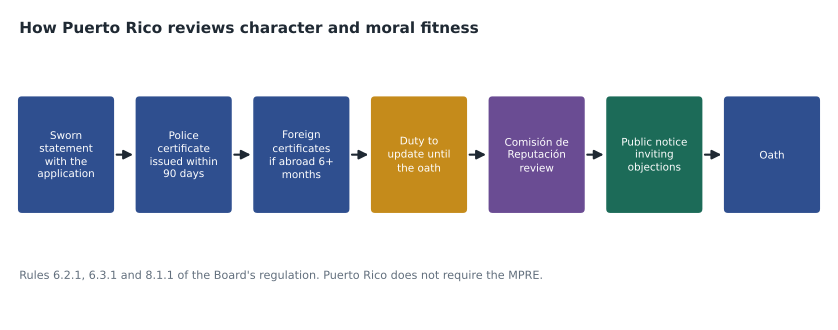
The character review starts with the application. Under Rule 6.2.1, the applicant files a sworn statement in the form the Board provides, answering its questions under oath. The applicant also files a certificate of criminal record from the Puerto Rico Police issued within 90 days before the application, and, if she lived or studied outside Puerto Rico for six or more consecutive months during the previous ten years, certificates from those places as well.
The duty does not end on filing. Rule 6.3.1 requires the applicant to keep the application current until the oath. If something happens after filing, such as an arrest, a lawsuit, a judgment, a disciplinary matter at work or a change in a pending case, it must be reported. Failing to update can be treated as a lack of candor, which is often more serious than the underlying event.
The public notice
Puerto Rico adds a step most states do not have. After the results of a sitting, the Board publishes a notice, under Rule 8.1.1(b) of its regulation, inviting anyone with an objection to the admission of a successful candidate to come forward. The notice reflects the idea that admission to the bar is a public matter: a former employer, a creditor, a victim of misconduct or anyone else with relevant information has a chance to be heard before the oath. Most candidates receive no objection. A candidate who expects one, for example because of a past dispute, should make sure her sworn statement already disclosed the matter fully.
What raises concern
The regulation does not list every kind of conduct that might raise a question, and no list could. The categories that recur in every jurisdiction recur in Puerto Rico. Criminal conduct, especially crimes involving dishonesty. Academic misconduct such as plagiarism or cheating. Financial irresponsibility, particularly unpaid debts that suggest disregard of obligations, as opposed to debts caused by illness or hardship. Discipline in another profession or another bar. And, above all, lack of candor in the application itself.
The analysis is usually the same everywhere. Was the conduct recent or remote? Was it an isolated event or part of a pattern? Did the applicant take responsibility, make amends and show rehabilitation? And did the applicant disclose it completely and honestly? A minor matter disclosed fully rarely prevents admission. A minor matter concealed can.
| Concern | Questions the reviewers ask | What helps |
|---|---|---|
| Criminal record | How serious, how recent, did it involve dishonesty? | Full disclosure, records of the outcome, evidence of rehabilitation |
| Academic discipline | What happened and how did the school respond? | The school file, an honest explanation, a clean record since |
| Debts and judgments | Neglect or hardship? Is there a plan? | A payment plan, proof of payments, explanation of the cause |
| Discipline elsewhere | Was it final, and what did it involve? | Copies of the decision and proof of compliance |
| Omissions in the application | Was it inadvertent or deliberate? | Prompt correction before anyone else finds it |
Conduct at the exam itself
Character questions can also arise from the exam. The Board's manual of general instructions lists prohibited conduct, including falsifying or misrepresenting academic credentials or other required documents, impersonating another candidate or having someone else take the exam. The Board also has a manual of norms and rules of conduct for the administration of the exams. Candidates should read both before exam day. A violation can cost more than one sitting: it can become a character finding that delays or prevents admission.
Why there is no MPRE
Most American jurisdictions require the MPRE, a separate multiple-choice exam on the ABA Model Rules of Professional Conduct, with a minimum scaled score. NCBE's chart lists no MPRE requirement for Puerto Rico. Instead, Puerto Rico tests professional responsibility within the general reválida. Professional ethics is one of the thirteen subjects the regulation lists in Rule 5.4.1, and the Board's edict marks Ethics and Professional Responsibility as one of the six asterisked subjects, together with Constitutional Law, Mortgage and Registry Law, Obligations and Contracts, Civil Procedure and Extracontractual Civil Liability.
That approach has a practical consequence. A Puerto Rico candidate does not take a separate ethics exam that she can pass early and forget. Ethics questions appear among the 184 multiple-choice questions and can appear as essays, and they are tested as Puerto Rico law. Since January 1, 2026, that law is the new Rules of Professional Conduct of Puerto Rico, adopted by the Supreme Court in Resolution ER-2025-02 of June 17, 2025. The 1970 Code of Professional Ethics, with its canons, still governs conduct that occurred before 2026.
Studying ethics for the reválida
Camila built her ethics study around three questions. First, what do the new Rules say? Because they follow the topical order of the ABA Model Rules, much of their structure will be familiar to anyone who studied the Model Rules in law school: competence, scope of representation, diligence, communication, fees, confidentiality and conflicts in the first chapter; the advisory function; the lawyer as advocate; transactions with others; law firms; public service; information about legal services; and maintaining the integrity of the profession. Second, where do they depart from the Model Rules? The resolution notes some local features, including a definitions rule, a rule on technological competence and the integration of notarial duties into the same body of rules. Third, which older decisions still matter? Many of the Court's disciplinary opinions under the 1970 canons express principles the new Rules carry forward, and the Court continues to decide cases involving conduct before 2026 under the canons.
Nilda Ocasio added a fourth point from experience. 'A large share of the Court's disciplinary opinions involve notarial errors,' she said. 'Read the notarial cases even for the general exam.' Lesson 6 explains why the notary's duties are so strict, and Lesson 11 covers the Rules in more detail.
The oath
A candidate who passes, clears the character review and survives the public notice is sworn in before the Supreme Court. Only then is she a lawyer in Puerto Rico. Her name enters the Court's Registro Único de Abogados, the RUA, and from that point she is subject to the Rules of Professional Conduct and to the continuing legal education requirements described in Lesson 11.
Worked problem
Disclose or not?
Gerardo Echevarría, a 2026 graduate preparing for the March 2027 sitting, tells Camila three things. In 2019, as an undergraduate, he received a warning from his university for sharing homework answers. In 2024, a credit card company obtained a judgment against him for 3,800 dollars, which he has been paying in monthly installments. In October 2026, after he filed his application, he was cited for driving without insurance.
Show solution
- The 2019 warning should be disclosed if the sworn statement asks about academic discipline; a full explanation and a clean record since will help.
- The 2024 judgment should be disclosed with proof of the payment plan, which shows responsibility rather than neglect.
- The October 2026 citation arose after filing, so Rule 6.3.1 requires him to update the application.
- None of these is likely to prevent admission if disclosed fully; concealing any of them could create a candor problem that is far more serious.
Answer: Gerardo should disclose all three. The update about the citation is required by the duty to keep the application current until the oath.
Common mistakes
MistakePuerto Rico requires an MPRE score like the states.
InsteadPuerto Rico does not require the MPRE; ethics is tested on the reválida.
MistakeThe character review is done by NCBE.
InsteadPuerto Rico does not use NCBE's character services; the Board and the Comisión de Reputación conduct the review.
MistakeOnce the application is filed, nothing more needs to be reported.
InsteadRule 6.3.1 requires updates until the oath.
MistakeEthics on the reválida means the ABA Model Rules.
InsteadIt means Puerto Rico law: since January 1, 2026, the Rules of Professional Conduct of Puerto Rico.
MistakePassing the exam guarantees admission.
InsteadAdmission also requires a good reputation, and the public notice allows objections before the oath.
Rehabilitation and the passage of time
Applicants with something difficult in their past often ask whether they should wait before applying. The usual answer is no. The character review looks at the whole person as she is now, and a candidate who has taken responsibility for past conduct, made restitution where appropriate, and built a record of responsible behavior since then is in a good position to show that she now has the reputation the rules require. What the reviewers want to see is evidence: letters from employers and others who know the applicant well, records showing that obligations were met, completion of any program a court imposed, and an honest account in the applicant's own words.
A candidate in doubt should consider consulting a lawyer experienced in admission matters before filing, not after a problem has arisen. The cost of advice is small compared with the cost of a delayed admission.
Character after admission
The good reputation requirement does not end at the oath. The Supreme Court disciplines lawyers and notaries who violate the Rules of Professional Conduct, the Notarial Law or other obligations of the profession. Complaints are investigated under the Court's procedures, and the Court may impose sanctions ranging from a censure or reprimand to suspension from practice to disbarment, known in Spanish as desaforo. A lawyer who is also a notary may be suspended from the notarial practice alone. The Court's disciplinary opinions are published, and reading them is one of the best ways to understand what the Court expects.
Many disciplinary cases begin with the same failings that concern the character reviewers: lack of candor, mishandling of other people's money, neglect of obligations and failure to respond to the Court. A lawyer who fails to answer the Court's orders in a disciplinary matter, or who does not keep her registry information current so that notices reach her, can be suspended for that alone.
Candor in practice
Marchetti closed the session with a point she makes in every jurisdiction. The habits that carry a candidate through the character review, complete answers, prompt updates and honest explanations, are the same habits that keep a lawyer out of trouble for a whole career. Camila wrote it at the top of her ethics outline.
Summary and key terms
- Rule 4.1.1(c) requires a good reputation, reviewed by the Board with the Comisión de Reputación; the Supreme Court decides.
- The applicant files a sworn statement and criminal record certificates and must update the application until the oath.
- After the results, a public notice under Rule 8.1.1(b) invites objections to admission.
- Puerto Rico does not require the MPRE; Ethics and Professional Responsibility is one of six asterisked subjects on the general reválida.
- Since January 1, 2026, ethics is governed by the new Rules of Professional Conduct; conduct before 2026 remains under the 1970 canons.
- 0
- buena reputación
- 1
- sworn statement
- 2
- public notice of objections
- 3
- candor
- 4
- Rules of Professional Conduct
- 5
- 1970 Code of Professional Ethics
Practice problems
Work each problem on paper first, then reveal the answer to check.
Which body works with the Board on character review?
Show answer
The Character Commission, the Comisión de Reputación.
What does the public notice after the results do?
Show answer
It invites anyone with an objection to a successful candidate's admission to come forward before the oath.
How is professional responsibility tested in Puerto Rico?
Show answer
As a subject on the general reválida, marked with an asterisk in the edict, rather than by the MPRE.
Which ethics rules govern conduct in 2026?
Show answer
The Rules of Professional Conduct of Puerto Rico, effective January 1, 2026.
What should an applicant do if she is cited for an offense after filing?
Show answer
Update the application, as Rule 6.3.1 requires until the oath.
Lesson quiz · 5 questions
Score 60% or more to complete this lesson.
Create a free account to save your progress, take quizzes and earn a certificate.