
BAR-254 · Lesson 12 of 12 · 22 min
Capstone: Puerto Rico practice questions and an exam-day plan
▶ Video coming soon A video version of this lesson is on the way.
On Saturday, November 21, 2026, Marchetti scheduled a long session for Camila alone, with Nilda Ocasio joining for the second hour. The first half would be problems: short questions in the style of the multiple-choice day and three essays in the style of the discussion day, each on Puerto Rico law. The second half would be planning: the months before March 2027, the two exam days and the weeks after. 'You have the law,' Marchetti said. 'Today we make sure you can show it under time pressure.'
This lesson works through those problems, then sets out the plan. Every problem is an original hypothetical written for this course; none is a released reválida question. The answers follow the grading criteria in Rule 2.5.4.4 of the Board's regulation: identify the issues, state the applicable law, analyze, reach a legally acceptable solution and write clearly.
How to answer a reválida essay
Camila's template for every essay had five steps, matched to the five criteria. Name each issue in a short heading. State the rule, citing the article of the Code or the procedural rule by number, and the leading Supreme Court decision if one exists. Apply the rule to the specific facts, explaining why each fact matters. Conclude with a clear answer. And keep the writing plain: short paragraphs, one idea each, so that each of the two graders can award points without hunting. When the facts straddle November 28, 2020, the first issue is always which Civil Code applies.
Part one: short questions
Marchetti read six short questions aloud, giving Camila about two minutes each, the pace of the multiple-choice day.
Question 1. A client fell in a supermarket on March 1, 2020 and first learned on March 10, 2020 who owned the store. She sued on March 15, 2021. Which rule governs the limitation period? Answer: the 1930 Code applies because the facts occurred before November 28, 2020. Under former Article 1868 the period is one year from knowledge of the damage and of who caused it, here March 10, 2020; absent an interruption, the suit filed on March 15, 2021 is late.
Question 2. Two buyers purchase the same house from the same seller; the second buys in good faith from the recorded owner, pays the price and records first. Who prevails? Answer: the second buyer, protected by registry public faith; the first buyer's remedy is against the seller.
Question 3. A testator who died in 2025 left a will giving 60 percent of his estate to a friend and 40 percent to his only child. Is the will valid as written? Answer: the 2020 Code governs. The forced share is one-half, so the child is entitled to at least 50 percent; the gift to the friend must be reduced to the free half.
Question 4. A lawyer admitted in Puerto Rico but not as a notary authenticates a client's signature on a contract. Is that proper? Answer: no. Authenticating signatures is notarial work; only a lawyer admitted to the notarial practice may perform it.
Question 5. A plaintiff injured in 2024 is found 40 percent at fault, with damages of 100,000 dollars. What does she recover? Answer: 60,000 dollars. Her own fault reduces the compensation proportionally; it does not bar recovery.
Question 6. Spouses with no children and no disputes want to divorce in 2026. Must they file a fault ground in court? Answer: no. Under the 2020 Code they may file a joint petition based on mutual consent or irreparable breakdown, and they may consider divorce by public deed before a notary if its conditions are met.
Essay 1: a sale, a defect and a mortgage
Facts. In January 2025, Iván Vázquez bought a house in Gurabo from Nereida Rosado for 240,000 dollars, financed with a loan from a cooperative secured by a mortgage. Nilda Ocasio authorized both deeds. The cooperative presented the mortgage deed to the Registry on January 20, 2025. In June 2025, heavy rains revealed that the roof had been leaking for years; Nereida had painted over the stains before the sale. Iván stopped making his loan payments, telling the cooperative that he would not pay for a defective house. Discuss Iván's rights against Nereida and the cooperative's rights against Iván.
Model answer. Applicable law: the facts occurred in 2025, so the 2020 Civil Code governs the sale, the loan and the mortgage, and the Registry Law governs recording. Issue one, the seller's liability for hidden defects: in a sale, the seller must warrant the buyer against hidden defects that make the thing unfit for its use or substantially reduce its usefulness. Here the leak was hidden, Nereida knew of it and concealed it by painting over the stains, and it substantially affects the house. Iván may pursue the remedies the Code gives a buyer for hidden defects, and because Nereida acted with knowledge and concealment, her fraud, dolo, increases her liability, including damages. Iván must act within the periods the Code sets for these actions, which are short, so he should act promptly. Issue two, the loan and the mortgage: the loan is a separate contract with the cooperative, which is not responsible for the condition of the house. Nereida's breach does not excuse Iván's obligation to repay the cooperative. The mortgage was constituted by public instrument and recorded, so it exists as a real right; if Iván defaults, the cooperative may accelerate as the loan permits and foreclose under the Registry Law and the Rules of Civil Procedure. Conclusion: Iván should keep paying the loan to protect the house from foreclosure and pursue Nereida for the hidden defect and the damages caused by her concealment.
Essay 2: an accident, two defendants and the calendar
Facts. On September 5, 2025, Nydia Benítez was injured when a delivery van owned by Distribuidora Aponte, Inc., driven by its employee, rear-ended her car at a red light in Caguas. A second car, driven by Wilfredo Tirado, had cut in front of the van moments before, forcing the van driver to brake late. Nydia was not wearing her seat belt, which a medical expert says made her injuries somewhat worse. On August 25, 2026, her lawyer sent a certified letter to Distribuidora Aponte demanding compensation. She has not contacted Tirado. It is now November 2026. Discuss liability and the time to sue.
Model answer. Applicable law: the accident occurred after November 28, 2020, so Article 1536 of the 2020 Code governs. Issue one, the van driver and the employer: the elements are fault or negligence, damage and an adequate causal link. A driver who rear-ends a stopped car is ordinarily negligent for failing to keep a safe distance; Tirado's maneuver may have contributed, but it does not necessarily break the causal link if a prudent driver would have been able to stop. Distribuidora Aponte is liable for its employee acting in the course of his duties under Article 1540, unless it shows it exercised the diligence of a prudent person to prevent the damage, which is difficult when the employee was driving its van on its business. Issue two, Tirado: his conduct may also be an adequate cause of the collision, making him a co-causer. Issue three, Nydia's own fault: not wearing a seat belt did not cause the accident, but if it aggravated her injuries, a court may treat it as concurrent negligence and reduce her compensation proportionally; it would not bar her claim. Issue four, the one-year period: the period began when she knew of the damage and who caused it, which was the day of the accident. The certified letter of August 25, 2026, an extrajudicial claim, interrupted the period as to Distribuidora Aponte, which then begins to run anew. Under Fraguada Bonilla, an interruption against one co-causer does not interrupt the period against another, so the period as to Tirado likely expired on or about September 5, 2026. Conclusion: Nydia has a strong claim against Distribuidora Aponte, subject to a possible reduction for the seat belt, and should file suit well before the renewed period runs; her claim against Tirado is likely time-barred.
Essay 3: a will, a divorce and the notary
Facts. Ramón Quiñones executed an open will before a notary in 2019, under the 1930 Code, leaving the free third to his then wife, Leonor, and the rest to his two children. He and Leonor divorced in 2023. In September 2026, Ramón asked Nilda Ocasio to prepare a new open will leaving half of his estate to his niece Yadira and the other half to his children. At the signing, Ramón, who is fully lucid, asked that no witnesses be called. Nilda authorized the will. Ramón died in October 2026. His children argue that the 2026 will is void for lack of witnesses and that the 2019 will, giving Leonor a share, controls in part. Discuss.
Model answer. Applicable law: the 2026 will was executed and Ramón died after November 28, 2020, so the 2020 Code governs its form and the succession. Issue one, form: under Article 1644 of the 2020 Code, witnesses are no longer mandatory for an open will executed before a notary; their number is left to the notary and the testator. The absence of witnesses does not make the 2026 will void. Issue two, revocation: under Article 1713, a later will revokes an earlier one tacitly to the extent their provisions are incompatible. The 2026 will disposes of the entire estate, so it is incompatible with the 2019 will and revokes it. In any event, Article 1714 revokes provisions in favor of a former spouse after divorce, so Leonor's share would not survive. Issue three, the forced share: under the 2020 Code the forced share is one-half of the estate. Ramón left one-half to his two children, satisfying their forced share, and the free half to Yadira, which he was entitled to do. Issue four, the notary: Nilda complied with her duties by authorizing an open will for a lucid testator who consented after her explanations; nothing in the facts suggests a defect in identification, capacity or consent. Conclusion: the 2026 will is valid, it revokes the 2019 will, Leonor takes nothing, and the estate passes one-half to the children and one-half to Yadira.
The plan: the months before March 2027
With the problems done, Marchetti and Camila built the calendar. December 2026: finish the outlines for the six asterisked subjects, matched to the specification tables amended on May 19, 2026; watch for the edict announcing the March 2027 dates and deadline; request the police certificate so that it is less than 90 days old on filing; file the application electronically before the deadline, with any accommodations request on the same day. January 2027: one full set of 92 multiple-choice questions every Saturday under the three-and-a-half-hour limit; two essays a week graded against the five criteria, with Nilda grading one of them. February 2027: two full simulated exams, each over two days, with the same start times as the real thing; review the Supreme Court's recent opinions interpreting the 2020 Code and the new Rules of Professional Conduct. The final week: light review, sleep and logistics.
The plan: the two days
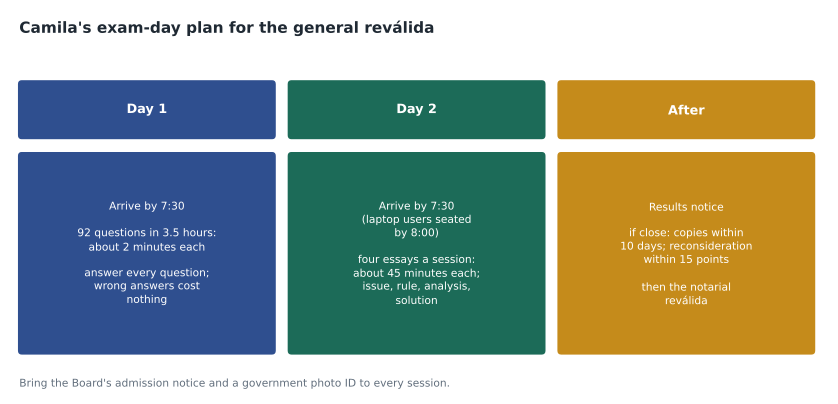
Day one, multiple choice. Arrive by 7:30 with the Board's admission notice and a government photo ID. In each session of 92 questions, keep a pace of about two minutes a question, answer every question because only correct answers count, mark the hardest ones and return if time allows. Eat lunch away from other candidates who want to compare answers. Day two, discussion. Laptop users must be seated by 8:00 in the morning and 2:30 in the afternoon. For each of the four questions in a session, spend about five minutes reading and outlining, thirty-five writing in the five-step template and five checking that every part of the call has an answer. Start with the question you know best to build momentum, but never leave a question blank: partial answers earn points from both graders.
The plan: after the exam
After the exam, Camila would wait for the results notice. If she passed, she would watch for the public notice inviting objections, keep her application updated, and prepare for the oath and registration in the RUA. If she fell short by 15 points or fewer, she would request copies of her answers within 10 days of the result and decide, with Nilda's help, whether to request reconsideration within 20 days after the copies arrived. Either way, the notarial reválida would come next, and her notes on mortgage and registry law, obligations and contracts and succession would already be half of her preparation.
| When | Task |
|---|---|
| December 2026 | Finish outlines against the May 2026 specification tables; watch for the edict; request the police certificate; file on time |
| January 2027 | Weekly 92-question timed sets; two graded essays a week |
| February 2027 | Two full simulated exams; recent Supreme Court opinions; new Rules of Professional Conduct |
| Exam week | Light review; logistics; admission notice and ID |
| After results | Public notice and oath if passed; copies within 10 days and reconsideration if within 15 points |
| Next | Notarial reválida and admission to the notarial practice |
Worked problem
A last-minute ethics question
Two weeks before the exam, Héctor Mattei asks Camila a question to test her. A client who bought a house through a deed Nilda authorized now wants to sue the seller, and the seller, also a former client of the firm on an unrelated matter, asks Nilda to authorize a new deed for him. What should the firm consider?
Show solution
- Under the new Rules of Professional Conduct, the firm must analyze conflicts of interest involving current and former clients before taking either matter.
- Suing the seller on the buyer's behalf requires checking whether the firm's former representation of the seller was substantially related or gave it confidential information that could be used against him.
- As a notary, Nilda must be impartial; authorizing a deed for a party the firm is suing would compromise that impartiality, and she should decline.
- The Rules integrate notarial duties with lawyers' duties, so both sets of concerns apply.
Answer: The firm may be able to represent the buyer after a careful conflict check, but Nilda should not act as notary for the seller while the firm is adverse to him.
Common mistakes
MistakeAn essay answer can skip the applicable article if the conclusion is right.
InsteadStating the applicable law is one of the five grading criteria.
MistakeLeaving a hard multiple-choice question blank is safe.
InsteadOnly correct answers count, so a blank is always a lost point.
MistakeThe date of the facts does not matter in a civil law question.
InsteadFacts before November 28, 2020 are governed by the 1930 Code.
MistakeA demand letter to one defendant protects the claim against all.
InsteadInterruption against one co-causer does not interrupt the period against the others.
MistakeReconsideration can be requested at any time.
InsteadCopies must be requested within 10 days of the result and reconsideration within 20 days after they are sent, only within 15 points.
Summary and key terms
- Answer every essay in five steps that match the Board's grading criteria: issue, applicable law, analysis, solution and clear writing.
- Always decide first which Civil Code governs, based on the date of the facts.
- Pace the multiple-choice day at about two minutes a question and answer every question.
- Build the final months around the May 2026 specification tables, timed sets and graded essays.
- After the exam, watch the reconsideration deadlines, the public notice and the oath, then prepare for the notarial reválida.
- 0
- grading criteria
- 1
- model answer
- 2
- hidden defects
- 3
- extrajudicial claim
- 4
- tacit revocation
- 5
- simulated exam
Practice problems
Work each problem on paper first, then reveal the answer to check.
What is the first issue in any civil law essay with facts near 2020?
Show answer
Which Civil Code governs: the 1930 Code for facts before November 28, 2020, the 2020 Code after.
A plaintiff injured in 2025 sent a demand letter to one of two co-causers. What happens to the period as to the other?
Show answer
It is not interrupted as to the other co-causer, under Fraguada Bonilla.
Is an open will executed in 2026 without witnesses valid?
Show answer
Yes, if the other requirements are met; Article 1644 no longer requires witnesses.
How long should a candidate spend on each essay?
Show answer
About 45 minutes: five to outline, thirty-five to write and five to check.
Within how many days of the result must a candidate request copies of her answers?
Show answer
Ten days, under Rule 10.3.1.
Lesson quiz · 5 questions
Score 60% or more to complete this lesson.
Create a free account to save your progress, take quizzes and earn a certificate.