
ACCT-480 · Lesson 7 of 12 · 25 min
REG I: ethics, tax procedures and business law
Taxation and Regulation tests federal taxation of individuals, entities and property transactions, but it also tests professional responsibilities in tax practice, federal tax procedures and business law. Candidates often treat the non-tax areas as an afterthought and lose points they could easily have earned. This lesson covers those areas: the ethical and professional rules that govern tax practice, the procedures of the Internal Revenue Service and the tax courts, and the business law topics in the blueprint. Lesson 8 covers the taxation of individuals and entities using the Brandt family from ACCT-351 and ACCT-352.
The REG blueprint
Under the 2024 blueprint, REG has five areas: ethics, professional responsibilities and federal tax procedures; business law; federal taxation of property transactions; federal taxation of individuals; and federal taxation of entities, including tax preparation. The tax areas carry most of the weight, but the first two together account for roughly a third of the section, which is more than many candidates assume. Tax law changes on a schedule: under the AICPA's policy, provisions of the 2025 federal tax act became testable in REG and TCP from July 1, 2026. Check which tax year the exam uses and which recent provisions are testable before you sit.
Professional responsibilities in tax practice
Three sets of rules govern a CPA's tax practice. Treasury Department Circular 230 regulates practice before the IRS by attorneys, CPAs, enrolled agents and others. It requires due diligence, prompt disposition of matters, the return of client records on request, advising clients of noncompliance and its consequences, and standards for written advice. It prohibits contingent fees in most situations, with exceptions such as services in connection with an IRS examination or a claim for refund. The AICPA's Statements on Standards for Tax Services (SSTSs), revised effective January 1, 2024, apply to AICPA members and cover tax return positions, answers to questions on returns, procedural aspects, use of estimates, knowledge of errors, and written and oral advice. The Internal Revenue Code imposes penalties on preparers and taxpayers.
The standards for tax return positions are tested often. A preparer must not take a position unless there is a reasonable basis for it and it is adequately disclosed, or unless there is substantial authority for it; for tax shelters and reportable transactions the standard is that the position is more likely than not to be sustained. Under section 6694, a preparer who takes an unreasonable position faces a penalty of the greater of 1,000 dollars or 50 percent of the fee, and for willful or reckless conduct, the greater of 5,000 dollars or 75 percent of the fee. Taxpayers face an accuracy-related penalty of 20 percent of an underpayment caused by negligence or a substantial understatement, which for individuals means an understatement exceeding the greater of 10 percent of the correct tax or 5,000 dollars. These amounts are from the Code as most recently studied; confirm current figures before relying on them.
| Standard of authority | Approximate likelihood of being sustained | Where it matters |
|---|---|---|
| More likely than not | More than 50 percent | Tax shelters, reportable transactions, some written advice |
| Substantial authority | Roughly 40 percent or more (judgment, not a number) | Undisclosed positions; avoiding the substantial understatement penalty |
| Reasonable basis | Roughly 20 percent (judgment) | Disclosed positions |
| Not frivolous | Above zero but below reasonable basis | Minimum for any position; frivolous positions are penalized |
Errors, confidentiality and conflicts
When a CPA learns of an error in a client's previously filed return, or that a client failed to file, the SSTSs and Circular 230 require the CPA to inform the client promptly of the error and its potential consequences and recommend corrective action. The CPA may not inform the IRS without the client's permission, except where required by law. If the client refuses to correct a significant error, the CPA should consider whether to continue the relationship. Confidentiality is protected by section 7216, which makes it a crime for a preparer to disclose or use return information without the taxpayer's consent, with limited exceptions. The federally authorized tax practitioner privilege in section 7525 extends attorney-client privilege to tax advice in noncriminal matters, but not to tax shelter promotion or return preparation. Conflicts of interest, such as preparing returns for both spouses in a divorce, are permitted under Circular 230 only with informed written consent and a reasonable belief that the practitioner can represent each client competently.
Federal tax procedures
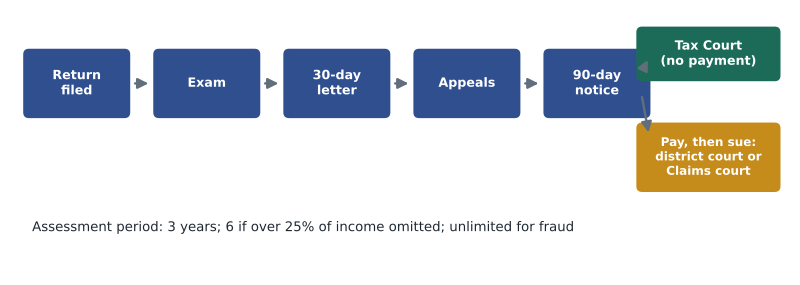
REG tests the procedures from filing to litigation. Returns are generally due on the fifteenth day of the fourth month after year end for individuals and C corporations and the third month for partnerships and S corporations, with automatic extensions of six months to file, not to pay. The IRS may examine a return by correspondence, in an office or in the field. A taxpayer who disagrees with a proposed adjustment can request a conference with the IRS Independent Office of Appeals, then file a petition with the Tax Court without paying the tax, or pay and sue for a refund in a district court or the Court of Federal Claims. Penalties include failure to file, failure to pay and estimated tax underpayment, and interest runs on unpaid tax.
The program below computes the failure-to-file and failure-to-pay additions for an individual who files four months late and pays seven months late, and checks which assessment period applies when income is omitted. The failure-to-file addition is 5 percent of the unpaid tax per month, reduced by the failure-to-pay addition for months when both apply, up to a maximum of 25 percent; the failure-to-pay addition is 0.5 percent per month. These are the general rules of section 6651; special minimums and rates apply in some cases, and interest is added.
# REG I: failure-to-file and failure-to-pay additions (IRC 6651), simplified.
# 5% per month for failure to file (max 25%), 0.5% per month for failure to pay;
# when both apply in a month, the filing addition is reduced by the paying one.
tax_due, months_late_file, months_late_pay = 18000, 4, 7
ftp = tax_due * 0.005 * months_late_pay
ftf = 0.0
for m in range(1, months_late_file + 1):
    ftf += tax_due * (0.05 - 0.005)
ftf = min(ftf, tax_due * 0.225)
print(f"Failure-to-file addition {ftf:,.0f}")
print(f"Failure-to-pay addition  {ftp:,.0f}")
print(f"Total additions          {ftf + ftp:,.0f}  (interest is extra)")
# Statute of limitations check on assessment: 3 years, 6 if income omitted > 25%
reported, omitted = 120000, 34000
years = 6 if omitted > 0.25 * reported else 3
print(f"Omitted {omitted / reported:.0%} of reported income -> assessment period {years} years")Failure-to-file addition 3,240 Failure-to-pay addition 630 Total additions 3,870 (interest is extra) Omitted 28% of reported income -> assessment period 6 years
Four months late gives a combined filing addition of 4.5 percent per month after the offset, 3,240 dollars, and seven months of the payment addition gives 630 dollars. Because the omitted income exceeds 25 percent of the income reported, the IRS has six years rather than the usual three to assess additional tax. There is no limitation period for a fraudulent return or for a return that was never filed. Questions on the statute of limitations are among the most predictable in REG; learn the three-year rule, the six-year rule for substantial omissions, the unlimited period for fraud, and the refund claim rule of three years from filing or two years from payment.
Business law
Business law in REG covers agency, contracts, debtor-creditor relationships, federal laws and regulations, and business structures. Agency questions test how an agency relationship arises, the agent's actual and apparent authority, the principal's liability for the agent's contracts and torts, and the duties of each party. Contract questions test formation (offer, acceptance, consideration, capacity and legality), defenses such as mistake, fraud, duress and undue influence, the statute of frauds (contracts for interests in land, contracts that cannot be performed within a year, promises to pay another's debt, and sales of goods for 500 dollars or more under the UCC), performance, breach and remedies. The UCC's Article 2 governs sales of goods between merchants and others, with rules on firm offers, additional terms and risk of loss.
Debtor-creditor questions test secured transactions under UCC Article 9: attachment of a security interest (value given, the debtor's rights in the collateral and a security agreement), perfection by filing, possession or automatically for purchase-money security interests in consumer goods, and priority among creditors. They also test bankruptcy: liquidation under Chapter 7, reorganization under Chapter 11 and individual repayment plans under Chapter 13; the order of priority for claims; voidable preferences made within 90 days before the filing, or one year for insiders; and debts that cannot be discharged. Federal law questions cover employment law, such as the Fair Labor Standards Act and employment discrimination, and the federal securities laws at an introductory level. Business structure questions compare sole proprietorships, partnerships, limited liability companies and corporations on liability, management, taxation and formation.
Business structure questions are among the easiest marks in this area if you organize the comparison. Ask four questions of each entity: who is personally liable for its debts, who manages it, how it is taxed and how it is formed. A general partner is personally liable for partnership debts, while limited partners risk only their investment as long as they do not participate in control in a way the governing statute forbids. Members of a limited liability company are generally protected from its debts, can manage it themselves or appoint managers, and choose its tax classification under the check-the-box rules. Shareholders of a corporation are protected unless a court pierces the corporate veil, for example because the corporation was a sham or was inadequately capitalized. Directors owe duties of care and loyalty, and the business judgment rule protects good-faith decisions made on an informed basis. Formation requires a filing with the state for limited partnerships, LLCs and corporations, but not for a general partnership, which can arise from conduct alone.
Worked problem
A secured transaction question
Copperline Outdoor Gear Inc. sells a tent display to a retailer on credit, keeping a security interest in the display under a signed security agreement. Copperline does not file a financing statement. A month later, the retailer's bank files a financing statement covering all its equipment.
Show solution
- Attachment: value was given, the retailer has rights in the display and there is a signed security agreement, so Copperline's interest attached.
- Perfection: the display is equipment, not consumer goods, so automatic perfection of a purchase-money interest does not apply; without filing, Copperline's interest is unperfected.
- Priority: a perfected interest beats an unperfected one, so the bank has priority.
- Lesson: a purchase-money seller of equipment must file within 20 days after the debtor receives the goods to obtain priority.
Answer: The bank has priority because Copperline never perfected; it should have filed within 20 days.
Common mistakes
MistakeTreating ethics and law as minor parts of REG.
InsteadTogether they carry roughly a third of the section; study them systematically.
MistakeTelling the IRS about a client's error without consent.
InsteadInform the client and recommend correction; disclosure to the IRS requires consent unless the law requires it.
MistakeConfusing an extension to file with an extension to pay.
InsteadAn extension gives more time to file, not to pay; interest and payment penalties still apply.
MistakeForgetting the six-year rule.
InsteadOmitting more than 25 percent of gross income extends the assessment period to six years.
MistakeAssuming any security interest has priority if it was first.
InsteadPriority generally goes to the first to file or perfect; unperfected interests lose to perfected ones.
MistakeMixing up the standards of authority.
InsteadReasonable basis with disclosure, substantial authority without, more likely than not for shelters.
Summary and key terms
- REG covers ethics and federal tax procedures, business law, and federal taxation of property, individuals and entities.
- Circular 230, the SSTSs and the Code's penalties govern tax practice; know the standards for return positions.
- A CPA who finds a client error informs the client and recommends correction; section 7216 protects confidentiality.
- Know filing deadlines, extensions, the appeals and litigation routes, and the statute of limitations rules.
- Failure-to-file and failure-to-pay additions interact; the six-year rule applies to substantial omissions.
- Business law covers agency, contracts and the UCC, secured transactions and bankruptcy, federal regulation and business structures.
- Circular 230
- Treasury Department regulations governing practice before the IRS.
- Statements on Standards for Tax Services (SSTSs)
- AICPA standards for members' tax practice, revised effective January 1, 2024.
- Substantial authority
- An objective standard of support for a tax position, below more likely than not and above reasonable basis.
- Ninety-day notice of deficiency
- The ninety-day letter that allows a taxpayer to petition the Tax Court.
- Statute of frauds
- The rule that certain contracts must be evidenced by a signed writing to be enforceable.
- Perfection
- The step, such as filing a financing statement, that makes a security interest effective against third parties.
- Voidable preference
- A transfer to a creditor shortly before bankruptcy that the trustee can recover.
Practice problems
Work each problem on paper first, then reveal the answer to check.
Name REG's five content areas.
Show answer
Ethics, professional responsibilities and federal tax procedures; business law; federal taxation of property transactions; individuals; entities.
What position standard applies to an undisclosed position under the SSTSs?
Show answer
Substantial authority (unless a higher standard applies, such as for tax shelters).
Rerun the penalty program with the return filed 7 months late and paid 7 months late. What is the filing addition?
Show answer
It reaches the cap of 22.5 percent after the offset, 4,050 dollars; the payment addition is 630.
A client refuses to amend a return with a significant error. What should the CPA do?
Show answer
Consider withdrawing from the engagement; do not inform the IRS without consent unless legally required.
How long does the IRS have to assess tax if a return was fraudulent?
Show answer
There is no limitation period.
Which contracts fall under the statute of frauds?
Show answer
Interests in land, contracts not performable within a year, promises to pay another's debt, sales of goods of 500 dollars or more, and promises in consideration of marriage.
What three elements create attachment of a security interest?
Show answer
Value given, the debtor's rights in the collateral and a signed security agreement (or possession).
How far back does the trustee look for preferences to insiders?
Show answer
One year before the filing.
Can a practitioner charge a contingent fee for preparing an original return?
Show answer
No; Circular 230 allows contingent fees only in limited situations such as examinations and refund claims.
Where can a taxpayer litigate without first paying the tax?
Show answer
The Tax Court, after receiving a notice of deficiency.
Lesson quiz · 5 questions
Score 60% or more to complete this lesson.
Create a free account to save your progress, take quizzes and earn a certificate.