
MELC-212 · Lesson 9 of 12 · 18 min
Contracts and the Builders' Lien Act
▶ Video coming soon A video version of this lesson is on the way.
Getting paid is the part of contracting that no apprenticeship teaches. In the Northwest Territories the law on construction payment changed recently: the Builders' Lien Act came into force on 1 September 2025 and replaced the old Mechanics Lien Act. The new Act sets a mandatory holdback, deadlines for registering a lien, and a process for perfecting it. What it does not include is a prompt payment or adjudication system of the kind several provinces have adopted, and builders in the territory have publicly called for one. This lesson covers the contract terms that protect a contractor, how the holdback and lien rules work, and what the absence of prompt payment means in practice. It describes the law in general terms; for any real dispute, talk to a lawyer, because the deadlines are short and strict.
The unpaid school invoice
Slave River Electric's Fort Resolution school job finishes in late June. The general contractor pays the first two progress invoices on time but holds the third, saying the owner has not paid. By the end of August, 28,000 dollars is outstanding. Tanya asks Ed what to do. He asks her three questions: What does your contract say about payment? When was your work substantially complete? And have you written down the date? Her answers will decide whether she has a lien, and how long she has to protect it.
The contract comes first
Most payment problems are easier to solve, or avoid, with a good written contract. Tanya's subcontract template covers the points that matter most when money gets tight:
- Price and payment schedule: lump sum or unit rates, progress billing dates, and how long the payer has to pay.
- Holdback: the amount held back from each payment, and when and how it is released.
- Changes: written change orders, priced before the work is done where possible, with a fallback rate if not.
- Who takes out the permit: the registered worker named in the contract, consistent with Lesson 6.
- Pay-when-paid terms: the contract should say what happens if the owner does not pay the general contractor. Read these clauses carefully, because they can shift the risk of the owner's non-payment onto the subcontractor.
- Interest on late payment and the right to suspend work, if the contract allows them.
- Records: daily logs, delivery tickets and photographs, which support both the invoice and any later claim.
The Builders' Lien Act in outline
A builders' lien is a security interest in the land where the work was done. It gives a contractor, subcontractor, worker or supplier who has not been paid a claim against the property itself, not just against the person who hired them. That gives owners a strong reason to make sure everyone down the chain gets paid. The territorial Act, as summarised by the government's announcement and by legal commentary, includes:
- Coming into force on 1 September 2025, replacing the Mechanics Lien Act. Contracts and liens that began under the old Act may still be governed by it; check the transition rules for any job that straddles the date.
- A mandatory holdback of 10 in every 100 of the value of work done or materials supplied, to be kept by the owner and by each payer down the chain.
- A time limit for registering a lien: within 60 days after the contract is substantially complete, or completed, terminated or abandoned, depending on the circumstances.
- A requirement to perfect the lien within 90 days by starting a court action and registering a certificate of pending litigation against the title.
- Court power to declare a lien expired if no significant step is taken in the action within two years.
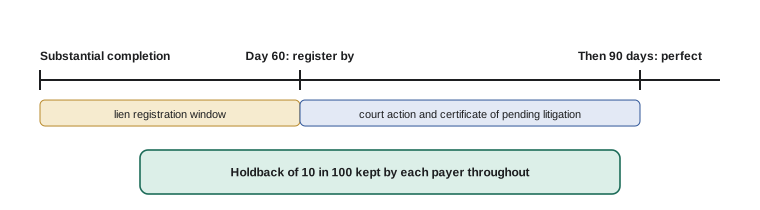
Holdback
The holdback protects people further down the chain. If the owner keeps 10 in every 100 of each payment until the lien period has passed, there is a fund from which unpaid subcontractors and suppliers can be paid. An owner who keeps the holdback properly limits their exposure to liens to roughly the holdback amount; an owner who pays it out early may find themselves paying twice. The same logic applies to a general contractor paying Slave River Electric, and to Slave River Electric paying its own suppliers.
For a small contractor, holdback is also a cash flow problem. On a 120,000 dollar job, 12,000 dollars may be held for weeks or months after the work is done. Price that into the job and plan for it in the bank account.
| Item | Builders' Lien Act (in force 1 September 2025) |
|---|---|
| Replaces | The Mechanics Lien Act |
| Holdback | Mandatory, 10 in every 100 of work or materials |
| Lien registration | Within 60 days after substantial completion, or completion, termination or abandonment |
| Perfection | Court action and certificate of pending litigation within 90 days |
| Expiry for inaction | Court may declare a lien expired if no significant step in two years |
| Prompt payment and adjudication | Not included |
Calculating the deadlines
The dates are where liens are won or lost. Substantial completion is usually a defined stage where the work is ready for use, with only minor items left. On a subcontract, the relevant date may be the completion of the subcontractor's own work. Write down the date and the evidence for it, such as the final inspection or the owner's acceptance.
# Builders' Lien Act windows counted from the relevant completion date.
# Periods: 60 days to register, 90 days to perfect (government and legal summaries).
from datetime import date, timedelta
completion = date(2026, 6, 26)        # invented substantial completion date
register_by = completion + timedelta(days=60)
perfect_by = register_by + timedelta(days=90)   # check whether the 90 days run from registration
contract = 120_000
holdback = contract * 0.10
print("completion       ", completion)
print("register lien by ", register_by)
print("perfect lien by  ", perfect_by, "(confirm how the period is counted)")
print(f"holdback on {contract:,} = {holdback:,.0f}")completion 2026-06-26 register lien by 2026-08-25 perfect lien by 2026-11-23 (confirm how the period is counted) holdback on 120,000 = 12,000
The calculator assumes the 90-day perfection period runs from registration. Legal commentary on the new Act should be checked on that point for each case, because an error in how a period is counted can lose the lien entirely.
No prompt payment, no adjudication
Several provinces now have prompt payment laws that require owners to pay proper invoices within a fixed number of days and pass payment down the chain quickly, backed by fast adjudication of disputes. The Northwest Territories' new Act does not include those features, and builders in the territory have publicly called for prompt payment legislation. Until that changes, a contractor's protection comes from the contract, the holdback and the lien, and from choosing customers carefully. Watch for any new legislation, because this area is changing across the country.
Public land and other exceptions
Liens generally attach to the owner's interest in land. Work on some public property, including property of the Crown, may be handled differently, for example through claims against the holdback or the contract funds rather than a lien on title. Many school and health centre jobs in the territory are on public property, so check how the Act treats the particular owner before relying on a lien. This is another point on which a lawyer's advice is worth the cost.
A worked example: the school invoice
Worked problem
Protecting the Fort Resolution claim
Slave River Electric's work at the school was substantially complete on 26 June 2026, and 28,000 dollars is unpaid on 25 August. The general contractor says it has not been paid by the owner. What should Tanya do?
Show solution
- Check the subcontract for pay-when-paid terms, interest and notice requirements, and send a written demand.
- Count the lien window: 60 days after 26 June is 25 August 2026, which is today. If a lien is available against this owner, it must be registered now.
- Get legal advice immediately, because the school is probably public property and the claim may run against the holdback or contract funds rather than the land.
- Diary the perfection deadline and keep every record of the work and the invoices.
Answer: Act today: the 60-day lien window closes on 25 August 2026; take legal advice on how the Act applies to a public owner.
Avoiding payment trouble
Liens are a last resort. Most payment problems can be reduced with simple habits. Check a new customer before signing: ask other trades about them, and for large private jobs, consider asking about financing. Bill promptly and accurately, with the backup the contract requires. Follow up an overdue invoice within days, not weeks, and in writing. Price changes before doing them, and get them signed. And do not let the unpaid balance on any one customer grow larger than the business can afford to lose.
For subcontractors, pay-when-paid clauses deserve special attention. A clause that says the general contractor will pay when it is paid by the owner may be read as a timing rule or as shifting the whole risk of the owner's non-payment to the subcontractor, depending on its wording and on the law. Read these clauses before signing, ask for changes if needed, and take advice on any large contract.
Paying your own suppliers
The holdback and lien rules apply down the chain. If Slave River Electric does not pay its supplier for the switchgear on a job, the supplier may have its own lien rights against the property. Paying suppliers on time, and keeping the holdback on any subcontractor Slave River Electric hires, protects the company's relationship with the owner and the general contractor as well as the supplier.
Releasing the holdback
When the lien period has passed and no liens have been registered, the holdback can be released. Ask for it in writing and keep track of when it is due, because holdback that is never asked for is often never paid. Some contracts provide for release of the holdback for different parts of the work at different times; others release it all at the end. Know which applies before the job starts.
On jobs where Slave River Electric holds back from its own subcontractors, Joe tracks the same dates in reverse, so that the company releases holdback when it should and does not pay it out too early.
Keeping a payment file
For every job, keep a payment file beside the permit and inspection folder. It holds the signed contract, every progress invoice and the backup sent with it, payment dates, change orders with their approvals, correspondence about late payments, and a note of the substantial completion date with the evidence for it. If a lien becomes necessary, a lawyer will ask for exactly these documents, usually in a hurry. A contractor who can hand them over the same day gives the lawyer time to register the lien properly within the 60-day window, rather than racing the deadline.
The payment file also helps on jobs that go well. It shows which customers pay promptly, which change orders were profitable and how long holdback actually took to come back, all of which helps price the next job.
Common mistakes
MistakeWaiting for a promised payment until the lien window has closed.
InsteadCount the 60-day window from completion and register in time if payment has not arrived.
MistakeAssuming a prompt payment law will force the general contractor to pay.
InsteadThe territory's Act has no prompt payment or adjudication system; rely on the contract and the lien.
MistakeIgnoring the holdback in cash flow planning.
InsteadExpect 10 in every 100 to be held back on each payment until the lien period passes.
MistakeApplying the new Act to a job governed by the old one.
InsteadCheck the transition rules for contracts that began before 1 September 2025.
Summary and key terms
- The Builders' Lien Act came into force on 1 September 2025 and replaced the Mechanics Lien Act.
- Owners and each payer must keep a holdback of 10 in every 100 of the value of work or materials.
- A lien must be registered within 60 days after substantial completion, or completion, termination or abandonment.
- A lien must be perfected within 90 days by court action and a certificate of pending litigation, and can expire if no significant step is taken in two years.
- The territory has no prompt payment or adjudication law, so contracts, holdback and liens are the main protections.
- Builders' lien
- A security interest in land held by an unpaid contractor, worker or supplier.
- Holdback
- The share of each payment, 10 in every 100, kept back until the lien period passes.
- Substantial completion
- The stage at which work is ready for use with only minor items left.
- Perfecting a lien
- Starting a court action and registering a certificate of pending litigation to keep a lien alive.
- Certificate of pending litigation
- A notice on title that a court action affects the land.
- Prompt payment
- A statutory system of fixed payment deadlines and adjudication, not adopted in the territory.
Practice problems
Work each problem on paper first, then reveal the answer to check.
When did the Builders' Lien Act come into force?
Show answer
1 September 2025.
What share of each payment is held back?
Show answer
10 in every 100.
Work was substantially complete on 3 March. When does the 60-day lien window close?
Show answer
2 May.
Does the territory have a prompt payment adjudication system?
Show answer
No. The new Act does not include one.
Lesson quiz · 5 questions
Score 60% or more to complete this lesson.
Create a free account to save your progress, take quizzes and earn a certificate.