
MELC-212 · Lesson 10 of 12 · 18 min
Occupational health and safety law for electrical contractors
▶ Video coming soon A video version of this lesson is on the way.
Electrical safety law protects the people who use an installation. Occupational health and safety law protects the people who build it. In the Northwest Territories the second job belongs to the Workers' Safety and Compensation Commission, the WSCC, which administers the Safety Act and its Occupational Health and Safety Regulations, and also runs the workers compensation system. A contractor who hires even one worker takes on duties under both. This lesson covers the employer's general duties, the joint health and safety committee and representative rules, the right to refuse unsafe work, electrical hazards on site, and how and when to report injuries and incidents to the WSCC. The WSCC serves both the Northwest Territories and Nunavut, and its website is the place to check current forms, codes of practice and deadlines.
Kyle's first winter job
Kyle Antoine's first winter on the crew includes a job at a Hay River warehouse where the temperature outside is minus 38. The work involves a scissor lift, a live panel that the owner does not want shut down, and a long drive on icy roads. Tanya stops the job planning meeting to go through each hazard with him: the lift, the panel, the cold, and the drive. She makes it clear that the panel will be de-energized and locked out before anyone works in it, whatever the owner wants, and that Kyle has the right to refuse any task he believes is unsafe. That conversation is not just good practice. It is what the Safety Act expects of an employer.
The employer's general duty
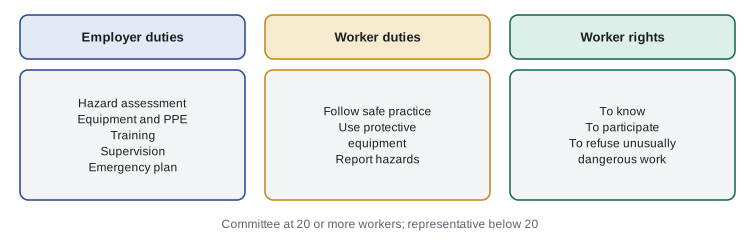
The Safety Act places a general duty on every employer to maintain the workplace, and the work, in a way that protects the health and safety of workers, so far as is reasonably practicable. The Occupational Health and Safety Regulations fill in the details for particular hazards. For a small contractor, the general duty means at least:
- Assessing the hazards of each job before it starts, and writing down how each will be controlled.
- Providing safe equipment, personal protective equipment and the training to use them.
- Supervising workers, especially apprentices and new hires, and making sure work is done by competent people.
- Having a plan for emergencies and first aid that suits the job's location, which on a remote site may mean a long way from a clinic.
- Keeping records of training, inspections and incidents.
Workers have duties too: to follow safe practices, use the protective equipment provided, and report hazards. A supervisor, which Tanya often is, must make sure the workers under them follow the rules.
Committees and representatives
The Occupational Health and Safety Regulations require a joint health and safety committee at a workplace where 20 or more workers are regularly employed, and a health and safety representative where there are fewer than 20. The committee includes worker and employer members and meets regularly. Published summaries say a new committee meets monthly for the first three months and quarterly after that. The committee or representative helps identify hazards, takes part in inspections and investigations, and makes recommendations to the employer.
Slave River Electric has six workers, so it needs a health and safety representative, not a committee. Kyle volunteers, Tanya makes sure he gets time and training for the role, and they walk through each active job together once a month. On larger sites, such as a mine surface facility or a school renovation, the owner or general contractor may run its own committee that Slave River Electric's crew is expected to take part in.
| Workforce regularly employed | Requirement |
|---|---|
| 20 or more workers | Joint health and safety committee |
| Fewer than 20 workers | Health and safety representative |
| New committee meetings | Monthly for the first three months, then quarterly (per published summaries) |
The right to refuse
A worker in the Northwest Territories has the right to refuse work that they have reasonable grounds to believe is unusually dangerous to themselves or others. The worker reports the refusal to the supervisor or employer, the danger is investigated, and if the matter is not resolved, a WSCC safety officer can be called in to decide. A worker must not be disciplined for exercising the right in good faith. Employers should treat a refusal as information about a hazard, not as defiance.
Electrical hazards on site
Electrical contractors face the hazards every construction trade faces, plus some that are their own. Shock and arc flash are the most serious. The safest rule is to de-energize, lock out, tag and test before working on any equipment, and to treat energized work as an exception that needs justification, planning, the right protective equipment and qualified workers. CSA Z462, the Canadian standard on workplace electrical safety, is the reference most employers use to set out how to assess shock and arc flash risk and choose protective equipment. Check how the OHS Regulations and the WSCC's codes of practice refer to it, and follow both.
Northern work adds cold stress, isolation, wildlife, long drives on highways and winter roads, and working far from medical help. A hazard assessment for a remote job should cover how an injured worker would be evacuated and how long it would take.
Reporting injuries and incidents to the WSCC
The WSCC's injury reporting guidance for employers sets out two steps.
- For every workplace injury or illness, the employer files an Employer's Report of Incident with the WSCC within three business days of learning about it, and gives the worker a copy. The WSCC Connect online service can be used to file.
- For a serious injury, a dangerous occurrence or a fatality, the employer must also call the WSCC's 24-hour incident reporting line as soon as possible, and then file the written report within three business days.
A worker files their own report as well. Do not delay reporting while deciding whether an injury is serious enough; if in doubt, report. Late or missing reports can lead to penalties and make claims harder for the worker.
# Employer's Report of Incident due within three business days (WSCC guidance).
# Weekends are skipped; statutory holidays would also need to be skipped. Dates are invented.
from datetime import date, timedelta
def add_business_days(start, n):
    d = start
    while n > 0:
        d += timedelta(days=1)
        if d.weekday() < 5:
            n -= 1
    return d
incidents = {"Cut hand at warehouse (Thursday)": date(2026, 11, 5),
             "Fall from ladder at lodge (Friday)": date(2026, 11, 6)}
for name, learned in incidents.items():
print(f"{name:36s} learned {learned} report due by {add_business_days(learned, 3)}")Cut hand at warehouse (Thursday) learned 2026-11-05 report due by 2026-11-10 Fall from ladder at lodge (Friday) learned 2026-11-06 report due by 2026-11-11
Workers compensation
Lesson 4 covered registration with the WSCC. The compensation system is a no-fault insurance scheme: injured workers receive benefits regardless of fault, and in exchange employers are generally protected from being sued by their workers for workplace injuries. The employer pays assessments based on payroll and the industry rate, and an employer with a poor claims record may pay more. Good safety practice therefore saves money as well as injuries. Subcontractors and owner-operators should check whether they need their own coverage, and a general contractor may ask for proof that a subcontractor's WSCC account is in good standing before paying.
A worked example: the live panel
Worked problem
Planning the warehouse panel work
The warehouse owner wants a new circuit added to a panel feeding a freezer room and does not want the panel shut down. Kyle will assist Tanya. What does the Safety Act and good practice require?
Show solution
- Assess the hazard: adding a circuit in an energized panel carries shock and arc flash risk.
- Choose the safest control: schedule a short shutdown, de-energize, lock out, tag and test. Explain to the owner that the freezer can be protected by planning the outage, not by working live.
- If energized work were truly unavoidable, it would need a documented justification, a risk assessment, protective equipment and qualified workers, following CSA Z462; an apprentice should not be exposed.
- Brief Kyle on the plan and his right to refuse, and record the briefing.
Answer: Plan a shutdown and lock out the panel; energized work is the exception, not the default.
Safety on other people's sites
Much of a small electrical contractor's work happens on sites controlled by others: general contractors, mine operators, schools and hospitals. Each will have its own safety orientation, rules and permits to work, and the site's prime contractor or owner will expect subcontractors to follow them. That does not remove the electrical contractor's own duties as an employer. Tanya's crews attend every site orientation, follow the site's rules where they are stricter, and keep their own hazard assessments and lockout procedures in place.
Coordinating lockout with other trades is a common problem. When mechanical and electrical trades work on the same equipment, each worker should apply their own lock, and nobody should remove another worker's lock. A clear written procedure, explained at the start of the job, prevents dangerous misunderstandings.
Cold, distance and fatigue
Northern work brings hazards that a southern hazard assessment might miss. Extreme cold affects people and tools: hands lose dexterity, batteries fail, plastic becomes brittle and cables crack. Long drives on highways and winter roads mean fatigue and isolation. Remote sites may have no cell coverage and hours between the job and the nearest clinic.
- Plan warm-up breaks and keep spare gloves, batteries and heaters.
- Carry a satellite communication device and a first aid kit suited to the distance from help.
- Set travel rules: check road conditions, carry emergency supplies and check in on arrival.
- Watch for fatigue on long shifts and long drives, and plan rest accordingly.
Training records
Training is one of the employer's clearest duties, and training records are the clearest proof that it was met. Keep a record of every safety orientation, lockout training session, fall protection course, first aid certificate and equipment operator qualification, with dates and expiry dates. When a WSCC safety officer asks how a worker was trained, the record is the answer.
Investigating incidents
Reporting an incident to the WSCC is not the end of the employer's job. Every incident, including a near miss that injured nobody, should be investigated to find out why it happened and what will stop it happening again. Involve the health and safety representative, talk to the workers who were there, look at the equipment and the conditions, and write down the causes and the corrective actions. Then follow up to make sure the actions were taken. A WSCC safety officer who investigates a serious incident will want to see this work, and a contractor who does it well usually finds that the next incident never happens.
Share what was learned with the whole crew, not just the people involved, and update the hazard assessments for similar jobs.
Common mistakes
MistakeTreating energized work as normal because the owner prefers no shutdown.
InsteadDe-energize, lock out, tag and test; plan the outage with the owner.
MistakeAssuming a six-person company needs no safety structure.
InsteadFewer than 20 workers still needs a health and safety representative.
MistakeWaiting to see whether an injury gets worse before reporting.
InsteadFile the Employer's Report of Incident within three business days; call the 24-hour line for serious incidents.
MistakeDisciplining a worker who refused a task.
InsteadA worker who refuses in good faith is protected; investigate the hazard.
Summary and key terms
- The WSCC administers the Safety Act, the OHS Regulations and workers compensation in the Northwest Territories.
- Employers have a general duty to protect workers so far as reasonably practicable, through hazard assessment, equipment, training and supervision.
- A joint health and safety committee is required at 20 or more regularly employed workers, and a representative below that.
- Workers have the right to refuse unusually dangerous work, and must not be disciplined for doing so in good faith.
- Employers file an Employer's Report of Incident within three business days, and call the 24-hour line first for serious injuries, dangerous occurrences and fatalities.
- WSCC
- The Workers' Safety and Compensation Commission, serving the Northwest Territories and Nunavut.
- Safety Act
- The territorial law that sets general workplace safety duties.
- Joint health and safety committee
- A worker and employer committee required at 20 or more regularly employed workers.
- Health and safety representative
- A worker representative required at workplaces with fewer than 20 workers.
- Right to refuse
- A worker's right to refuse unusually dangerous work.
- Employer's Report of Incident
- The employer's report to the WSCC, due within three business days.
Practice problems
Work each problem on paper first, then reveal the answer to check.
At what workforce size is a joint health and safety committee required?
Show answer
20 or more regularly employed workers.
An employer learns of a worker's injury on a Monday. When is the report due?
Show answer
Within three business days, so by Thursday unless there is a holiday.
What must an employer do first after a serious injury?
Show answer
Call the WSCC's 24-hour incident line as soon as possible, then file the written report.
Which standard is commonly used to assess arc flash risk?
Show answer
CSA Z462.
Lesson quiz · 5 questions
Score 60% or more to complete this lesson.
Create a free account to save your progress, take quizzes and earn a certificate.