
MELC-212 · Lesson 1 of 12 · 23 min
How electrical work is regulated in the Northwest Territories
▶ Video coming soon A video version of this lesson is on the way.
Every province and territory regulates electrical work, and each does it a little differently. In the Northwest Territories the rules come from one short statute and one set of regulations: the Electrical Protection Act and the Electrical Protection Regulations made under it. The Act defines electrical work, adopts the Canadian Electrical Code as the technical standard, provides for a Chief Inspector and inspectors, requires a permit before electrical work starts, and sets the penalties. The regulations fill in the detail: who must register, how long a registration lasts, the three kinds of permit, the fees, plan approval and inspection charges.
The single most important fact for anyone coming to this course from the rest of the master electrician program is this: the Northwest Territories does not license electrical contractors and does not set a contractor exam. In Alberta, permits go to holders of a Master Electrician Certificate earned by passing a provincial exam. In Ontario, every licensed electrical contractor must employ a designated master electrician. In the Northwest Territories, the control point is the individual worker. Section 2 of the regulations requires every qualified electrical worker doing electrical work under the Act to be registered, and a worker who is not registered cannot be issued an installation permit. The qualification behind that registration is the electrician's certificate, earned through the trade certification system.
This course is therefore not an exam cram. It prepares a certified electrician to register, take out permits and run an electrical contracting business in the Northwest Territories legally and well: who counts as a qualified electrical worker, how registration works, how the Code is adopted, how installation, annual and homeowner permits work, how inspections and appeals work, and the business, lien and safety law that surrounds every job. Lesson 12 closes with a readiness review in place of exam practice.
A word on sources. Everything in this course was checked in late 2026 against the territorial government's own electrical pages and forms, the published Electrical Protection Act and Regulations, the Workers' Safety and Compensation Commission's guidance and recognized legal summaries of the new Builders' Lien Act. Each lesson says where a detail is likely to change. Fees, forms and procedures change often, so before you register or rely on a deadline, confirm the current requirements with the Electrical/Mechanical Safety Section of the Department of Infrastructure and the other bodies named in each lesson. As in the rest of the series, this course never reproduces the text or tables of the Canadian Electrical Code. Rule numbers are cited and explained in our own words.
Tanya decides to go out on her own
Tanya Lafferty has been a Red Seal construction electrician for eight years. She grew up in Fort Smith, apprenticed with a contractor in Yellowknife, took her technical training blocks at Aurora College, and for the last six years has run crews for Northern Spark Electric in Yellowknife. Her crews have wired houses in the Niven Lake subdivision, fitted out offices downtown, rebuilt services after the 2023 wildfire evacuations and travelled to communities on the south shore of Great Slave Lake for school and health centre work.
This spring she decides to start her own company, Slave River Electric Ltd., based in Hay River, where her partner Joe Lafferty runs a small trucking business and keeps good books. Her old supervisor, Ed Kowalski, ran an electrical contracting company in Yellowknife for thirty years before retiring, and he has promised to answer any question she brings him. A second-year apprentice, Kyle Antoine, wants to come with her, and a journeyperson who recently moved north from Edmonton, Ravi Sandhu, will work for her full time.
Tanya's cousin, Priya Raman, lives in Red Deer, Alberta, and has just written the Alberta Master Electrician Certificate exam. When Tanya mentions her plans on a family call, Priya assumes Tanya will need the territorial version of that exam. Ed laughs when Tanya repeats this. There is no such exam in the Northwest Territories, he tells her. What matters is that every person doing electrical work is a registered qualified electrical worker, that a permit is in place before work starts, that the work is ready for inspection before anything is covered, and that the business itself is set up properly. Tanya already holds her certificate and her territorial registration. The legal gate is open. Running the business properly is the hard part.
The law in two parts
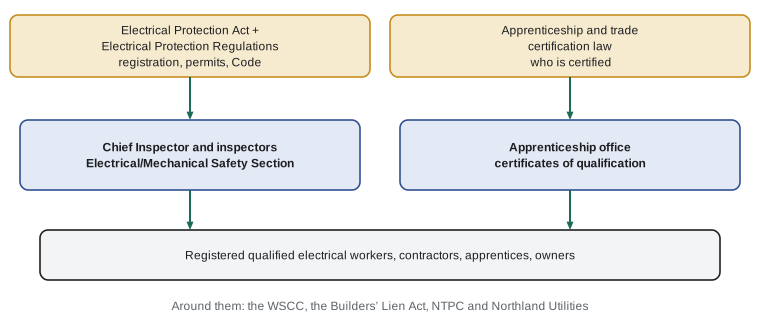
Ed sketches two boxes on a napkin at the Hay River diner. The first box is about installations and the people who may work on them; the second is about how people become electricians in the first place.
- The Electrical Protection Act. This territorial statute is the legal base for electrical safety. It defines electrical work as installing, repairing, altering, extending or maintaining electrical equipment. It defines a qualified electrical worker. It says that electrical work and equipment must conform to the Code (section 7), requires a permit for electrical work (section 8), provides for plan approval (section 9), requires work to be available for inspection before it is concealed (section 14), controls when power may be supplied (sections 16 and 17), creates an appeal to the Chief Inspector (section 19) and sets fines (section 21).
- The Electrical Protection Regulations. Made under section 22 of the Act, these regulations require qualified electrical workers to register (sections 2 and 3), set the registration fee and its three-year term, govern installation permits (sections 9 to 15), annual permits (sections 16 to 19) and residential property owner's permits (sections 20 to 24), and set inspection fees and plan approval rules (sections 26.1 to 29).
- Apprenticeship and trade certification law. A separate body of law, administered by the Department of Education, Culture and Employment through its Apprenticeship, Trade and Occupation Certification program, governs apprenticeship and the certificate of qualification. The Electrical Protection Act relies on it: a qualified electrical worker is someone who holds an electrician's certificate from the Northwest Territories or another province or territory, or who has been approved by the Chief Inspector.
Ed's point is that the first pair of laws is about installations and who may work on them, and the apprenticeship law is about how a person earns the certificate. When a question begins with what an installation must meet, whether it needs a permit or how it is inspected, start with the Electrical Protection Act and Regulations. When it begins with how someone becomes an electrician, start with the apprenticeship rules.
Who does what
Several organizations touch an electrical contractor's work. Tanya writes them down as a list, because she knows she will deal with every one of them in her first year.
- The Electrical/Mechanical Safety Section, Department of Infrastructure. This section of the territorial government administers the Electrical Protection Act through the Chief Electrical Inspector and the electrical inspectors. It registers qualified electrical workers, receives permit applications by email, carries out inspections and publishes electrical bulletins, including the notice adopting the current Code.
- Regional electrical inspectors. The section lists inspectors in Yellowknife, Hay River and Inuvik. A homeowner's permit can only be obtained in person from a regional inspector, and the inspector for the area is the person who will look at the work before it is covered and before power is supplied.
- Municipal electrical inspectors. Section 3(2) of the Act makes municipal electrical inspectors inspectors under the Act, so a municipality that employs one can inspect within its boundaries. Check locally whether that applies where you work.
- The Apprenticeship, Trade and Occupation Certification program. Run by Education, Culture and Employment, it registers apprentices, administers level exams and certification exams, and issues certificates of qualification.
- The supply authorities. These are the utilities that generate and distribute power, such as the Northwest Territories Power Corporation and Northland Utilities in the communities they serve. Under sections 16 and 17 of the Act a supply authority connects power only once an inspector has confirmed the work may be energized. A utility does not issue electrical permits.
- The Workers' Safety and Compensation Commission (WSCC). The WSCC provides workers compensation coverage, administers the Safety Act and its Occupational Health and Safety Regulations, and requires employer incident reports within three business days.
- Municipalities and the territorial business registries. Communities issue business licences and building permits where they require them, and the territorial corporate registry registers companies and business names. A building permit does not replace an electrical permit.
| Organization | Main role for a contractor |
|---|---|
| Electrical/Mechanical Safety Section (Chief Electrical Inspector) | Worker registration, permits, bulletins, Code administration |
| Regional electrical inspectors (Yellowknife, Hay River, Inuvik) | Inspections, homeowner permits in person |
| Apprenticeship, Trade and Occupation Certification | Apprentice registration, certificates of qualification |
| Supply authorities (utilities) | Connecting power once an inspector allows it |
| WSCC | Workers compensation, safety law, incident reports |
| Municipalities | Business licences and building permits |
| Corporate registry | Company and business name registration |
Registration of workers, not licensing of contractors
Tanya's first instinct, after hearing about Priya's exam, is to look for a territorial contractor licence. Ed stops her. The Electrical Protection Act and Regulations create no contractor licence. The control point is the individual: section 2(1) of the regulations says qualified electrical workers doing electrical work must be registered, and section 2(2) says a worker who is not registered cannot be issued an installation permit. The territory's own frequently asked questions page confirms that any individual registered as a qualified electrical worker may apply for an electrical permit, and that electrical contractors are expected to obtain the permit as part of the project agreement, because the permit holder is responsible for the work.
Registration itself is simple. A worker applies to an inspector on the approved form, provides a copy of a valid licence or certificate from the Northwest Territories or another province or territory, and pays the fee in Schedule A of the regulations, currently 82 dollars. Under section 3(3) the registration is valid for three years. Lesson 3 covers the details.
Compare that with the provinces earlier in this program. Alberta certifies the master electrician by exam; Ontario licenses the contractor and requires a designated master electrician; Saskatchewan licenses the contracting business and requires a qualifying journeyperson and a bond; Newfoundland and Labrador registers the contracting business. The Northwest Territories goes furthest towards the individual: it registers each qualified worker and lets that registered worker take out permits.
| Jurisdiction | What lets someone take out electrical permits |
|---|---|
| Alberta | A Master Electrician Certificate, earned by passing a provincial exam |
| Ontario | An electrical contractor licence with a designated master electrician |
| Newfoundland and Labrador | An Electrical Contractor's Registration Certificate held by the business |
| Northwest Territories | Registration as a qualified electrical worker, based on an electrician's certificate; no exam |
A worked example: who may do what
Worked problem
Matching people to permits and work
Slave River Electric will have three people doing electrical work in its first month: Tanya, Kyle the second-year apprentice, and Ravi, the journeyperson from Edmonton. Who may take out permits, and who may do the work?
Show solution
- Tanya holds an electrician's certificate and a current territorial registration, so she is a registered qualified electrical worker and may apply for installation permits for the company's jobs.
- Ravi holds an Alberta journeyperson certificate, which makes him a qualified electrical worker under the Act's definition. Before he does electrical work in the territory, or applies for any permit, he must register with the Electrical/Mechanical Safety Section using a copy of that certificate and paying the fee.
- Kyle is a registered apprentice, not a qualified electrical worker. He may do electrical work as part of his apprenticeship under the supervision his training plan requires, but he cannot hold a permit or work alone as a contractor.
- The permit holder is responsible for the work under the permit. On Slave River Electric's jobs that will usually be Tanya, so she must make sure the work her crew does meets the Code.
Answer: Tanya, as a registered qualified electrical worker, takes out the permits. Ravi must register before he works or applies for permits. Kyle works only under supervision as an apprentice.
A first look at the costs of compliance
Joe wants to know what the compliance side will cost before the company earns anything. Ed tells him the fixed items are small compared with trucks, tools and travel, but they recur. The calculator below adds up a first-year compliance budget. The registration fee of 82 dollars for three years and the 45 dollar minimum permit fee are the territory's published figures; the other lines are illustrative and should be replaced with real quotes and the current fee schedule.
# First-year compliance budget for a new Northwest Territories contractor.
# Registration (82 for 3 years) and the 45 minimum permit fee are published figures;
# the other lines are illustrative only - use real quotes and the current fee schedule.
items = {
    "worker registrations: 2 x 82 (3-year term)": 2 * 82,
    "business licence and registration (illustrative)": 350,
    "liability insurance (illustrative)": 3200,
    "WSCC assessment estimate (illustrative)": 2400,
    "small-job permits: 30 at the 45 minimum": 30 * 45,
    "larger-job permits (illustrative)": 2800,
}
for name, amount in items.items():
    print(f"{name:52s} {amount:7,d}")
print(f"{'total':52s} {sum(items.values()):7,d}")worker registrations: 2 x 82 (3-year term) 164 business licence and registration (illustrative) 350 liability insurance (illustrative) 3,200 WSCC assessment estimate (illustrative) 2,400 small-job permits: 30 at the 45 minimum 1,350 larger-job permits (illustrative) 2,800 total 10,264
The permit lines grow with the volume and value of work, and in the north they also grow with distance, because permit fees are based on the total project cost, including reasonable travel and living expenses for work away from home. Lesson 6 explains how.
Two important exclusions
Ed adds one more thing to the napkin. The Electrical Protection Act does not cover everything that carries current in the territory. Section 2 says it does not apply to electrical equipment in aircraft or marine vessels, or in a mine within the meaning of the Mine Health and Safety Act. Section 2.1 says it does not apply to work or activities governed by the Oil and Gas Operations Act. Contractors who work at diamond mines or on oil and gas projects work under those regimes instead, with their own inspection arrangements. Lesson 5 returns to this, because it changes which rules and which inspector apply to a job.
Why this structure matters
Most of the problems new contractors run into are not technical. They are administrative and legal: starting work before the permit is issued, covering wiring before it is inspected, letting an unregistered worker take out permits, letting an apprentice work alone, assuming a homeowner can take out a permit for work the contractor is doing, or asking the utility to connect power before the inspector allows it. Every one of those problems is easier to avoid when you can picture the law and the organizations around it.
The rest of the course builds that picture. Lesson 2 covers qualified electrical workers and the certificate. Lesson 3 covers registration. Lesson 4 covers setting up the business. Lessons 5 to 8 cover the Code, the three kinds of permit, plan approval, inspections and appeals. Lessons 9 and 10 cover lien and safety law. Lesson 11 covers offences and staying compliant, and Lesson 12 is a readiness review.
Common mistakes
MistakeLooking for a Northwest Territories contractor licence or master electrician exam.
InsteadThere is none. Each qualified electrical worker registers with the Electrical/Mechanical Safety Section, and a registered worker may take out permits.
MistakeAsking the utility for an electrical permit.
InsteadPermits come from the Electrical/Mechanical Safety Section. The supply authority connects power only once an inspector allows it.
MistakeTreating a municipal building permit as covering the electrical work.
InsteadElectrical work needs an electrical permit under the Electrical Protection Act; building permits are separate.
MistakeAssuming the Act covers work at a mine or an oil and gas site.
InsteadSections 2 and 2.1 exclude mines under the Mine Health and Safety Act and work governed by the Oil and Gas Operations Act.
Summary and key terms
- Electrical work in the Northwest Territories is governed by the Electrical Protection Act and the Electrical Protection Regulations.
- The Electrical/Mechanical Safety Section, through the Chief Electrical Inspector and regional inspectors, registers workers, issues permits and inspects.
- There is no contractor licence and no contractor exam; qualified electrical workers must register, and only registered workers may be issued installation permits.
- A qualified electrical worker holds an electrician's certificate from the Northwest Territories or another province or territory, or is approved by the Chief Inspector.
- Utilities connect power; the WSCC, municipalities and the corporate registry each play a separate role, and mines and oil and gas work are excluded from the Act.
- Electrical Protection Act
- The territorial statute that adopts the Code, requires permits and sets penalties for electrical work.
- Electrical Protection Regulations
- The regulations under the Act that set registration, permit, fee and inspection rules.
- Qualified electrical worker
- A person who holds an electrician's certificate from the territory or a province or territory, or is approved by the Chief Inspector.
- Chief Electrical Inspector
- The territorial official responsible for administering the Act and regulations.
- Supply authority
- A utility that supplies electric energy and connects it only with an inspector's permission.
- Installation permit
- The permit a registered qualified electrical worker takes out before electrical work starts.
Practice problems
Work each problem on paper first, then reveal the answer to check.
Who issues electrical permits for a job in Hay River?
Show answer
The Electrical/Mechanical Safety Section of the Department of Infrastructure; permits are issued to registered qualified electrical workers.
Which section of the regulations bars an unregistered worker from receiving an installation permit?
Show answer
Section 2(2) of the Electrical Protection Regulations.
Priya says Tanya must pass a contractor exam before she can take out permits. Is that right?
Show answer
No. The Northwest Territories has no contractor exam; Tanya needs a current registration as a qualified electrical worker.
A contractor is asked to wire a building inside a working diamond mine. Does the Electrical Protection Act apply?
Show answer
No. Section 2 excludes electrical equipment in a mine within the meaning of the Mine Health and Safety Act.
Lesson quiz · 5 questions
Score 60% or more to complete this lesson.
Create a free account to save your progress, take quizzes and earn a certificate.