
MELC-212 · Lesson 7 of 12 · 19 min
Annual permits, homeowner permits and plan approval
▶ Video coming soon A video version of this lesson is on the way.
Most jobs in the Northwest Territories run on an ordinary installation permit, but the Electrical Protection Act creates two other kinds, and the regulations add a plan approval step for larger and higher-voltage work. Section 12 of the Act creates the annual permit, which lets the owner of an industrial or commercial property have routine maintenance and small changes done without a separate permit for each job. Section 13 creates the residential property owner's permit, which lets a homeowner do electrical work on their own single-family home. Sections 9 of the Act and 28 and 29 of the regulations deal with plans and specifications. A contractor meets all three: as the worker named on a customer's annual permit, as the professional a homeowner calls when their own permit work goes wrong, and as the installer who must wait for plan approval before starting a large job. This lesson explains each one and the limits that come with it.
Three calls in one week
In her first spring, Tanya gets three calls that each turn on one of these rules. The manager of a Hay River fish plant asks whether Slave River Electric can take over the plant's maintenance work under the plant's annual permit. A homeowner in the Old Town wants to wire his own garage and asks whether Tanya will check his work before the inspector comes. And a developer wants a price on a new 600 A, 347/600 V service for a small warehouse and office building, and wants to know whether the drawings need an engineer. Each call has a different answer, and each answer comes straight from the regulations.
The annual permit
Section 12 of the Act lets an inspector issue an annual permit to the owner or operator of a property for electrical work done on that property during a 12-month period. Sections 16 to 19 of the regulations fill in the details. In outline:
- Who it is for. Annual permits are for industrial and commercial properties where routine electrical maintenance and minor alterations are a regular part of operations: plants, mines' surface facilities that fall under the Act, hospitals, large stores, office buildings and similar sites.
- The fee. The annual permit fee is based on the installed capacity of the electrical system, measured in kVA, under the regulations and Schedule A.
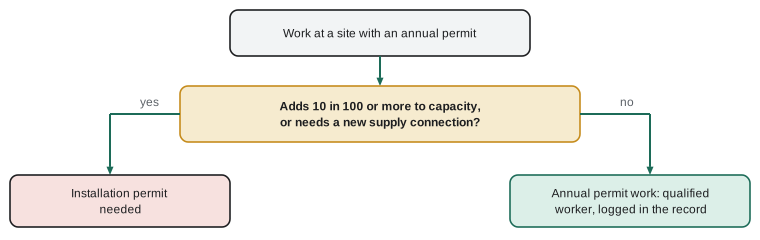
- The limits. Work under an annual permit may not increase the capacity of the electrical system by 10 in every 100 or more, and may not need a new connection from the supply authority. Bigger changes need an ordinary installation permit.
- The record. The holder must keep a record of the work done under the permit, available to an inspector, so the inspector can see what changed during the year.
The annual permit does not remove the need for qualified people. The work must still be done by qualified electrical workers and must still conform to the Code. What the annual permit removes is the paperwork of a separate permit and fee for every small job.
The fish plant answer
Tanya's answer to the fish plant manager is yes, with conditions. Slave River Electric can do the routine work under the plant's annual permit, but the plant remains the permit holder and must keep the record. Tanya sets up a simple log that her crew fills in after every visit, and the plant manager signs it monthly. She also writes into the service agreement that any job adding significant load, such as the new blast freezer the plant has been talking about, will be quoted and permitted separately, because it is likely to cross the capacity limit or need work by the utility.
| Feature | Annual permit | Installation permit |
|---|---|---|
| Who holds it | Owner or operator of the property | Registered qualified electrical worker |
| Typical use | Routine maintenance and minor alterations at one site | New installations, additions and alterations generally |
| Term | 12 months | One year, or 90 days for temporary service |
| Fee basis | Installed capacity in kVA | Total project cost |
| Main limit | No capacity increase of 10 in 100 or more; no new supply connection | Scope of the work described |
| Record | Work record kept for the inspector | Inspection reports on the permit |
The residential property owner's permit
Section 13 of the Act lets an inspector issue a permit to the owner of a residential property to do electrical work on it personally. The regulations, in sections 20 to 24, and the territory's FAQ set the conditions:
- Where to apply. Homeowner permits are issued in person by a Regional Inspector. The inspector can talk through the work, judge whether the owner understands what is involved, and refuse or cancel the permit.
- Whose home. The permit is for the owner's own residence, for work the owner does personally. It is not a way for a friend or an unregistered tradesperson to do work for pay.
- The fee. The fee is calculated on twice the cost of the electrical equipment, under section 20(2), which reflects the extra inspection a homeowner job usually needs.
- The limits. Section 24 says a homeowner permit is not issued for a service larger than 125 A or for a service that is not single phase.
- Inspection. The work must be inspected like any other permitted work: available before concealment, and not energized until an inspector allows it.
The territory's FAQ adds that the inspector may cancel a homeowner permit, for example if the work shows the owner is not able to do it safely. In that case the owner must hire a registered worker to finish.
The garage answer
Tanya's answer to the Old Town homeowner is careful. He can apply in person for a homeowner permit to wire his own garage, provided his service stays within the 125 A single-phase limit, and he must do the work himself. Tanya will not sign anything that looks like she is taking responsibility for work under his permit, because she would be accepting liability for work she did not do and does not control. She offers instead to quote the job under her own installation permit, or to give him a paid consultation on his plan before he starts. He decides to do it himself, passes his rough-in inspection on the second try and calls her six months later to install a car charger, which he decides is beyond him.
Plans and specifications
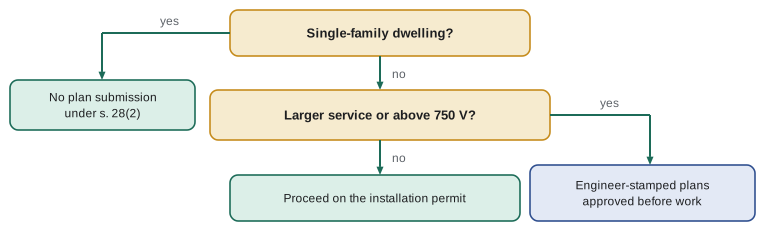
Section 9 of the Act lets the Chief Inspector require plans and specifications for electrical work, and sections 28 and 29 of the regulations say when. In outline, plans must be submitted for approval before work starts on larger services and on installations above 750 V, and plans for those installations must be stamped by a professional engineer registered to practise in the territory. Section 28(2) exempts single-family dwellings. The section's permit pages list the forms and the information plans should show; the exact thresholds and drawing requirements are in the current regulations and should be checked before quoting any job that might need them.
Plan approval adds time. On a commercial project the electrical engineer of record prepares the drawings, the drawings are reviewed, and comments may need to be answered before approval. The contractor's job is to know whether plans are required, make sure the approval is in hand before work starts, and build to the approved drawings. Changes during construction should go back through the engineer, because a field change that departs from approved plans can stall an inspection.
The warehouse answer
Tanya's answer to the developer is that plan approval is very likely. A 600 A service at 347/600 V for a commercial building is the kind of installation the plan rules are aimed at, and it is not a single-family dwelling, so the exemption does not apply. She tells the developer to have the building's electrical engineer prepare and stamp the drawings, to submit them early, and to allow review time in the schedule. Her quote assumes approved drawings and excludes design.
Pricing annual permit work
Annual permit work is steady but small, and it is easy to lose money on it. Joe prices it as a monthly retainer for a set number of hours, with extra hours billed at the agreed rate, and he keeps track of how much of the plant's capacity has been added during the year so that nobody accidentally crosses the 10 in 100 limit.
# Track additions under an annual permit against the 10-in-100 capacity limit.
# The limit is from the regulations; the plant capacity and additions are invented.
installed_kva = 750
limit_share = 0.10
additions_kva = {"Jan: shop heater": 9, "Mar: packaging line motor": 22,
                 "May: lighting retrofit (reduces load)": -6, "Jul: freezer fans": 18}
total = 0
for job, kva in additions_kva.items():
    total += kva
    share = total / installed_kva
    status = "needs an installation permit" if share >= limit_share else "within annual permit"
    print(f"{job:40s} running total {total:4d} kVA  ({share*100:4.1f} in 100)  {status}")
print("limit reached at", installed_kva * limit_share, "kVA")Jan: shop heater running total 9 kVA ( 1.2 in 100) within annual permit Mar: packaging line motor running total 31 kVA ( 4.1 in 100) within annual permit May: lighting retrofit (reduces load) running total 25 kVA ( 3.3 in 100) within annual permit Jul: freezer fans running total 43 kVA ( 5.7 in 100) within annual permit limit reached at 75.0 kVA
A worked example: which permit?
Worked problem
Matching four jobs to the right permit
Slave River Electric is asked to (a) replace a failed motor starter at the fish plant, (b) add a 40 kVA blast freezer at the same plant, whose installed capacity is 300 kVA, (c) help a homeowner who wants to upgrade his own house to a 200 A service, and (d) wire a new 347/600 V office building. Which permit or approval applies to each?
Show solution
- (a) Like-for-like repair: within the plant's annual permit, done by a qualified worker and logged.
- (b) 40 kVA on 300 kVA is about 13 in 100, over the 10 in 100 limit: an installation permit is needed.
- (c) A 200 A service is above the 125 A homeowner limit: the owner cannot do it under a homeowner permit; a registered worker needs an installation permit.
- (d) A 347/600 V commercial building: plans are likely required, stamped by a professional engineer, before an installation permit job begins.
Answer: Annual permit for (a); installation permits for (b) and (c); plan approval and an installation permit for (d).
Annual permits and outside contractors
An annual permit is held by the owner, but the work is often done by outside contractors. That creates a coordination question: who decides whether a job fits under the annual permit, who keeps the record, and who answers the inspector's questions? Tanya's service agreements answer those questions in writing. The owner's maintenance manager approves each job as annual permit work; Slave River Electric's crew records it in the log; and anything that might cross the capacity limit or need the utility is flagged for a separate permit before work starts.
Common mistakes
MistakeTreating an annual permit as cover for any work at the site.
InsteadIt covers routine work only; capacity increases of 10 in 100 or more and new supply connections need an installation permit.
MistakeSigning off on a homeowner's own work.
InsteadThe homeowner is responsible under their permit; offer a consultation or your own permit instead.
MistakeAssuming a homeowner can do any residential service.
InsteadHomeowner permits are not issued for services over 125 A or that are not single phase.
MistakeStarting a large commercial job before the plans are approved.
InsteadWhere sections 28 and 29 apply, approval comes first, and the drawings need an engineer's stamp.
Summary and key terms
- Annual permits under section 12 let an industrial or commercial owner have routine work done for 12 months, with a fee based on installed kVA and a work record.
- Work under an annual permit may not add 10 in 100 or more to capacity or need a new supply connection.
- Homeowner permits under section 13 are issued in person by a Regional Inspector for work the owner does personally on their own home.
- Homeowner permit fees are based on twice the equipment cost, and the permits are not issued for services over 125 A or that are not single phase.
- Plans stamped by a professional engineer must be approved before work on larger services and installations above 750 V; single-family dwellings are exempt.
- Annual permit
- A 12-month permit held by a property owner or operator for routine electrical work at one site.
- Installed capacity
- The size of the electrical system in kVA, used to set the annual permit fee.
- Work record
- The log of work done under an annual permit, kept for the inspector.
- Residential property owner's permit
- A permit for a homeowner to do electrical work personally on their own home.
- Regional Inspector
- An inspector based in a region, who issues homeowner permits in person.
- Plan approval
- Review and approval of stamped plans before work starts on larger or higher-voltage installations.
Practice problems
Work each problem on paper first, then reveal the answer to check.
What is the largest service a homeowner permit can be issued for?
Show answer
125 A, and only single phase.
A plant with 500 kVA installed wants to add 45 kVA. Can it go under the annual permit?
Show answer
Yes on capacity, since 45 is 9 in 100 of 500, unless it needs a new supply connection.
What fee basis is used for a homeowner permit?
Show answer
Twice the cost of the electrical equipment.
Which buildings are exempt from the plan submission rules in section 28?
Show answer
Single-family dwellings.
Lesson quiz · 5 questions
Score 60% or more to complete this lesson.
Create a free account to save your progress, take quizzes and earn a certificate.