
MELC-212 · Lesson 12 of 12 · 28 min
Readiness review: a practice test for new contractors
▶ Video coming soon A video version of this lesson is on the way.
Unlike many provinces, the Northwest Territories does not set a contractor licensing exam. Nobody will sit you down in a test centre before you open an electrical contracting business. The test comes later, and it comes in pieces: an inspector's question on a rough-in, an owner's question about holdback, a WSCC form with a three-business-day deadline, a renewal date that slips by. This final lesson is a readiness review. It pulls the course together into a set of checks, a practice test with worked answers, and a final run through the numbers and dates you should know without looking them up. The course exam that follows uses the same kinds of questions.
Tanya's first year in review
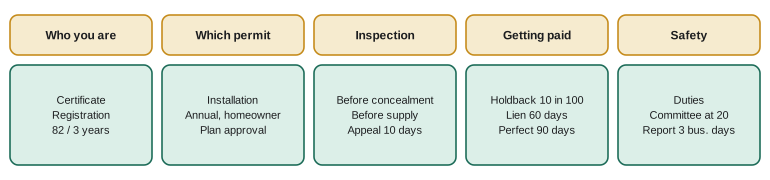
On the first anniversary of Slave River Electric, Tanya, Joe and Ed sit down with a coffee and the job folders. In twelve months the company has taken out 41 permits, passed 37 rough-in inspections the first time, settled two serious disagreements with inspectors by conversation rather than appeal, registered two new workers, hired an apprentice, filed one incident report, registered one lien and been paid before it had to be perfected. Ed asks Tanya what she would tell a new contractor. Her answer is the outline of this lesson: know who you are under the Act, know which permit you need, know when the inspector must see the work, know how you get paid, and know how you keep your people safe.
Part 1: who you are under the Act
Start with your own status. Under section 1 of the Act, a qualified electrical worker holds an electrician's certificate from the territory, a province or another territory, or is approved by the Chief Inspector under section 4. Under section 2 of the regulations, a qualified electrical worker must be registered before doing electrical work, and section 2(2) says an unregistered worker cannot be issued an installation permit. Registration costs 82 dollars and lasts three years. The territory does not license contracting businesses, so the business can only take out permits through its registered workers.
- Check: every person who will do electrical work holds a certificate or approval and is registered, with expiry dates on the calendar.
- Check: at least two people in the business can take out permits, or there is a plan if the only one leaves.
- Check: apprentices are registered in the territory's apprenticeship system and supervised, and their training blocks at Aurora College are planned.
Part 2: which permit you need
Next, the permit. An installation permit, held by a registered worker, is the default, with a fee based on the total project cost including travel and living, a minimum of 45 dollars up to 500 dollars, and a term of one year or 90 days for temporary service. An annual permit, held by an industrial or commercial owner, covers routine work for 12 months with a kVA-based fee, as long as no change adds 10 in 100 or more to capacity or needs a new supply connection. A homeowner permit, issued in person by a Regional Inspector, lets an owner do work personally on their own home, but not for a service over 125 A or one that is not single phase. Plans stamped by an engineer must be approved first for larger services and installations above 750 V, but not for single-family dwellings.
Part 3: the inspection gates
Then, the gates on every job. Work must be available for inspection before it is concealed under section 14. Power must not be supplied until an inspector confirms it may be, under sections 16 and 17. Re-inspections cost a fee per half hour plus travel. An inspector may permit a safe deviation from the Code under section 7(2), and a person affected by a decision can appeal to the Chief Inspector by registered mail within 10 days.
- Check: the Code edition in force is the one being designed to; the 2024 edition has been enforced since 1 October 2024.
- Check: the work is not in a mine or under the Oil and Gas Operations Act, which the Act excludes; if it might be, settle jurisdiction first.
- Check: the serving utility's requirements for the community are known before the service is designed.
Part 4: getting paid
The Builders' Lien Act came into force on 1 September 2025. Owners and payers keep a holdback of 10 in every 100. A lien must be registered within 60 days after substantial completion, or completion, termination or abandonment, and perfected within 90 days by a court action and a certificate of pending litigation. There is no prompt payment or adjudication law in the territory, so the contract matters more. Public owners may be treated differently, so take advice.
Part 5: keeping people safe
Finally, safety. The WSCC administers the Safety Act and the OHS Regulations. Employers have a general duty to protect workers. A joint health and safety committee is needed at 20 or more regularly employed workers, and a representative below that. Workers may refuse unusually dangerous work. Employers file the Employer's Report of Incident within three business days, and call the 24-hour line first for serious injuries, dangerous occurrences and fatalities.
| Number | What it is |
|---|---|
| 82 dollars / 3 years | Qualified electrical worker registration fee and term |
| 45 dollars / 500 dollars | Minimum installation permit fee and the project value it covers |
| 1 year / 90 days | Standard and temporary construction service permit terms |
| 10 in 100 | Annual permit capacity limit; also the Builders' Lien Act holdback |
| 125 A single phase | Largest service for a homeowner permit |
| 750 V | Voltage above which plan approval rules apply |
| 10 days | Appeal to the Chief Inspector |
| 60 / 90 days | Register a lien / perfect it |
| 20 workers | Joint health and safety committee threshold |
| 3 business days | Employer's Report of Incident to the WSCC |
| 2,000 / 500 dollars | Maximum fines under section 21(1) and 21(2) |
A practice test
Try each question before reading the answer. They mix the topics on purpose, because real problems do.
Worked problem
Question 1: the new hire from Nova Scotia
Danielle Martin holds a Nova Scotia certificate of qualification and starts work on Monday. Can she start wiring that day?
Show solution
- She is a qualified electrical worker because she holds a provincial certificate.
- But section 2 of the regulations requires registration before electrical work. Until she is registered, she should not do electrical work under the Act.
- She can do layout, material handling and non-electrical tasks while the 82 dollar application is processed.
Answer: Not until she is registered.
Worked problem
Question 2: the remote clinic fee
A clinic job in a fly-in community has 9,500 dollars of labour, 6,200 of material and 7,300 of flights, accommodation and meals. What project value goes on the permit application?
Show solution
- The FAQ says the total project cost includes materials, labour and reasonable travel and living expenses.
- 9,500 + 6,200 + 7,300 = 23,000 dollars.
Answer: 23,000 dollars.
Worked problem
Question 3: the plant upgrade
A plant with 400 kVA installed holds an annual permit and wants to add a 35 kVA compressor. Can it go under the annual permit?
Show solution
- 35 divided by 400 is 0.0875, or about 8.8 in 100, below the 10 in 100 limit.
- If no new supply connection is needed, it can go under the annual permit, done by a qualified worker and logged.
Answer: Yes, if no new supply connection is needed.
Worked problem
Question 4: the order you disagree with
An inspector's order is given on 3 August. By when must an appeal be sent?
Show solution
- Section 19 allows 10 days after the decision, by registered mail, unless the Chief Inspector extends the time.
- 3 August plus 10 days is 13 August.
Answer: By 13 August.
Worked problem
Question 5: the unpaid subcontract
Your work was substantially complete on 15 April. You have not been paid. When does the lien registration window close?
Show solution
- The window is 60 days after substantial completion.
- 15 April plus 60 days is 14 June.
Answer: 14 June.
Worked problem
Question 6: the Friday injury
A worker cuts a hand on a Friday and the employer learns of it that day. It is not serious. When is the Employer's Report of Incident due?
Show solution
- Three business days after the employer learns of it, skipping the weekend.
- Monday, Tuesday and Wednesday are the three business days, so the report is due by Wednesday, unless there is a holiday.
Answer: By the following Wednesday.
# Check the practice test dates and numbers.
from datetime import date, timedelta
print("Q2 project value:", 9_500 + 6_200 + 7_300)
print("Q3 share of capacity:", round(35 / 400 * 100, 1), "in 100")
print("Q4 appeal by:", date(2026, 8, 3) + timedelta(days=10))
print("Q5 lien window closes:", date(2026, 4, 15) + timedelta(days=60))
d, n = date(2026, 11, 6), 0          # a Friday
while n < 3:
    d += timedelta(days=1)
    n += d.weekday() < 5
print("Q6 report due:", d, ["Mon","Tue","Wed","Thu","Fri","Sat","Sun"][d.weekday()])Q2 project value: 23000 Q3 share of capacity: 8.8 in 100 Q4 appeal by: 2026-08-13 Q5 lien window closes: 2026-06-14 Q6 report due: 2026-11-11 Wed
How to use the course exam
The course exam that follows has 20 questions drawn from every lesson. Some are multiple choice; others ask for a number, true or false, several correct answers, an order or a match. Work through it with the Act, the regulations and the section's pages open, the way you would on the job, then go back to the lesson for any question you missed. The goal is not a score. It is to make the rules automatic, so that on a busy day the right step happens without thinking.
Staying current
The rules in this course will change. The Code is revised regularly, the territory may adopt prompt payment legislation, fees change, and forms are updated. Bookmark the Electrical/Mechanical Safety Section's pages, the WSCC's employer pages and the territorial legislation site, and check them every quarter. When something changes, update the compliance calendar and tell the crew.
A self-check before you start contracting
Answer each of these without looking anything up. If you cannot, go back to the lesson listed.
- Who counts as a qualified electrical worker, and what must they do before doing electrical work? (Lessons 2 and 3)
- Which permit does each kind of job need, and what are the limits of the annual and homeowner permits? (Lessons 6 and 7)
- What must happen before work is concealed and before it is energized? (Lesson 8)
- What are the holdback, lien registration and perfection periods? (Lesson 9)
- When must you file an incident report, and what must you do first for a serious injury? (Lesson 10)
- What are the maximum fines, and what is the limitation period? (Lesson 11)
If every answer comes quickly, you are ready for the course exam and, more importantly, ready to run jobs the right way.
Keep this list, and the course map, somewhere you will see them. Re-read them before your first permit, before your first commercial job, before your first lien deadline and before your first hire, because those are the moments when the rules in this course stop being theory and start to cost or save real money.
Common mistakes
MistakeTreating the absence of a contractor exam as the absence of rules.
InsteadThe rules are in the Act, the regulations, the Builders' Lien Act and the Safety Act; the tests come on the job.
MistakeMemorizing numbers without the situations they belong to.
InsteadLearn each number with its rule: 60 days for a lien, 10 days for an appeal, three business days for an incident report.
MistakeStudying once and never checking again.
InsteadFees, forms and laws change; review the official pages every quarter.
MistakeWorking from memory on a real deadline.
InsteadCount dates with a calendar and confirm with the source.
Summary and key terms
- The Northwest Territories has no contractor licensing exam; it registers individual qualified electrical workers.
- Know which permit applies: installation, annual, homeowner, and when plans must be approved.
- Respect the inspection gates: before concealment, before supply, and appeals within 10 days.
- Protect payment with contracts, the holdback and the Builders' Lien Act's 60 and 90 day periods.
- Meet the Safety Act duties, the committee and representative rules and the WSCC reporting deadlines.
- Readiness review
- A structured check that a contractor knows and follows the rules that apply.
- Course map
- A one-page summary of the course's main rules.
- Practice test
- A set of questions with worked answers, used for review.
- Compliance calendar
- The schedule of recurring checks that keeps the business compliant.
- Official sources
- The Act, the regulations and the territory's and WSCC's own pages.
- Quarterly review
- A check of official pages for changes every three months.
Practice problems
Work each problem on paper first, then reveal the answer to check.
Does the Northwest Territories require an electrical contractor licensing exam?
Show answer
No. It registers qualified electrical workers and requires permits and inspections.
What two numbers matter for a lien, and from when are they counted?
Show answer
60 days to register after substantial completion, and 90 days to perfect.
What is the largest service a homeowner may install under a homeowner permit?
Show answer
125 A, single phase.
How often should a contractor check the official pages for changes?
Show answer
At least every quarter.
Lesson quiz · 5 questions
Score 60% or more to complete this lesson.
Create a free account to save your progress, take quizzes and earn a certificate.