
MELC-212 · Lesson 4 of 12 · 19 min
Setting up an electrical contracting business in the Northwest Territories
▶ Video coming soon A video version of this lesson is on the way.
Because the Northwest Territories does not license electrical contractors, the Electrical Protection Act says almost nothing about the business side of contracting. That does not mean there are no rules. A contracting business still needs a legal form, registrations with the right governments, workers compensation coverage, insurance, sound contracts and good records. This lesson walks through those pieces in the order a new contractor usually meets them. Many of the details come from laws outside electrical safety and change often, so treat this lesson as a checklist of questions to confirm, not as the final word on any one of them.
Joe opens a folder
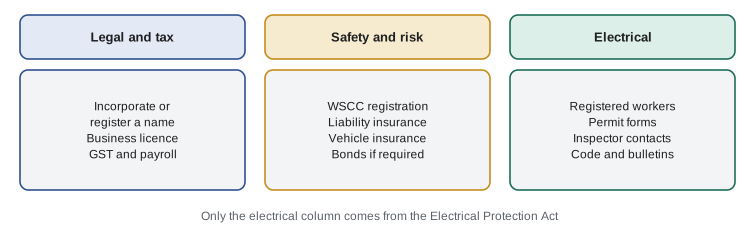
Joe Lafferty already runs a small trucking business in Hay River, so he knows the paperwork that comes with being an employer. He opens a folder labelled Slave River Electric and lists what has to be done before the first invoice goes out: choose the legal form, register the company and its name, get a business licence from the town, register for the federal goods and services tax, register with the Workers' Safety and Compensation Commission, buy insurance, open a separate bank account, set up payroll, and prepare a standard contract and estimate form. Tanya adds one more line at the top: confirm that she and Ravi are registered qualified electrical workers, because without that the company cannot take out a single permit.
Choosing a legal form
Most small contractors choose between a sole proprietorship and a corporation. A sole proprietor is the business: profits and debts are personal, and the owner is personally liable for the business's obligations. A corporation is a separate legal person, which can limit the owners' personal exposure for ordinary business debts, but costs more to set up and maintain. Partnerships are a third choice, less common for a single tradesperson.
Tanya and Joe decide to incorporate, mainly because the company will sign contracts for school and health centre work with large values and payment risks. Corporations in the territory are formed and registered through the territorial corporate registry, which also registers business names. An accountant or lawyer is worth paying for at this stage, because the choice affects tax, liability and how the business can later be sold.
Whatever the legal form, remember the point from Lesson 3: in the Northwest Territories the permit rests on an individual's registration, not the company's. Incorporating Slave River Electric Ltd. does not create a new permit holder. Tanya, as a registered qualified electrical worker, still takes out the permits, and she remains responsible for the work under each permit.
| Legal form | Main advantage | Main drawback |
|---|---|---|
| Sole proprietorship | Simple and cheap to start | Owner is personally liable for business debts |
| Partnership | Shares work and capital between partners | Each partner can bind the others; personal liability |
| Corporation | Separate legal person; can limit personal exposure | More cost and paperwork; directors still have duties |
Registrations and licences
- Corporate and business name registration. Incorporate, or register a business name, with the territorial corporate registry before trading under that name.
- Municipal business licence. Most communities, including Hay River and Yellowknife, require a business licence to operate within their boundaries. A contractor working in several communities should ask each one, because rules for non-resident businesses vary.
- Goods and services tax. A business must register for GST once its taxable sales pass the federal small-supplier threshold, and many contractors register voluntarily from the start so they can recover the tax they pay on materials and vehicles. Confirm the current threshold and rules with the Canada Revenue Agency.
- Payroll accounts. An employer withholds income tax, Canada Pension Plan contributions and Employment Insurance premiums, and remits them to the Canada Revenue Agency. The territory also has a payroll tax on employment income; ask an accountant how it applies to the business and its workers.
- WSCC registration. An employer of workers in the territory must register with the Workers' Safety and Compensation Commission and pay assessments based on its payroll and industry rate. Lesson 10 covers the safety side of the WSCC's role.
Insurance and bonds
The Electrical Protection Act and Regulations do not require a contractor to carry a particular amount of insurance or to post a bond, and the territory's electrical pages do not mention either. In practice, though, almost every owner, general contractor and public body will ask for proof of insurance before work starts, and larger public jobs often require bonds.
- Commercial general liability insurance covers claims by third parties for property damage or bodily injury arising from the work. Owners commonly ask for a certificate naming them as additional insured.
- Commercial vehicle insurance covers the trucks, which in the north spend long hours on highways and winter roads.
- Tools and equipment coverage protects the inventory and tools that are expensive and slow to replace in a remote community.
- Bonds are three-party guarantees. A bid bond backs the promise to sign the contract if the bid wins; a performance bond backs completion of the work; a labour and material payment bond backs payment to subcontractors and suppliers. A new contractor usually needs a relationship with a surety and clean financial statements before a surety will issue them.
The amounts and wording come from each contract, not from electrical law, so read the insurance and bonding clauses before bidding and price the cost of meeting them into the bid.
Pricing for the north
Work in the territory has costs that a southern contractor may not expect: charter flights or long drives to communities, accommodation and meals, freight on material that must arrive by barge or winter road, and short building seasons. Those costs matter for electrical permits too. Lesson 6 explains that permit fees are based on the total project cost, including reasonable travel and living expenses for work away from home, so a remote job carries a larger permit fee as well as larger direct costs.
Tanya also learns early that markup and margin are not the same thing. A markup is added to cost; a margin is the share of the selling price that is profit and overhead. A 25 markup on 100 dollars of cost gives a price of 125, but the margin on that price is only 25 out of 125, which is 20 in every 100. Confusing the two is one of the most common reasons small contractors underprice their work.
# Price a remote job: direct costs, northern travel, and markup vs margin.
# All amounts are illustrative.
labour = 18_400
material = 11_250
freight = 2_100          # barge or winter-road freight
travel_and_living = 6_800  # flights, accommodation, meals
cost = labour + material + freight + travel_and_living
markup = 0.25
price = cost * (1 + markup)
margin = (price - cost) / price
print(f"total cost        {cost:9,.0f}")
print(f"price at 25 markup {price:9,.0f}")
print(f"margin on price {margin:9.3f} (that is {margin*100:.0f} in every 100 of price)")total cost 38,550 price at 25 markup 48,188 margin on price 0.200 (that is 20 in every 100 of price)
Contracts, estimates and records
A written contract protects both sides. Tanya's standard contract names the parties, describes the work and the drawings it relies on, sets the price or the rates, says who takes out the electrical permit, sets out how changes are priced and approved, sets the payment schedule and the holdback, and describes the warranty. Lesson 9 covers the holdback and lien rules under the territory's new Builders' Lien Act, which apply to most construction contracts whether or not the contract mentions them.
Good records are the other half. Keep every permit, inspection report, change order, invoice and payment record for each job together. They answer an inspector's questions, support a lien claim if a customer does not pay, and make year-end accounting simple.
A worked example: Joe's checklist
Worked problem
Which set-up tasks come from which law
Joe's list has eight items. Sort them into the law or body each one comes from.
Show solution
- Registered qualified electrical workers: Electrical Protection Regulations, section 3.
- Incorporation and business name: territorial corporate law and the corporate registry.
- Business licence: the municipality, such as the Town of Hay River.
- GST and payroll accounts: federal tax law, through the Canada Revenue Agency.
- WSCC registration and assessments: territorial workers compensation law.
- Liability and vehicle insurance, and bonds: the contracts the company signs, not electrical law.
- Holdback and lien terms in contracts: the Builders' Lien Act.
- Permit forms and inspector contacts: the Electrical/Mechanical Safety Section.
Answer: Only the first and last items come from electrical safety law; the rest come from corporate, municipal, tax, compensation, contract and lien law.
Hiring and payroll basics
The first hire changes a contractor's obligations. Before Ravi's first payday, Joe sets up payroll so that each pay cheque shows gross pay, deductions for income tax, Canada Pension Plan contributions and Employment Insurance premiums, any territorial deductions an accountant advises, and net pay. He registers the new worker with the WSCC account so that the payroll on which assessments are calculated is accurate. He also prepares a written job offer that sets out the wage, hours, overtime arrangements, travel and living allowances for remote work, and the probation period.
Employment standards law in the territory sets minimum rules on wages, hours, overtime, vacation pay, holidays and termination. A contractor who pays travel time, camp allowances or per diems for remote work should make the rules for those payments clear in writing, because disputes over them are common in the north. When in doubt, check the territory's employment standards pages or ask an advisor.
Banking, credit and suppliers
A separate business bank account keeps the company's money apart from personal money, which makes bookkeeping and tax filing simpler and protects the owners if the company is incorporated. Suppliers in the south will often want a credit application and references before they open an account for a new contractor, and freight to the north can add weeks to delivery. Tanya opens accounts with two suppliers, so that a shortage at one does not stop a job, and she orders long-lead items such as switchgear and transformers as soon as a contract is signed.
Working with local and Indigenous communities
Much of the work in the territory is in small communities, many of them Indigenous communities with their own governments, land claim agreements and business policies. Some public contracts give weight to northern or local businesses and to local hiring. A contractor who wants to work in a community should learn how its government handles contracts, whether local business registration or permission is needed, and how to hire and train local workers. These policies change from time to time, so check them for each project rather than relying on a past bid.
A last practical point: keep the set-up folder Joe started. Every registration number, account number, policy number and renewal date in one place makes the first year-end, the first insurance renewal and the first public tender far easier, and it means someone other than the owners can find what is needed if they are away.
Common mistakes
MistakeAssuming incorporation creates a permit holder.
InsteadPermits rest on an individual's registration as a qualified electrical worker, whatever the company's legal form.
MistakeLooking for an insurance or bond requirement in the Electrical Protection Act.
InsteadThere is none there; insurance and bonds are required by contracts and owners, and should be priced into bids.
MistakeConfusing markup with margin.
InsteadA 25 markup on cost is a margin of 20 in every 100 of price.
MistakeForgetting northern travel and freight in the price and the permit fee.
InsteadPrice travel, living and freight into the job; permit fees are based on total project cost including travel and living.
Summary and key terms
- The Electrical Protection Act does not license contracting businesses; business set-up is governed by corporate, municipal, tax, compensation, contract and lien law.
- Choose a legal form with professional advice; incorporation does not change who holds permits.
- Register the business and its name, obtain municipal business licences, and set up GST, payroll and WSCC accounts.
- Insurance and bonds are required by owners and contracts rather than by electrical law.
- Price northern travel, freight and living costs into each job, and keep complete job records.
- Sole proprietorship
- A business owned and run by one person who is personally liable for its debts.
- Corporation
- A separate legal person formed under corporate law.
- Commercial general liability insurance
- Insurance covering third-party property damage and injury claims arising from the work.
- Performance bond
- A surety's guarantee that the contractor will complete the work.
- Labour and material payment bond
- A surety's guarantee that subcontractors and suppliers will be paid.
- Margin
- Profit and overhead as a share of the selling price.
Practice problems
Work each problem on paper first, then reveal the answer to check.
Does incorporating Slave River Electric Ltd. let the company take out permits without a registered worker?
Show answer
No. Permits are issued to registered qualified electrical workers.
Where would a contractor look for the required amount of liability insurance on a school job?
Show answer
In the contract and the owner's tender documents; the Electrical Protection Act does not set one.
What margin results from a 25 markup on cost?
Show answer
20 in every 100 of the selling price.
Name two set-up registrations that come from federal law.
Show answer
GST registration and payroll accounts with the Canada Revenue Agency.
Lesson quiz · 5 questions
Score 60% or more to complete this lesson.
Create a free account to save your progress, take quizzes and earn a certificate.