
MELC-212 · Lesson 2 of 12 · 19 min
Qualified electrical workers and the electrician's certificate
▶ Video coming soon A video version of this lesson is on the way.
Lesson 1 showed that the Northwest Territories builds its electrical safety system around the individual worker rather than the contracting business. This lesson looks closely at that individual. Who counts as a qualified electrical worker? How does a person earn the electrician's certificate the definition relies on? What about apprentices, workers who trained in another province, and people who do specialized electrical work? By the end of the lesson you should be able to look at any person on a crew and say whether they may do electrical work, whether they must register, and whether they may take out a permit.
The starting point is the definition in section 1 of the Electrical Protection Act. A qualified electrical worker is a person who holds an electrician's certificate issued in the Northwest Territories or by another territory or a province, or a person who has been approved by the Chief Inspector under section 4 of the Act. Everything else in this lesson follows from those two routes: the certificate route, which almost every contractor uses, and the approval route, which is narrower and at the Chief Inspector's discretion.
Kyle asks what he is allowed to do
On the first day at Slave River Electric, Kyle Antoine asks Tanya a direct question. He is in the second year of his apprenticeship, he has done a lot of rough-in work in Yellowknife, and he wants to know whether he can take the small service calls in Hay River on his own while Tanya and Ravi are out at a school job in Fort Resolution. A homeowner wants a dryer circuit, a café wants two more receptacles behind the counter, and a neighbour of Joe's wants a block heater outlet on a garage.
Tanya's answer is no, and the reasons are worth working through, because they are exactly the questions an inspector would ask. Kyle is not a qualified electrical worker. He does not hold an electrician's certificate, and he has not been approved by the Chief Inspector. He cannot be registered as a qualified electrical worker, so he cannot be issued a permit. He may do electrical work only as an apprentice, under the supervision his training requires, on jobs where the permit is held by a registered qualified worker who takes responsibility for the work. Sending him alone to three customers would leave three jobs without proper supervision and, if no permits were taken out, three jobs done without permits, which section 21 of the Act makes an offence.
The certificate route
For a construction electrician the usual route to the electrician's certificate is apprenticeship. Education, Culture and Employment administers apprenticeship in the territory through its Apprenticeship, Trade and Occupation Certification program, under the Apprenticeship, Trade and Occupation Certification Act and its regulations. Electrician is a designated trade, which means it has a formal apprenticeship program, technical training, level exams and a certificate of qualification at the end.
Aurora College delivers the technical training in the territory. Its electrician program page describes four levels of technical training, of which the college provides the first three. Each of those levels is 240 hours, or eight weeks, and must be taken in its entirety. Absence of more than a small fraction of the total time can lead to removal and repeating the whole course. To pass a level, an apprentice needs a school mark and a shop mark of at least 65, must complete all the school work, and must score 70 on the territorial level exam to move to the next level. Each level leads to a certificate of status for the next level, and at the end of the apprenticeship the apprentice receives a certificate of qualification from the Government of the Northwest Territories.
Construction electrician is also a Red Seal trade. The Red Seal endorsement, earned by passing the interprovincial exam, appears on the certificate of qualification and is recognized across Canada. For a contractor, the Red Seal matters mainly because it makes a worker's qualification easy to recognize elsewhere, and because many employers and owners outside the territory ask for it.
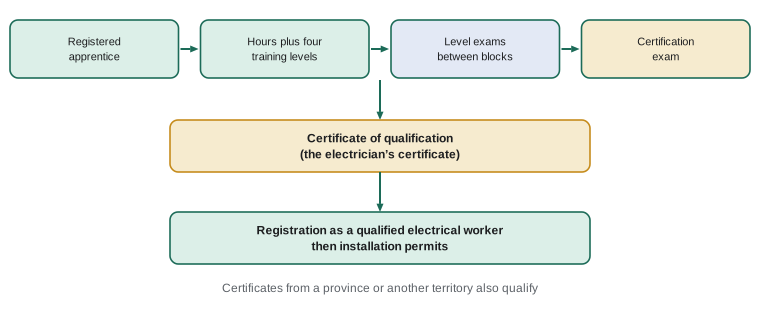
| Stage | What happens | Who runs it |
|---|---|---|
| Registration as an apprentice | Employer and apprentice sign up; hours start counting | Apprenticeship, Trade and Occupation Certification |
| Technical training levels | Levels of 240 hours each; school and shop marks of 65 or more | Aurora College (levels 1 to 3) |
| Level exams | A mark of 70 on the territorial level exam to move up | Government of the Northwest Territories |
| Certification exam and certificate | Certificate of qualification, with Red Seal endorsement where earned | Government of the Northwest Territories |
| Registration as a qualified electrical worker | Copy of certificate, 82 dollar fee, three-year term | Electrical/Mechanical Safety Section |
Certificates from other provinces and territories
Ravi Sandhu trained in Alberta and holds an Alberta journeyperson certificate. Under the Act's definition, an electrician's certificate issued by a province counts in the same way as a territorial one, so Ravi is already a qualified electrical worker. That does not mean he can start work immediately. Section 2(1) of the regulations requires every qualified electrical worker doing electrical work under the Act to be registered, so Ravi must apply on the territory's registration form, attach a photocopy of his Alberta certificate and pay the fee before he works on Slave River Electric's jobs or applies for any permit.
Workers arriving from outside Canada are a different matter. A foreign trade credential is not a certificate issued by a province or territory, so it does not satisfy the first branch of the definition. Such a worker would normally go through the territory's trade qualification process to earn a certificate of qualification, or could ask the Chief Inspector for approval under section 4 of the Act. Approval is discretionary, and the Act does not set out a public list of criteria, so anyone relying on it should ask the Electrical/Mechanical Safety Section exactly what it needs.
The approval route under section 4
The second branch of the definition lets the Chief Inspector approve a person as a qualified electrical worker. The Act gives the Chief Inspector that power without spelling out in detail when it is used, and the territory's public pages focus on the certificate route. In practice the approval route matters for specialized work and unusual situations, not for an ordinary contractor setting up shop. Tanya does not need it: she holds a certificate. A new contractor should treat approval as a question to raise with the Chief Electrical Inspector in writing, not something to assume.
The Electrical/Mechanical Safety Section also publishes separate registration forms for other kinds of qualified worker, including an electronic technician registration and elevator mechanic registrations. Each form asks for the credential that fits that kind of work. A contractor who employs specialists should make sure each specialist is registered in the category that matches the work they do.
Apprentices on the crew
An apprentice is a worker in training, not a qualified electrical worker. The apprentice may do electrical work as part of the apprenticeship, but the permit is always held by a registered qualified worker, and that worker answers for the work. The apprenticeship program sets supervision expectations and ratios through its regulations and training plans, and the details can change, so a contractor should confirm the current rules with Education, Culture and Employment before deciding how many apprentices each journeyperson can carry.
Good practice is easy to describe and easy to neglect. Record the apprentice's hours promptly and honestly, because those records are what the certification program relies on. Rotate the apprentice through the tasks they still need instead of leaving them on one kind of work for a year. Release them for their technical training levels, which run for eight weeks at a time. And never send an apprentice alone to a job, however small, that the training plan says must be supervised.
A worked example: sorting the crew
Worked problem
Who may work, who must register and who may take out permits
Slave River Electric's crew for a September job list includes Tanya (territorial certificate, registered), Ravi (Alberta certificate, registration application in the mail), Kyle (second-year apprentice) and Marie Beaulieu, a summer student with no electrical training who helps carry material. Sort them.
Show solution
- Tanya: qualified electrical worker by certificate, registered. She may do electrical work and take out permits.
- Ravi: qualified electrical worker by certificate, but not yet registered. Until his registration is confirmed he should not do electrical work under the Act or apply for permits.
- Kyle: apprentice. He may do electrical work under supervision as part of his apprenticeship, on a job with a permit held by Tanya. He may not take out permits or work alone.
- Marie: neither qualified nor an apprentice. She may carry material and clean up, but she should not do electrical work.
Answer: Only Tanya may take out permits today. Ravi joins her once his registration arrives. Kyle works under supervision; Marie does labour only.
Tracking qualifications
Joe sets up a simple table to keep track of every worker's status. The calculator below checks a crew list against the rules in this lesson and flags anyone who should not be on the electrical work. The dates are invented; the three-year registration term comes from section 3(3) of the regulations.
# Check a crew list against the basic Northwest Territories rules.
# Registration lasts three years (Electrical Protection Regulations s. 3(3)). Dates are invented.
from datetime import date
today = date(2026, 9, 14)
crew = [
    ("Tanya", "certificate", date(2025, 3, 2)),
    ("Ravi", "certificate", None),           # application not yet confirmed
    ("Kyle", "apprentice", None),
    ("Marie", "none", None),
]
for name, status, registered_on in crew:
    if status == "certificate" and registered_on:
        expires = registered_on.replace(year=registered_on.year + 3)
        note = "registered until " + expires.isoformat() + "; may take out permits"
    elif status == "certificate":
        note = "qualified but not registered; no electrical work or permits yet"
    elif status == "apprentice":
        note = "supervised electrical work only; no permits"
    else:
        note = "labour only"
print(f"{name:6s} {note}")Tanya registered until 2028-03-02; may take out permits Ravi qualified but not registered; no electrical work or permits yet Kyle supervised electrical work only; no permits Marie labour only
The check is crude, but it catches the most common problem: a qualified worker who arrives from another province and starts work before the registration is in place.
A note for apprentices joining a contractor
For an apprentice like Kyle, the path to a certificate runs through the employer as much as the college. The employer provides the on-the-job hours and the supervision; the apprenticeship office records the hours and the levels; and the territory's level exams test progress between technical training blocks. A contractor who takes on an apprentice should keep the hours records accurate and current, release the apprentice for each training block, and assign work that covers the tasks the trade requires rather than the same task for a whole year. That investment comes back when the apprentice becomes a certified journeyperson who can register and take out permits for the company.
Contractors who hire from outside the territory should also remember that certificates of qualification from other provinces and territories, and the Red Seal endorsement, are what make a worker a qualified electrical worker under the Act. Ask to see the certificate on the first day and keep a copy.
Common mistakes
MistakeLetting a second-year apprentice take small service calls alone.
InsteadAn apprentice is not a qualified electrical worker and cannot hold a permit; supervised work only.
MistakeAssuming an out-of-province journeyperson can start work on arrival.
InsteadThe out-of-province certificate makes the worker qualified, but section 2(1) of the regulations still requires registration first.
MistakeTreating a foreign trade credential as an electrician's certificate.
InsteadOnly certificates issued by the territory, another territory or a province count; otherwise the worker needs a territorial certificate or the Chief Inspector's approval.
MistakeRegistering specialists under the wrong category.
InsteadThe section publishes separate forms, such as electronic technician registration; register each worker in the category that matches the work.
Summary and key terms
- A qualified electrical worker holds an electrician's certificate from the Northwest Territories, another territory or a province, or is approved by the Chief Inspector under section 4.
- Electrician is a designated trade; apprentices complete technical training levels of 240 hours each and level exams before receiving a certificate of qualification.
- Certificates from other provinces and territories count, but the worker must still register before doing electrical work in the territory.
- Apprentices are not qualified electrical workers; they work under supervision on jobs where a registered worker holds the permit.
- Specialized workers register under their own categories, such as electronic technicians.
- Electrician's certificate
- The certificate of qualification in the trade, issued by the territory or a province or territory.
- Certificate of qualification
- The trade certificate issued at the end of an apprenticeship or trade qualification.
- Red Seal
- The interprovincial endorsement on a certificate of qualification, recognized across Canada.
- Designated trade
- A trade with a formal territorial apprenticeship and certification program.
- Level exam
- The territorial exam at the end of each technical training level; 70 is needed to progress.
- Approval under section 4
- The Chief Inspector's discretionary approval of a person as a qualified electrical worker.
Practice problems
Work each problem on paper first, then reveal the answer to check.
What are the two ways a person can become a qualified electrical worker under the Act?
Show answer
Holding an electrician's certificate issued by the territory, another territory or a province, or being approved by the Chief Inspector under section 4.
How long is each of the first three levels of electrician technical training at Aurora College?
Show answer
240 hours, or eight weeks.
Ravi holds an Alberta certificate. What must he do before working on a Hay River job?
Show answer
Register as a qualified electrical worker with the Electrical/Mechanical Safety Section, with a copy of his certificate and the fee.
May Kyle hold the permit for a dryer circuit if Tanya checks the work afterwards?
Show answer
No. Only a registered qualified electrical worker may be issued a permit; Kyle works under supervision on Tanya's permit.
Lesson quiz · 5 questions
Score 60% or more to complete this lesson.
Create a free account to save your progress, take quizzes and earn a certificate.