
MELC-212 · Lesson 5 of 12 · 18 min
The Canadian Electrical Code as adopted in the Northwest Territories
▶ Video coming soon A video version of this lesson is on the way.
The Canadian Electrical Code, Part I, is the technical heart of every electrical installation in Canada, but it has no legal force on its own. It becomes law in each province and territory through that jurisdiction's own legislation, sometimes with local changes. This lesson explains how the Code becomes law in the Northwest Territories, which edition is in force, how inspectors can permit deviations, what other standards the regulations adopt, and how the exclusions for mines and oil and gas work change which rules apply. It also covers the territory's electrical bulletins, which are where local interpretations appear.
As everywhere in this series, the course does not reproduce the Code's text or tables. When it refers to a rule, it gives the rule number and explains the idea in its own words. Have your own copy of the current edition at hand.
Ravi's question about the edition
Ravi Sandhu learned his trade under Alberta's adoption of the Code, and on his first permit in Hay River he asks Tanya which edition applies here and whether the territory has its own changes, the way some provinces do. Tanya pulls up the Electrical/Mechanical Safety Section's notice on the adoption of the Canadian Electrical Code. It says the territory adopted the 2024 edition in March 2024, when it was released, and that the inspection department would start enforcing the 2024 Code on 1 October 2024. Contractors with concerns about the change were asked to contact the inspection department with details.
That answers the edition question for now. The second question, about local changes, needs a look at the Act and the regulations.
How the Code becomes law
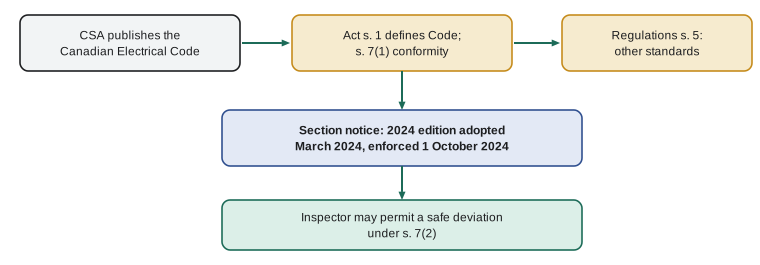
- The definition of Code. Section 1 of the Electrical Protection Act defines the Code as the Canadian Electrical Code published by the Canadian Standards Association, as amended. That is the document the rest of the Act points to.
- Conformity. Section 7(1) of the Act requires electrical work and equipment to conform to the Code, as altered by the regulations.
- Alterations. Section 4 of the Electrical Protection Regulations lists code alterations in Schedule B. In the published consolidation, both items in Schedule B have been repealed, which means there are currently no territorial amendments to the Code text in the regulations.
- Other adopted standards. Section 5 of the regulations adopts other standards: the elevator and escalator safety code, ASME A17.1/CSA B44-2019, with variations in Schedule C, and specified CSA standards, including those for overhead and underground systems and for elevator electrical equipment, as amended from time to time. Section 5.1 says no person shall perform electrical work except in accordance with the codes and standards adopted under section 5.
- The power to make more. Section 22 of the Act lets the Commissioner, on the Minister's recommendation, make regulations adopting or amending the Code and adopting other codes in whole or in part, with variations.
What enforcement date means
The territory's notice separates two dates: the date the 2024 edition was adopted, when it was released in March 2024, and the date the inspection department began enforcing it, 1 October 2024. The gap gave designers and contractors time to finish work planned under the previous edition and to learn the changes. For a contractor, the practical rule is simple: for permits and work after the enforcement date, design and install to the edition the inspectors are enforcing, and if a project straddles a change, ask the inspection department in writing which edition applies before you start.
Because the Act's definition refers to the Code as amended, future editions will be handled the same way: watch for the section's notice, which will say when a new edition applies. The Code is usually revised on a three-year cycle, so a contractor should expect the next change to arrive in the same way.
Deviations permitted by an inspector
Section 7(2) of the Act lets an inspector permit an installation that does not comply with the Code if it poses no hazard to life or property. This is a safety valve for unusual northern situations, older buildings and special equipment. It is not a way to skip requirements a contractor finds inconvenient. Ed's advice is to ask before installing, explain the situation in writing, describe why the alternative is safe, and keep the inspector's written answer in the job file. A deviation obtained verbally on site is hard to prove a year later.
| Source | What it does |
|---|---|
| Electrical Protection Act, s. 1 | Defines the Code as the CSA Canadian Electrical Code, as amended |
| Act, s. 7(1) | Electrical work and equipment must conform to the Code, as altered by regulation |
| Act, s. 7(2) | An inspector may permit a non-conforming installation that poses no hazard |
| Regulations, s. 4 and Schedule B | Code alterations; both Schedule B items are currently repealed |
| Regulations, s. 5 and 5.1 | Adopt elevator and other CSA standards; work must follow them |
| Section notice | 2024 edition adopted March 2024; enforced from 1 October 2024 |
Bulletins
The Electrical/Mechanical Safety Section publishes bulletins on its website. They explain how the section applies the Act and the Code to particular situations, and they include topics such as permit expiry dates, the wiring of communications circuits and photovoltaic installations. Bulletins do not change the law, but they tell you how the inspectors will read it. A contractor should check the current list before starting any job type that is new to the business, and again whenever a new Code edition is announced.
Where the Act does not apply
Lesson 1 noted two exclusions. Section 2 of the Act says the Act does not apply to electrical equipment in aircraft or marine vessels, or in a mine within the meaning of the Mine Health and Safety Act. Section 2.1 says it does not apply to work or activities governed by the Oil and Gas Operations Act. Those industries have their own safety regimes and inspectors.
For a contractor this changes which rules and which inspector apply. Electrical work inside a mine is regulated under the mine health and safety regime, not by the Electrical/Mechanical Safety Section, and the section publishes a bulletin on mine jurisdiction. Work at a mining company's town office or staff housing, outside the mine itself, may well fall under the Electrical Protection Act. Where the line falls on a particular site is a question to settle in writing before the job starts.
Cold-climate practice
The Code applies across Canada, but northern conditions put pressure on some of its requirements more than others: equipment rated for very low temperatures, cable and raceway that stay flexible in the cold, protection of underground and overhead conductors against frost heave and ice loading, heat tracing and block heater circuits, and services that must work through long outages and generator use. None of this changes the rules; it changes how often a designer reaches for them. Check equipment temperature ratings and installation instructions carefully, and ask the inspector early about anything unusual.
A worked example: which rules apply?
Worked problem
Sorting four jobs by rule set
Slave River Electric is asked to quote four jobs in the same month: a house addition in Hay River, a warehouse lighting retrofit, a control panel inside an underground mine, and staff housing at a remote lodge. Which rules apply to each?
Show solution
- House addition: Electrical Protection Act and Regulations, the 2024 Code as enforced since 1 October 2024, and an installation permit.
- Warehouse retrofit: the same Act, regulations and Code; it may also be done under the owner's annual permit if the conditions in Lesson 7 are met.
- Control panel in the mine: excluded from the Act by section 2; the mine health and safety regime and its inspectors apply. Settle jurisdiction before quoting.
- Remote lodge housing: the Act, regulations and Code apply. Travel and living costs will be part of the permit fee calculation.
Answer: Three of the four jobs follow the Electrical Protection Act and the 2024 Code; the mine job falls under the mine regime.
Tracking the edition by permit date
Joe adds a simple check to the job tracker so that nobody quotes to the wrong edition. The cut-over date below is the 1 October 2024 enforcement date from the section's notice; the permit dates are invented.
# Which Code edition were inspectors enforcing on a given permit date?
# Cut-over: the 2024 edition enforced from 1 October 2024 (territorial notice). Permit dates invented.
from datetime import date
cutover = date(2024, 10, 1)
permits = {"Garage, Fort Smith": date(2024, 8, 19),
           "House addition, Hay River": date(2026, 9, 2),
           "Clinic upgrade, Fort Resolution": date(2024, 10, 1)}
for job, issued in permits.items():
    edition = "2024 edition" if issued >= cutover else "previous edition (confirm with the inspector)"
print(f"{job:34s} {issued} {edition}")Garage, Fort Smith 2024-08-19 previous edition (confirm with the inspector) House addition, Hay River 2026-09-02 2024 edition Clinic upgrade, Fort Resolution 2024-10-01 2024 edition
Reading a new edition
When a new edition of the Code is announced, the work of learning it falls on the contractor. Tanya's routine is simple. She reads the summary of changes published with the new edition, notes the rules that affect the work Slave River Electric does most often, such as dwelling unit receptacles, ground fault and arc fault protection, service sizing and photovoltaic systems, and runs a short session with the crew before the enforcement date. She also checks whether the section has issued any bulletins that interpret the new rules. The goal is that nobody on the crew is surprised by a deficiency based on a changed rule.
Estimating changes too. A rule change that adds protection devices or changes wiring methods can change the cost of a typical house or shop. Joe updates the company's standard estimates for any change that affects material or labour, so that quotes given after the enforcement date reflect the edition that will be inspected.
The Code and other codes
The Electrical Protection Act is not the only law that applies to a building. Building, fire and energy codes, administered under other legislation and sometimes by municipalities, cover matters such as fire separations, smoke alarms and energy efficiency that can affect electrical work. Where a building permit is also required, the electrical permit does not replace it. A contractor should ask early which other codes and permits apply to a project, especially on public buildings, where the owner may have its own design standards that go beyond the Code.
Equipment approval is another link. The Code requires electrical equipment to be approved, which in practice means certified or evaluated by an accredited body and marked accordingly. Equipment bought online or shipped from outside Canada may lack an acceptable mark. Check before installing, because an inspector can refuse unapproved equipment, and replacing it in a remote community can take weeks.
Common mistakes
MistakeAssuming the territory has its own amended version of the Code text.
InsteadSchedule B's code alterations are currently repealed; the Code applies as published, plus the other standards in section 5.
MistakeRelying on a verbal deviation given on site.
InsteadAsk for deviations under section 7(2) in writing before installing, and keep the answer.
MistakeQuoting a mine job as if the Electrical Protection Act applied.
InsteadSection 2 excludes mines under the Mine Health and Safety Act; settle jurisdiction first.
MistakeIgnoring the section's bulletins.
InsteadBulletins show how inspectors apply the Code; check them for any unfamiliar job type.
Summary and key terms
- Section 1 of the Act defines the Code as the CSA Canadian Electrical Code, as amended, and section 7(1) requires work to conform to it.
- The territory adopted the 2024 edition in March 2024 and began enforcing it on 1 October 2024.
- The regulations' Schedule B code alterations are currently repealed; section 5 adopts elevator and other CSA standards.
- Section 7(2) lets an inspector permit a deviation that poses no hazard to life or property.
- The Act does not apply to aircraft, marine vessels, mines under the Mine Health and Safety Act or work under the Oil and Gas Operations Act.
- Canadian Electrical Code, Part I
- The CSA safety standard for electrical installations, given legal force by territorial law.
- Enforcement date
- The date from which inspectors enforce a new Code edition, 1 October 2024 for the 2024 edition.
- Deviation
- An inspector's permission under section 7(2) for a non-conforming but safe installation.
- Schedule B
- The regulations' list of Code alterations; its items are currently repealed.
- Bulletin
- A notice from the Electrical/Mechanical Safety Section explaining how it applies the rules.
- Mine jurisdiction
- The exclusion of electrical equipment in mines from the Act, under section 2.
Practice problems
Work each problem on paper first, then reveal the answer to check.
Which Code edition did territorial inspectors begin enforcing on 1 October 2024?
Show answer
The 2024 edition of the Canadian Electrical Code.
Which section of the Act lets an inspector permit a non-conforming installation?
Show answer
Section 7(2), where the installation poses no hazard to life or property.
Does the Electrical Protection Act apply to wiring inside an underground mine?
Show answer
No. Section 2 excludes mines within the meaning of the Mine Health and Safety Act.
Name one standard other than the Code adopted by section 5 of the regulations.
Show answer
The elevator and escalator safety code, ASME A17.1/CSA B44-2019, or the CSA standards for overhead or underground systems.
Lesson quiz · 5 questions
Score 60% or more to complete this lesson.
Create a free account to save your progress, take quizzes and earn a certificate.