
MELC-212 · Lesson 8 of 12 · 18 min
Inspections, concealment, connection and appeals
▶ Video coming soon A video version of this lesson is on the way.
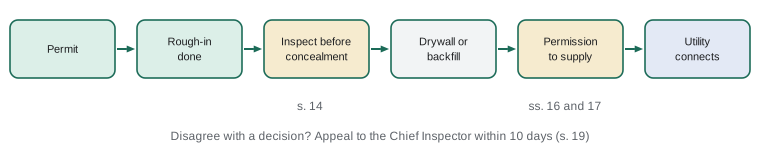
A permit is a promise to the territory that the work will be done to the Code and shown to an inspector at the right moments. This lesson covers those moments. Section 14 of the Electrical Protection Act requires work to be available for inspection before it is concealed. Sections 16 and 17 deal with connection: electric energy may only be supplied to an installation after an inspector has confirmed it is safe. Sections 5 and 6 give inspectors their powers, section 26.1 of the regulations lets them inspect any electrical work, and section 27 sets a re-inspection fee. Section 19 of the Act gives a person affected by an inspector's decision a route of appeal to the Chief Inspector. Between them these sections set the rhythm of every permitted job.
Rough-in at Paradise Gardens
The Paradise Gardens house is ready for drywall on a Thursday in June. Ravi has finished the rough-in, the boxes are all in, the cables are stapled and the panel is set but not connected. Tanya submits the Electric Energy/Conceal Rough Wiring form to the section and asks for an inspection before the drywall crew arrives on Monday. The Hay River inspector comes on Friday afternoon, finds two missing cable straps near a box and a kitchen counter circuit that does not match the plan, and gives permission to conceal on condition that both are fixed before the board goes up. Ravi fixes them that evening and photographs the corrections for the job file. On Monday the drywall goes up on schedule.
It is an ordinary story, but every step in it is a legal requirement, and skipping any of them would have cost the company more time than it saved.
Inspection before concealment
Section 14 of the Act says, in substance, that a person doing electrical work must make it available for inspection before it is concealed, and must not conceal it until an inspector has inspected it or allowed concealment. Concealment means anything that makes the work inaccessible: drywall, ceiling board, insulation over buried cable, backfill over an underground run, or concrete over embedded conduit.
The territory's Electric Energy/Conceal Rough Wiring Permit Application to Supply form is the practical tool. The permit holder uses it to tell the section that roughed-in work is ready and to ask for permission to conceal, and later to ask for permission to supply power. The form certifies that the work follows the permit and the Code. Fill it in accurately: it is a statement on which the inspector relies.
- Plan inspections into the schedule, and tell the general contractor and other trades when the electrical rough-in will be ready.
- For underground work, have the trench open, the cable or conduit in place and the depth visible.
- For remote jobs, ask the section early how inspections will be arranged, because an inspector may have to travel or combine trips.
- Never let other trades cover your work before permission to conceal. If they do, tell the inspector at once.
What an inspector can do
Sections 5 and 6 of the Act give inspectors broad powers to carry out inspections. In summary, an inspector may enter premises at reasonable times to inspect electrical work and equipment, require tests, require information and documents, and order that defective or dangerous work be corrected, disconnected or not used. Section 26.1 of the regulations confirms that an inspector may inspect any electrical work. Inspectors may also be municipal inspectors appointed under section 3(2), and section 3(4) allows an agreement with the WSCC for safety officers to act in some matters.
A contractor's practical duties follow: give inspectors access, answer their questions honestly, supply documents when asked, and carry out correction orders by the date given. Contravening the Act, which can include ignoring an order, may lead to a charge, and Lesson 11 covers the penalties.
Deficiencies and re-inspection
When an inspector finds a deficiency, the report or notice says what must be fixed and usually whether a re-inspection is needed. Minor items, like Ravi's straps, may be fixed and photographed. Larger items will need the inspector to come back. Section 27 of the regulations sets a re-inspection fee charged for each half hour or part, plus the inspector's travel expenses, where an inspection has to be repeated because the work was not ready or not corrected.
In a territory where an inspector may fly to a community, a failed inspection can cost much more than the fee: the crew waits, other trades wait, and the next inspection may be days away. The cheapest inspection is the one you pass the first time. Tanya's crews walk through every job with a checklist the day before an inspection.
| Stage | Who acts | Legal basis |
|---|---|---|
| Permit before work | Registered worker applies; section issues | Act s. 8 and 11 |
| Inspection before concealment | Permit holder requests; inspector inspects or allows | Act s. 14 |
| Correction of deficiencies | Permit holder fixes; inspector may re-inspect | Act s. 5 and 6; regulations s. 27 |
| Permission to supply | Inspector confirms; supply authority connects | Act s. 16 and 17 |
| Appeal of a decision | Affected person writes to the Chief Inspector | Act s. 19 |
Connection: the inspector, the utility and the permit
Sections 16 and 17 of the Act deal with the supply of electric energy. In outline, a supply authority must not connect or supply energy to an installation until an inspector has confirmed that it may be supplied, and no person may connect an installation to a supply without that permission. A breach of section 17(1) is one of the offences for which the Act sets its highest fine, as Lesson 11 explains.
In the Northwest Territories, power is supplied by the Northwest Territories Power Corporation and, in some communities, by Northland Utilities. Each has its own rules for new services, metering and service entrance equipment, and each will want to see the inspector's permission before connecting. Check the serving utility's current requirements for each community before designing a service, because meter locations, service heights and the paperwork they need can differ.
On remote jobs, a temporary generator sometimes stands in for the utility. A generator does not change the rule: an installation must still be inspected, and the electrical work connecting the generator is itself electrical work under the permit.
Appeals
Section 19 of the Act gives a person who is affected by an inspector's decision or order a way to challenge it. In outline, the person may appeal to the Chief Inspector by registered mail within 10 days after the decision, and the Chief Inspector may extend that time. The Chief Inspector considers the appeal and may confirm, change or reverse the decision.
Appeals should be rare. Most disagreements with an inspector are about interpretation and are resolved by a conversation, a reference to the Code rule involved, and if necessary a written request for a deviation under section 7(2). But if a contractor believes an order is wrong and the cost of complying is significant, the 10-day clock starts with the decision. Write down the date the decision was given, keep a copy of the order, and send the appeal in time.
Ed's rule for appeals is to stick to facts and rules: what the order says, what the installation is, which Code rule or section of the Act applies, and why the contractor reads it differently. An appeal that argues about the inspector's manner rather than the rule rarely succeeds.
Tracking inspections and appeal dates
Joe keeps a short script that lists open inspections and the last day for an appeal on any order the company disagrees with. The 10-day period is from section 19; the dates are invented.
# Last day to appeal an inspector's order: 10 days after the decision (Act s. 19).
# Dates are invented; the Chief Inspector may extend the time on request.
from datetime import date, timedelta
orders = {"Warehouse grounding order": date(2026, 6, 11),
          "Lodge kitchen GFCI order": date(2026, 7, 2)}
for name, decided in orders.items():
    last_day = decided + timedelta(days=10)
print(f"{name:28s} decided {decided} appeal by registered mail by {last_day}")Warehouse grounding order decided 2026-06-11 appeal by registered mail by 2026-06-21 Lodge kitchen GFCI order decided 2026-07-02 appeal by registered mail by 2026-07-12
A worked example: a disputed order
Worked problem
Deciding whether to appeal
On 11 June 2026 an inspector orders Slave River Electric to add a supplementary grounding electrode at the warehouse job. Tanya believes the existing electrode arrangement meets the Code and that the order will cost about 3,000 dollars. What should she do, and by when?
Show solution
- Talk to the inspector first and ask which Code rule the order is based on.
- If that does not resolve it, consider whether the issue is really a deviation that could be permitted under section 7(2).
- If she still disagrees, appeal to the Chief Inspector by registered mail within 10 days, that is by 21 June 2026, or ask for an extension in time.
- Set out the facts, the rule and her reading of it; attach photographs and the order. Do not energize the work in breach of the order while the appeal is pending.
Answer: Discuss, then if needed appeal in writing to the Chief Inspector by 21 June 2026.
Preparing for an inspection
A good inspection starts the day before. Tanya's checklist for a rough-in inspection covers the basics that inspectors most often find: boxes secured and at the right heights, cables supported and protected, bonding in place, the panel labelled to match the plan, required protection devices identified, and penetrations through fire separations ready to be sealed. For a final inspection, she adds device covers in place, circuit directory complete, tests done and recorded, and any outstanding deficiencies from earlier inspections corrected and photographed.
She also makes sure the inspector can reach everything. A locked electrical room, a crawlspace without a light or a ceiling with no access hatch can turn a twenty-minute inspection into a second visit and a re-inspection fee.
Remote inspections
In small communities the inspector may not be able to visit at every stage. Ask the section early how it will handle the job: whether inspections can be combined, whether photographs or video will be accepted for some stages, and how much notice it needs. Whatever is agreed, write it down and keep it in the job folder. Do not assume that an arrangement on one job will apply to the next.
Photographs taken before concealment are valuable even when they are not required. Take them systematically, room by room, with something in the frame to show where the picture was taken. They help answer questions later and make future renovation easier for the owner.
Working with the utility
The utility's connection process runs in parallel with the inspection process. Apply for a new service or service change early, give the utility the information it needs about the load and the service equipment, and coordinate the connection date with the inspector's permission. In a community where the utility's crew visits on a schedule, a missed connection can cost weeks.
Common mistakes
MistakeLetting the drywall crew close a wall before permission to conceal.
InsteadSection 14 requires inspection or permission before concealment; tell the inspector if it happens.
MistakeAsking the utility to connect before the inspector confirms.
InsteadSections 16 and 17 require the inspector's confirmation before supply.
MistakeMissing the appeal deadline while arguing on site.
InsteadThe appeal must be made by registered mail within 10 days after the decision, unless extended.
MistakeTreating a generator-fed remote job as outside the inspection rules.
InsteadThe installation and the generator connection are still electrical work under the permit.
Summary and key terms
- Section 14 requires work to be available for inspection before it is concealed.
- Inspectors have broad powers under sections 5 and 6, and may inspect any electrical work under section 26.1 of the regulations.
- Re-inspection is charged per half hour plus travel under section 27, so passing first time saves money.
- Under sections 16 and 17, no installation may be supplied with energy until an inspector confirms it may be.
- Section 19 allows an appeal to the Chief Inspector by registered mail within 10 days after a decision, extendable by the Chief Inspector.
- Concealment
- Making electrical work inaccessible, for example behind drywall or under backfill.
- Permission to conceal
- An inspector's permission to cover roughed-in work.
- Permission to supply
- An inspector's confirmation that an installation may be connected to electric energy.
- Supply authority
- The utility that supplies power, such as the Northwest Territories Power Corporation or Northland Utilities.
- Re-inspection fee
- The fee charged per half hour plus travel when an inspection must be repeated.
- Appeal
- A written challenge to an inspector's decision, made to the Chief Inspector under section 19.
Practice problems
Work each problem on paper first, then reveal the answer to check.
Which section of the Act requires inspection before concealment?
Show answer
Section 14.
Within how many days must an appeal to the Chief Inspector be made?
Show answer
10 days after the decision, by registered mail, unless the time is extended.
Can the utility connect a new service before the inspector confirms it?
Show answer
No. Sections 16 and 17 require the inspector's confirmation first.
How is the re-inspection fee charged?
Show answer
Per half hour or part, plus the inspector's travel expenses.
Lesson quiz · 5 questions
Score 60% or more to complete this lesson.
Create a free account to save your progress, take quizzes and earn a certificate.