
MELC-212 · Lesson 3 of 12 · 18 min
Registering and renewing as a qualified electrical worker
▶ Video coming soon A video version of this lesson is on the way.
Registration is the one piece of paperwork every electrician in the Northwest Territories needs before doing electrical work under the Electrical Protection Act. It is not hard, but it is easy to let it lapse, and a lapsed registration has an immediate consequence: section 2(2) of the regulations says a worker who is not registered cannot be issued an installation permit, and the territory's registration form adds that a worker cannot get permits unless the registration is in good standing. This lesson covers the application, the fee, the three-year term, renewal, keeping records, and what to do when something changes.
Ravi's application
Ravi Sandhu's first week at Slave River Electric is spent on wiring a new house in Hay River's Paradise Gardens area under Tanya's permit, while his registration application is processed. Tanya does not let him work under the Act until the registration is confirmed, so for those first days he lays out the job, pulls material lists, and helps Kyle with a temporary service pole. It is a slower start than he wanted, but Ed tells him it is the right one: if an inspector finds an unregistered worker doing the electrical work on a permitted job, the permit holder has a problem, and so does the worker.
What the regulations require
Section 3 of the Electrical Protection Regulations sets out the process in three short subsections.
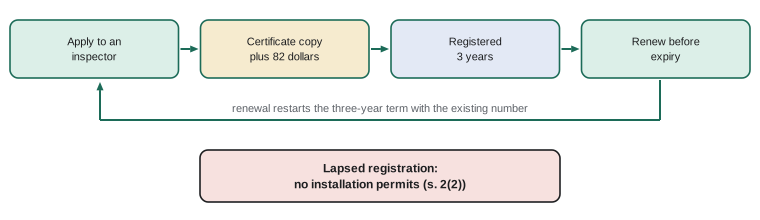
- Section 3(1): a qualified electrical worker who wants to be registered applies to an inspector on a form approved by the Chief Inspector.
- Section 3(2): the application must be accompanied by the fee set out in item 1 of Schedule A, which is currently 82 dollars.
- Section 3(3): the registration is valid for three years.
The territory's Qualified Electrical Worker Registration form puts that into practice. For a new registration, the applicant states that they hold a valid licence or certificate from a province or territory, gives its number and attaches a photocopy for the file. For a renewal, the applicant gives their existing territorial registration number. The form asks for the fee of 82 dollars, payable to the Government of the Northwest Territories, and states plainly that the fee covers three years of registration or renewal and that permits will not be issued unless the registration is in good standing.
Permit applications go to the Electrical/Mechanical Safety Section by email, and the section's permits page directs applicants to download the correct form, complete it and email it with the fee. Check the current page for how registration forms and payment should be submitted, because the forms page and the payment options are the parts of the process most likely to change.
What registration is and is not
Registration is a record that a qualified electrical worker is known to the territory and may work and take out permits. It is not a new test of competence. The competence test was the certification exam behind the electrician's certificate. Nor is registration a business licence. It belongs to the individual worker, not to the company, which is one of the most important practical differences between the Northwest Territories and the provinces that license contracting businesses.
That has consequences for a business. If Tanya is the only registered worker at Slave River Electric and she leaves, sells the company or is off work for months, the company has no one who can take out permits until another registered worker joins. A contractor planning to grow should make sure more than one person on staff is registered, and should keep everyone's registration dates in one place.
| Question | Answer under the regulations |
|---|---|
| Who registers? | Each qualified electrical worker who will do electrical work under the Act |
| Who processes it? | An inspector, on a form approved by the Chief Inspector |
| What does it cost? | The Schedule A, item 1 fee, currently 82 dollars |
| How long does it last? | Three years (section 3(3)) |
| What if it lapses? | No installation permits can be issued to the worker |
| Is it a business licence? | No. It belongs to the individual worker |
Renewal
Renewal uses the same form, with the existing registration number in place of the out-of-territory certificate details, and the same fee. The regulations do not set out a grace period in the published text, so the safe assumption is that a registration that has passed its three-year date is not in good standing until it is renewed. Plan renewals a couple of months ahead, especially if you work in communities where mail and travel take time.
Tanya keeps a calendar reminder for every worker's renewal three months ahead of expiry. Ed's advice is blunter: renew early. The fee is the same, the term is the same, and the risk of a lapse is all on the contractor's side. A contractor who finds out in the middle of a job that the permit holder's registration has expired faces delays, possible charges and an awkward conversation with the owner.
Keeping the certificate behind the registration valid
Registration rests on a certificate. If the certificate itself depends on a home province's rules, keep it in good standing there too. Some provinces have stopped requiring certificate renewal, while others attach conditions. A worker like Ravi, whose qualification comes from Alberta, should keep a clear copy of the certificate on file and know whether his home province expects anything of him. If a certificate is ever suspended or cancelled, the worker should tell the Electrical/Mechanical Safety Section, because the registration depends on it.
Records a contractor should keep
The regulations do not prescribe a personnel file, but good records make every later step easier. For each worker, Joe keeps:
- A copy of the electrician's certificate, front and back, with any Red Seal endorsement.
- The territorial registration number and the date the current three-year term began.
- The date the renewal was mailed or emailed and the date it was confirmed.
- For apprentices: the apprenticeship registration, the training level and the dates of technical training blocks.
- For specialists: the registration category that matches their work.
A contractor who can produce these in a few minutes will rarely have trouble with an inspector's question about who did the work.
A worked example: a registration audit
Worked problem
Checking registrations before a busy season
In March 2027 Slave River Electric is bidding on a school renovation that will run from May to October. Tanya was registered on 2 March 2025, Ravi on 21 September 2026, and a new hire, Danielle Martin from Nova Scotia, has not yet applied. Will everyone be in good standing for the whole job?
Show solution
- Tanya's three-year term runs to 2 March 2028, which covers the whole job.
- Ravi's term runs to 21 September 2029, which also covers it.
- Danielle holds a Nova Scotia certificate, so she is a qualified electrical worker, but she is not yet registered. She must apply with a copy of her certificate and the fee before May.
- Tanya decides to have both Tanya and Ravi named as possible permit holders on the bid, so that the loss of either person does not stop the job.
Answer: Tanya and Ravi are covered for the job; Danielle must register before May.
A renewal calculator
The calculator below works out each worker's expiry date from the start of the current term and flags anyone whose registration expires within 90 days of a chosen date. The three-year term is from section 3(3); the dates are invented.
# Flag registrations that expire within 90 days of a check date.
# Term: three years (Electrical Protection Regulations s. 3(3)). Dates are invented.
from datetime import date, timedelta
check = date(2027, 12, 15)
workers = {"Tanya": date(2025, 3, 2), "Ravi": date(2026, 9, 21), "Danielle": date(2027, 4, 10)}
for name, start in workers.items():
    expires = start.replace(year=start.year + 3)
    days_left = (expires - check).days
    flag = "RENEW NOW" if days_left <= 90 else "ok"
    print(f"{name:9s} expires {expires}  ({days_left:5d} days)  {flag}")
print("fee per renewal: 82 (check the current Schedule A)")Tanya expires 2028-03-02 ( 78 days) RENEW NOW Ravi expires 2029-09-21 ( 646 days) ok Danielle expires 2030-04-10 ( 847 days) ok fee per renewal: 82 (check the current Schedule A)
Run something like this every quarter, and renew anyone inside the window. It takes a minute and removes one of the few ways a properly qualified contractor can be stopped from taking out permits.
Other registrations the section keeps
The Electrical/Mechanical Safety Section uses registration for more than general electricians. Its forms page includes a separate registration form for electronic technicians and another for elevator work, which reflect the specialised work covered by the regulations and the other standards adopted under section 5. A contractor who moves into those areas should check which registration category fits the work, and should not assume that a general registration covers every specialty. The section can confirm which category is needed for a particular job.
The approval route in section 4 of the Act is another special case. A person who does not hold an electrician's certificate may be approved by the Chief Inspector as a qualified electrical worker for certain work. The criteria and limits of an approval are set by the Chief Inspector, so a worker relying on one should keep the written approval with their registration and confirm with the section what it allows before doing any work under it.
What an inspector may ask on site
Inspectors routinely ask who did the work and whether that person is registered. A permit holder should be able to name each worker on the job and give their registration number. On a remote site where the inspector may only visit once, a short crew list in the job folder, with names, registration numbers and expiry dates, saves time and shows the inspector the company is organised. It also helps if a question comes up months later about who did a particular part of the installation.
Registration also matters for subcontracting. If Slave River Electric subcontracts part of a job to another electrical firm, that firm's workers must be registered too, and the permit arrangements for the subcontracted work should be agreed in writing. A permit holder who lets an unregistered subcontractor's crew do electrical work under their permit is taking a risk with their own permit and reputation.
Moving between jurisdictions
Workers in the north often move between the Northwest Territories, Nunavut, Yukon and the provinces as projects come and go. Each jurisdiction has its own rules for working there, so registration in the Northwest Territories does not by itself allow work elsewhere, and registration elsewhere does not allow work here. Before taking a job across a border, check that jurisdiction's requirements and allow time to meet them.
Finally, treat the registration card or confirmation like any other licence. Keep a photograph of it on your phone, a copy in the office file and the expiry date in the shared calendar, so that anyone in the business can answer an inspector, an owner or a general contractor who asks for proof of registration before a job starts.
Common mistakes
MistakeLetting a worker start electrical work while the registration application is in the mail.
InsteadWait until the registration is confirmed; until then the worker does layout, material and labour only.
MistakeTreating registration as the company's licence.
InsteadRegistration belongs to each worker. If the only registered worker leaves, the company cannot take out permits.
MistakeWaiting for a reminder from the territory before renewing.
InsteadTrack each three-year term yourself and renew well before expiry.
MistakeForgetting the certificate behind the registration.
InsteadKeep the electrician's certificate valid and on file; the registration depends on it.
Summary and key terms
- Section 3 of the regulations requires an application to an inspector on the approved form, with the Schedule A fee, currently 82 dollars.
- Registration is valid for three years and is renewed on the same form with the existing registration number.
- A worker whose registration is not in good standing cannot be issued installation permits.
- Registration belongs to the individual, so a business should have more than one registered worker and track every renewal date.
- Keep copies of certificates, registration numbers and renewal dates for every worker.
- Registration
- The territorial record that a qualified electrical worker may do electrical work and take out permits.
- Schedule A
- The fee schedule in the Electrical Protection Regulations; item 1 is the registration fee.
- Good standing
- A current, unexpired registration that allows permits to be issued.
- Renewal
- Re-registration for a further three years on the same form, with the existing number.
- Three-year term
- The period a registration is valid under section 3(3).
- Registration number
- The territorial number assigned to a registered worker and used on renewals and permits.
Practice problems
Work each problem on paper first, then reveal the answer to check.
How long is a qualified electrical worker registration valid?
Show answer
Three years, under section 3(3) of the regulations.
What does a new applicant attach to the registration form?
Show answer
A photocopy of the valid licence or certificate from the territory or a province or territory, with the fee.
Tanya's registration began on 2 March 2025. When does it expire?
Show answer
2 March 2028.
Why should a contracting business have more than one registered worker?
Show answer
Registration belongs to individuals; if the only registered worker leaves, nobody at the company can take out permits.
Lesson quiz · 5 questions
Score 60% or more to complete this lesson.
Create a free account to save your progress, take quizzes and earn a certificate.