
MELC-212 · Lesson 11 of 12 · 18 min
Offences, records and staying compliant
▶ Video coming soon A video version of this lesson is on the way.
The Electrical Protection Act is mostly about doing things in the right order: register, get a permit, build to the Code, show the work before covering it, and wait for permission before energizing it. Section 21 sets out what happens when people do not. The penalties look small next to those in some provinces, but a conviction is a public record, the costs of rework and delay are often far larger than the fine, and an inspector who loses trust in a contractor will look much harder at every job. This lesson covers the offences and penalties, the limitation period, the records a contractor should keep, and a practical compliance routine for a small business. It also looks at how the Act's few rules fit with the many other laws a contractor must follow.
The neighbour's hot tub
A Hay River resident calls Slave River Electric about a hot tub. A friend of the owner, an unregistered worker from out of territory who was visiting, wired it last summer for cash. There was no permit, and the breaker trips whenever it rains. Tanya will not touch it without a permit of her own, and when she opens the disconnect she finds undersized conductors and no proper bonding. She takes out a permit, fixes the work and explains to the owner that the friend's work could have led to charges, and that the owner's insurer would probably not have been pleased either. The story spreads, and within a month Slave River Electric has three more calls to correct work done without permits.
Offences and penalties
Section 21 of the Act sets out the offence and penalty provisions. In summary:
- Section 21(1): a person who contravenes section 8, by doing work without the required permit, or section 17(1), by connecting or supplying an installation without an inspector's permission, is guilty of an offence and liable on summary conviction to a fine of up to 2,000 dollars.
- Section 21(2): a person who contravenes any other provision of the Act or the regulations is liable to a fine of up to 500 dollars, and, if the fine is not paid, to imprisonment for up to one month.
- Section 21.1: a prosecution must begin within one year after the offence was committed.
Note the pattern. The two offences with the highest penalty are about the two moments the system depends on: getting a permit before work, and waiting for an inspector before power is supplied. The law treats those as the most important rules, and so should a contractor.
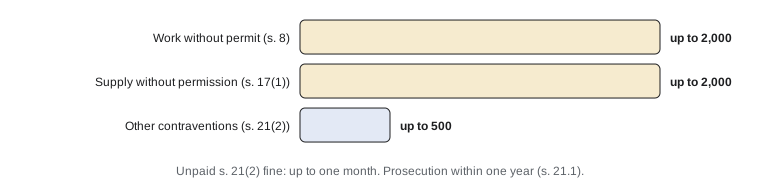
| Offence | Maximum penalty under the Act |
|---|---|
| Electrical work without a permit (s. 8) | Fine up to 2,000 dollars |
| Connecting or supplying without inspector permission (s. 17(1)) | Fine up to 2,000 dollars |
| Any other contravention of the Act or regulations | Fine up to 500 dollars; up to one month in default of payment |
| Time limit for prosecution | One year after the offence (s. 21.1) |
The real costs
Fines are only part of it. Work done without a permit may have to be opened up for inspection, which means cutting drywall or digging up trenches. The owner may refuse to pay for work that has to be redone. An insurer may deny a claim for damage caused by unpermitted work. A contractor who causes an injury or fire through unsafe work can face civil claims far larger than any fine, and possibly charges under other laws. And every inspector in a small territory knows every contractor. Reputation travels fast.
There is also an ethical point. The permit and inspection system exists because electrical faults injure and kill people and burn buildings, and the territory's small population and long distances mean fire and medical help may be far away. Following the rules is part of the job's responsibility to the people who will use the building long after the contractor has left.
Records worth keeping
The Act and regulations require few records of contractors directly: the annual permit work record in Lesson 7 is the clearest example. But good records are the best defence against almost every problem in this course. Joe's records policy for Slave River Electric covers:
- Registrations: a copy of each worker's certificate, registration number and renewal date (Lesson 3).
- Permits: every application, permit, extension and cancellation, and proof of fee payment (Lesson 6).
- Inspections: requests, reports, deficiency notices, photographs of corrections and permissions to conceal and supply (Lesson 8).
- Contracts and payments: signed contracts, change orders, invoices, payments, holdback releases and lien dates (Lesson 9).
- Safety: hazard assessments, training records, representative inspections and incident reports (Lesson 10).
- Tax and payroll: the records the Canada Revenue Agency, the territory and the WSCC require, kept for the periods they set.
Joe keeps a digital folder for each job, named by permit number, and backs it up off site. Ed's rule is that if you cannot find a document within five minutes, you might as well not have it.
A compliance routine
Tanya's routine is built around the calendar rather than memory:
- Daily: no work starts without a permit number on the job sheet; no wall is closed without permission to conceal; no service is connected without permission to supply.
- Weekly: open permits reviewed for inspection requests and deficiencies; incidents reported within three business days.
- Monthly: health and safety representative walk-through; annual permit logs signed by customers; lien windows checked on unpaid invoices.
- Quarterly: registration expiry dates checked; new bulletins and notices from the Electrical/Mechanical Safety Section read.
- Yearly: insurance renewed, WSCC payroll reported, municipal business licences renewed, and the records policy reviewed.
# A small compliance calendar: flag items due within 30 days of a check date.
# Item dates are invented; the intervals reflect rules discussed in this course.
from datetime import date, timedelta
check = date(2026, 11, 9)
items = {"Ravi registration renewal": date(2029, 9, 21),
         "Fish plant annual permit renewal": date(2026, 12, 1),
         "Lien window, unpaid lodge invoice": date(2026, 11, 28),
         "Business licence renewal": date(2027, 1, 1)}
for name, due in sorted(items.items(), key=lambda kv: kv[1]):
    days = (due - check).days
    flag = "DUE SOON" if days <= 30 else ""
print(f"{name:34s} {due} {days:5d} days {flag}")Lien window, unpaid lodge invoice 2026-11-28 19 days DUE SOON Fish plant annual permit renewal 2026-12-01 22 days DUE SOON Business licence renewal 2027-01-01 53 days Ravi registration renewal 2029-09-21 1047 days
When things change
Staying compliant also means telling people when something changes. If a registered worker leaves, check that every open permit still has a responsible holder, and talk to the section about any permit in that worker's name, since permits are not transferable. If the company changes its name or legal form, update the corporate registry, business licences, the WSCC and insurers. If a new kind of work comes along, such as solar, elevators or work near a mine, check which rules and which registrations apply before quoting it.
A worked example: an audit of open permits
Worked problem
Cleaning up before the winter
In October Tanya reviews Slave River Electric's open permits. One permit for a garage has had no work for four months because the owner ran out of money. Another, for a lodge, was completed in September but the final inspection was never requested. A third is in the name of a worker who left the company in August. What should she do?
Show solution
- Garage: no work for over 90 days means the inspector may cancel the permit. Ask for an extension now if the job will resume, or close it out.
- Lodge: request the final inspection and permission to supply, if not already given, and close the permit; an open permit can hide a problem.
- Former worker's permit: permits are not transferable. Contact the section to cancel it and take out a new permit in a current registered worker's name for any remaining work.
- Record what was done in each job folder.
Answer: Extend or close the garage permit, finish the lodge inspection, and replace the former worker's permit with a new one.
Dealing with an inspector's concerns
When an inspector raises a concern about a contractor's work generally, rather than a single deficiency, the best response is to listen, ask for specifics and fix the pattern. If several jobs show the same problem, it is a training issue, and the crew should be briefed. If an inspector finds work without a permit, admit it, take out the permit, open the work for inspection and fix what is wrong. Arguing over a clear breach rarely helps and often makes the next inspection harder.
Keep a record of every such conversation: the date, what was said and what was done. That record shows good faith if the matter goes further, and it helps the business learn from its mistakes.
When a customer complains
Customer complaints about electrical work sometimes end up with the inspector. A homeowner who believes work was done badly may call the section and ask for an inspection, and section 26.1 of the regulations lets an inspector inspect any electrical work. A contractor who answers complaints promptly, offers to inspect the work with the customer and fixes genuine problems will usually resolve them before that happens. A written warranty in the contract, saying what is covered and for how long, sets expectations on both sides.
Insurance claims and unpermitted work
Insurers often ask whether electrical work was permitted and inspected after a fire or other loss. Work done without a permit can complicate a claim. A contractor who always takes out permits and keeps inspection records gives the customer a clean answer to that question, and protects the contractor too if the insurer looks for someone else to blame.
Privacy and record security
Records about workers and customers contain personal information: certificate numbers, addresses, payroll details and sometimes injury reports. Keep them secure, share them only with those who need them, and dispose of old records safely when the retention period ends. A stolen laptop or an emailed spreadsheet sent to the wrong address can expose people's personal information. Ask an advisor which privacy rules apply to the business and how long each kind of record should be kept.
Planning for succession
Because permits depend on individual registrations, a small contractor should plan for the day the main permit holder is unavailable, through illness, retirement or a sale. Training a second worker to take out permits and run inspections, documenting the business's procedures, and keeping records organised all make the business easier to keep running, and easier to sell.
Learning from other contractors' mistakes
Inspectors, suppliers and other contractors are a good source of warnings. When a bulletin is issued, ask why: it often follows a pattern of problems the section has seen on many jobs. When a supplier mentions that a product has been recalled or refused, check whether you have installed it. When another contractor has trouble with a lien deadline, an incident report or a lapsed registration, treat it as a free lesson. Small trades communities in the north talk to one another, and the contractor who listens learns most of what this course teaches without paying for it.
Tanya also keeps a short list of the company's own mistakes and what was changed after each one, and reviews it with the crew every year.
Common mistakes
MistakeAssuming small fines mean the rules do not matter.
InsteadRework, lost payment, insurance problems and reputation cost far more than the fine.
MistakeCorrecting someone else's unpermitted work without a permit of your own.
InsteadTake out a permit for the corrective work and have it inspected.
MistakeLeaving permits open after jobs finish.
InsteadRequest final inspections and close permits; review open permits regularly.
MistakeRelying on memory for renewal and deadline dates.
InsteadKeep a compliance calendar and check it on a fixed schedule.
Summary and key terms
- Working without a permit or connecting without inspector permission can bring a fine of up to 2,000 dollars under section 21(1).
- Other contraventions can bring a fine of up to 500 dollars, with up to one month imprisonment if the fine is not paid.
- Prosecutions must begin within one year after the offence.
- Good records of registrations, permits, inspections, contracts, safety and tax protect a contractor against most problems.
- A calendar-based routine of daily, weekly, monthly, quarterly and yearly checks keeps a small contractor compliant.
- Summary conviction
- A conviction for a less serious offence, dealt with in a simplified court process.
- Section 21(1)
- The penalty provision for work without a permit and connection without permission.
- Section 21(2)
- The general penalty provision for other contraventions.
- Limitation period
- The one-year time limit for starting a prosecution under section 21.1.
- Compliance calendar
- A schedule of recurring checks and deadlines for the business.
- Unpermitted work
- Electrical work done without the permit the Act requires.
Practice problems
Work each problem on paper first, then reveal the answer to check.
What is the maximum fine for doing electrical work without a permit?
Show answer
2,000 dollars, under section 21(1).
What can happen if a fine under section 21(2) is not paid?
Show answer
Imprisonment for up to one month.
How long after an offence can a prosecution begin?
Show answer
Within one year.
A worker who held a permit leaves the company. Can the permit be transferred?
Show answer
No. A new permit is needed in a current registered worker's name.
Lesson quiz · 5 questions
Score 60% or more to complete this lesson.
Create a free account to save your progress, take quizzes and earn a certificate.