
MELC-209 · Lesson 9 of 12 · 19 min
Contracts and mechanics' liens in Prince Edward Island
▶ Video coming soon A video version of this lesson is on the way.
Every electrical contractor eventually does work for someone who does not pay. On the Island, the main protection is the Mechanics' Lien Act, which gives people who do work or supply materials for an improvement to land a lien on that land, and requires owners to hold back part of the price for a period after the work is done. The Island's statute is older and simpler than the construction acts that several provinces adopted in recent years, and the Island has not joined the national move to prompt payment legislation. A September 2025 review by a national law firm put it plainly: Prince Edward Island has no plans to implement prompt payment legislation and continues to operate under its Mechanics' Lien Act.
This lesson explains the parts of the Act a small electrical contractor uses most: who can claim a lien, the holdback, the deadlines for registering and enforcing a lien, and how good contract practice reduces the need for any of it. Section numbers refer to the office consolidation of the Act, current to January 1, 2009, the most recent consolidation found for this course. Statutes can be amended after a consolidation date, so check the current Act or ask a lawyer before relying on any deadline. This lesson is not legal advice.
The terminology on the Island
Other provinces call these claims builders' liens or construction liens. The Island statute is the Mechanics' Lien Act, and the registrar registers a claim as a mechanics' lien. The ideas are the same everywhere: a lien attaches to the land being improved, and the person claiming it can ultimately have the land sold to pay the debt. The details, especially the deadlines and the holdback, differ from province to province. On an Island job, use the Island's terms and the Island's rules.
Who can claim a lien
Under section 2 of the Act, a person who does work on an improvement, or causes work to be done, or who furnishes materials for an owner, contractor or subcontractor, may claim a lien for wages or for the price of the work or materials. The Act defines owner, contractor, subcontractor and labourer in section 1.
For Gallant Electric that means three things. If the company works directly for an owner, it can claim a lien on the owner's land if it is not paid. If it works as a subcontractor to a general contractor, it can still claim a lien on the owner's land, but its claim is limited in practice by what the owner owes and by the holdback. And the company's own suppliers and employees can claim liens on the same land if Gallant Electric does not pay them, which is one more reason to pay suppliers on time.
The holdback
Section 14 of the Act requires the owner to retain part of the value of the work and materials as a holdback. The rate depends on the size of the contract. The owner must retain 20 in 100 of the value of the work and materials, and where that value is more than 15,000 dollars, the holdback is 15 in 100. The owner keeps the holdback for 60 days after the contract is completed or abandoned.
The holdback protects people further down the chain. If a general contractor fails to pay its electrical subcontractor, the owner's holdback is a fund the subcontractor can look to. An owner who pays out the holdback early, before the 60 days have passed, may have to pay again if a lien is registered.
| Item | Rule in the consolidated Act |
|---|---|
| Holdback, value up to 15,000 dollars | 20 in 100 of the value of work and materials (s.14(1)) |
| Holdback, value over 15,000 dollars | 15 in 100 (s.14(3)) |
| Holdback period | 60 days after completion or abandonment (s.14, s.16) |
| Time to register a lien | 60 days from the last work, completion of services, last materials, or completion or abandonment of the contract (s.24) |
| Contracts supervised by an architect or engineer | Within the s.24(4) period, or 7 days after a final certificate is given or refused (s.24(5)) |
| Lien expires unless enforced | 90 days after registration unless an action is started (s.27) |
| Section 28 notice to sue | A third party may give notice requiring an action within 30 days (s.28) |
The holdback rates on the Island are higher than in many provinces, which use 10 in 100. That means more of each job's revenue sits with the owner for 60 days after completion. Lesson 8's cash flow planning matters more here than in a province with a lower holdback.
Working out a holdback
Natalie wants a quick check for any contract. The calculator below applies the consolidated Act's rule to the value of the work and materials. It follows the wording summarized above, applying 15 in 100 where the value is over 15,000 dollars. Read section 14 for exactly how the rate applies to a contract that crosses the threshold.
from datetime import date, timedelta

def holdback(value):
    rate = 15 if value > 15000 else 20     # parts per 100, from s.14 as consolidated
    return value * rate / 100, rate

def release_date(completed: date) -> date:
    return completed + timedelta(days=60)

jobs = [("Cavendish cottage service upgrade", 9800, date(2027, 6, 18)),
        ("MacLean duplex, Summerside", 38500, date(2027, 9, 30))]
for name, value, done in jobs:
    hb, rate = holdback(value)
    print(f"{name}: value {value:,} dollars, holdback {hb:,.0f} ({rate} in 100), "
f"released after {release_date(done)}")Cavendish cottage service upgrade: value 9,800 dollars, holdback 1,960 (20 in 100), released after 2027-08-17 MacLean duplex, Summerside: value 38,500 dollars, holdback 5,775 (15 in 100), released after 2027-11-29
On the duplex, 5,775 dollars of Gallant Electric's money will sit with the owner until the end of November. Sam enters both dates in the company calendar: the day the holdback period ends, and, in case the company is not paid, the last day to register a lien.
Registering and enforcing a lien
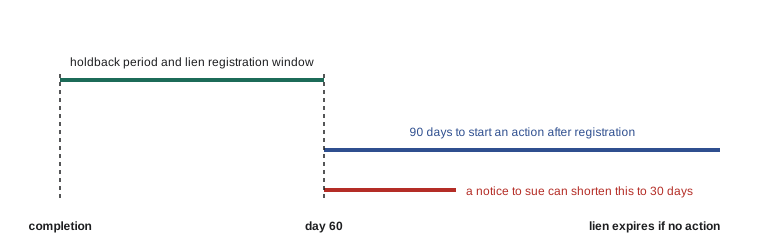
Section 24 sets the time to register. For a contractor or subcontractor, the claim must be registered within 60 days from the completion or abandonment of the contract. For wages, it is 60 days from the last work done; for services, 60 days from their completion; for materials, 60 days from furnishing the last material claimed. Where an architect or engineer supervises the contract, section 24(5) adds an alternative of 7 days after a final certificate is given or refused.
Registration is not the end. Under section 27, a registered lien expires 90 days after registration unless an action to enforce it is started in that time. And under section 28, a third party, such as the owner, can send a notice that gives the lienholder 30 days to start an action. A contractor who registers a lien and then does nothing can lose it.
Worked problem
A subcontractor who isn't paid
Gallant Electric finishes the electrical work on a renovation for a general contractor on September 30. The subcontract price is 22,000 dollars. The general contractor pays 12,000 dollars and then stops answering calls. What can Natalie do, and by when?
Show solution
- As a subcontractor, Gallant Electric may claim a lien for the unpaid price of its work under section 2.
- Its claim must be registered within 60 days of completing its subcontract, so by November 29.
- The owner should still hold the holdback. On the general contract, that fund is the first place an unpaid subcontractor looks.
- Once registered, the lien expires after 90 days unless Natalie starts an action, sooner if she receives a notice under section 28. She should talk to a lawyer before registering.
Answer: Diarize the 60-day registration deadline from completion, and get legal advice early. A lien that is registered late, or not enforced in time, protects nothing.
Contracts that prevent disputes
Wayne says that in thirty-five years he registered four liens, and that each one was a sign that the contract had failed earlier. Good contracts make liens rare.
- Put every job in writing, even small ones: scope, price, payment schedule, what happens with changes, and who supplies what.
- Write change orders before doing extra work, with the price agreed and signed. Most payment disputes are about work nobody priced.
- Invoice on time and follow up quickly. A customer who is 30 days late is easier to collect from than one who is 90 days late.
- Know the completion date. The lien and holdback clocks run from completion or abandonment, so record when the contract work was finished.
- Pay suppliers and employees on time. Their liens attach to the same land as yours.
On public work, liens generally cannot be registered against government land, and payment bonds take their place. Read the contract and the tender documents carefully on any public job.
Liens on residential work
Much of Gallant Electric's work will be for homeowners. A mechanics' lien can be registered against a home just as against a commercial building, but the practical position is different. Homeowners usually pay contractors directly, there is often no general contractor in between, and the amounts are smaller. In most residential disputes, a clear written contract, a signed change order and a polite but firm collection process will do more than a lien. A lien is the last step, not the first.
That said, the holdback rules still apply to residential contracts. A homeowner who hires Gallant Electric directly is an owner under the Act and is entitled to hold back the required amount for the 60-day period. Natalie's contracts say so plainly, so that a homeowner who holds back part of the final payment is not mistaken for one who refuses to pay.
Tracking every job's dates
For every job, Sam records three dates in the company calendar: the date the contract work was completed, the date the holdback period ends, and the last day to register a lien if the company has not been paid. Because the Act counts from completion or abandonment, the completion date is the one that matters most, and it should be recorded with evidence, such as the date of the final inspection notice or the certificate of compliance.
Wayne says the contractors who lose lien rights are almost never the ones who misunderstand the law. They are the ones who do not know what day a job finished, and who realize too late that the 60 days have passed.
Getting legal advice
Registering a lien is a legal step with consequences. A lien registered for more than is owed, or registered against the wrong land, can expose the contractor to liability. Before registering, Natalie will call a lawyer who does construction work. The cost of an hour of advice is small compared with a 9,000 dollar debt, and much smaller than the cost of getting it wrong.
Payment terms in the contract
Because the Island has no prompt payment legislation, payment timing comes entirely from the contract. That makes the payment clause one of the most important parts of every agreement. Natalie's standard terms set out a deposit on larger jobs, progress payments tied to stages such as rough-in passed and final inspection passed, the holdback the Act requires, and the date the holdback will be released. They also say what happens if payment is late, so that there is no argument about it later.
When Gallant Electric works for a general contractor, the general contractor's subcontract usually sets the terms instead. Natalie reads those clauses carefully, especially any that make her payment depend on the general contractor being paid by the owner first. She cannot always change those terms, but she can price for the risk or decline the job.
Common mistakes
MistakeCalling an Island lien a builders' lien or construction lien and assuming another province's rules.
InsteadThe Island statute is the Mechanics' Lien Act, with its own holdback and deadlines.
MistakeAssuming the holdback is 10 in 100, as in many provinces.
InsteadThe consolidated Act sets 20 in 100, or 15 in 100 where the value is over 15,000 dollars, held for 60 days.
MistakeRegistering a lien and then waiting.
InsteadA registered lien expires 90 days after registration unless an action is started, or sooner after a notice to sue.
MistakeExpecting prompt payment rules to apply on the Island.
InsteadThe Island has no prompt payment legislation; payment terms come from the contract.
Summary and key terms
- The Mechanics' Lien Act gives people who do work or supply materials for an improvement a lien on the land; the Island has no prompt payment legislation.
- Owners must hold back 20 in 100 of the value of work and materials, or 15 in 100 where the value is over 15,000 dollars, for 60 days after completion or abandonment.
- Contractors and subcontractors must register a lien within 60 days of completion or abandonment of the contract.
- A registered lien expires after 90 days unless an action is started, and a notice to sue can require an action within 30 days.
- Written contracts, signed change orders and prompt invoicing prevent most lien disputes.
- Mechanics' lien
- A claim against improved land for unpaid work or materials under the PEI Mechanics' Lien Act.
- Holdback
- The part of the contract price an owner must retain for a period after completion.
- Completion or abandonment
- The event from which the holdback period and the contractor's lien deadline are counted.
- Section 28 notice to sue
- A notice under section 28 requiring a lienholder to start an action within 30 days.
- Change order
- A written, priced agreement to change the scope of a contract.
Practice problems
Work each problem on paper first, then reveal the answer to check.
What holdback applies to a contract with 12,000 dollars of work and materials?
Show answer
20 in 100, or 2,400 dollars, because the value is not over 15,000 dollars.
A contract is completed on March 10. By when must a contractor register a lien?
Show answer
Within 60 days, by May 9.
How long after registration does a lien expire if no action is started?
Show answer
90 days.
Does PEI have prompt payment legislation for construction?
Show answer
No. The Island continues to rely on its Mechanics' Lien Act.
Lesson quiz · 5 questions
Score 60% or more to complete this lesson.
Create a free account to save your progress, take quizzes and earn a certificate.