
MELC-209 · Lesson 7 of 12 · 19 min
Duties and responsibilities of the licensed electrical contractor
▶ Video coming soon A video version of this lesson is on the way.
A licence is permission, and permission comes with duties. Some of a licensed electrical contractor's duties on the Island are written into the Electrical Inspection and Code Regulations. Others come from the contractor's role as an employer, a party to contracts and the person whose name is on the permit. This lesson collects the duties that matter most, explains the consequences of ignoring them, and shows how Natalie builds them into the way Gallant Electric works.
Duties written into the regulations
The office consolidation of the regulations sets out the following duties for contractors and licence holders. Section and rule numbers refer to the consolidation and the Island's Schedule 1 amendments.
| Duty | Where | In practice |
|---|---|---|
| Use only certified electricians, supervised apprentices or permit holders for electrical work | Section 2(6) | Check every worker's status before they touch an installation |
| Carry the licence on site | Section 2(7) | Keep the licence, or an accepted copy, in every truck |
| Produce the licence on request | Section 10(3) | Failing to do so is an offence and grounds for suspension |
| Restricted contractors employ only registered technicians for their licensed work | Section 4(4) | A restricted firm cannot send a general labourer to wire |
| Apply for a permit before doing electrical work | Rule 2-004 as amended | One application per building, by the contractor doing the work |
| Notify the inspector and follow the rough-in rule | Rule 2-012 as amended | Keep records of every notice |
| Give a certificate of compliance on completion | Rule 2-012 as amended | To the inspector and the owner |
| Discuss upgrades before work on existing installations | Rule 2-022 as amended | Talk to the inspector before quoting the job |
| Install only certified equipment | Rule 2-024 as amended | Refuse customer-supplied equipment without a recognized mark |
| Correct defects | Rule 2-036 as amended | Uncorrected defects can lead to refused permits |
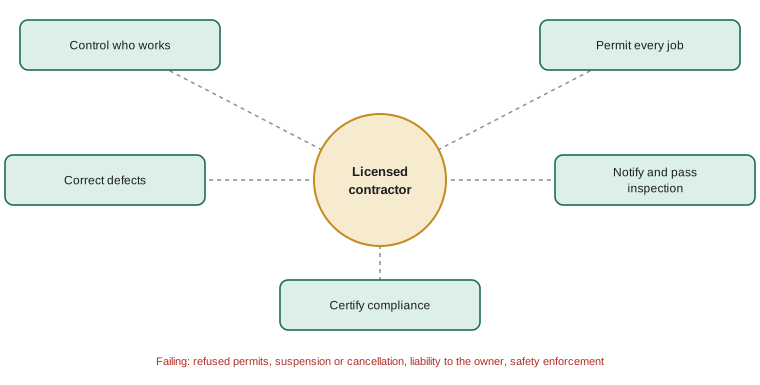
Read together, these duties describe a contractor who controls who does the work, makes sure the work is permitted and inspected, stands behind it with a certificate of compliance, and fixes what is wrong. That is what the licence is for.
Supervising apprentices
The phrase direct supervision appears in the regulations' rule on who may do electrical work. Apprentices may do electrical work under direct supervision. The regulations do not define the phrase in detail, and the apprenticeship system has its own rules on supervision and ratios. What is clear is that a licensed contractor who sends an apprentice to a job alone, with no certified electrician supervising, is using a person who is not allowed to do that work.
Owen is a capable second-year apprentice. He can do much of the work on a house on his own skill. That is not the test. Natalie sets a simple rule for Gallant Electric: an apprentice is never the most senior electrical worker on a site. If she cannot be there, Luc is; if neither of them can be, Owen works on something else that day. Wayne approves. He says supervision is the duty contractors are most tempted to cut when work is busy, and the one that hurts most when something goes wrong.
Supervision also matters for safety law and for the apprentice's own training record. Lesson 10 covers the employer's safety duties. The apprenticeship office covers the hours and ratios an apprentice needs to progress.
Standing behind the certificate of compliance
The certificate of compliance is the contractor's promise that the installation meets the Code as adopted on the Island. It goes to the inspector and to the owner. Owners keep it, insurers ask for it, and buyers' lawyers ask for it years later when the house is sold.
Because the contractor signs it, the contractor needs to know the work actually complies. On a job where the contractor did all the work personally, that is straightforward. On a job where three different crew members worked over two weeks, it requires a process. Natalie's process is a final walk-through before she signs: every panel, every bonding connection, every GFCI and AFCI location, every heat pump disconnect. Only then does she sign.
Consequences when duties are not met
The regulations give Inspection Services several tools. A licence may be suspended or cancelled under section 7(4) for lack of qualification, failing to comply with an order, or contravening the Act, the regulations or the Code. Orders must state their grounds and be served personally or by registered mail, under section 7(2). A suspension decision can be appealed to the minister within 10 days of notice, under section 7(6). Separately, permits may be refused to a contractor who fails to correct defects or contravenes the rules, and inspectors can order hidden work exposed or a non-compliant installation disconnected.
The Electrical Inspection Act itself creates offences and penalties. The consolidation of the regulations does not list fine amounts, and this course does not quote them; check the Act for the current penalty provisions.
Beyond the regulator, there is civil liability. An owner whose installation does not comply, or whose building is damaged by a fault in the contractor's work, can sue the contractor. The certificate of compliance the contractor signed will be one of the first documents the owner's lawyer reads. Lesson 8 covers the insurance that responds to claims like this.
Duties that come from the business
Some duties are not in the electrical regulations at all but come with running a contracting business. Natalie lists them so nothing is forgotten.
- As an employer, Gallant Electric must register with WCB, report injuries within the required time, and meet the Occupational Health and Safety Act's duties. Lesson 10 covers these.
- As a party to contracts, the company must perform what it agreed, pay its suppliers, and follow the Mechanics' Lien Act rules on holdbacks. Lesson 9 covers these.
- As a business, it must keep its registrations, tax accounts and insurance current. Lesson 8 covers these.
- As a licence holder, it must renew every year before December 31 and keep its qualifying certified electrician. Lesson 11 covers renewal.
A duties checklist for every job
Natalie turns the regulatory duties into a short checklist that Sam attaches to every job file. The code below scores a job file against it, so Sam can see at a glance which files are incomplete.
CHECKLIST = [
    "building permit number recorded (if required)",
    "electrical permit issued before work started",
    "crew list: certified electricians and supervised apprentices only",
    "rough-in notice date recorded",
    "inspection result recorded",
    "final notice given",
    "certificate of compliance to inspector and owner",
]

def review(job, done):
    missing = [c for c in CHECKLIST if c not in done]
    status = "complete" if not missing else f"{len(missing)} item(s) missing"
    print(f"{job}: {status}")
    for m in missing:
        print(f"   - {m}")

review("MacLean duplex", set(CHECKLIST))
review("Cavendish cottage", set(CHECKLIST[:5]))MacLean duplex: complete Cavendish cottage: 2 item(s) missing - final notice given - certificate of compliance to inspector and owner
The Cavendish cottage file is missing the final notice and the certificate of compliance. Natalie will not mark the job complete, or send the final invoice, until both are done.
A worked example: an apprentice alone
Worked problem
The Saturday call
On a Saturday, a customer calls Gallant Electric about a tripped heat pump breaker that will not reset at a rental duplex. Natalie is away and Luc is sick. Owen offers to go alone, replace the breaker and get the heat back on. What should Natalie say?
Show solution
- Owen is a registered apprentice. The regulations allow apprentices to do electrical work only under direct supervision.
- Sending Owen alone would mean using a person who is not allowed to do the work unsupervised. That is a contravention that could put the licence at risk.
- It also exposes Owen to a fault without anyone qualified to supervise or help, which is a safety law problem.
- Natalie should tell the customer that a certified electrician will attend as soon as one is available, or refer the call to another licensed contractor if the tenant has no heat.
Answer: An apprentice does not go alone, however simple the job looks. Arrange certified supervision or refer the call.
Delegating without losing control
As Gallant Electric grows, Natalie will not be on every job. That is normal; no contractor with more than one crew can be. The duties in this lesson do not require the licence holder to do every task personally. They require the licence holder to control the work: to make sure the right people do it, that it is permitted and inspected, that defects are fixed, and that the certificate of compliance is true.
Control at a distance needs systems. Natalie's are simple. Every job has a lead hand who is a certified electrician. Every job file has the checklist from this lesson. Every certificate of compliance is signed only after a lead hand's walk-through and a photo record of panels and connections that Natalie reviews. And every defect notice comes to Natalie personally, so she sees patterns before they become problems.
Wayne's version of the same idea was a weekly Friday meeting with his lead hands. Every open permit was read out, every inspection result discussed, and every defect notice explained. He says those meetings caught more problems than any inspector did.
Working with other trades
Many electrical jobs on the Island involve other trades: a refrigeration contractor for a heat pump, a plumber for a water heater, a general contractor for a renovation. The electrical contractor's duties cover the electrical work. They do not transfer to the other trades, and the other trades' duties do not transfer to the electrical contractor.
Natalie makes the split explicit in writing on every shared job: who supplies the equipment, who does which connections, who takes out which permit, and who calls for which inspection. When a heat pump job goes wrong, the first question is always whose work failed, and a clear written split answers it.
When an inspector disagrees
Occasionally a contractor and an inspector will disagree about whether an installation complies. The best first step is a calm conversation: explain the reasoning, cite the rule, and listen to the inspector's reasoning. Most disagreements end there. If they do not, ask for the decision in writing, and ask Inspection Services how such questions are reviewed. Formal orders must state their grounds, and suspension decisions can be appealed to the minister within 10 days. Wayne says he appealed once in thirty-five years and lost; he says he should have spent the time fixing the installation instead.
Duties toward the owner
The regulations focus on the contractor's duties toward Inspection Services, but the owner is the person who lives with the work. Natalie adds a few duties of her own that no regulation requires. Every owner receives a copy of the certificate of compliance, a short note listing what was installed and any maintenance it needs, such as testing GFCI receptacles, and the company's contact details for questions. Panel directories are filled in clearly and accurately.
Wayne says those small courtesies are what bring customers back and send their neighbours to the same contractor. On an island where most work comes by word of mouth, they also protect the licence in a quieter way: a contractor with satisfied customers rarely ends up in disputes that draw an inspector's attention.
Natalie also writes down what she will do when something goes wrong: a failed inspection is corrected and re-inspected promptly, a customer complaint is answered within a day, and a mistake on a job is owned rather than argued. Wayne calls this the cheapest insurance a contractor can buy.
Common mistakes
MistakeSending an apprentice to a job with no certified electrician supervising.
InsteadApprentices may do electrical work only under direct supervision.
MistakeSigning the certificate of compliance without checking the work.
InsteadThe certificate is the contractor's declaration. Do a final walk-through before signing.
MistakeIgnoring an order because it seems minor.
InsteadFailing to comply with an order is a ground for suspension or cancellation.
MistakeMissing the 10-day window to appeal a suspension.
InsteadAppeals to the minister must be made within 10 days of notice.
Summary and key terms
- The regulations require contractors to use only certified electricians, supervised apprentices or permit holders, and to carry and produce their licence.
- Contractors must permit every job, notify the inspector, follow the rough-in rule, give a certificate of compliance, discuss upgrades on existing work, install certified equipment and correct defects.
- Licences can be suspended or cancelled for lack of qualification, failing to comply with an order, or contravening the Act, regulations or Code; suspensions can be appealed within 10 days.
- Permits can be refused to contractors who fail to correct defects.
- Employer, contract, business and renewal duties sit alongside the electrical regulations.
- Direct supervision
- Supervision by a certified electrician under which an apprentice may do electrical work.
- Order
- A written direction from Inspection Services, stating its grounds and served personally or by registered mail.
- Suspension
- A temporary loss of a licence, which can be appealed to the minister within 10 days.
- Civil liability
- Responsibility to compensate another party for loss caused by defective work or breach of contract.
Practice problems
Work each problem on paper first, then reveal the answer to check.
How must an order from Inspection Services be served, according to the consolidation?
Show answer
Personally or by registered mail, and it must state its grounds.
Name three grounds for suspending or cancelling a licence.
Show answer
Lack of qualification, failing to comply with an order, and contravening the Act, regulations or Code.
Who receives the certificate of compliance?
Show answer
The inspector and the owner.
May a restricted contractor have a general labourer do its licensed electrical work?
Show answer
No. A restricted contractor may employ only registered technicians for that work.
Lesson quiz · 5 questions
Score 60% or more to complete this lesson.
Create a free account to save your progress, take quizzes and earn a certificate.