
MELC-209 · Lesson 4 of 12 · 19 min
How competence is checked without a master electrician exam
▶ Video coming soon A video version of this lesson is on the way.
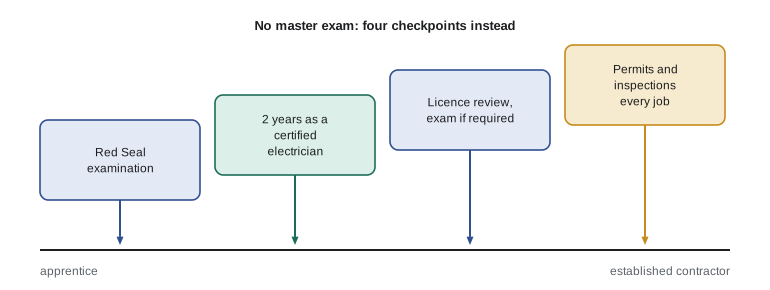
People who move between provinces are often surprised that the Island has no master electrician exam. It is tempting to read that as a lower standard. It is not. The Island checks competence at several points instead of one, and some of those checks happen on every job, for as long as a contractor works. This lesson sets out the checkpoints, explains what each one does and does not test, and helps a new contractor fill the gaps that no checkpoint covers.
Checkpoint 1: the certificate of qualification
The foundation is trade certification. Construction Electrician is a certified compulsory Red Seal trade on the Island. The provincial pages list 7,200 hours for the apprenticeship route and 10,800 trade qualifier hours for an experienced worker who wants to challenge the certification exam without completing an apprenticeship. Either route ends with the interprovincial Red Seal examination, a national standard written by electricians across the country.
The Red Seal exam is a serious test of technical knowledge: Code use, calculations, wiring methods, motors and controls, and safety. What it does not test is running a business, managing permits, dealing with liens, or supervising other people's work. Those are exactly the areas a master electrician exam covers in provinces that have one.
Checkpoint 2: two years as a certified electrician
The second check is time. The regulations require the electrical contractor, or for a firm one of its members, partners or employees, to have at least two years of experience working as a certified electrician. Two years after certification is long enough to have seen most kinds of residential and light commercial work, to have worked through inspections, and to have made and fixed mistakes under someone else's licence.
The requirement does not say what kind of experience counts, and it does not ask for supervisory experience. A certified electrician who spent two years pulling wire on one large project meets the rule just as well as one who ran small jobs alone. That is a gap a new contractor should be honest about.
Checkpoint 3: the licence application
The third check is the application itself. Inspection Services reviews the applicant's certification and experience, and the government's service page says the applicant may be required to write an exam. That discretion lets Inspection Services ask for more assurance in unusual cases, such as certification from outside Canada or an experience record that does not clearly show two years as a certified electrician.
The regulations also make the licence conditional on continued qualification. Section 7 allows suspension or cancellation for lack of qualification, failing to comply with an order, or contravening the Act, the regulations or the Code. A licence is not a one-time credential; it can be taken away.
Checkpoint 4: permits and inspections on every job
The fourth check is the one that never ends. Every electrical job on the Island needs a permit, and the work is inspected. The Island's amendments to the Code require the contractor to notify an inspector when work is ready for inspection, to leave rough-in work uncovered for the period the amended rule sets, and to give a certificate of compliance on completion. Rule 2-036 as amended for the Island allows permits to be refused to a contractor who fails to fix defects or who contravenes the Act or regulations.
This is where competence is really tested, job after job. A contractor whose installations repeatedly fail inspection will hear about it, and one who ignores defect notices risks losing the ability to get permits at all. Wayne says the inspectors on a small island know every contractor by name, and that a reputation, good or bad, travels fast.
What no checkpoint tests
Put the four checkpoints side by side and a pattern appears. The Red Seal and inspections test technical work. The two-year rule tests time in the trade. The application tests paperwork. None of them tests the business and legal knowledge that a master or contractor exam covers elsewhere. Natalie writes down the areas she must teach herself.
| Area | Tested by a master exam elsewhere? | Tested on PEI? | Where this program covers it |
|---|---|---|---|
| Code navigation and calculations | Yes | Red Seal, inspections | MELC-101, MELC-102 |
| Wiring methods and protection | Yes | Red Seal, inspections | MELC-103 |
| Grounding and bonding | Yes | Red Seal, inspections | MELC-104 |
| Special installations | Yes | Inspections | MELC-105 |
| Permits, notice and the Island amendments | Yes | Only by experience | Lessons 5 and 6 of this course |
| Contracts, holdbacks and liens | Yes | No | MELC-106 and Lesson 9 |
| Safety law, WCB and supervision | Yes | No | Lesson 10 |
| Estimating, insurance and cash flow | Often | No | MELC-106 and Lesson 8 |
Natalie has eight years of good technical work behind her. What she has never done is quote a job she then has to deliver at a profit, chase a customer for a holdback, or be the person whose name is on the licence when an apprentice gets hurt. Those are the gaps.
A self-assessment
Wayne suggests a simple exercise. For each area, Natalie scores herself from 0 (never done it) to 3 (could teach it), and weights each area by how much trouble a mistake would cause in her first year. Areas with a high weight and a low score are where she should spend her preparation time. The calculator below ranks them.
# Self-assessment: score 0 (never done) to 3 (could teach); weight 1 (minor) to 3 (serious).
areas = {
    "Code navigation and calculations":  (3, 2),
    "Permits, notice, Island amendments": (1, 3),
    "Quoting and estimating":            (1, 3),
    "Contracts, holdbacks, liens":        (0, 3),
    "Safety law and WCB duties":          (1, 3),
    "Supervising an apprentice":          (2, 2),
    "Insurance and cash flow":            (0, 2),
}
ranked = sorted(areas.items(), key=lambda kv: (kv[1][0] - 3) * kv[1][1])
print("Gap score = weight x (3 - score); higher means study first")
for name, (score, weight) in ranked:
print(f"{name:36s} score {score} weight {weight} gap {weight * (3 - score)}")Gap score = weight x (3 - score); higher means study first Contracts, holdbacks, liens score 0 weight 3 gap 9 Permits, notice, Island amendments score 1 weight 3 gap 6 Quoting and estimating score 1 weight 3 gap 6 Safety law and WCB duties score 1 weight 3 gap 6 Insurance and cash flow score 0 weight 2 gap 6 Supervising an apprentice score 2 weight 2 gap 2 Code navigation and calculations score 3 weight 2 gap 0
Her top priorities come out as contracts, holdbacks and liens; permits and the Island amendments; quoting; and safety law. That matches what Wayne expected. The technical core is where she is strongest, and the business law is where she is weakest.
Building a preparation plan
Because there is no exam date forcing the pace, Natalie sets her own. She gives herself eight weeks before her last day at Harbourside, and builds a plan around the gaps.
- Weeks 1 and 2: read the Electrical Inspection and Code Regulations end to end, especially Part 2 and Schedule 1. Mark every Island amendment in her Code book.
- Weeks 3 and 4: work through MELC-106's contracting and lien material, then read the Island's Mechanics' Lien Act holdback and registration sections, covered in Lesson 9.
- Week 5: shadow Harbourside's estimator on three quotes and compare her own numbers with his.
- Week 6: study the Occupational Health and Safety Act duties of an employer and the WCB reporting rules, covered in Lesson 10.
- Weeks 7 and 8: run the Lesson 12 readiness review, fill any remaining gaps, and apply for the licence so it arrives before she leaves.
Wayne's one addition is to ask an inspector, at the end of a routine inspection, whether there are any common mistakes new contractors make. Inspectors are usually glad to answer, and the answer is better than any textbook.
What other provinces' exams can teach
Even though Natalie will not write one, she finds it useful to look at what other provinces' master and contractor exams cover. Ontario's Master Electrician exam, for example, tests the Ontario Electrical Safety Code alongside the regulation that sets out contractor and master electrician duties. Alberta's two-part exam devotes a whole part to Acts and regulations. Both make the same point: a person responsible for a contracting business must know the legal framework as well as the technical rules.
On the Island that legal framework is shorter, but it is still there, and Natalie will be expected to know it the first time an inspector asks why a permit was not taken out, or a supplier registers a lien on a job she was paid for. The lack of an exam does not change what she is accountable for; it only changes who checks that she knows it before she starts.
A worked example: competence after licensing
Worked problem
Defects that keep coming back
In its first year a small contractor receives defect notices on four jobs in a row for the same problem: missing bonding of metal water piping on heat pump installations. The contractor fixes each one when told, but the problem keeps appearing on new jobs. What checkpoint is catching this, and what could happen if it continues?
Show solution
- The permit and inspection system is catching it, job by job. No licensing check would have.
- Each notice is fixed, so the contractor is complying with orders, but the same mistake on every job shows a gap in the crew's knowledge.
- Repeated contraventions of the Code are a ground for suspension or cancellation under section 7(4), and Rule 2-036 as amended lets Inspection Services refuse permits to a contractor who contravenes the regulations.
- The fix is to find the gap and close it: review the bonding rules covered in MELC-104 with the crew, add a checklist step, and check the next few jobs before calling for inspection.
Answer: Inspections test competence continuously. A pattern of defects is a warning that the licence itself could be at risk.
What a mentor adds
Natalie is lucky to have Wayne. Most new contractors do not have a retired contractor willing to answer every question, and the Island's system, with no master exam and no mandatory business course, puts more weight on informal learning than most provinces do. If you do not have a mentor, find substitutes: an industry association, a supplier's counter staff who have seen every mistake, an accountant who works with trades, and the inspectors themselves.
A mentor is most useful for the questions nobody writes down. How do you tell a customer their old wiring will need upgrading before you can add a heat pump, without losing the job? How much contingency should a renovation quote carry? When should you walk away from a customer? Wayne's answers come from thirty-five years of jobs, some of which went badly. Natalie writes them down in a notebook she calls the second Code book.
Measuring progress after licensing
Because inspections are the Island's continuing competence check, they also give a contractor a way to measure progress. Natalie decides to track two numbers from her first year: the share of jobs that pass inspection the first time, and the number of defect notices per twenty jobs. Wayne says a new contractor who keeps first-time passes high and defect notices low will build a reputation with inspectors quickly, and that reputation makes everything easier, from scheduling inspections to getting the benefit of the doubt on borderline judgment calls.
Comparing the Island with its neighbours
It helps to see the Island beside the other Maritime provinces, because contractors and electricians move between them often. New Brunswick and Nova Scotia each have their own licensing arrangements for electrical contractors, set by their own statutes and regulations, and each has its own permit and inspection system. A certified electrician moving from Moncton or Halifax to Summerside brings a Red Seal that is recognized everywhere, but not a licence: the contractor licence is always provincial.
That is why Lesson 3's worked example stressed confirming that an out-of-province certificate is recognized on the Island, and counting experience from the date of certification. The trade credential travels; the contractor licence does not. A contractor who works in more than one province needs a licence in each, and must follow each province's permit rules on each job.
Common mistakes
MistakeReading the lack of a master exam as a lower standard.
InsteadCompetence is checked at several points, including inspections on every job, and the licence can be suspended for contraventions.
MistakeAssuming the Red Seal covers business and legal knowledge.
InsteadThe Red Seal tests technical trade knowledge. Contracts, liens, permits and safety law have to be learned separately.
MistakeCounting any two years in the trade toward the licence requirement.
InsteadThe regulations count two years of experience working as a certified electrician, after certification.
MistakeTreating a defect notice as a one-off.
InsteadFix the cause. Repeated defects can lead to refused permits or a suspended licence.
Summary and key terms
- The Island checks competence through certification, experience, the licence application and inspections, instead of a single master exam.
- Construction Electrician needs 7,200 apprenticeship hours or 10,800 trade qualifier hours before the Red Seal exam.
- The contractor or one of the firm's people needs two years as a certified electrician; the application may involve an exam at Inspection Services' discretion.
- Inspections on every job test competence continuously, and repeated contraventions can lead to refused permits or a suspended licence.
- Business, contract, lien and safety law are not tested anywhere on the Island, so a new contractor must prepare for them deliberately.
- Red Seal examination
- The interprovincial exam that leads to certification in a Red Seal trade.
- Trade qualifier
- An experienced worker who challenges the certification exam without completing an apprenticeship.
- Defect notice
- An inspector's written finding that an installation does not comply and must be corrected.
- Gap score
- In this lesson, a simple ranking of preparation priorities by weight times missing skill.
Practice problems
Work each problem on paper first, then reveal the answer to check.
How many hours does the provincial page list for the Construction Electrician apprenticeship route?
Show answer
7,200 hours.
What does the Red Seal exam not test that a master exam elsewhere usually does?
Show answer
Business and legal knowledge such as contracts, liens, permits and safety law.
Which amended Code rule allows permits to be refused to a contractor who fails to fix defects?
Show answer
Rule 2-036, as amended for the Island.
Name the four checkpoints described in this lesson.
Show answer
Certification, two years as a certified electrician, the licence application, and permits and inspections on every job.
Lesson quiz · 5 questions
Score 60% or more to complete this lesson.
Create a free account to save your progress, take quizzes and earn a certificate.