
MELC-209 · Lesson 8 of 12 · 19 min
Insurance, bonding and running the business
▶ Video coming soon A video version of this lesson is on the way.
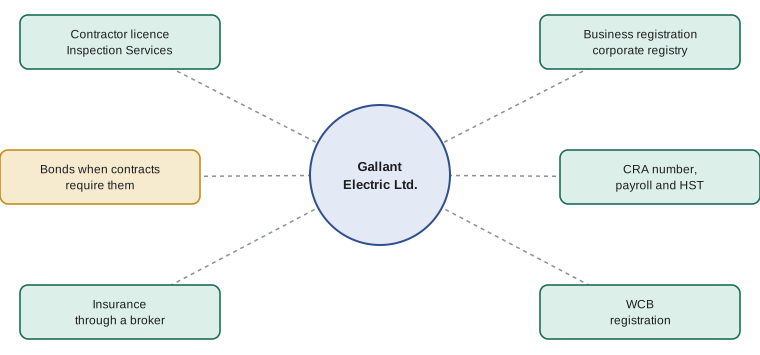
The electrical contractor licence is the cheapest thing Gallant Electric will buy in its first year. The registrations, insurance, workers compensation and tax accounts that surround it cost far more and matter just as much. Some of them are legal requirements; others are requirements in practice, because customers, general contractors and suppliers will not deal with a contractor who lacks them. This lesson walks through what an Island electrical contractor needs, which items the electrical regulations themselves require, and which come from somewhere else.
A note on what was verified. The government's licensing pages and the consolidated regulations do not list an insurance or bonding requirement for an electrical contractor licence on the Island. That is different from provinces such as Saskatchewan, where a surety bond is a licensing condition. Where this lesson discusses insurance and bonds, it is describing what contractors commonly carry and what contracts commonly require, not a licensing rule. Confirm current requirements with Inspection Services and your insurer.
The registrations
- Business registration. Gallant Electric Ltd. was incorporated through the province's corporate registry. A sole proprietor trading under a business name registers the name. The registry record is what lenders, suppliers and some customers will ask to see.
- Federal business number. The Canada Revenue Agency issues a business number, with program accounts for payroll deductions and sales tax. Prince Edward Island uses the harmonized sales tax, administered federally, so Gallant Electric's sales tax account is with the CRA.
- Workers compensation. An Island employer in the construction industry registers with the Workers Compensation Board of PEI and pays assessments based on payroll. Lesson 10 covers WCB in detail. General contractors routinely ask subcontractors for proof of WCB coverage, or a clearance letter, before paying them.
- Municipal business licensing. Some municipalities require business licences or registrations; many on the Island do not. Check where the business is based.
Insurance
No electrical contractor should work without commercial general liability insurance, whether or not a regulation requires it. A single fire caused by a loose connection can cost far more than a small contracting company is worth. Natalie's insurance broker walks her through the usual coverages for a contractor of her size.
| Coverage | What it responds to | Why it matters for an electrical contractor |
|---|---|---|
| Commercial general liability | Bodily injury and property damage to others caused by the business | Fires and shocks traced to the work; damage to a customer's property |
| Completed operations | Claims arising after the job is finished | A fault that causes a fire two years later |
| Tools and equipment | Loss or theft of tools, meters and stock | Trucks are broken into; meters are expensive |
| Commercial auto | Vehicles used in the business | Personal policies may not cover work vehicles |
| Errors and omissions | Financial loss from professional mistakes | Design-build or load calculation work for others |
General contractors and institutional owners commonly require subcontractors to carry liability insurance at a stated minimum limit, name the owner or general contractor as an additional insured, and provide a certificate of insurance before starting. Those requirements come from the contract, not from the electrical regulations, but they are just as binding once Natalie signs.
Bonds
A surety bond is a three-party promise. The surety company promises the obligee, usually an owner or general contractor, that the contractor, called the principal, will perform. If the contractor does not, the surety pays and then recovers from the contractor. Bonds are not insurance for the contractor; they protect the other side.
The Island's electrical licensing rules, as consolidated and as described on the government's pages, do not require a licence bond. Natalie will meet bonds instead on larger jobs, particularly public work.
- Bid bonds guarantee that a contractor who wins a tender will sign the contract.
- Performance bonds guarantee that the contractor will complete the work.
- Labour and material payment bonds guarantee that the contractor will pay its workers and suppliers.
To get bonded, a surety looks at the contractor's finances, experience and track record. A new company like Gallant Electric will usually start small, often with the owner personally guaranteeing the surety, and build bonding capacity over years.
Pricing the work
Natalie's biggest risk in her first year is not a defect or an inspection. It is pricing jobs badly. MELC-106 covers estimating in depth; the Island version of the problem is the same as anywhere. Every quote must cover materials, labour, overhead and profit, and the overhead must include all the items in this lesson.
The most common mistake new contractors make is confusing markup with margin. Markup is added to cost; margin is the share of the selling price that is profit and overhead. A 25 in 100 markup on cost is only a 20 in 100 margin on price. The calculator below shows the difference for a heat pump job.
def price_from_markup(cost, markup):
    return cost * (1 + markup)

def margin(price, cost):
    return (price - cost) / price

cost = 6400.0              # materials and labour for a ducted heat pump job (illustrative)
for markup in (0.15, 0.25, 0.40):
    p = price_from_markup(cost, markup)
print(f"markup {markup:.2f}: price {p:9,.2f} margin {margin(p, cost):.3f}")markup 0.15: price 7,360.00 margin 0.130 markup 0.25: price 8,000.00 margin 0.200 markup 0.40: price 8,960.00 margin 0.286
If Gallant Electric needs 0.20 of every dollar of sales to cover overhead and profit, it needs a markup of 0.25 on cost, not 0.20. Sam builds that into the quoting spreadsheet so nobody has to do the arithmetic on a customer's doorstep.
Cash flow and holdbacks
Island construction contracts are subject to the Mechanics' Lien Act holdback, covered in Lesson 9. Owners must retain part of the contract price for a period after the work is completed. For a small contractor, that means part of every larger job's revenue arrives weeks or months after the work is done, while payroll and supplier bills arrive on time. Natalie and Sam plan for it: a line of credit, supplier terms negotiated before the first big job, and a rule that no single job may tie up more than a set amount of the company's cash.
Equipment the business installs that others regulate
Heat pump work is a large part of Island electrical contracting, and it touches other trades. Refrigerant handling requires the appropriate refrigeration certification, and connecting gas appliances requires gas certification. The electrical contractor licence covers the electrical work only. Natalie partners with a refrigeration contractor for the refrigerant side and does the electrical supply, disconnect and controls herself. Each contractor takes out its own permits.
A worked example: a general contractor's paperwork
Worked problem
What a general contractor asks for
A general contractor building a small medical clinic in Summerside invites Gallant Electric to price the electrical work. The invitation asks for a certificate of liability insurance naming the general contractor as additional insured, proof of WCB coverage, the electrical contractor licence number, and a performance bond equal to half the subcontract price. Which of these does the electrical regulation require, and which come from the contract?
Show solution
- The electrical contractor licence is required by the regulations; without it Gallant Electric could not take out the electrical permit.
- WCB coverage is required by workers compensation law for an employer in construction, and the general contractor needs proof to protect itself.
- The liability insurance and the additional insured requirement come from the contract.
- The performance bond also comes from the contract. A new company may not yet have bonding capacity for it, which is a reason to price smaller jobs first.
Answer: Licensing, WCB and insurance are ordinary requirements; bonds are a contract requirement that a new contractor may not be able to meet yet.
Building a simple business plan
Before she leaves Harbourside, Natalie writes a two-page business plan. Wayne insists, not because a bank asked for it but because writing it forces decisions. Who are the customers? What work will the company take, and what will it turn down? How many billable hours can three people realistically produce in a year, after travel, quoting, paperwork and bad weather? What does the company need to charge per hour to cover wages, overhead and profit?
The billable-hours question surprises Natalie most. On paper, three people working forty hours a week for fifty weeks produce six thousand hours. In practice, after travel between jobs across the Island, quoting, ordering, inspections, training and the slow weeks after Christmas, Wayne's experience is that a small company bills perhaps two thirds of that. Pricing as if every hour is billable is the fastest way to work hard and lose money.
Choosing the work
A new contractor's first instinct is to take every job. Wayne's advice is to choose. Some work is profitable and builds a reputation: service upgrades, heat pumps, renovations for repeat customers. Some work ties up cash and carries risk: large subcontracts with long holdbacks, or jobs for general contractors with a history of slow payment. Natalie decides that in her first year, no single job will be larger than she can carry through the 60-day holdback without straining the company's cash.
The accountant and the broker
Two professionals pay for themselves for almost every new contractor: an accountant who works with trades, and an insurance broker who places contractor coverage. The accountant helps choose the business structure, sets up the tax and payroll accounts, and keeps the company out of trouble with the Canada Revenue Agency. The broker matches insurance to the work the company actually does and reads the insurance clauses in contracts before Natalie signs them. Natalie meets both before she applies for the licence.
Wayne's last piece of advice on the business side is to pay himself a regular wage from the start, even a small one, and to keep the company's money separate from his personal money. He says that habit, more than any other, separates contractors who last from those who do not.
Quoting on the Island
Distance matters more on the Island than newcomers expect. A job in Souris is about two hours from Summerside, and a job in Tignish is about an hour the other way. Travel time is paid time, and fuel and vehicle costs are real. Natalie's quoting spreadsheet adds a travel allowance based on distance from Summerside, and she groups jobs by area where she can, so that a week's work in Kings County is done in one or two trips rather than five.
Seasonality matters too. Cottage and tourism work peaks before the summer season, heat pump work peaks in the autumn, and new construction slows in the depth of winter. A contractor who plans for the slow months, by setting aside cash in the busy ones and lining up winter renovation work, avoids the cash crunch that catches many new businesses in their first January.
Finally, Natalie prices the paperwork. Permit applications, inspection scheduling, certificates of compliance and holdback tracking all take time. On a small job they can take as long as the wiring. Wayne says contractors who do not price the paperwork end up doing it for free in the evenings.
Natalie reviews her prices every six months against her actual costs. Wire, breakers and heat pump parts change price often, and a quote template built on last year's costs quietly eats the margin on every job.
Common mistakes
MistakeAssuming the Island requires a licence bond because another province does.
InsteadThe consolidated regulations and government pages do not list a bond for the PEI contractor licence. Bonds arise from contracts.
MistakeWorking without liability insurance because no regulation requires it.
InsteadA single fire claim can exceed the value of the business. Carry commercial general liability and completed operations coverage.
MistakeTreating markup and margin as the same number.
InsteadA markup of 0.25 on cost gives a margin of 0.20 on price.
MistakeIgnoring the holdback in cash flow planning.
InsteadPart of each larger job's revenue arrives after the holdback period. Plan credit and supplier terms.
Summary and key terms
- The electrical contractor licence is only one of several registrations: the corporate registry, the CRA business number with payroll and harmonized sales tax accounts, and WCB.
- The PEI regulations and government pages do not list an insurance or bond requirement for the contractor licence; contracts and good practice do.
- Contractors commonly carry commercial general liability, completed operations, tools, auto and sometimes errors and omissions coverage.
- Bid, performance and payment bonds are contract requirements on larger and public jobs; bonding capacity grows over time.
- Price jobs on margin, not just markup, and plan cash flow around the lien holdback.
- Commercial general liability
- Insurance against claims for injury or property damage caused by the business.
- Completed operations
- Coverage for claims that arise after a job is finished.
- Surety bond
- A promise by a surety to an obligee that the contractor will perform or pay.
- Additional insured
- A party added to a contractor's liability policy at a customer's request.
- Margin
- The share of the selling price left after direct costs, which covers overhead and profit.
Practice problems
Work each problem on paper first, then reveal the answer to check.
A job costs 8,000 dollars and is priced with a markup of 0.25. What is the price, and what is the margin?
Show answer
10,000 dollars; the margin is 2,000 divided by 10,000, or 0.20.
Which agency administers PEI's harmonized sales tax?
Show answer
The Canada Revenue Agency, through the business number's sales tax account.
Does the PEI electrical contractor licence require a surety bond, according to the consolidated regulations and the government's pages?
Show answer
No such requirement is listed; bonds arise from contracts.
Name the three common types of construction surety bond.
Show answer
Bid bonds, performance bonds, and labour and material payment bonds.
Lesson quiz · 5 questions
Score 60% or more to complete this lesson.
Create a free account to save your progress, take quizzes and earn a certificate.