
MELC-209 · Lesson 6 of 12 · 19 min
Permits, inspections and the inspection authority
▶ Video coming soon A video version of this lesson is on the way.
The government's guidance on electrical work states the rule in one line: electrical permits are required for all electrical work in PEI. A second line explains who can get one: only electrical contractors licensed to do work in PEI can apply for an electrical permit. Everything else in this lesson follows from those two sentences. The details come from the Island's amendments to Section 2 of the Code, set out in Schedule 1 of the Electrical Inspection and Code Regulations. As before, the descriptions here summarize the office consolidation current to October 2024; read the current wording before relying on any detail.
Who applies for the permit
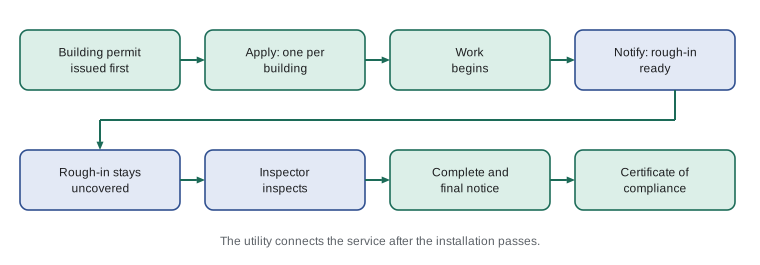
Under the Island's version of Rule 2-004, the contractor responsible for the work applies for the electrical permit. Two further conditions in the amended rule shape how permits work day to day.
- Only the contractor who will perform the work may apply. A general contractor cannot take out the electrical permit for an electrical subcontractor, and an owner cannot take it out for whichever contractor they eventually hire.
- A separate application is required for each building. A farm with a new machine shed and a new potato storage needs two permits, even if one crew wires both in the same week.
The amended rule also ties the electrical permit to other approvals. No electrical permit is issued for work that also requires a development or building permit until that permit has been issued. On a new house, that means the owner or builder must have the building permit from the municipality, or from the province in areas without municipal planning, before Natalie can get the electrical permit.
This is the first thing Wayne teaches every new contractor about Island permits. Ask the customer for the building permit number before you quote a schedule. If there isn't one yet, your start date depends on someone else's paperwork.
Kinds of permits
| Permit | Who it is for | Key points from the consolidation |
|---|---|---|
| Electrical work permit | The licensed contractor doing the work | One per building; issued only after any required development or building permit |
| Construction-stage service permit | A contractor providing a service during construction | Expires after six months and may be renewed |
| Annual permit | An owner or occupant of listed premises | Covers minor work by the owner's employed certified electrician; 200 dollars |
| Temporary installations | A contractor installing a temporary pole service | Governed by the Island amendment to Rule 76-018 |
The annual permit deserves a closer look because it is the Island's answer to large premises with their own maintenance staff. At the discretion of the Chief Electrical Inspector, an owner or occupant can obtain an annual permit covering minor electrical work on the listed premises, done by a certified electrician the owner employs. The government's page lists it alongside the licences. A potato processing plant or a large hotel might use one; a homeowner would not.
The consolidation does not set out a homeowner permit of the kind some provinces have, and the government's guidance says only licensed contractors may apply for an electrical permit. Natalie treats that as the rule: if a customer wants to do their own wiring, she tells them to call Inspection Services and ask before they start.
Permit fees
Permit fees are set in schedules to the regulations. The consolidation shows flat fees for some common jobs and itemized fees for others.
| Item | Fee in the consolidation |
|---|---|
| New single-family dwelling, per unit | 175 dollars |
| Mobile home | 100 dollars |
| Pool or hot tub | 50 dollars |
| Annual permit | 200 dollars |
| Other work | Itemized by services, outlets, motors and other equipment |
For anything other than the flat-rate jobs, the fee is built up from the items in the installation. Natalie builds a small calculator so she can quote permit fees accurately. The flat fees below come from the consolidation; the itemized rates are placeholders she must replace from the current schedule.
FLAT = {"single-family dwelling": 175, "mobile home": 100, "pool or hot tub": 50}
ITEM = {"service": 60, "outlet": 2, "motor": 12, "heat pump": 25}   # placeholders

def permit_fee(job):
    if job["type"] in FLAT:
        return FLAT[job["type"]] * job.get("units", 1)
    return sum(ITEM[k] * n for k, n in job["items"].items())

jobs = [
    {"name": "MacLean duplex, Summerside", "type": "single-family dwelling", "units": 2},
    {"name": "Cavendish cottage hot tub", "type": "pool or hot tub"},
    {"name": "Kinkora machine shed", "type": "itemized",
     "items": {"service": 1, "outlet": 24, "motor": 2}},
]
for j in jobs:
print(f"{j['name']:28s} {permit_fee(j):5d} dollars")MacLean duplex, Summerside 350 dollars Cavendish cottage hot tub 50 dollars Kinkora machine shed 132 dollars
The duplex shows why the per-unit wording matters: two units at 175 dollars each is 350 dollars, not 175. Whether a particular duplex counts as two units under the schedule is a question for Inspection Services, but it is the right question to ask before the quote goes out.
Calling for inspection
The Island's version of Rule 2-012 sets out the inspection steps. As summarized from the consolidation:
- The contractor must notify an inspector when work is ready for inspection.
- Rough-in work must not be covered until the conditions in the amended rule are met. The consolidation ties covering rough-in to a 48-hour period, so a contractor who has given notice can plan when walls may be closed. Read the amended rule for exactly how the 48 hours is counted.
- A final inspection notice is also required when the work is complete.
- On completion, the contractor fills out a certificate of compliance and gives it to the inspector and to the owner.
The certificate of compliance is the contractor's own declaration that the work complies. It is a serious document. Signing it for work that does not comply is not a paperwork shortcut; it is a false statement made under the regulations.
Inspectors also have powers under the Island rules to order material that hides work removed so the work can be seen, and to order an installation disconnected when it does not comply. Wayne's basement story from Lesson 3 is an example of the first power in action.
Connection and the utilities
Before a utility energizes a new or altered service, the installation must be inspected or authorized under the rules. The Island's version of Rule 2-016 governs current permits and connection. In practice, Maritime Electric, or the City of Summerside's utility inside its service area, coordinates with Inspection Services before connecting, and each utility has its own service requirements for meter locations, service entrances and clearances. A contractor who has passed inspection but ignored the utility's requirements may still be refused connection.
Natalie keeps both utilities' current service requirement documents in a folder on her phone. On a Summerside job, the city utility's rules apply; a few kilometres outside the city, Maritime Electric's do.
Defects and refused permits
When an inspection finds a defect, the contractor must correct it. The Island's version of Rule 2-036 allows permits to be refused to a contractor who fails to correct defects or who contravenes the Act or regulations. That is a strong incentive. A contractor who cannot get permits cannot legally work.
Worked problem
A permit that cannot be issued yet
Owen takes a call while Natalie is on a roof. A builder wants Gallant Electric to start wiring a new house in Cornwall on Monday. The builder says the building permit is in process and should be issued next week. Can Gallant Electric apply for the electrical permit and start on Monday?
Show solution
- The work is on a new house, which needs a building or development permit.
- Under the Island's version of Rule 2-004, no electrical permit is issued until any required development or building permit has been issued.
- Without an electrical permit, Gallant Electric cannot start the electrical work.
- Natalie should tell the builder that the electrical start date depends on the building permit, and apply for the electrical permit as soon as the builder provides the building permit number.
Answer: The electrical permit follows the building permit. Ask for the building permit number before committing to a start date.
A permit log
With several jobs open at once, Sam keeps a permit log: job, building, permit number, date of rough-in notice, inspection results, and the date the certificate of compliance went to the owner. Wayne says that log was the most useful piece of paper in his office for thirty-five years. When a customer, insurer or inspector asks a question two years later, the answer is in the log.
Inspections in practice
Inspection Services covers the whole Island from its office, and inspectors travel to jobs from Tignish to Souris. That shapes how inspections work in practice. Give notice as early as the rules allow, so the inspector can plan a route. Be ready when you said you would be: a rough-in that is not finished when the inspector arrives wastes a trip and does not help your reputation. And be reachable, so that if the inspector has a question, it can be answered without another visit.
On a busy job, Natalie keeps the permit, the drawings, any load calculation and the crew list in a folder on site. Inspectors rarely ask for all of them, but when they do, having them ready turns a difficult conversation into a short one.
Annual permits and maintenance staff
The annual permit is worth understanding even for a small contractor, because Gallant Electric may work alongside a customer who holds one. On premises with an annual permit, the owner's own certified electrician can do minor work covered by the permit. Larger work, such as a new service or a new building, still needs an ordinary electrical permit from a licensed contractor. When a plant manager asks Natalie to quote work at a facility with an annual permit, her first question is whether the work falls under the annual permit or needs its own.
The construction-stage service permit also deserves a note. Temporary services on building sites often outlast the original schedule. Because these permits expire after six months, a contractor who installs a temporary service on a slow-moving project should diarize the expiry and renew before it lapses, rather than discover months later that the service has no current permit.
When the customer is the problem
Some customers push contractors to skip the permit: to save the fee, to avoid an inspection of an older installation, or simply to start sooner. Wayne's answer was always the same. The permit is not optional, the fee is small compared with the job, and the inspection protects the customer as much as the contractor. A contractor who works without a permit to please a customer puts the licence at risk for someone else's convenience.
Permits on renovation work
Renovations generate more permit questions than new construction. Is moving a receptacle a permitted job? Replacing a panel? Adding a circuit for a heat pump? The government's rule is that permits are required for all electrical work, and Natalie applies it literally: if Gallant Electric is doing electrical work, it takes out a permit. The permit fee on small jobs is modest, and the alternative is explaining to an inspector why work was done without one.
Renovations also bring Rule 2-022 into play, because the work touches an existing installation. Natalie's routine on any renovation is the same: look at the existing wiring before quoting, call the inspector to discuss any upgrades the work will trigger, price the job with those upgrades in it, and then take out the permit. Customers sometimes balk at the upgrades. Wayne's advice is to explain that the inspector, not the contractor, decides what is required, and that a quote that ignores required upgrades is not a real quote.
Common mistakes
MistakeLetting a general contractor or owner take out the electrical permit.
InsteadOnly the contractor who will perform the work may apply for the electrical permit.
MistakeTaking one permit for a farm with several new buildings.
InsteadA separate application is required for each building.
MistakeApplying for the electrical permit before the building permit exists.
InsteadNo electrical permit is issued until any required development or building permit has been issued.
MistakeCovering rough-in as soon as notice is given.
InsteadFollow the amended Rule 2-012 on when rough-in may be covered, and keep records of the notice.
Summary and key terms
- Electrical permits are required for all electrical work on the Island, and only licensed contractors may apply.
- The contractor who will do the work applies, one application per building, and only after any required development or building permit is issued.
- Annual permits cover minor work on listed premises by an owner's employed certified electrician; construction service permits last six months.
- Fees are flat for some jobs, such as 175 dollars per single-family dwelling unit, and itemized for others.
- The contractor notifies the inspector, follows the rough-in covering rule, gives a final notice and provides a certificate of compliance; permits can be refused for uncorrected defects.
- Electrical work permit
- Permission from Inspection Services for a licensed contractor to do electrical work on one building.
- Annual permit
- A yearly permit covering minor work on listed premises by an owner's employed certified electrician.
- Certificate of compliance
- The contractor's declaration, given to the inspector and owner, that completed work complies.
- Rough-in
- Wiring installed before walls and ceilings are closed, which must be inspected or left open as the rules require.
Practice problems
Work each problem on paper first, then reveal the answer to check.
How many permit applications does a farm need for a new machine shed and a new storage building?
Show answer
Two, because a separate application is required for each building.
What is the consolidated fee for a pool or hot tub permit?
Show answer
50 dollars.
To whom does the contractor give the certificate of compliance?
Show answer
To the inspector and to the owner.
How long does a construction-stage service permit last before it must be renewed?
Show answer
Six months.
Lesson quiz · 5 questions
Score 60% or more to complete this lesson.
Create a free account to save your progress, take quizzes and earn a certificate.