
MELC-209 · Lesson 2 of 12 · 19 min
Licence types and the certified electrician requirement
▶ Video coming soon A video version of this lesson is on the way.
Part 2 of the Electrical Inspection and Code Regulations sets out four licences: the electrical contractor licence, the restricted contractor licence, the registered technician licence and the special electrician licence. It also says who may do electrical work at all. This lesson walks through each licence, the qualifications behind it, and the rules that apply to all of them. Section numbers below refer to the office consolidation of the regulations current to October 2024; confirm them against the current official version before you rely on them.
The electrical contractor licence
The electrical contractor licence is the full licence. The government describes it as allowing the holder to contract for all areas of electrical work, as defined in the Act and regulations. It is the licence Gallant Electric needs.
Section 2 of the regulations sets the qualifications. An individual applicant must be a certified electrician with at least two years of experience working as a certified electrician, and must have a copy of the Code. When the applicant is a firm, such as a corporation or partnership, at least one member, partner or employee must meet the qualifications. The firm then holds the licence, and that person's qualifications support it.
Two parts of that requirement are worth reading closely.
- The two years are counted as a certified electrician, not as an apprentice. Natalie's four years of apprenticeship do not count toward the two years; her eight years since receiving her certificate of qualification do. A brand-new journeyperson who received a certificate last spring will need to wait until the second anniversary of certification, or work for a licensed contractor in the meantime.
- The applicant must have a copy of the Code. This is a real requirement, not a formality. The regulations adopt a specific edition, and an inspector may ask to see that you have it. Lesson 5 covers the edition and the Island amendments.
The regulations do not use the phrase qualifying person, and they do not create a separate exam for the person whose qualifications support a firm's licence. In practice contractors talk about the qualifier: the certified electrician the firm names. Natalie will be Gallant Electric's qualifier.
The restricted contractor licence
Not every business that does electrical work needs to do all of it. The restricted contractor licence covers work in restricted areas of electrical installations, listed in a schedule of the regulations. The government's licensing page points to the latest PEI Canadian Electrical Code Regulations for the list, and the office consolidation places it in a schedule near the end of the regulations.
Under section 4, a restricted contractor licence is issued either to a firm that employs a registered technician, or to a registered technician who is an individual. The licence must be labelled as restricted and must name the technician. A restricted contractor may only employ registered technicians to do the electrical work it is licensed for.
The restricted areas are specialties where a full trade certificate is not the only route to competence. The schedule in the consolidation lists the specific areas; typical examples in other provinces include alarm and low-voltage systems, sign installation, and work tied to particular equipment. Read the schedule in the current regulations before you assume any specialty is or is not on it. If a job falls outside the listed area, a restricted contractor cannot take it, and a full electrical contractor licence is needed.
The registered technician licence
A registered technician licence is the personal licence that goes with the restricted contractor licence. Under section 3, an applicant needs at least one year of experience in a restricted area, either one listed in the schedule or another area the Chief Electrical Inspector accepts, plus either completion of a manufacturer's program or other recognized training program, or a certified home inspection program.
The registered technician licence lets the holder work for a restricted contractor in the restricted area. It does not let the holder do general electrical work, and it does not make the holder a certified electrician.
The special electrician licence
The special electrician licence, under section 9, is the in-house maintenance licence. It allows the holder to maintain or operate electrical systems or related equipment only on the holder's employer's premises. The Chief Electrical Inspector must be satisfied that the person is qualified. A food processing plant in Borden-Carleton or a hospital in Charlottetown might employ someone under this licence.
A special electrician does not contract with the public and cannot apply for ordinary electrical permits. Larger premises with their own electrical staff typically combine this licence with an annual permit, which Lesson 6 covers.
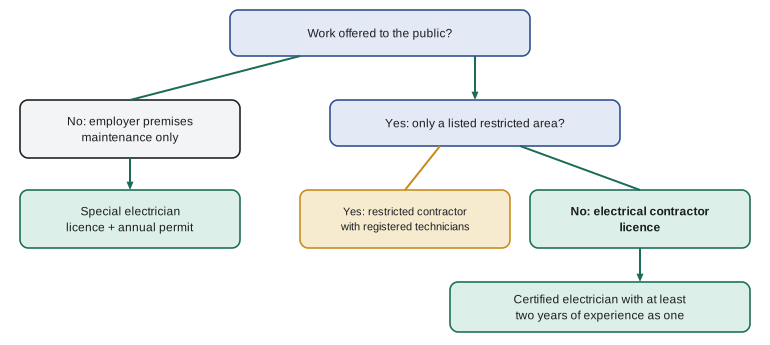
Who may do electrical work at all
Section 2 also contains the rule that governs every crew on the Island. Only certified electricians, apprentices working under direct supervision, or holders of the appropriate permit or licence may do electrical work. The regulations also require the licence to be carried on site, and section 10 requires a licence holder to produce it to an inspector on request. Failing to produce a licence on request is an offence and can lead to suspension or cancellation.
Construction Electrician is also a certified compulsory trade under the province's apprenticeship legislation. The two systems reinforce each other. Apprenticeship law says you must be a registered apprentice or hold a certificate of qualification to work in the trade. The electrical regulations say who may do electrical work on an installation and require the contractor's licence for permits.
Section 5 deals with people who were already working before the current system: certain holders of journeyman licences as of December 31, 2006, and holders of construction electrician permits, may continue to work under a contractor's supervision. Natalie will rarely meet this now, but older electricians sometimes hold credentials from before 2007, and Wayne remembers the change.
Rules common to every licence
| Rule | Where | What it means in practice |
|---|---|---|
| Licences expire December 31 of the year issued | Section 10(1) | Every licence on the Island renews at the same time each year |
| Licences cannot be transferred | Section 6 | A buyer of a contracting business needs its own licence |
| Licence must be carried on site and produced on request | Sections 2(7) and 10(3) | Keep the licence, or a copy, in the truck |
| Failing to produce a licence is an offence | Section 10(4) | It can lead to suspension or cancellation |
| Licences may be suspended or cancelled | Section 7(4) | For lack of qualification, failing to comply with an order, or contravening the Act, regulations or Code |
| Suspension decisions can be appealed | Section 7(6) | To the minister within 10 days of notice |
The annual fees are set in a schedule of the regulations. The consolidation lists 250 dollars a year for an electrical contractor licence, 80 for a restricted contractor licence, and 15 each for registered technician and special electrician licences. The government's application page confirms the 250 dollar contractor fee for a one-year licence.
A worked example: when the qualifier leaves
Worked problem
A firm loses its certified electrician
Harbourside Electric holds an electrical contractor licence as a corporation. Its licence application named its operations manager, a certified electrician with twelve years of experience, as the person who met the qualifications. In March he retires. Can Harbourside keep operating under its licence?
Show solution
- The regulations require at least one member, partner or employee of a firm to meet the qualifications for the firm to be licensed.
- Once the only qualifying person leaves, the firm no longer meets that requirement.
- Section 7(4) allows a licence to be suspended or cancelled for lack of qualification.
- Harbourside should name another certified electrician with at least two years of experience as one, and tell Inspection Services, before the qualifier leaves. Two of its lead hands, Natalie among them, meet the requirement today.
Answer: A firm's licence depends on keeping a qualifying certified electrician. Plan the replacement before the departure, and keep Inspection Services informed.
Wayne says this is the most common way small Island firms get into trouble. The founder is the only qualifier, nobody thinks about it for twenty years, and then the founder retires or falls ill. Natalie writes a note to herself: once Gallant Electric has a second certified electrician with two years of experience, make sure that person could step in.
Counting the two years
Because the requirement is counted from certification, Natalie wants a quick way to check when a new hire will become eligible to be a firm's qualifier. The calculator below adds two years to the date on a certificate of qualification. It ignores leap-day edge cases, and the official count is whatever Inspection Services accepts, so treat the output as a planning date.
from datetime import date

def eligible_from(certified: date) -> date:
    # Two years of experience as a certified electrician, counted from certification.
    try:
        return certified.replace(year=certified.year + 2)
    except ValueError:            # certified on February 29
        return date(certified.year + 2, 3, 1)

crew = {
    "Natalie Gallant": date(2018, 6, 14),
    "Luc Arsenault": date(2024, 11, 2),
    "Owen Doucette (apprentice, not yet certified)": None,
}
today = date(2026, 11, 10)
for name, cert in crew.items():
    if cert is None:
        print(f"{name}: no certificate yet")
        continue
    when = eligible_from(cert)
    status = "meets the two years" if when <= today else f"eligible from {when}"
print(f"{name}: certified {cert}, {status}")Natalie Gallant: certified 2018-06-14, meets the two years Luc Arsenault: certified 2024-11-02, meets the two years Owen Doucette (apprentice, not yet certified): no certificate yet
Luc became certified in November 2024, so he reaches two years as a certified electrician in November 2026. If Natalie ever needs a second qualifier, he is the obvious candidate.
Choosing the right licence for Gallant Electric
Natalie's work covers houses, small commercial spaces, farm buildings and heat pumps. None of it fits within a restricted area. She needs the full electrical contractor licence, and as a corporation, Gallant Electric will name her as the certified electrician whose qualifications support it. If she later wanted to add a fire alarm or sign division staffed by registered technicians, the full licence already covers all areas of electrical work, but the people doing that work would still need to be qualified to do it.
Licences and the people who hold them
It helps to keep two questions separate whenever a licence comes up. The first is who holds the licence: the individual contractor, or a firm such as a corporation or partnership. The second is whose qualifications support it: the certified electrician with two years of experience as one. For a sole proprietor, the answer to both questions is the same person. For a firm, the licence belongs to the firm, and the qualifications belong to a person the firm employs or includes.
That separation explains several rules that might otherwise seem odd. A firm's licence cannot simply follow a qualifying electrician who leaves, because the licence belongs to the firm and section 6 says licences cannot be transferred. A buyer of a contracting business cannot use the seller's licence, for the same reason. And a firm can stay licensed through changes of ownership, as long as it keeps a qualifying person and reports changes to Inspection Services.
Wayne ran his business as a sole proprietor for the first ten years and then incorporated. He remembers having to apply for a new licence in the company's name, even though nothing about the work changed. Natalie is incorporating from the start, so Gallant Electric will hold its licence from day one, with Natalie named as the certified electrician whose qualifications support it.
Common mistakes
MistakeCounting apprenticeship years toward the two-year requirement.
InsteadThe two years are counted as a certified electrician, after the certificate of qualification is issued.
MistakeAssuming a firm can keep its licence after its only qualifying person leaves.
InsteadA firm needs at least one member, partner or employee who meets the qualifications. Plan a replacement and keep Inspection Services informed.
MistakeSending a registered technician to do general electrical work.
InsteadA registered technician works for a restricted contractor in the restricted area only.
MistakeLeaving the licence at the office.
InsteadThe licence must be carried on site and produced to an inspector on request.
Summary and key terms
- The regulations create four licences: electrical contractor, restricted contractor, registered technician and special electrician.
- An electrical contractor licence needs a certified electrician with at least two years of experience as one, and a copy of the Code; for a firm, one member, partner or employee must qualify.
- Restricted contractors employ registered technicians and work only in the restricted areas listed in the regulations.
- Only certified electricians, apprentices under direct supervision, and permit or licence holders may do electrical work.
- All licences expire December 31, cannot be transferred, and can be suspended or cancelled; suspensions can be appealed to the minister within 10 days.
- Electrical contractor licence
- The full PEI licence to contract for all areas of electrical work and apply for permits.
- Restricted contractor licence
- A licence limited to the restricted areas listed in the regulations, held by a firm employing a registered technician or by a technician.
- Registered technician
- An individual licensed to work for a restricted contractor in a restricted area.
- Special electrician licence
- A licence to operate or maintain installations only on the holder's employer's premises.
- Qualifier
- Common term for the certified electrician whose qualifications support a firm's contractor licence.
- Direct supervision
- The level of supervision under which an apprentice may do electrical work.
Practice problems
Work each problem on paper first, then reveal the answer to check.
A journeyperson received her certificate of qualification on May 1, 2025. When can she first support a contractor licence on her own qualifications?
Show answer
May 1, 2027, two years after certification.
A sign company wants to install and connect illuminated signs with its own technicians. What licence route should it investigate?
Show answer
A restricted contractor licence employing registered technicians, if sign work is a listed restricted area; otherwise a full contractor licence.
What is the annual fee for an electrical contractor licence according to the government's application page?
Show answer
250 dollars for a one-year licence.
Within how many days can a licence holder appeal a suspension to the minister?
Show answer
Within 10 days of notice.
Lesson quiz · 5 questions
Score 60% or more to complete this lesson.
Create a free account to save your progress, take quizzes and earn a certificate.