
MELC-209 · Lesson 12 of 12 · 16 min
Readiness review: a practice test for new contractors
▶ Video coming soon A video version of this lesson is on the way.
In provinces with a master electrician exam, the last lesson of a course like this is an exam rehearsal. The Island has no such exam, so this lesson does something different. It walks Natalie, and you, through a structured readiness review: a practice test on the Island's rules, a set of scenarios drawn from the jobs in this course, and a checklist for the first week of a new contracting business. If Inspection Services ever asks you to write an exam as part of a licence application, this review, together with MELC-101 to MELC-106, is the right preparation for it.
How to use this review
Work through the practice questions without notes first, then check each answer against the lesson that covers it. Any question you miss points to a lesson to reread. The scenarios are best done with a colleague or mentor, as Natalie does with Wayne: one person reads the situation, the other explains what they would do and why, citing the rule or statute that applies. The checklist at the end is for real use before the first job.
Part 1: the rules at a glance
Natalie starts by writing the Island's key rules on a single page, from memory, then checks them. This is her corrected page.
| Topic | The rule | Lesson |
|---|---|---|
| Licensing body | Inspection Services, under the Chief Electrical Inspector | 1 |
| Master electrician exam | None on the Island | 1, 4 |
| Contractor licence qualification | Certified electrician with at least two years of experience as one, and a copy of the Code; for a firm, one member, partner or employee | 2 |
| Licence types | Electrical contractor, restricted contractor, registered technician, special electrician | 2 |
| Licence fee and term | 250 dollars a year for a contractor licence; all licences expire December 31 | 2, 3, 11 |
| Processing | At least two weeks; an exam may be required | 3 |
| Code in force | 2024 Canadian Electrical Code Part I, Twenty-sixth Edition, with Schedule 1 amendments | 5 |
| Who may apply for a permit | Only the licensed contractor who will do the work; one application per building | 6 |
| Building permit first | No electrical permit until any required development or building permit is issued | 6 |
| Completion | Notify the inspector, follow the rough-in rule, give a certificate of compliance to the inspector and owner | 6, 7 |
| Who may do electrical work | Certified electricians, apprentices under direct supervision, permit or licence holders | 2, 7 |
| Suspension appeal | To the minister within 10 days of notice | 7 |
| Holdback | 20 in 100, or 15 in 100 where the value is over 15,000 dollars, for 60 days | 9 |
| Lien registration | Within 60 days of completion or abandonment; expires 90 days after registration unless enforced | 9 |
| Prompt payment | No prompt payment legislation on the Island | 9 |
| Injury reporting | To WCB within three days; serious injuries immediately to the OHS Division | 10 |
Part 2: scenarios
Each scenario below draws on more than one lesson. Read it, decide what you would do, then compare with Natalie and Wayne's discussion.
Scenario 1: the out-of-province partner
A Red Seal electrician certified in Nova Scotia eighteen months ago wants to become a partner in Gallant Electric and be named as a second qualifier. He has worked continuously since certification.
Natalie and Wayne agree he cannot yet support the licence on his own qualifications: he has eighteen months, not two years, as a certified electrician. He can work for the company as a certified electrician once his certification is recognized on the Island, and in six months he will meet the experience requirement. Lessons 2 and 3 cover both points.
Scenario 2: the farm with three buildings
The Rogers farm near Kinkora wants a new machine shed, a new potato storage and a service upgrade to the existing barn, all done in one week by the same crew. The storage is in an area where the province issues building permits.
Three buildings means three electrical permit applications. The new buildings need their building or development permits issued before the electrical permits can be. The barn upgrade is work on an existing installation, so Natalie talks to an inspector about required upgrades before quoting it. Lessons 5 and 6.
Scenario 3: the customer's own heat pump
A cottage owner in Cavendish bought a mini-split heat pump online and wants Gallant Electric to connect it. The unit has no Canadian certification mark.
Natalie declines. Rule 2-024 as it applies on the Island requires certified equipment, and the quote template says so. She offers to supply and install a certified unit instead, with a refrigeration contractor for the refrigerant work. Lessons 5 and 8.
Scenario 4: the unpaid subcontract
A general contractor owes Gallant Electric 9,000 dollars for a renovation completed 50 days ago and has stopped returning calls.
Natalie has 10 days left of the 60-day period to register a lien. She calls a lawyer that day. If she registers, she must start an action within 90 days of registration, or within 30 days if she receives a notice under section 28. Lesson 9.
Scenario 5: the Saturday injury
Owen cuts his hand badly on a sharp box edge on a Saturday and needs stitches at the emergency department; he is not admitted.
Natalie reports the injury to the WCB within three days of being notified. She checks section 36(1) of the OHS Act to decide whether it is a serious injury needing an immediate report; stitches without admission usually are not, but she checks rather than assumes. She also asks why Owen was working alone on a Saturday, because as an apprentice he should have been under direct supervision. Lessons 7 and 10.
Part 3: scoring your readiness
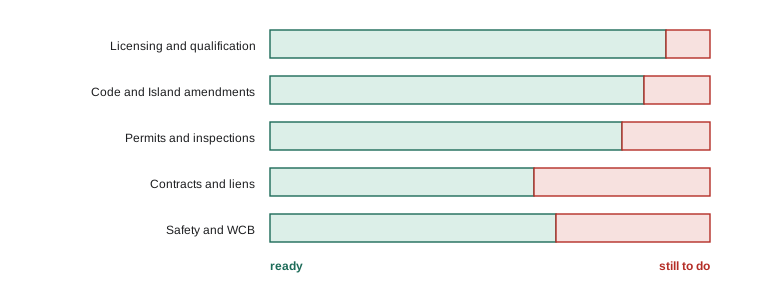
Wayne suggests turning the review into a score. For each of the five areas, count how many of the practice questions and scenarios you got right without notes. The script below turns the counts into a simple dashboard and flags any area below 0.8 for review.
results = {   # (correct, attempted) without notes
    "licensing and qualification": (9, 10),
    "Code and Island amendments": (7, 8),
    "permits and inspections": (8, 10),
    "contracts and liens": (5, 8),
    "safety and WCB": (6, 8),
}
for area, (right, total) in results.items():
    share = right / total
    bar = "#" * round(share * 20)
    flag = "" if share >= 0.8 else "  <- review"
print(f"{area:30s} {bar:20s} {share:.2f}{flag}")licensing and qualification ################## 0.90 Code and Island amendments ################## 0.88 permits and inspections ################ 0.80 contracts and liens ############ 0.62 <- review safety and WCB ############### 0.75 <- review
Natalie's own results flag contracts and liens and safety and WCB, the same areas her Lesson 4 self-assessment predicted. She spends another evening on Lessons 9 and 10 before her licence arrives.
Part 4: the first-week checklist
The last part of the review is practical. Before Gallant Electric does its first job, Natalie and Sam check every item below.
- Electrical contractor licence issued in the company's name, with a copy in each truck.
- Natalie's certificate of qualification and proof of experience on file, in case Inspection Services asks.
- Current Code book with Schedule 1 amendments tabbed, and a copy of the regulations.
- Business registration, CRA business number, payroll and harmonized sales tax accounts in place.
- WCB registration complete, and a clearance letter ready for general contractors.
- Commercial general liability and completed operations insurance in force, with certificates ready.
- Written contract and change order templates, with the certified equipment clause.
- Permit log, crew list form and job checklist set up.
- Safety procedures written for lockout, energized work, ladders and fall protection, with training records for Owen and Luc.
- Calendar entries for licence renewal in November, quarterly regulation checks, and holdback and lien dates on every job.
When every item is ticked, Wayne says, she is more ready than he was in his first year. Natalie takes the first call the next morning: a heat pump in Summerside.
Where to go from here
This course is the last step in the Prince Edward Island program. MELC-101 to MELC-106 built the technical and business foundation, and this course applied it to the Island's licensing, permits and law. Keep the one-page summary from Part 1, update it when the regulations change, and revisit the Code courses when the Island adopts a new edition.
Part 5: questions to ask Inspection Services
Some things a new contractor should simply ask rather than guess. Natalie writes down the questions she will ask Inspection Services in her first call after the licence arrives.
- Is the October 2024 consolidation of the regulations still current, or have there been amendments, including to the permit fees?
- How does Inspection Services prefer contractors to give notice that rough-in is ready, and how is the 48-hour period counted?
- For a duplex or a house with a secondary suite, how many dwelling units does the permit fee schedule count?
- What documents should a contractor keep on site for an inspection?
- When will the Island adopt the next edition of the Code, and will the Schedule 1 amendments change?
Wayne says inspectors appreciate contractors who ask before they guess. The answers will also help Natalie update her one-page summary from Part 1.
Part 6: a final self-check
Before closing the course, Natalie answers five questions in her own words, without notes. Why does the Island not need a master electrician exam, and what replaces it? What has to be in place before the company can apply for its first permit? What will she do differently on an older house than on a new one? What three dates will Sam record for every job? And what will she do in the first hour after a worker is seriously injured? If you can answer all five clearly, you are ready to work as a licensed contractor on the Island.
Wayne reads her answers, makes two small corrections, and hands back the notebook. He says the most important thing she wrote was not any one answer but the line at the bottom of the page: when in doubt, call Inspection Services before the work, not after.
Part 7: common traps, revisited
Across the course, the same handful of traps came up again and again. Natalie lists them on the back of her one-page summary as a final reminder.
- Assuming another province's rules apply: master exams, licence bonds, lower holdbacks, prompt payment. None of these is part of the Island's system.
- Starting work before the licence or the permit is in place, or before the customer's building permit exists.
- Sending an apprentice to work without direct supervision.
- Applying the national Code wording where Schedule 1 has amended the rule.
- Installing uncertified customer-supplied equipment.
- Losing track of the completion date, and with it the holdback and lien deadlines.
- Confusing the three-day WCB report with the immediate report of a serious injury.
- Letting the licence lapse on December 31.
Each of these traps has caught real contractors. None of them requires deep technical knowledge to avoid; each requires knowing the rule and having a system that applies it every time.
Part 8: a second pass with a mentor
Natalie finishes the review by going through it a second time with Wayne, a month after the first. The aim is not to memorize answers but to check that her systems would catch each trap without her having to remember it. For each scenario, Wayne asks one question: what in Gallant Electric's paperwork or calendar would stop this going wrong? Where the answer is only Natalie's memory, they add a checklist item or a calendar entry.
By the end of the second pass, every trap on her list has a system behind it. Wayne says that is the real test of a new contractor: not what you know on a good day, but what your business does on a busy one.
Common mistakes
MistakeTreating the readiness review as optional because there is no exam.
InsteadThe review covers what you will be accountable for on every job, exam or not.
MistakeStudying only the technical areas you already know well.
InsteadSpend preparation time where your score is lowest, usually contracts, liens and safety law.
MistakeRelying on the one-page summary after the regulations change.
InsteadUpdate it whenever the regulations, fees or Code edition change.
Summary and key terms
- The Island has no master exam, so readiness is a matter of knowing the rules and setting up the business correctly.
- Key rules: licence through Inspection Services, two years as a certified electrician, 250 dollars a year, December 31 expiry, permits by the contractor doing the work.
- Scenarios test combinations of licensing, permits, Code, liens and safety rules, as real jobs do.
- Score each area and review anything below 0.8.
- Complete the first-week checklist before the first job.
- Readiness review
- A structured self-test and checklist used in place of a licensing exam.
- Scenario
- A realistic situation that requires applying several rules at once.
- First-week checklist
- The list of licences, registrations, insurance, templates and procedures needed before the first job.
Practice problems
Work each problem on paper first, then reveal the answer to check.
A Red Seal electrician has been certified for 18 months. Can he support a firm's contractor licence on the Island?
Show answer
Not yet; he needs two years of experience as a certified electrician.
A farm wants three buildings wired. How many electrical permit applications are needed?
Show answer
Three, one for each building.
Fifty days after completing a subcontract, a contractor is unpaid. How many days remain to register a lien?
Show answer
Ten days, because the period is 60 days from completion.
Which two areas does this lesson say usually need the most preparation?
Show answer
Contracts and liens, and safety and WCB.
Lesson quiz · 5 questions
Score 60% or more to complete this lesson.
Create a free account to save your progress, take quizzes and earn a certificate.