
MELC-209 · Lesson 3 of 12 · 20 min
Applying for an electrical contractor licence
▶ Video coming soon A video version of this lesson is on the way.
Applying for an electrical contractor licence on the Island is one of the simplest licensing processes in the country, at least on paper. The government's service page describes an online application that takes under ten minutes to complete if you have your documents ready, a one-year licence fee of 250 dollars, and a processing time of at least two weeks. The page also warns that you may be required to write an exam, without saying when. The real work is everything around the application: setting up the business so that the right entity applies, gathering proof of certification and experience, and lining up the insurance, registrations and accounts that you will need on the first day you are licensed.
This lesson follows Natalie through the application for Gallant Electric Ltd., step by step. Lesson 8 covers the business registrations, insurance and accounts in more depth.
Step 1: decide who is applying
The regulations allow an individual or a firm to hold an electrical contractor licence. For an individual, the applicant must personally be a certified electrician with two years of experience as one. For a firm, such as a corporation or partnership, at least one member, partner or employee must meet the qualifications.
Natalie has incorporated Gallant Electric Ltd. so that the company, not Natalie personally, enters contracts and carries the business risk. That means the company is the applicant, and Natalie is named as the certified electrician who meets the qualifications. Wayne points out that the licence will be in the company's name, so every contract, quote, permit application and invoice should be in the same name. A licence in one name and contracts in another is the kind of mismatch that causes trouble when something goes wrong.
If Natalie had decided to work as a sole proprietor, she would apply in her own name. Either structure works for licensing. The choice affects liability, taxes and how the business can be sold or passed on, which is why most contractors talk to an accountant before choosing.
Step 2: register the business
A corporation is created by incorporation, and a business operating under a name other than the owner's own needs to register that name. Both are handled by the province's corporate registry, not by Inspection Services. Gallant Electric Ltd. was incorporated provincially, which gave it its legal name and a registration record Natalie can point to on the licence application.
Sam also sets up the federal business number and an account for sales tax, and opens the company's workers compensation account with WCB. None of these is part of the electrical licence application, but each is needed before the company sends its first invoice or hires its first employee.
Step 3: gather the documents
The government's page says the online application needs certification documents and full payment. Natalie assembles the following before she sits down to apply.
- Her certificate of qualification as a construction electrician, with the Red Seal endorsement, showing the date she was certified.
- Evidence of at least two years of experience working as a certified electrician. Her certificate date shows she has been certified for eight years; letters or records from Harbourside Electric confirming her employment as a journeyperson show the experience.
- The company's incorporation record and legal name, and the names of its directors.
- Proof that she has a copy of the Code, since the regulations require the applicant to have one. A receipt for the 2024 Canadian Electrical Code Part I, or the book itself, is enough to answer the question if it is asked.
- A payment card for the 250 dollar fee. The service page lists Visa, Visa Debit, Mastercard and Debit Mastercard.
Wayne adds one more: a short summary of the kind of work the company will do. It is not on any form, but if an inspector calls to ask questions about the application, Natalie will be able to answer clearly.
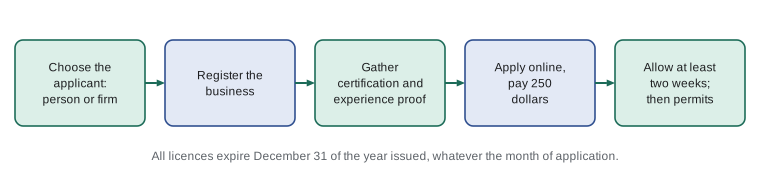
Step 4: apply and pay
The application is made through the government's online services. The service page notes that it takes under ten minutes to complete with the documents on hand, and offers an optional reminder for renewal. Natalie fills in the company's details, names herself as the certified electrician who meets the qualifications, uploads her certification documents, and pays.
The page also says the applicant may be required to write an exam. The regulations, as consolidated, do not describe a licensing exam, a pass mark or retake rules, so the most likely reading is that Inspection Services keeps the option to examine an applicant where it needs more assurance, for example where the applicant's certification or experience is unusual. If you are asked to write an exam, Inspection Services will tell you what it covers. Natalie's preparation for that possibility is the whole of the master electrician core: MELC-101 to MELC-106 cover the Code and the business knowledge any reasonable exam would draw on.
Step 5: wait for the licence, and do not start early
The service page says to allow at least two weeks for processing. That matters because the company cannot apply for electrical permits until it holds a licence, and it cannot start electrical work that needs a permit until the permit is in place. Natalie times her application so the licence arrives before her last day at Harbourside.
Wayne tells a story from the 1990s about a new contractor who started roughing in a basement while his licence was still being processed, on the theory that he would apply for the permit as soon as the licence came. The inspector who eventually came for the rough-in asked when the work had started. The contractor told the truth. The inspector made him open up the walls he had already closed. The licence did arrive; the reputation took longer to repair.
Timing the application
Licences expire on December 31 of the year they are issued, regardless of when in the year they are issued. That has a practical consequence for timing. A licence issued in November costs the same 250 dollars as one issued in January, but it lasts only a few weeks before it must be renewed. Natalie wants to leave Harbourside in late spring, so the timing works out well: she will get seven months of use from her first licence before the first renewal.
from datetime import date

FEE = 250   # dollars for a one-year electrical contractor licence

def months_of_use(issued: date) -> int:
    # Licences expire December 31 of the year they are issued.
    return 12 - issued.month + 1

for issued in (date(2027, 1, 15), date(2027, 5, 3), date(2027, 11, 20)):
    m = months_of_use(issued)
print(f"issued {issued}: about {m:2d} months of use, about {FEE / m:6.2f} dollars a month")issued 2027-01-15: about 12 months of use, about 20.83 dollars a month issued 2027-05-03: about 8 months of use, about 31.25 dollars a month issued 2027-11-20: about 2 months of use, about 125.00 dollars a month
The output shows why contractors who can choose their start date avoid starting in late autumn. It is a small amount of money, but the renewal paperwork arrives almost as soon as the first licence does.
What the licence does not cover
Once the licence arrives, Natalie can contract for electrical work and apply for permits. The licence does not on its own make the company insured, registered with WCB, or entitled to do gas or plumbing work that some heat pump and water heater jobs touch. Each of those has its own requirement. Lesson 8 lists them. The licence also does not replace the permit: every electrical job still needs its own permit, and the work must be inspected, which Lesson 6 covers.
A worked example: an application that gets stuck
Worked problem
Missing evidence of experience
Luc Arsenault considers applying for his own contractor licence before deciding to join Gallant Electric. His Red Seal certificate was issued in New Brunswick in November 2024. He applies in September 2026. What problems might Inspection Services raise?
Show solution
- Luc is a certified electrician, but in September 2026 he has less than two years of experience as a certified electrician. He reaches two years in November 2026.
- His certificate was issued in another province. The Red Seal endorsement is recognized across Canada, but Inspection Services may want confirmation that his certification is recognized on the Island, which the apprenticeship office can provide.
- If Luc applies before November 2026, the application should be refused, or held, for lack of the two-year experience requirement.
- The fix is to wait until he has two years as a certified electrician, with proof of his work since certification, and confirm Island recognition of his certificate.
Answer: Applications most often stall on the experience requirement and on proof of certification. Check both before paying the fee.
A checklist Natalie keeps
| Item | Who handles it | Done before applying? |
|---|---|---|
| Choose the business structure | Natalie, with an accountant | Yes |
| Incorporate or register the business name | Corporate registry | Yes |
| Certificate of qualification with certification date | Natalie | Yes |
| Proof of two years as a certified electrician | Natalie, former employer | Yes |
| Copy of the adopted Code | Natalie | Yes |
| Apply online and pay the licence fee | Natalie | Application |
| Allow at least two weeks for processing | Inspection Services | After |
| Insurance, WCB account, tax accounts | Sam and the insurer | Before the first job |
If an exam is required
The government's service page says an applicant may be required to write an exam, but the consolidated regulations do not describe one. If Inspection Services asks you to write an exam, ask three questions before you prepare: what subjects it covers, what references are allowed, and how it is scored. In provinces that have contractor or master exams, the subjects are usually the Code, including calculations and installation rules, the province's own act and regulations, and business and safety law. The references allowed are usually the Code book and the provincial regulations, sometimes with a calculator.
The master electrician core in this program covers all of those subjects in the Canadian context. MELC-101 teaches Code navigation under time pressure; MELC-102 covers calculations; MELC-103 to MELC-105 cover wiring methods, grounding and bonding, and special installations; MELC-106 covers business and law. This course adds the Island's regulations, permits, liens and safety law. A candidate who has worked through all seven courses, and done the Lesson 12 readiness review, is well prepared for any reasonable exam Inspection Services might set.
Changes after the licence is issued
A licence describes a business at a moment in time. Businesses change: they move, add partners, change their names, or hire and lose qualifying electricians. The consolidated regulations do not set out a detailed change-notification procedure, but a licence that no longer matches the business invites problems, from a permit application rejected because the names do not match, to a suspension for lack of qualification. Natalie's rule is to tell Inspection Services about any change to the company's name, address, ownership or qualifying electrician as soon as it happens, and to keep a record of when she did.
Wayne adds a practical point. If you move your business from Summerside to Charlottetown, nothing about your licence's scope changes, because PEI licences cover the whole province. What changes is which utility serves your jobs, and which municipalities' building permits your customers need.
Sole proprietor or corporation: what changes for licensing
Natalie's accountant lays out the licensing side of the business structure decision in plain terms. As a sole proprietor, Natalie would apply in her own name, her own qualifications would support the licence, and every contract would be with her personally. As a corporation, Gallant Electric Ltd. applies, Natalie is named as the qualifying certified electrician, and contracts are with the company. In both cases the licence fee, the processing time and the December 31 expiry are the same.
What changes is what happens around the licence. A corporation can hire a second qualifying electrician and keep its licence if Natalie steps back. A sole proprietorship is tied to Natalie: if she cannot work, the business cannot hold a licence on anyone else's qualifications without becoming a different business. For a contractor who hopes to grow, or one day sell, that difference matters more than the paperwork.
Natalie also learns that incorporation does not shield her from every responsibility. As the certified electrician whose qualifications support the licence, and as the person who signs certificates of compliance, she remains personally accountable to Inspection Services for the work she controls. The corporation protects her personal assets from many business debts; it does not let her ignore the regulations.
Common mistakes
MistakeApplying in one name and contracting in another.
InsteadThe licence holder, the name on contracts, quotes and permit applications, and the name on invoices should match.
MistakeApplying before reaching two years as a certified electrician.
InsteadThe experience requirement is counted from certification. Apply once the two years are complete and documented.
MistakeStarting work while the licence is being processed.
InsteadA contractor cannot apply for permits without a licence, and work that needs a permit cannot start without one. Allow at least two weeks.
MistakeAssuming the licence fee is prorated.
InsteadLicences expire December 31 whatever the issue date; a late-year licence gives only a few weeks of use.
Summary and key terms
- Decide whether an individual or a firm will hold the licence; a firm needs a qualifying member, partner or employee.
- Register the business and set up tax and WCB accounts outside the licensing process.
- Gather certification documents, proof of two years as a certified electrician, and a copy of the Code.
- Apply online, pay the 250 dollar annual fee, and allow at least two weeks for processing; an exam may be required in some cases.
- Do not start permitted work until the licence and the permit are both in place.
- Applicant
- The individual or firm that will hold the electrical contractor licence.
- Certification documents
- The certificate of qualification and supporting records showing when the applicant became a certified electrician.
- Processing time
- The period, at least two weeks according to the government, between application and licence.
- Corporate registry
- The provincial office that incorporates companies and registers business names.
Practice problems
Work each problem on paper first, then reveal the answer to check.
Natalie applies on May 3 and the licence is issued on May 20. When does it expire?
Show answer
December 31 of the same year.
What fee does the government list for a one-year electrical contractor licence?
Show answer
250 dollars.
Name two things outside the licence application that a new contractor needs before the first job.
Show answer
Any two of: business registration, a WCB account, sales tax and payroll accounts, liability insurance.
Do the consolidated regulations set out a licensing exam with a pass mark?
Show answer
No. The service page says an exam may be required, but the consolidated regulations do not describe one.
Lesson quiz · 5 questions
Score 60% or more to complete this lesson.
Create a free account to save your progress, take quizzes and earn a certificate.