
MELC-209 · Lesson 10 of 12 · 19 min
Occupational health and safety law for electrical contractors
▶ Video coming soon A video version of this lesson is on the way.
Electrical work is dangerous in ways that most trades are not. Shock, arc flash, falls from ladders and roofs, and work in crawl spaces and attics are everyday hazards. When Natalie hires Owen and Luc, she stops being only a worker who follows safety rules and becomes an employer who is responsible for them. On the Island, that responsibility comes from the Occupational Health and Safety Act and its regulations, enforced by the Occupational Health and Safety Division of the Workers Compensation Board of PEI, and from the Workers Compensation Act, administered by the WCB itself.
This lesson covers the duties that matter most to a small electrical contractor. The reporting rules were checked against the WCB's own pages in late 2026. Other details, such as committee thresholds and specific regulation sections, are described in general terms; confirm them in the current Act and regulations, or with the OHS Division, before relying on them.
Who enforces what
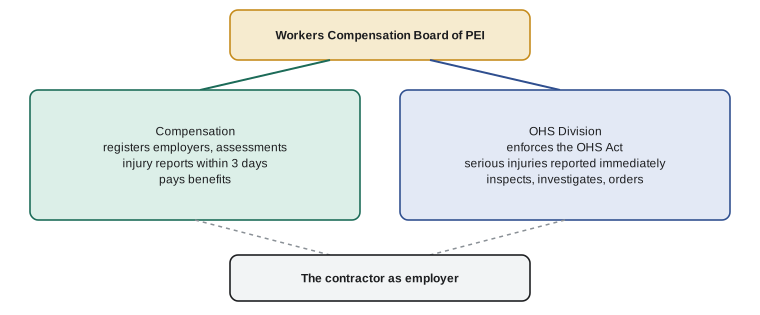
The WCB of PEI wears two hats. As the compensation board, it registers employers, collects assessments, pays benefits to injured workers and requires injury reports. Through its Occupational Health and Safety Division, it enforces the Occupational Health and Safety Act and its regulations: officers inspect workplaces, investigate serious incidents and can issue orders. A contractor deals with both sides.
The employer's general duties
Like every province's OHS law, the Island's Act places a general duty on employers to take every reasonable precaution to protect the health and safety of their workers. For an electrical contractor, that general duty is made concrete in a few practical ways.
- Provide training and supervision so that workers know the hazards of the work and how to control them. An apprentice needs more of both.
- Provide and maintain the equipment the work needs: rated test meters, insulated tools, arc-rated clothing where the work calls for it, ladders, fall protection and lockout devices.
- Have safe work procedures for the hazards the company faces, especially working on or near energized equipment and lockout of equipment before work.
- Involve workers in safety through a committee or a representative, as the Act requires for the size of the workplace.
- Investigate incidents and fix what caused them.
Workers have duties too: to follow procedures, use the equipment provided and report hazards. Workers also have the right to refuse work they reasonably believe is dangerous, without reprisal. An employer who punishes a worker for a legitimate refusal is breaking the law.
Electrical hazards and the standards that address them
OHS regulations on the Island, as elsewhere, include rules for electrical safety: de-energizing and locking out equipment before work where possible, keeping safe distances from overhead lines, and using qualified workers for electrical tasks. The national standard CSA Z462, Workplace electrical safety, sets out the practices for assessing shock and arc flash risk and choosing controls. Whether a given part of Z462 is referenced in Island regulations is something to check, but it reflects what a court or an OHS officer would treat as reasonable practice.
For a small contractor, the practical core is short. De-energize and lock out whenever possible. Verify absence of voltage with a rated tester that has been checked on a known source. Treat work on energized equipment as the exception that needs justification, a risk assessment and the right protective equipment. Keep well clear of overhead lines, and call the utility before working near them.
Reporting injuries
The WCB's employer pages set out two reporting duties that every Island contractor must know.
- Report injuries to the WCB within three days. Employers must file a report with the WCB within three days of being notified of a work-related injury or illness, through the WCB's online services or on the Employer's Report form. Failing to report on time may result in fines.
- Report serious injuries immediately to the OHS Division. Serious work-related injuries, as defined in section 36(1) of the Occupational Health and Safety Act, must be reported immediately to the WCB's Occupational Health and Safety Division, which runs a 24-hour emergency line for the purpose.
The two reports are different. The three-day report starts the compensation claim. The immediate report lets the OHS Division investigate. A serious injury needs both. And until an officer allows it, the scene of a serious incident should be left as it is, except to help the injured person or prevent further harm.
| Event | Report to | When |
|---|---|---|
| A worker is injured at work and sees a doctor | WCB (compensation) | Within three days of being notified |
| A serious injury as defined in section 36(1) of the OHS Act | WCB Occupational Health and Safety Division | Immediately |
| A serious injury | Both of the above | Immediately to OHS, and within three days to WCB |
| A near miss with no injury | Internal investigation | Promptly, as good practice |
Counting the three days
Sam wants to be sure he never misses the three-day deadline. The calculator below gives the last day to file, counting from the day the company is notified. It counts calendar days; if the deadline falls on a weekend, file early rather than assume an extension.
from datetime import date, timedelta

def wcb_deadline(notified: date) -> date:
    # Employers must report within three days of being notified.
    return notified + timedelta(days=3)

for notified in (date(2027, 4, 5), date(2027, 4, 9), date(2027, 7, 1)):
    d = wcb_deadline(notified)
print(f"notified {notified} ({notified:%A}) -> file by {d} ({d:%A})")notified 2027-04-05 (Monday) -> file by 2027-04-08 (Thursday) notified 2027-04-09 (Friday) -> file by 2027-04-12 (Monday) notified 2027-07-01 (Thursday) -> file by 2027-07-04 (Sunday)
Notification on a Friday gives a Monday deadline. Sam's rule is simpler: file the same day if possible, and never later than the next working day.
Committees and representatives
The Island's Act, like those of other provinces, requires workplace health and safety committees in larger workplaces and a health and safety representative in smaller ones, with the thresholds set by the Act. A three-person contractor like Gallant Electric is unlikely to need a formal committee, but it may need a representative as it grows, and it always needs a way for workers to raise concerns. Check the current thresholds in the Act as the company hires.
On construction sites with several employers, the general contractor or owner typically coordinates safety, and each employer remains responsible for its own workers. Natalie's crew follows the site rules and her own procedures, whichever is stricter.
Workers compensation
Workers compensation is a no-fault system. Workers who are injured at work receive benefits regardless of fault, and in exchange they generally cannot sue their employer. Employers fund the system through assessments based on payroll and their industry classification. Construction classifications carry higher rates than office work because the risks are higher.
An Island employer must register with the WCB and keep its payroll reporting current. General contractors commonly ask subcontractors for proof of good standing before paying them, because a principal can become responsible for a subcontractor's unpaid assessments in some circumstances. Natalie keeps a current clearance letter on file to send with every invoice on larger jobs.
A worked example: an arc flash in a panel
Worked problem
An incident on the duplex job
While Luc is installing a breaker in a live panel at the MacLean duplex, a dropped screwdriver causes an arc flash. Luc is wearing safety glasses but not arc-rated clothing. He has burns to his hand and forearm and is taken to hospital, where he is admitted. What must Gallant Electric do?
Show solution
- Get Luc medical care first, and make the area safe.
- Decide whether this is a serious injury as defined in section 36(1) of the OHS Act. A burn requiring admission to hospital is very likely to be one. If so, report it immediately to the OHS Division.
- Report the injury to the WCB within three days of being notified.
- Leave the scene as it is, except as needed to make it safe, until the OHS Division says otherwise. Then investigate: why was the panel live, why was arc-rated clothing not worn, and what will change?
Answer: A serious injury needs an immediate report to the OHS Division and a three-day report to the WCB, followed by an investigation that changes how the work is done.
Wayne says the hardest question after an incident like this is the first one: why was the panel energized? On most service work, there is no good answer. Natalie writes it into Gallant Electric's procedures: no work in an energized panel without her approval, a risk assessment and the protective equipment the assessment calls for.
Writing safe work procedures
OHS law expects an employer to have safe work procedures for the hazards its workers face. For a small electrical contractor, a handful of written procedures covers most of the risk: lockout and verification before work, work on or near energized equipment, ladder and fall protection use, work in attics and crawl spaces, and work near overhead lines. Each procedure should be short enough to read in a few minutes and specific enough to follow on a job.
Natalie writes Gallant Electric's procedures in plain language, one page each, and goes through them with Owen and Luc before the first job. Each worker signs to say they have been trained on them, and Sam files the signed copies. Wayne says the signatures matter less than the conversation, but that if an OHS officer ever asks, the signatures prove the conversation happened.
Seasonal hazards on the Island
Island work has its own seasonal pattern. Winter brings icy roofs and ladders, cold that makes conductors stiff and insulation brittle, and short days that put more work under temporary lighting. Summer brings heat in attics, a rush of cottage and seasonal work, and new workers on crews. Natalie adds a short seasonal briefing at the start of each winter and summer: what changes, and what the crew should watch for.
Young and new workers
New workers are injured far more often than experienced ones, regardless of age. An apprentice in the first weeks on a new crew is at the highest risk. OHS law expects employers to give new workers an orientation and closer supervision. For an electrical contractor, that fits naturally with the regulations' requirement that apprentices work under direct supervision. Natalie treats every new hire, even an experienced certified electrician, as new for the first two weeks: an orientation, a review of the procedures, and a lead hand who checks in daily.
Inspections by OHS officers
OHS officers from the WCB's Occupational Health and Safety Division may visit construction sites, including sites where Gallant Electric is working. An officer can inspect, ask questions, review records and, where there is a problem, issue orders. The best preparation is ordinary good practice: procedures written and followed, training records on file, protective equipment in good condition, and a crew that knows what to do.
Natalie tells her crew that if an officer visits, they should be courteous, answer honestly, and call her. She keeps copies of the company's procedures and training records on her phone so she can produce them quickly. Wayne says an officer's visit is far less stressful for a contractor who has nothing to hide, and that most officers would rather help a small contractor improve than punish one.
If an officer issues an order, comply with it by the date given and keep a record of how. Orders are not suggestions, and a pattern of ignored orders invites much stricter enforcement.
Natalie also holds a short safety talk every Monday morning, ten minutes on one topic, and keeps a sign-in sheet. It costs little and gives the company a record of training that would otherwise be informal.
Common mistakes
MistakeTreating the WCB injury report and the OHS serious injury report as the same thing.
InsteadThe WCB report starts the claim within three days; a serious injury must also be reported immediately to the OHS Division.
MistakeWorking in energized panels as routine.
InsteadDe-energize and lock out wherever possible; energized work needs justification, assessment and protective equipment.
MistakeDisturbing the scene of a serious incident to get back to work.
InsteadLeave the scene, except to help the injured or prevent harm, until the OHS Division allows otherwise.
MistakePunishing a worker who refuses unsafe work.
InsteadWorkers have the right to refuse dangerous work without reprisal.
Summary and key terms
- The WCB of PEI handles compensation, and its Occupational Health and Safety Division enforces the OHS Act and regulations.
- Employers must take every reasonable precaution: training, supervision, equipment, safe procedures and worker involvement.
- Employers must report work injuries to the WCB within three days of being notified.
- Serious injuries, as defined in section 36(1) of the OHS Act, must be reported immediately to the OHS Division.
- Electrical safety practice centres on de-energizing, lockout and verification, with CSA Z462 as the national reference for shock and arc flash risk.
- OHS Division
- The WCB of PEI's Occupational Health and Safety Division, which enforces the OHS Act.
- Serious injury
- An injury meeting the definition in section 36(1) of the OHS Act, which must be reported immediately.
- Right to refuse
- A worker's right to refuse work reasonably believed to be dangerous, without reprisal.
- Lockout
- Isolating and locking an energy source so equipment cannot be energized during work.
- Assessment
- The amount an employer pays the WCB, based on payroll and industry classification.
Practice problems
Work each problem on paper first, then reveal the answer to check.
Within how many days must an Island employer report a work injury to the WCB?
Show answer
Within three days of being notified.
To whom must a serious injury be reported immediately?
Show answer
The WCB's Occupational Health and Safety Division.
Name the national standard for workplace electrical safety and arc flash.
Show answer
CSA Z462.
What is the first question to ask after an arc flash during panel work?
Show answer
Why the equipment was energized.
Lesson quiz · 5 questions
Score 60% or more to complete this lesson.
Create a free account to save your progress, take quizzes and earn a certificate.