
MELC-209 · Lesson 11 of 12 · 19 min
Renewal, records and staying current
▶ Video coming soon A video version of this lesson is on the way.
A licence that lapses is as useless as one that was never issued. Every electrical licence on the Island expires on December 31 of the year it was issued, so every contractor renews at the same time each year. This lesson covers the renewal itself, the records that keep a contracting business ready for questions from inspectors, customers and insurers, and the habits that keep a contractor current as the Code and the regulations change.
Annual renewal
Under section 10(1) of the consolidated regulations, licences expire on December 31 of the year issued. The government's service page for the electrical contractor licence confirms that licences expire every December 31 and must be renewed annually, and offers an optional email reminder. The renewal fee is the same 250 dollars a year as the original licence, according to the service page and the consolidated fee schedule.
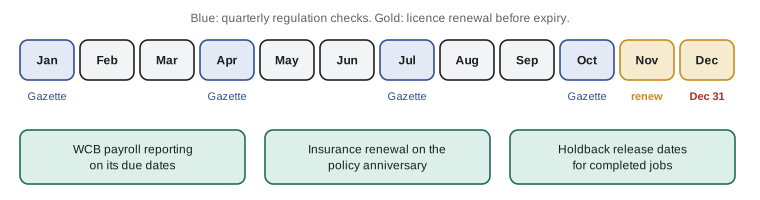
Because licences expire on the same day across the Island, Inspection Services sees a wave of renewals every December. Wayne's advice is to renew in November. A licence that has lapsed on January 1 means no new permits until it is renewed, and any work done in the gap is work done without a licence.
Renewal is also a check on qualification. A firm renewing its licence must still have a member, partner or employee who meets the qualifications. If the qualifying certified electrician has left during the year, renewal is the latest point at which that has to be fixed, and Lesson 2 explained why it should be fixed sooner.
What to check at renewal
Natalie builds a renewal checklist that Sam runs every November.
- The qualifying certified electrician is still with the company and still certified.
- The company's legal name, address and directors are the same as on the licence, or the changes have been reported.
- Insurance is current, and certificates of insurance sent to customers have not expired.
- WCB registration is in good standing, with payroll reported.
- The company has the edition of the Code the regulations currently adopt, and any new Island amendments are marked in it.
- Restricted licences and registered technician licences, if the company holds any, are renewed at the same time.
Records worth keeping
The regulations do not set out a record-keeping schedule for contractors, but a contracting business that cannot find its own records is exposed. Questions arrive years after the work: a buyer's lawyer wants the certificate of compliance, an insurer is investigating a fire, a former employee's WCB claim needs payroll records, or the Canada Revenue Agency audits the business. Wayne kept everything for at least seven years, and job files for houses for as long as the company existed.
| Record | Why it matters | Natalie's retention rule |
|---|---|---|
| Permit and inspection log | Shows each job was permitted and passed | Life of the company |
| Certificates of compliance | Owners, buyers and insurers ask for them | Life of the company |
| Contracts, change orders and invoices | Payment disputes and lien claims | At least seven years |
| Crew lists by job | Shows only certified electricians and supervised apprentices worked | At least seven years |
| Payroll and WCB reports | Assessments, claims and audits | At least seven years |
| Incident and investigation reports | OHS inquiries and claims | At least seven years |
| Training and certification copies | Proof of qualification and safety training | Life of employment plus seven years |
Staying current with the Code
CSA publishes a new edition of the Code every three years. The Island adopts editions by amending its regulations, sometimes with a delay, and may change its Schedule 1 amendments at the same time. A contractor needs to know three things at any moment: which edition is in force, what changed in it, and what the Island amends.
Natalie sets three habits.
- A quarterly check of the Royal Gazette and the government's legislation pages for amendments to the Electrical Inspection and Code Regulations.
- A new Code book with every edition the Island adopts, marked up with Schedule 1 tabs as in Lesson 5.
- A change summary course or seminar each cycle. The rest of this program, especially MELC-101, is built to be revisited at each edition.
The calculator below projects CSA's three-year cycle forward from the 2024 edition so Natalie can plan when to expect the next books. It only projects publication years; adoption on the Island depends on when the regulations are amended.
edition_year, edition = 2024, 26
for _ in range(4):
    print(f"{edition}th edition: published {edition_year}; watch for Island adoption after that")
    edition_year += 3
edition += 126th edition: published 2024; watch for Island adoption after that 27th edition: published 2027; watch for Island adoption after that 28th edition: published 2030; watch for Island adoption after that 29th edition: published 2033; watch for Island adoption after that
Wayne remembers when editions came and went with little fuss. Now customers ask about new rules before contractors have read them, especially on EV chargers and heat pumps. Staying current is part of selling the work.
Staying current with the regulations
The regulations change more often than the Code edition. Permit fees, licence fees and Schedule 1 amendments can all change between editions. The office consolidation this course used is current to October 2024; a later consolidation, or amendments published in the Royal Gazette, may change details. Before relying on a fee or a rule from this course, check the current version.
Natalie also keeps the phone number and email address of Inspection Services in her contacts, and calls when she is unsure. Wayne says the call is never wasted: an inspector would much rather answer a question before the work than write a defect notice after it.
Keeping certification current
A certificate of qualification does not expire in the way a licence does, but a contractor should still plan for continued learning. Safety training such as first aid and fall protection has its own renewal cycles. Manufacturers' training for equipment such as heat pumps and EV chargers keeps changing. And if the company employs registered technicians under a restricted licence, their licences renew every December along with the company's.
A worked example: a lapsed licence
Worked problem
The January permit
Sam was off sick in December, and Gallant Electric's licence renewal was missed. On January 6, Natalie tries to apply for a permit for a heat pump installation scheduled for January 8. What is the position, and what should she do?
Show solution
- The licence expired on December 31 under section 10(1). From January 1, the company has no valid electrical contractor licence.
- Only licensed contractors can apply for electrical permits, so the permit application cannot proceed.
- Natalie should renew immediately and contact Inspection Services to confirm when the licence is valid again.
- She should reschedule the January 8 job until the licence and the permit are both in place, and tell the customer why. Doing the work without them would be contracting without a licence.
Answer: A missed renewal stops new permits on January 1. Renew in November, and put the date in more than one calendar.
Planning renewal reminders
Sam sets reminders at three points: November 1 to start the renewal checklist, November 15 to submit the renewal, and December 15 to confirm the renewed licence has arrived. The small script below prints the reminder dates for any year.
from datetime import date

def reminders(year):
    return [("start renewal checklist", date(year, 11, 1)),
            ("submit licence renewal", date(year, 11, 15)),
            ("confirm renewed licence received", date(year, 12, 15)),
            ("licence expires if not renewed", date(year, 12, 31))]

for label, d in reminders(2027):
print(f"{d} {label}")2027-11-01 start renewal checklist 2027-11-15 submit licence renewal 2027-12-15 confirm renewed licence received 2027-12-31 licence expires if not renewed
When the company grows
Renewal is a good moment each year to look at how the business has changed. A company that started with three people may have six by its second renewal. Growth brings new questions. Does the company now need a second qualifying certified electrician in case Natalie is unavailable? Has the payroll grown enough to change WCB assessments or OHS committee requirements? Does the insurance still match the work, especially if the company has started taking larger commercial jobs? Natalie adds a growth review to her November checklist.
Wayne also recommends looking back at the year's jobs at renewal: how many permits, how many first-time passes, how many defect notices, and how many payment problems. Those numbers tell a contractor more about how the business is going than the bank balance does, because they show whether the work and the paperwork are under control.
Planning for retirement or sale
Natalie is a long way from retirement, but Wayne's own story taught her to think about it early. When he retired, his company's licence could not be transferred. The buyer of his trucks and customer list had to apply for its own licence, supported by its own certified electrician. Customers who wanted copies of old certificates of compliance called Wayne at home for years. A contractor who keeps good records and plans succession makes that transition easier for everyone, including the customers who trusted the company.
Keeping in touch with the industry
Staying current is easier with company. Supplier training nights, manufacturer courses on heat pumps and EV chargers, and conversations with other contractors all carry news about changes in the Code, the regulations and inspection practice. Natalie puts two industry events a year in the calendar and asks Owen and Luc to attend at least one. Wayne says some of the best advice he ever got came from another contractor at a supplier's counter.
Digital records
Wayne kept his records in filing cabinets. Natalie keeps hers in the cloud, with a simple folder for each job named by address and permit number, containing the permit, inspection results, photos of panels and connections, the certificate of compliance, the contract and invoices. A digital system makes records easy to find and share, but it brings its own risks: a lost password, a cancelled subscription or a deleted folder can wipe out years of records. Sam sets up automatic backups to a second location and checks them every quarter.
Photos deserve special mention. A photo of every panel before the cover goes on, and of every bonding connection before it is hidden, costs nothing and answers questions that would otherwise need walls opened. Natalie makes it part of every job's checklist.
A compliance calendar
Putting every recurring deadline in one calendar is the simplest way to stay current. Natalie's calendar has the licence renewal reminders, quarterly regulation checks, WCB payroll reporting dates, insurance renewal, safety training renewals for the crew, and the holdback and lien dates for every open job. Each entry has an owner, either Natalie or Sam, so nothing falls between them.
Wayne looks at the calendar and laughs. He says he kept the same dates in his head for thirty-five years and missed only a few of them. Natalie points out that a few missed dates, such as a lien deadline or a licence renewal, could be enough to sink a new business. He agrees.
When the qualifying electrician changes
Records matter most when people change. If a second certified electrician joins Gallant Electric and later becomes the qualifier, or if Natalie steps back, the company needs to show Inspection Services who qualifies the licence and from when. Sam keeps a short history on file: each qualifying person, the dates they served, and copies of their certificates and proof of experience. When a change happens, he contacts Inspection Services the same week rather than waiting for renewal.
Wayne points out that the same history helps with customers and insurers. A homeowner asking about work done five years ago, or an insurer investigating a claim, may want to know who was responsible for the company's work at that time. A record kept as it happens is far easier than one rebuilt from memory.
Common mistakes
MistakeLeaving renewal until the last week of December.
InsteadRenew in November; a lapsed licence stops new permits on January 1.
MistakeAssuming a licence issued mid-year lasts twelve months.
InsteadEvery licence expires December 31 of the year issued.
MistakeKeeping only the current year's job files.
InsteadCertificates of compliance and permit records are asked for years later; keep them for the life of the company.
MistakeRelying on an old consolidation for fees and rules.
InsteadCheck the current regulations and any amendments in the Royal Gazette.
Summary and key terms
- Every PEI electrical licence expires December 31 of the year issued and must be renewed annually; the contractor fee is 250 dollars a year.
- Renewal is a check on qualification: a firm must still have a qualifying certified electrician.
- Keep permit logs and certificates of compliance for the life of the company, and contracts, payroll and incident records for at least seven years.
- CSA publishes a new Code edition every three years; the Island adopts editions by amending its regulations.
- Check the Royal Gazette quarterly, mark new Island amendments in the Code book, and call Inspection Services when unsure.
- Renewal
- The annual process of keeping a PEI electrical licence valid beyond December 31.
- Lapse
- The loss of a licence's validity when it is not renewed before it expires.
- Permit log
- A record of every job's permit, inspections and certificate of compliance.
- Code cycle
- The three-year interval between editions of the Canadian Electrical Code.
Practice problems
Work each problem on paper first, then reveal the answer to check.
A licence is issued on August 12, 2027. When does it expire?
Show answer
December 31, 2027.
What happens on January 1 if a contractor has not renewed?
Show answer
The licence has expired, so the contractor cannot apply for permits or contract for electrical work until it is renewed.
How often does CSA publish a new edition of the Code?
Show answer
Every three years.
Name two records Natalie keeps for the life of the company.
Show answer
The permit and inspection log, and certificates of compliance.
Lesson quiz · 5 questions
Score 60% or more to complete this lesson.
Create a free account to save your progress, take quizzes and earn a certificate.