
MELC-209 · Lesson 1 of 12 · 22 min
How electrical licensing works in Prince Edward Island
▶ Video coming soon A video version of this lesson is on the way.
Every province regulates electrical work in its own way, and Prince Edward Island has one of the most compact systems in the country. A single statute, the Electrical Inspection Act, and a single set of regulations made under it, the Electrical Inspection and Code Regulations, decide who may do electrical work, which code that work must meet, and how permits and inspections operate. One government office, Inspection Services, runs the system day to day under the direction of the Chief Electrical Inspector. It issues licences, sells permits, inspects installations and decides questions the regulations leave to the inspector's judgment.
The most important fact about the Island for anyone coming to this course from the rest of the master electrician program is this: Prince Edward Island does not issue a master electrician licence, and it has no master electrician exam. In Alberta, permits go to holders of a Master Electrician Certificate earned by passing a two-part provincial exam. In Ontario, every licensed electrical contractor must employ a designated master electrician who has passed an ESA exam. The Island takes a simpler route. It licenses the electrical contractor, and it requires the contractor, or for a company one of its members, partners or employees, to be a certified electrician with at least two years of experience working as a certified electrician. The competence test is the trade certification the electrician already holds, not a separate master exam.
This course is therefore not an exam cram. It prepares a certified electrician to obtain an electrical contractor licence and to run a contracting business legally on the Island: which licence fits, how to apply, how the Code is adopted and amended in PEI, how permits and inspections work through Inspection Services, what a licensed contractor answers for, and the contract, lien, safety and workers compensation law that surrounds every job. Lesson 12 closes with a readiness review in place of the exam practice found in the provincial courses that do have exams.
A word on sources. The facts in this course were checked in late 2026 against the Government of Prince Edward Island's own pages, the office consolidation of the Electrical Inspection and Code Regulations, the Mechanics' Lien Act, the Workers Compensation Board of PEI and recognized legal summaries. Office consolidations are unofficial, fees and forms change, and the inspector has discretion in several areas. Before you apply for a licence or rely on any deadline, confirm the current requirements with Inspection Services. As in the rest of the series, this course never reproduces the text or tables of the Canadian Electrical Code. Rule numbers are cited and explained in our own words.
Natalie decides to go out on her own
Natalie Gallant has been a Red Seal construction electrician for eight years. She apprenticed with a contractor in Summerside, earned her certificate of qualification and Red Seal endorsement in her fourth year, and has spent the last five years as a lead hand for Harbourside Electric, a mid-size contractor in Charlottetown. Her crews wire new houses, renovate small commercial spaces and install the heat pumps that seem to be going into every second home on the Island. She is good at it, and for two years her customers have been asking whether she could take their jobs directly.
This spring she decides to start her own company, Gallant Electric Ltd., based in Summerside. Her brother-in-law, Sam Bernard, keeps the books for two small businesses already and will handle invoicing, payroll and the office. Wayne MacDonald, who ran a three-truck electrical contracting firm out of Montague for thirty-five years before retiring, has promised to answer every question she brings him. A second-year apprentice from Harbourside, Owen Doucette, has asked to come with her.
Natalie's cousin by marriage, Priya Raman, lives in Red Deer and has just written the Alberta Master Electrician Certificate exam. When Natalie mentions her plans on a video call, Priya assumes Natalie will have to write the same kind of exam. Natalie isn't sure. Wayne laughs when she asks him. On the Island, he tells her, there is no master electrician licence or exam. What matters is the contractor licence, and the contractor licence rests on being a certified electrician with two years of experience behind the certificate. Natalie has eight. The licence is within reach. Running the business properly is the hard part.
One statute, one set of regulations
Wayne draws two boxes on the back of a supplier's invoice. On the Island, he says, you only need to know two documents well, and you will open the second one far more often than the first.
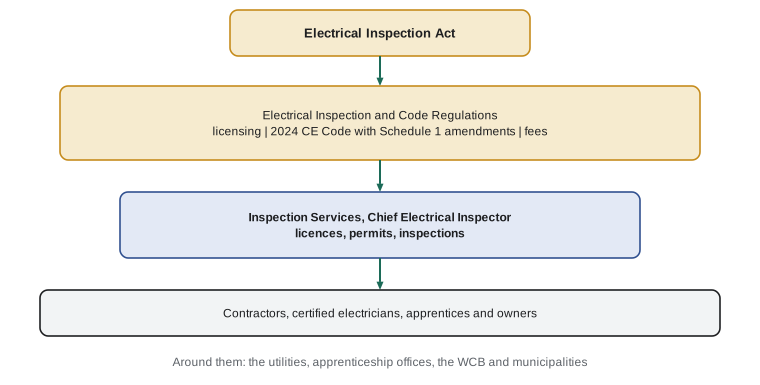
- The Electrical Inspection Act. This statute creates the framework: it gives the minister and the Chief Electrical Inspector their powers, authorizes the licensing of people who do electrical work, requires permits and inspections, allows the government to adopt an electrical code by regulation, and sets out offences. It is short, and most contractors read it once.
- The Electrical Inspection and Code Regulations. These regulations do the detailed work. Part 2 sets out the licences, who qualifies for each, how long they last and when they can be suspended or cancelled. Other parts adopt the Canadian Electrical Code with a schedule of Island amendments, and the schedules set permit fees and licence fees. When a question begins with who may do something or what something costs, this is the document to open.
Wayne's point is that the Island has folded licensing and installation rules into one regulation. In Saskatchewan, for example, licensing and inspection sit under two different statutes. On the Island the same regulation that tells you who may hold a contractor licence also amends Rule 2-004 of the Code to tell you who may apply for a permit. That makes the regulation the single most useful document a new PEI contractor can keep on the truck.
Who does what
Several organizations touch an electrical contractor's work on the Island. Natalie writes them down as a set, because she expects to deal with all of them in her first year.
- Inspection Services. A provincial government office, headed for electrical matters by the Chief Electrical Inspector, based in Charlottetown. It issues electrical contractor, restricted contractor, registered technician and special electrician licences, issues electrical permits and annual permits, inspects installations, and enforces the Act and regulations.
- The provincial government. Owns the legislation. Changes to the Act and the regulations come from government and are published in the Royal Gazette. Other departments handle related areas such as apprenticeship, labour standards and corporate registration.
- The electric utilities. Maritime Electric serves most of the Island, and the City of Summerside runs its own electric utility. A utility connects and disconnects services and sets its own service and metering requirements, and it coordinates with the inspection authority before energizing a new or altered service.
- Apprenticeship and trade certification. The province's apprenticeship offices in Charlottetown and Summerside register apprentices and issue certificates of qualification. Construction Electrician is a designated, certified compulsory trade in PEI, which means you must be a registered apprentice or hold a certificate of qualification to work in it.
- The Workers Compensation Board of PEI (WCB). Provides compensation coverage, requires employers to report injuries, and through its Occupational Health and Safety Division enforces the Occupational Health and Safety Act and its regulations.
- Municipalities. Cities and towns, and the province in areas without municipal planning, issue development and building permits. An electrical permit cannot be issued for work that also needs a development or building permit until that permit exists, which Lesson 6 explains.
Licensing the contractor, not a master
Natalie's first instinct, after years of working for someone else, is to think of her certificate as her licence. On the Island two separate credentials are involved, and the difference matters.
Her certificate of qualification as a construction electrician is a trade credential. It was issued through apprenticeship and trade certification after she passed the Red Seal examination, and it is what makes her a certified electrician under the regulations. Because the trade is certified compulsory, it is also what allows her to do electrical work at all, as an employee of a licensed contractor.
The electrical contractor licence is a licence issued by Inspection Services under the regulations. It is what allows a person or a firm to contract to do electrical work and to apply for electrical permits. The government's own guidance puts it bluntly: you must be a licensed electrical contractor in order to perform any electrical work in PEI as a contractor, and only licensed electrical contractors can apply for an electrical permit. When Natalie starts Gallant Electric Ltd., the company will apply for the licence, and Natalie will be the certified electrician whose qualifications support it.
| Credential | Issued by | What it does |
|---|---|---|
| Certificate of qualification, Construction Electrician (Red Seal) | Apprenticeship and trade certification | Makes the holder a certified electrician who may work in the trade |
| Electrical contractor licence | Inspection Services | Lets a person or firm contract for all areas of electrical work and apply for permits |
| Restricted contractor licence | Inspection Services | Lets a firm or technician contract for work in the restricted areas listed in the regulations |
| Registered technician licence | Inspection Services | Lets an individual work for a restricted contractor in a restricted area |
| Special electrician licence | Inspection Services | Lets the holder operate or maintain installations on the employer's premises only |
Compare that with Alberta, where Priya's certificate is a personal credential that allows her to take out permits, and with Ontario, where the contractor licence and the master electrician licence are separate but linked. The Island's arrangement is closest to Saskatchewan's: the contractor holds the licence, and the certified electrician with experience behind the certificate gives it the competence to hold it.
A worked example: who needs what
Worked problem
Matching people to credentials
Gallant Electric will have three people doing electrical work in its first month: Natalie; Owen, the second-year apprentice; and Luc Arsenault, a Red Seal electrician who has just moved from Moncton and also does evening work for a sign company. What does each person need, and could Luc be the certified electrician named on the company's licence instead of Natalie?
Show solution
- Natalie is a certified electrician with eight years of experience as one. She meets the two-year requirement and can support the company's licence.
- Owen is a registered apprentice. Under the regulations an apprentice may do electrical work under direct supervision. He cannot work on his own and does not qualify the company.
- Luc holds a Red Seal certificate, so he is a certified electrician and can work for Gallant Electric. Whether his New Brunswick certificate needs to be registered or recognized on the Island is a question for the apprenticeship office before he starts.
- Luc could in principle be the qualifying member, partner or employee if he has two years as a certified electrician. Natalie would still want to be the qualifier herself, because the person whose qualifications support the licence should be the person who controls the work.
Answer: Natalie is the natural qualifier. Luc can work as a certified electrician once his certification is recognized, and Owen works only under direct supervision.
A first look at the costs of compliance
Sam wants to know what the licensing side will cost before the company earns a cent. Wayne tells him the government fees on the Island are modest, but insurance and workers compensation are not, and permit fees recur on every job. The calculator below builds a first-year compliance budget. The licence fee is the published annual fee for an electrical contractor licence; every other figure is a placeholder Sam must replace with current quotes and the permit fee schedule.
# First-year compliance budget for a new PEI electrical contractor.
# The licence fee is the published annual fee; all other figures are placeholders.
items = {
    "electrical contractor licence (annual)": 250,
    "business registration (placeholder)": 150,
    "liability insurance (placeholder)": 2600,
    "WCB assessment estimate (placeholder)": 2100,
    "permits, about 70 jobs at 110 each (placeholder)": 70 * 110,
    "Code book and amendment updates (placeholder)": 220,
}
for name, amount in items.items():
    print(f"{name:52s} {amount:7,d}")
print(f"{'total':52s} {sum(items.values()):7,d}")electrical contractor licence (annual) 250 business registration (placeholder) 150 liability insurance (placeholder) 2,600 WCB assessment estimate (placeholder) 2,100 permits, about 70 jobs at 110 each (placeholder) 7,700 Code book and amendment updates (placeholder) 220 total 13,020
The permit line is the largest because it scales with the amount of work the company does. The licence itself is one of the smallest costs, which surprises most people the first time they see the numbers. Lesson 8 returns to the business side in detail.
Why this structure matters
Most of the problems new Island contractors run into are not technical. They are administrative and legal: starting work before applying for a permit, letting the licence expire on December 31 without renewing it, sending an apprentice to a job without direct supervision, applying for a permit on a building that needs a building permit the owner never obtained, or not knowing that the Island has amended the Code's rules on permits and inspection notice. Every one of those problems is easier to avoid if you can picture the Act, the regulations and Inspection Services in the middle.
The rest of the course builds that picture. Lesson 2 covers the licence types and the certified electrician requirement. Lesson 3 is the application. Lesson 4 explains how competence is checked when there is no master exam. Lessons 5 and 6 cover the Code as adopted and amended, permits and inspections. Lesson 7 sets out a licensed contractor's duties. Lessons 8 to 10 cover the business, contract, lien and safety law. Lesson 11 covers renewal and staying current, and Lesson 12 is a readiness review.
Common mistakes
MistakeLooking for a Prince Edward Island master electrician exam.
InsteadThe Island has no master electrician licence or exam. It licenses electrical contractors, and the contractor or one of the firm's people must be a certified electrician with at least two years of experience as one.
MistakeTreating a certificate of qualification as permission to contract with the public.
InsteadThe certificate makes you a certified electrician. Contracting and applying for permits require an electrical contractor licence from Inspection Services.
MistakeTreating a municipal building permit as covering the electrical work.
InsteadElectrical work needs an electrical permit from Inspection Services; building and development permits are separate and may have to come first.
MistakeAssuming the utility inspects new services.
InsteadMaritime Electric and the Summerside utility connect services. Inspection Services inspects the installation.
Summary and key terms
- PEI electrical safety rests on the Electrical Inspection Act and the Electrical Inspection and Code Regulations, which cover licensing, the adopted Code and fees in one place.
- Inspection Services, under the Chief Electrical Inspector, issues licences and permits, inspects, and enforces the rules.
- The Island has no master electrician licence; an electrical contractor licence rests on a certified electrician with at least two years of experience as one.
- Construction Electrician is a certified compulsory Red Seal trade on the Island.
- The utilities, the apprenticeship offices, WCB and municipalities each play a separate role around the contractor.
- Inspection Services
- The provincial office that issues electrical licences and permits and inspects installations in PEI.
- Chief Electrical Inspector
- The official who leads electrical inspection and exercises the discretion the regulations give the inspector.
- Electrical Inspection Act
- The PEI statute that authorizes electrical licensing, permits, inspections and code adoption.
- Electrical Inspection and Code Regulations
- The regulations that set out licences, adopt the Canadian Electrical Code with Island amendments, and set fees.
- Certified electrician
- A person who holds a certificate of qualification in the electrical trade.
- Certified compulsory trade
- A trade in which you must be a registered apprentice or hold a certificate of qualification to work.
Practice problems
Work each problem on paper first, then reveal the answer to check.
Which office issues electrical contractor licences in Prince Edward Island?
Show answer
Inspection Services, under the Chief Electrical Inspector.
Which document would you open to find out who may apply for an electrical permit on the Island?
Show answer
The Electrical Inspection and Code Regulations, which amend Rule 2-004 of the Code for PEI.
Natalie's cousin says Natalie must pass a master electrician exam before she can apply for permits. Is that right?
Show answer
No. The Island has no master electrician exam. Natalie's company needs an electrical contractor licence supported by a certified electrician with at least two years of experience.
Who connects a new service in Summerside?
Show answer
The City of Summerside's electric utility, after the installation has passed inspection.
Lesson quiz · 5 questions
Score 60% or more to complete this lesson.
Create a free account to save your progress, take quizzes and earn a certificate.