
MELC-208 · Lesson 9 of 12 · 19 min
Contracts and builders' liens in Nova Scotia
▶ Video coming soon A video version of this lesson is on the way.
A contractor can do perfect work, pass every inspection and still fail as a business if it does not get paid. In construction, getting paid depends on two things: a clear contract, and the security the law provides when payment does not come. In Nova Scotia, that security comes mainly from the Builders' Lien Act. The province has also passed prompt payment and adjudication amendments, but as of the legal summaries we found, they are not yet in force. This lesson covers contracts, change orders, holdback and liens, and explains where the prompt payment reforms stand.
Lien rules are strict and deadline-driven. The numbers below come from the Act as amended and from published legal summaries, and they are given for study. A contractor facing an unpaid account should get advice from a lawyer quickly, because a missed deadline can lose the lien right entirely.
Contracts first
Every job, however small, should have a written contract. For a homeowner job, that may be a two-page quote signed by the customer. For commercial work, it is often an industry standard form, such as the forms published by the Canadian Construction Documents Committee, with supplementary conditions added by the owner. Whatever the form, a good electrical contract answers the same questions.
- Scope. Exactly what work is included and, just as important, what is excluded. Permits and inspections should be listed as included.
- Price and payment terms. A fixed price or a unit price, how progress payments are calculated, when invoices are due, and how holdback is handled.
- Changes. How extra work is requested, priced and approved before it is done.
- Schedule. Start and completion dates and what happens when another trade causes delay.
- Warranty. How long the contractor warrants its work and what the warranty covers.
- Risk. Insurance requirements, who is responsible for damage, and how disputes are resolved.
Gerry's rule for Aisha is short: if it is not in writing, it did not happen. Most payment disputes he saw in thirty years came from extra work done on a verbal request and then refused when the invoice arrived.
Change orders
A change order is a written agreement to change the scope, price or schedule of a contract. On a busy job, changes come constantly: an owner adds circuits, a designer moves a panel, another trade's delay pushes the schedule. Each change should be written down, priced and approved before the work is done, or, if the work is urgent, approved in writing at least in principle with the price to follow. A contractor that does extra work without a signed change order is lending money it may never get back.
Changes also affect permits. If the scope of electrical work grows, the wiring permit may need to be updated with the inspection authority before the extra work is done. Aisha adds a line to her change order form: permit updated, yes or no.
Holdback
The Builders' Lien Act requires owners and contractors to hold back a share of each payment, so that there is a fund available to pay people who have lien rights if the party above them fails to pay. The holdback is 10 in 100 of the value of the work done. Holdback is released once the holdback period after substantial performance has passed without liens being registered, or when liens have been dealt with.
Published summaries of the 2004 amendments describe a holdback period of 60 days from substantial performance, and a reduced holdback of 2.5 in 100 that can be kept until all required work is complete. The exact rules on release and the reduced holdback are technical; confirm them in the current Act before relying on them for a particular contract. For a subcontractor, the practical point is cash flow: a tenth of every invoice will arrive weeks or months after the rest.
# Holdback on progress payments (10 in 100), illustrative subcontract.
invoices = [("progress 1", 24_000), ("progress 2", 31_500), ("progress 3", 28_000), ("final", 16_500)]
held_total = 0
for name, value in invoices:
    held = value * 10 / 100
    paid = value - held
    held_total += held
    print(f"{name:11s} value {value:8,.0f}  paid now {paid:8,.0f}  held back {held:7,.0f}")
print("total held back until release:", f"{held_total:,.0f}")progress 1 value 24,000 paid now 21,600 held back 2,400 progress 2 value 31,500 paid now 28,350 held back 3,150 progress 3 value 28,000 paid now 25,200 held back 2,800 final value 16,500 paid now 14,850 held back 1,650 total held back until release: 10,000
Liens
A builders' lien is a right to claim against the owner's interest in the land, and against the holdback, for the value of work or materials supplied to improve it. It gives an unpaid contractor, subcontractor, worker or supplier security that does not depend on the honesty or solvency of the party that hired them. To use it, the claimant must follow the Act's steps on time.
- Registration. A claim for lien must be registered against the property within the time the Act allows. Published summaries of the 2004 amendments describe this as 60 days from the last day labour or materials were supplied.
- Perfection. The lien must then be preserved by starting a court action and registering a certificate of lis pendens. The same summaries describe this as within 105 days of the last day of work. For projects involving the Province, a notice of intended action is also required, which shortens the effective deadline.
- Information. The Act gives lien claimants rights to request information about the contract and holdback, with a time limit for the response.
Everything depends on being able to prove the last day of work, which is why Sam requires daily job records with dates, and why Aisha never goes back to a finished job for a trivial item just to extend the lien period. Courts look closely at whether late work was genuine contract work or an attempt to restart the clock.
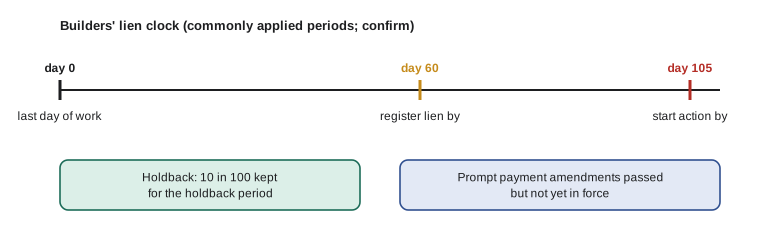
# Lien deadlines from the last day of work (commonly applied periods; confirm).
from datetime import date, timedelta
last_day = date(2026, 9, 18)
register_by = last_day + timedelta(days=60)
action_by = last_day + timedelta(days=105)
print("last day of work:", last_day.isoformat())
print("register claim for lien by:", register_by.isoformat())
print("start action and register lis pendens by:", action_by.isoformat())last day of work: 2026-09-18 register claim for lien by: 2026-11-17 start action and register lis pendens by: 2027-01-01
Prompt payment: passed but not in force
Nova Scotia was one of the first provinces to pass prompt payment legislation. Bill 119 received royal assent on April 12, 2019; when it comes into force, it will rename the statute the Builders' Lien and Prompt Payment Act. Bill 211, which received royal assent on November 9, 2022, provides for an Adjudication Authority. Legal summaries we found describe both sets of amendments as not yet in force, awaiting regulations on application, payment timelines, adjudication procedures and notices of non-payment.
So, unlike in Ontario, Saskatchewan, Alberta and Manitoba, a Nova Scotia contractor cannot yet rely on statutory payment deadlines or fast-track adjudication. Payment timing is set by the contract, and disputes go to negotiation, the contract's dispute process, or the courts, with the lien as security. Check the province's current status before every major contract, because when the amendments are proclaimed, the rules will change substantially and may apply to contracts made after that date.
| Province | Prompt payment status |
|---|---|
| Ontario | In force, with adjudication |
| Saskatchewan | In force since March 1, 2022 |
| Alberta | In force since August 29, 2022 |
| Manitoba | In force since April 1, 2025 |
| Nova Scotia | Passed (2019, 2022) but not yet in force, awaiting regulations |
A worked example: an unpaid subcontract
Worked problem
Highland Construction stops paying
Benoit Electric's subcontract on the Antigonish dental clinic is worth 100,000 dollars. Highland Construction has paid two progress invoices, net of holdback, but has not paid the third, worth 30,000 dollars before holdback. Benoit's last day of work was September 18, 2026. Highland says the owner hasn't paid it. What are Benoit's options?
Show solution
- Check the contract's payment terms and dispute process; there are no statutory prompt payment deadlines yet in Nova Scotia.
- Calculate the lien deadlines from September 18, 2026, using the commonly applied periods: register by November 17 and start an action by January 1, 2027. Confirm with a lawyer.
- Remember that the holdback on the first two invoices is still owed and protected by the Act.
- Speak to a lawyer immediately about registering a claim for lien, because the registration deadline is the one most easily missed.
Answer: Rely on the contract and the Builders' Lien Act, calculate the deadlines from the last day of work, and get legal advice before the registration deadline.
Reading a contract before signing it
Many payment problems begin before the job starts, when a contractor signs a contract it has not read carefully. General contractors often use their own subcontract forms, and those forms may shift risk onto the subcontractor in ways that are easy to miss. Before signing, Aisha reads each subcontract for a short list of clauses.
- Pay-when-paid or pay-if-paid. Clauses that link the subcontractor's payment to the general contractor being paid by the owner. Their effect depends on the wording and the law, and they deserve legal advice.
- Holdback and release. How holdback is calculated and when it will be released, and whether the contract adds conditions beyond those in the Act.
- Back charges. Whether the general contractor can deduct costs from the subcontractor's payments, and on what notice.
- Indemnity and insurance. What the subcontractor promises to cover and what insurance it must carry.
- Schedule and delay. Who bears the cost when another trade or the owner causes delay.
- Dispute resolution. Whether disputes go to negotiation, mediation, arbitration or the courts.
When a clause is unacceptable, the right time to negotiate is before signing. Once the contract is signed, the contractor is bound by it.
Invoicing well
A good invoice is clear, accurate and on time. It identifies the contract and the period, describes the work done, shows the value of work completed to date, deducts previous payments and holdback, and adds any approved change orders. Disputed items should be separated from undisputed ones, so that a disagreement over one change order does not hold up payment for the rest. Sam sends progress invoices on the dates the contract sets and follows up the day after any payment is due.
Collecting without burning bridges
Most late payments are not disputes. They are a customer or general contractor short of cash, disorganized or waiting on someone else. A polite reminder, a phone call and a clear record of what is owed resolve most of them. When those do not work, the contractor's leverage comes from its legal rights, especially the lien, and from its contract. A lien is a serious step and can damage a business relationship, but it is far less damaging than losing the right to be paid. The deadlines do not wait for a relationship to recover, which is why Sam tracks every unpaid account against its lien dates.
Finally, every unpaid account should be reviewed on a fixed day each week. Sam lists each one with the amount owed, the date it fell due, the last day of work on the job and the lien dates that follow from it. The list takes a few minutes to update, and it means no deadline ever arrives as a surprise.
Common mistakes
MistakeDoing extra work on a verbal request.
InsteadGet a written, signed change order, and update the permit if the scope grows.
MistakeAssuming Nova Scotia has statutory prompt payment deadlines like Ontario.
InsteadThe prompt payment amendments were passed in 2019 and 2022 but are not yet in force.
MistakeGoing back for a trivial item to restart the lien clock.
InsteadCourts look at whether late work was genuine; keep honest daily records instead.
MistakeForgetting that holdback reduces cash flow.
InsteadA tenth of each invoice is held back until release; plan for it.
Summary and key terms
- Written contracts and signed change orders prevent most payment disputes.
- The Builders' Lien Act requires a holdback of 10 in 100, released after the holdback period following substantial performance.
- Commonly cited periods are 60 days from the last day of work to register a lien and 105 days to start an action; confirm the current Act.
- Nova Scotia's prompt payment and adjudication amendments received royal assent in 2019 and 2022 but are not yet in force.
- Daily records proving the last day of work are essential to lien rights.
- Builders’ lien
- A claim against the owner’s interest in land and the holdback for unpaid work or materials.
- Holdback
- The share of each payment, 10 in 100, kept back to protect lien claimants.
- Substantial performance
- The stage at which a project is ready for use, which starts the holdback period.
- Certificate of lis pendens
- A registered notice that a court action affects title to the land.
- Change order
- A written agreement changing a contract’s scope, price or schedule.
Practice problems
Work each problem on paper first, then reveal the answer to check.
What share of each payment must be held back under the Builders' Lien Act?
Show answer
10 in 100.
Benoit's last day of work was March 2. Using the commonly applied period, by when must it register a lien?
Show answer
Within 60 days, by May 1 in a non-leap year; confirm the current Act.
Are Nova Scotia's prompt payment amendments in force?
Show answer
Not according to the legal summaries we found; they await regulations.
Why keep daily job records?
Show answer
To prove the last day of work, which starts the lien deadlines.
Lesson quiz · 5 questions
Score 60% or more to complete this lesson.
Create a free account to save your progress, take quizzes and earn a certificate.