
MELC-208 · Lesson 11 of 12 · 19 min
Keeping certificates current and staying up to date
▶ Video coming soon A video version of this lesson is on the way.
Getting qualified is a moment; staying qualified is a habit. A contractor that set up correctly in its first year can still drift out of compliance by its fifth: a business registration lapses, an insurance certificate expires, a new Code edition arrives and the crew keeps wiring to the old one, or a bulletin changes a utility requirement nobody read. This lesson covers what needs to be kept current in Nova Scotia, what changed in October 2025 for certificates of qualification, how the Code cycle works, and how a small contractor builds a simple system for staying up to date.
Where this lesson gives dates and procedures, they come from provincial and utility sources current when it was written. Check the Agency, the inspection authority and the province's electrical safety pages for anything newer before relying on them.
Certificates of qualification after October 7, 2025
For years, Nova Scotia certificates of qualification in compulsory trades had to be renewed, with a fee, on a fixed cycle. On October 7, 2025, the province announced that certificates of qualification would no longer need to be renewed. A certificate holder in good standing keeps the certificate without a renewal application or fee.
That is a real saving of time and money for every electrician in the province, but it does not mean there is nothing left to track. The certificate still has to be proved on site, so every worker should carry their identification card, and the business should keep a copy of each certificate on file. Apprentices still have to keep their registration active, log their hours and progress through their levels. Workers holding temporary permits still have permits with conditions and end dates. And the Agency can still act against someone working in a compulsory trade without proper status.
| Item | Current position | What the business tracks |
|---|---|---|
| Certificate of qualification | No renewal needed since October 7, 2025 | Copy on file; worker carries card |
| Apprentice registration | Must stay active, with hours logged | Hours, level, supervision |
| Temporary permit | Has conditions and an end date | Expiry date and conditions |
| Out-of-province certificate | Must be recognized by the Agency | Recognition on file |
The Code cycle
The Canadian Electrical Code, Part I is revised on a regular cycle, with a new edition published by CSA Group every three years. Nova Scotia adopts each new edition by bulletin and amendment to the Electrical Code Regulations, as it did with the 2024 edition, effective July 2, 2024, through Bulletin 2024-35. On that pattern, the next edition can be expected in 2027, with adoption by the province some time after.
Each new edition brings changes, some minor and some that affect everyday installations. A contractor that waits for an inspector to point out the changes will pay for them in rework. A better approach is to plan for each new edition as a project.
- Buy the new edition as soon as it is published, and a copy of the handbook or a changes guide if you find them useful.
- Take an update course. Industry associations, colleges and training providers in Atlantic Canada run Code update courses after each new edition.
- Read the province's adoption bulletin carefully, with special attention to the transition rule and any Nova Scotia amendments.
- Hold a crew meeting on the changes that affect your usual work, and update your price book where new requirements add material or labour.
- Watch for interpretation bulletins in the first year, when questions about the new edition are most common.
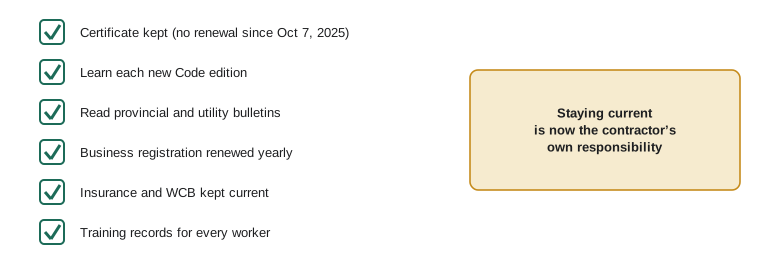
Bulletins and notices
Between Code editions, the most important source of change is the bulletin. Provincial bulletins from the Chief Electrical Inspector cover Code adoption, interpretations and safety matters; Nova Scotia Power issues its own bulletins on service requirements, metering and its inspection practices; and municipal utilities may issue their own. Bulletin 2024-37 on Rule 10-210, reissued in July 2025, is a good example of a bulletin that a busy contractor could easily miss and then run into at inspection.
Aisha assigns Kayla the job of checking the province's electrical safety page and Nova Scotia Power's bulletin page on the first working day of each month and reporting anything new at the next crew meeting. It takes fifteen minutes, and it is the cheapest insurance against rework the company has.
Keeping the business current
Lesson 8 introduced the compliance calendar. This lesson turns it into a routine. Each item has a responsible person, a frequency and a reminder date.
# A simple compliance calendar: which items fall due in the next 60 days?
from datetime import date, timedelta
today = date(2026, 11, 9)
items = [
    ("Joint stock registration renewal", date(2027, 3, 31), "Sam"),
    ("CGL insurance renewal", date(2026, 12, 15), "Sam"),
    ("Vehicle insurance renewal", date(2027, 6, 1), "Sam"),
    ("WCB annual payroll report", date(2027, 2, 28), "Sam"),
    ("HST return", date(2026, 12, 31), "Sam"),
    ("Owen apprentice hours submission", date(2026, 11, 30), "Aisha"),
    ("Monthly bulletin check", date(2026, 12, 1), "Kayla"),
]
window = today + timedelta(days=60)
for name, due, who in sorted(items, key=lambda x: x[1]):
    flag = "DUE SOON" if due <= window else ""
print(f"{due.isoformat()} {name:34s} {who:6s} {flag}")2026-11-30 Owen apprentice hours submission Aisha DUE SOON 2026-12-01 Monthly bulletin check Kayla DUE SOON 2026-12-15 CGL insurance renewal Sam DUE SOON 2026-12-31 HST return Sam DUE SOON 2027-02-28 WCB annual payroll report Sam 2027-03-31 Joint stock registration renewal Sam 2027-06-01 Vehicle insurance renewal Sam
The dates in the calendar are illustrative; each business sets its own from the actual renewal notices and filing schedules it receives. What matters is that every item has a date, an owner and a reminder.
Training records and continuing education
Nova Scotia does not require electricians to complete a set number of continuing education hours to keep their certificates, but staying competent is still the contractor's job. Customers, general contractors and insurers increasingly ask what training a crew has. A good training record shows each worker's certificate or apprentice status, safety training with dates, Code update training, manufacturer training for products the company installs, and any specialty training such as fire alarm, solar or electric vehicle charging work.
Safety training has its own refresh cycles. First aid certificates expire, fall protection and other safety courses are often expected to be refreshed every few years, and CSA Z462 is itself revised on a regular cycle. Aisha keeps the training record in the same spreadsheet as the compliance calendar, so that expiring safety certificates show up with everything else.
Watching the law change
Several areas of the law that affect contractors are moving. Prompt payment and adjudication amendments to the Builders' Lien Act were passed but are not yet in force, and when they are proclaimed they will change payment practices substantially. The apprenticeship system is evolving, as the October 2025 change on renewals showed. Labour mobility between provinces is being expanded. A contractor does not need to follow every proposal, but it should know where to look: the province's news releases, the Agency, the inspection authorities, the Electrical Contractors Association of Nova Scotia, Construction Safety Nova Scotia and the Construction Association of Nova Scotia all publish updates for the industry.
A worked example: an annual review
Worked problem
Benoit Electric's first annual review
A year after starting, Aisha and Sam sit down for an annual compliance review. What should be on the agenda?
Show solution
- Trade status: confirm every worker's certificate or registration is on file, and check Owen's apprentice hours and level.
- Business: confirm the joint stock registration, HST, payroll and WCB accounts are current, and that the WCB clearance is available.
- Insurance: review the CGL limit, completed operations coverage and other policies with the broker before renewal.
- Code: check for new bulletins, plan for the next Code edition, and review the deficiency log for patterns.
- Safety: review the injury and incident log, the lockout procedure and training records, and prepare for the five-employee threshold for a written OHS policy.
- Law: check the status of the prompt payment amendments and anything new from the Agency or the province.
Answer: A one-day annual review, built around the compliance calendar, catches drift before it becomes a problem.
Learning from new technology
The work itself is changing as fast as the rules. Heat pumps, electric vehicle chargers, battery storage, solar photovoltaic systems, smart panels and load management devices are now common on residential jobs in Nova Scotia, and each brings Code requirements, utility requirements and manufacturer instructions that a contractor must learn. Many of these installations also involve the utility directly, for example through interconnection approval for solar systems, and the utility's own requirements change from time to time.
A contractor that wants this work needs a plan for learning it. Manufacturer training is often free or inexpensive. Industry associations and colleges run courses on new technologies. Utility bulletins explain interconnection and metering rules. And the Code itself has sections dealing with each of these installations, which change with each edition. Aisha decides that Benoit Electric will specialize in heat pump and electric vehicle charger installations in its first two years, and sends Kayla to a manufacturer course on load management before the company takes its first charger job.
Keeping the customer file current
Staying current also means keeping track of what the company has already installed. When a manufacturer issues a recall, when a utility changes a requirement for existing installations, or when a customer calls with a problem years later, the company needs to know what it installed, where and when. A simple customer file, with the address, the work done, the main equipment and the permit number, makes those questions easy to answer and builds a list of customers to contact when new services are offered.
Succession and continuity
A small contractor should also plan for the day a key person is not available. If Aisha is the only certified construction electrician who can hold the company's permits, an illness or an injury could stop the business. Having a second certified electrician on staff, documented procedures, and records that someone else can read are all part of keeping the business current in the widest sense: able to keep working when circumstances change.
Gerry, who sold his own business when he retired, adds one more point. A business that keeps good records, current registrations and a clean compliance history is worth far more to a buyer than one that depends on the owner's memory. Keeping current is not only about staying out of trouble. It is also about building something that lasts.
A note on the course as a whole
This course has covered the rules that apply to a Nova Scotia electrical contractor as they stood when it was written. Rules change, sometimes quietly and sometimes substantially, as the October 2025 change on renewals and the pending prompt payment amendments show. The skills the course aims to build are the ones that do not go out of date: knowing where each rule lives, reading the source document rather than relying on memory, asking the right authority before the work is done, and keeping records that prove the work was done properly.
Staying current is therefore less about memorizing the latest rule than about keeping a few reliable habits: a monthly bulletin check, an annual compliance review, a plan for each new Code edition, and records that someone else could pick up and understand.
Common mistakes
MistakeThinking the end of certificate renewals means nothing needs tracking.
InsteadProof on site, apprentice hours, temporary permits and recognition of outside certificates still need tracking.
MistakeWaiting for an inspector to explain the new Code edition.
InsteadBuy it, train on it, and read the adoption bulletin before the transition date.
MistakeReading bulletins only when a problem arises.
InsteadCheck provincial and utility bulletin pages on a fixed schedule.
MistakeKeeping renewal dates in someone's head.
InsteadPut every renewal, filing and training expiry in a shared compliance calendar with an owner and a reminder.
Summary and key terms
- Since October 7, 2025, Nova Scotia certificates of qualification no longer need to be renewed, but proof and apprentice records still need tracking.
- The Canadian Electrical Code is revised every three years; Nova Scotia adopts each edition by bulletin with a transition date.
- Provincial and utility bulletins are the main source of change between editions; check them on a schedule.
- A compliance calendar with owners and reminders keeps registrations, insurance, tax, WCB and training current.
- An annual review catches drift before it becomes a problem.
- Code cycle
- The regular revision of the Canadian Electrical Code, with a new edition every three years.
- Adoption bulletin
- A provincial bulletin announcing that a new Code edition applies, with its effective date and transition rule.
- Compliance calendar
- A schedule of every renewal, filing and training expiry, each with an owner and a reminder.
- Training record
- A record of each worker’s status, safety training and technical training, with dates.
Practice problems
Work each problem on paper first, then reveal the answer to check.
Do Nova Scotia certificates of qualification still need to be renewed?
Show answer
No; since October 7, 2025, renewal is no longer required.
How often is a new edition of the Canadian Electrical Code published?
Show answer
Every three years.
What should a contractor read first when a new edition is adopted?
Show answer
The province's adoption bulletin, especially the transition rule.
Name two items in a compliance calendar.
Show answer
For example, insurance renewal and the WCB payroll report.
Lesson quiz · 5 questions
Score 60% or more to complete this lesson.
Create a free account to save your progress, take quizzes and earn a certificate.