
MELC-208 · Lesson 3 of 12 · 19 min
Setting up an electrical contracting business
▶ Video coming soon A video version of this lesson is on the way.
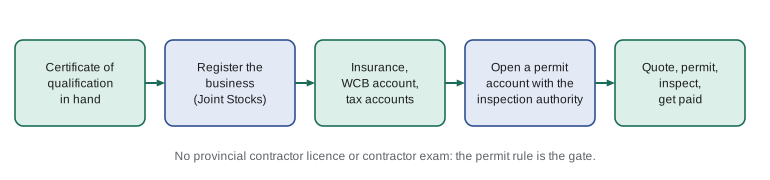
In a province with a contractor licence, opening an electrical business starts with an application to the licensing body. In Nova Scotia there is no such application, because there is no contractor licence. That does not mean there is nothing to do. A new electrical contracting business still needs the right people, a legal business structure, registrations with several government bodies, insurance and a working relationship with the inspection authority that will issue its permits. This lesson walks through those steps in the order Aisha takes them.
A reminder before we start: the registrations described here are the ones almost every small contractor needs, but forms, fees and online systems change, and some depend on how the business is organized. Treat this lesson as a checklist to work through with the actual agencies, and with an accountant and a lawyer for the structure decisions.
Step 1: the certified electrician
The permit rule in section 8 of the Electrical Code Regulations makes the first step obvious. The business must be run by, or employ, a person who holds a valid Nova Scotia construction electrician certificate of qualification, or a certificate the Agency recognizes. Without that person, the business cannot obtain an electrical wiring permit and so cannot legally do permitted electrical work.
Aisha is the certified electrician for Benoit Electric. She keeps a copy of her certificate with the company records, and she writes down a plan for what happens if she cannot work, because a one-person certification creates a single point of failure. Her plan is to hire a second certified journeyperson within the first year, and to keep a list of certified electricians she trusts who could step in on short notice.
Step 2: choosing a business structure
Most small contractors choose between three structures. Each has consequences for liability, tax and paperwork, and the choice is worth a conversation with an accountant and a lawyer.
- Sole proprietorship. The simplest structure: the business and the owner are the same legal person. Debts and claims against the business are claims against the owner personally. A sole proprietor operating under a name other than their own registers the business name.
- Partnership. Two or more people carrying on business together. Partners are generally personally responsible for the partnership's obligations, and a written partnership agreement is essential.
- Corporation. A separate legal person, created by incorporation, that can own assets, sign contracts and be sued in its own name. Owners are shareholders, and their personal liability is generally limited to what they have invested, though directors have duties of their own and personal guarantees often reduce the protection in practice.
Aisha and Sam choose to incorporate, as Benoit Electric Ltd., because electrical work can produce large claims if something goes wrong and they want the business's risks kept separate from their house. They know that a bank will still ask for a personal guarantee on the company's line of credit, and that insurance, not the corporate structure, is the real protection against a claim for damage caused by the work.
| Structure | Separate legal person? | Owner liability | Registration |
|---|---|---|---|
| Sole proprietorship | No | Personal | Business name, if not trading under own name |
| Partnership | No | Generally personal for partners | Partnership name |
| Corporation | Yes | Generally limited to investment | Incorporation and annual renewal |
Step 3: registering the business
In Nova Scotia, the Registry of Joint Stock Companies registers corporations, partnerships and business names. Incorporation creates the company; business name registration records the name a sole proprietor or partnership trades under. Registrations generally need to be renewed every year, and a company that fails to renew can lose its good standing or be struck from the register, which can make contracts and bank accounts awkward to manage. Sam puts the renewal date in the company calendar the day the registration is complete.
A registered business number comes with registration. Sam uses it for the company's bank account and for the accounts with the Canada Revenue Agency that come next.
Step 4: tax accounts
A business that sells taxable services must register for the harmonized sales tax once its taxable sales pass the small supplier threshold, and may register voluntarily before then. In Nova Scotia, HST applies to most construction services, including electrical work. Registering early lets the business claim input tax credits on its tools, vehicles and materials, and it avoids the awkward moment of having to start charging tax partway through a job. The threshold and rules are set federally; Sam confirms the current figures with the Canada Revenue Agency.
If the business will have employees, it also needs a payroll account to remit income tax, Canada Pension Plan contributions and employment insurance premiums withheld from wages. Even a corporation whose only employee is its owner usually needs one if the owner is paid a salary.
Step 5: WCB Nova Scotia
WCB Nova Scotia says that, under the law, most employers must register for coverage and pay premiums. Electrical contracting is a construction industry with real injury risk, and a contractor with employees should expect to need coverage from the day the first employee starts. WCB coverage protects workers, who receive benefits if they are hurt at work, and it protects the employer, because covered workers generally cannot sue their employer for a workplace injury.
General contractors and many commercial customers ask for proof that a subcontractor is registered and in good standing with WCB before they let it on site or pay its invoices. Sam requests a clearance letter as soon as the account is open. Owners who work in the business themselves should ask WCB whether they are covered automatically or need to buy personal coverage; the answer depends on the business structure and the industry.
Step 6: insurance
Nova Scotia law does not set a minimum liability insurance amount for electrical contractors, because there is no contractor licence to attach one to. In practice, liability insurance is not optional. General contractors, property managers, institutions and many homeowners require proof of commercial general liability insurance before the first day of work, often naming themselves as additional insureds, and a contractor without it can be ruined by a single fire claim. Lesson 8 looks at the kinds of insurance a contractor needs and at bonds.
Vehicles are a separate risk. A work truck used for business needs commercial use declared on its policy, and tools and equipment in the truck need their own coverage, because personal auto policies rarely cover them.
Step 7: the inspection authority
Benoit Electric will work mostly in Nova Scotia Power's territory around Truro, but Gerry reminds Aisha that six towns have their own municipal electric utilities, and each of those utilities is the inspection authority in its own area. A job in Antigonish, Berwick, Canso, Lunenburg, Mahone Bay or Riverport means dealing with that utility's permit process, not Nova Scotia Power's.
Nova Scotia Power's inspection pages say inspections are scheduled through its Wiring Permit Contact Centre, and its bulletins describe how wiring permits are issued and how monthly billing for permits works. Aisha calls the centre to ask how a new contractor sets up to obtain permits, what proof of her certificate they need, and how billing works. She makes a note to ask the same questions of the Town of Antigonish's electric utility before her first job there.
Step 8: municipal requirements
Some Nova Scotia municipalities require business licences or have their own rules for businesses operating within their boundaries, and many require building permits for the projects Benoit Electric will be part of. A municipal building permit is the owner's or general contractor's responsibility on most projects, but it does not replace the electrical wiring permit. Aisha checks the municipal requirements for Truro and for the surrounding county before she starts, and she asks each general contractor she works for whether a building permit is in place.
A worked example: the start-up checklist
Worked problem
Is Benoit Electric ready for its first job?
Two weeks before her first booked job, a service upgrade at the MacKenzie farmhouse outside Truro, Aisha reviews the company's status: Benoit Electric Ltd. is incorporated; it has a business number; it has applied for an HST account; WCB registration is pending because Owen hasn't started yet; liability insurance is quoted but not bound; she has spoken to Nova Scotia Power about permits. What still has to happen before the first day?
Show solution
- The certified electrician requirement is met: Aisha holds a certificate of qualification.
- Liability insurance must be bound, not just quoted, before work starts.
- WCB registration must be in place before Owen starts work as an employee.
- The wiring permit for the MacKenzie job must be opened before any electrical work begins.
- The HST account should be active before the first invoice so tax can be charged correctly.
Answer: Bind the insurance, complete WCB registration before Owen's first day, open the wiring permit, and confirm the HST account before invoicing.
The cost of getting started
Sam totals the one-time and first-year costs so that Aisha can see how much working capital the company needs before the first payment arrives. Every figure is a placeholder to be replaced with a real quote; the point is the shape of the budget, not the numbers.
# Illustrative start-up budget for a small Nova Scotia electrical contractor.
one_time = {
    "incorporation and legal (illustrative)": 1200,
    "tools and test equipment (illustrative)": 9000,
    "truck shelving and signs (illustrative)": 2500,
}
first_year = {
    "liability insurance (illustrative)": 2400,
    "WCB premium (illustrative)": 1900,
    "accounting and software (illustrative)": 1800,
    "registration renewals (illustrative)": 150,
}
for title, group in (("one-time", one_time), ("first year", first_year)):
    print(title)
    for k, v in group.items():
        print(f"  {k:44s} {v:7,d}")
    print(f"  {'subtotal':44s} {sum(group.values()):7,d}")
print(f"{'total before the first payment':46s} {sum(one_time.values()) + sum(first_year.values()):7,d}")one-time incorporation and legal (illustrative) 1,200 tools and test equipment (illustrative) 9,000 truck shelving and signs (illustrative) 2,500 subtotal 12,700 first year liability insurance (illustrative) 2,400 WCB premium (illustrative) 1,900 accounting and software (illustrative) 1,800 registration renewals (illustrative) 150 subtotal 6,250 total before the first payment 18,950
Gerry's last advice is about cash, not law: most small contractors that fail do so because they run out of money while waiting to be paid, not because they lack skill. Lesson 9's material on contracts and liens is as much about cash flow as about legal rights.
Building the business plan
Registration and insurance are the legal minimum, but a contracting business also needs a plan for how it will make money. Aisha and Sam write a short business plan before they register anything. It answers five questions: what work the company will do, who its customers will be, what it will charge, how much cash it needs to survive the first six months, and what it will do if the first year goes worse than expected.
The first answer shapes everything else. Benoit Electric will focus on residential service upgrades, heat pump circuits and small renovations around Truro, with commercial subcontracts for general contractors when the crew has capacity. That focus tells Aisha which tools and test equipment to buy, which suppliers to open accounts with, and which training the crew needs first.
Pricing is where many new contractors go wrong. A rate that covers wages and materials but not insurance, vehicles, permits, holdback, warranty callbacks and the owner's own unpaid office hours will feel busy and still lose money. Sam builds the company's labour rate from the bottom up, starting with the real cost of each hour on the tools and adding overhead and a margin, and then checks it against what established contractors in the area charge.
Cash flow is the last test. Customers pay weeks after the work is done, general contractors hold back a tenth of each invoice, and suppliers want to be paid on their own terms. Sam's plan includes a line of credit arranged before it is needed, because a bank is far more willing to lend to a business that is not yet in trouble.
Common mistakes
MistakeWaiting for a contractor licence to arrive before taking work.
InsteadNova Scotia has no contractor licence; the business needs a certified electrician, registrations, insurance and a permit for each job.
MistakeTreating an insurance quote as coverage.
InsteadCoverage starts only when the policy is bound; get written confirmation before work begins.
MistakeAssuming Nova Scotia Power inspects everywhere in the province.
InsteadSix towns have municipal electric utilities that act as the inspection authority in their own areas.
MistakeForgetting to renew the business registration.
InsteadRegistrations with the Registry of Joint Stock Companies generally renew every year; missing it can cost the business its good standing.
Summary and key terms
- The first requirement is a certified construction electrician who runs or is employed by the business.
- Choose a structure with professional advice; incorporation separates business and personal assets, but insurance is the real protection against claims.
- Register with the Registry of Joint Stock Companies, the Canada Revenue Agency for HST and payroll, and WCB Nova Scotia.
- Liability insurance is not set by statute here, but customers and general contractors require it.
- Set up with the inspection authority for each area you will work in: Nova Scotia Power or one of six municipal utilities.
- Registry of Joint Stock Companies
- The Nova Scotia registry for corporations, partnerships and business names.
- Incorporation
- Creating a corporation, a separate legal person that can own assets and sign contracts.
- Input tax credit
- A credit for HST paid on business purchases, available to registered businesses.
- Clearance letter
- Proof from WCB that a business is registered and in good standing.
- Commercial general liability insurance
- Insurance against claims for damage or injury caused by the business.
Practice problems
Work each problem on paper first, then reveal the answer to check.
What is the first legal requirement for a business that wants electrical wiring permits?
Show answer
It must be run by, or employ, a certified construction electrician.
Which registry handles incorporation and business names in Nova Scotia?
Show answer
The Registry of Joint Stock Companies.
A general contractor asks for proof Benoit Electric is in good standing with WCB. What should Sam send?
Show answer
A WCB clearance letter.
Benoit Electric gets a job in Lunenburg. Who issues the wiring permit?
Show answer
The Town of Lunenburg's electric utility, the inspection authority for its area.
Lesson quiz · 5 questions
Score 60% or more to complete this lesson.
Create a free account to save your progress, take quizzes and earn a certificate.