
MELC-208 · Lesson 6 of 12 · 19 min
Permits, inspections and the inspection authorities
▶ Video coming soon A video version of this lesson is on the way.
In Nova Scotia, the wiring permit is where the whole system comes together. It is the point at which the Electrical Code Regulations check that a certified person is responsible, the point that triggers inspection, and the record that lets a utility connect power with confidence. A contractor who handles permits and inspections well avoids most of the trouble new businesses run into. This lesson covers who issues permits, who may hold them, what work is exempt, how inspections work, and what happens when an installation fails.
Procedures, contact numbers and fees in this lesson come from the province's regulations and Nova Scotia Power's published inspection pages and bulletins. They change. Confirm the current process with the inspection authority before you rely on any detail, and if you work in one of the six towns with a municipal electric utility, ask that utility how its process differs.
The inspection authorities
The Electrical Code Regulations define an inspection department as a public utility that supplies, or will supply, electric power and grants permits to contractors. The Act requires a public utility or an inspector to inspect a consumer's installation before supplying power, and it says utility inspections of new work must be carried out by people approved for the job. The province's electrical safety page lists seven utilities that carry out inspections: Nova Scotia Power and the municipal electric utilities of Antigonish, Berwick, Canso, Lunenburg, Mahone Bay and Riverport.
For most of the province, that means Nova Scotia Power. Its inspection pages direct contractors to its Wiring Permit Contact Centre, listed at 1-800-464-1520 from 7:00 a.m. to 6:00 p.m., Monday to Friday, for scheduling inspections, and to its mailing address at 25 Lakeside Park Drive, Lakeside, for Inspection Services. In the six towns, the town's own utility issues permits and inspects within its service area.
Above them all sits the Provincial Chief Electrical Inspector, who approves inspection procedures, sets qualifications for inspectors, issues bulletins and interpretations, and can order disconnection of a hazardous installation. If a contractor and a utility inspector disagree about the Code, the Chief Electrical Inspector is the final authority.
When a permit is needed
Section 7 of the Electrical Code Regulations requires a permit before any electrical or communications work begins, unless the regulations exempt it. The rule is simple and strict: the permit comes first, then the work. Starting before the permit is in place, even for a day, means the work was unpermitted, and covering it before inspection is an offence under the Act.
Nova Scotia Power's pages put the inspection side just as plainly: installations must be inspected before any wiring is concealed by backfill, lathing, boarding, insulation or other coverings, and the contractor arranges a final inspection when the work is complete.
Who may hold a permit
Section 8 limits electrical permits to two kinds of holder.
- An electrical contractor who is a construction electrician, or who employs one. This is the route for every contracting business.
- The owner or occupant of an establishment where routine electrical work is done frequently, if they employ a construction electrician or an industrial electrician. This is a maintenance permit. It runs for one year and requires a record of the work to be kept and made available to the inspector, and the establishment gets an annual limited inspection.
Communications permits, under section 9, go to communications technicians and construction electricians. Nova Scotia Power's pages say communications wiring must be done by a certified communications cabling specialist.
There is no general homeowner permit route in the regulations, and Nova Scotia Power states that only a person holding a valid Nova Scotia certificate in the electrical construction trade can obtain an electrical wiring permit. That is a real difference from provinces that let homeowners pull permits for work on their own houses. A Nova Scotia homeowner who wants electrical work done needs a certified electrician to take out the permit.
| Permit type | Who may hold it | Key conditions |
|---|---|---|
| Electrical permit (contracting) | Electrical contractor who is or employs a construction electrician | Before work starts; inspections before concealment and at completion |
| Maintenance permit | Owner or occupant employing a construction or industrial electrician | One year; work record kept; annual limited inspection |
| Communications permit | Communications technician or construction electrician | Before communications work starts |
Work that does not need a permit
Section 12 exempts certain minor electrical work from permits, on two conditions: a construction electrician does it, and keeps a record of it available for inspection. Nova Scotia Power's pages list examples, and the regulations set the limits. In our own words, the exempt work includes:
- replacing wiring devices or equipment rated up to 30 amperes at 120 volts, or 50 amperes at 240 volts;
- installing one branch circuit of 15 to 30 amperes at 120 volts, or 15 to 50 amperes at 240 volts;
- replacing light fixtures in a dwelling unit, and replacing motors.
These exemptions do not apply in locations covered by Sections 18 and 20 of the Code, the hazardous location sections. Section 13 exempts small communications jobs, up to six cabling drops, or relocating up to 20 outlets without new cable runs or fire wall penetrations. Section 14 exempts certain installations entirely, such as security and intrusion alarm systems.
The record-keeping condition is easy to forget and important to keep. An exemption from the permit is not an exemption from the Code, and the record is the evidence that a certified electrician did the work. Aisha keeps a simple log in the company's job software: date, address, what was done, who did it, and the circuit rating.
# Is this small job exempt from a permit under section 12? (study aid only)
def exempt(kind, volts, amps, hazardous=False, count=1):
    if hazardous:
        return False, "no exemption in Section 18 or 20 locations"
    limit = 30 if volts == 120 else 50 if volts == 240 else 0
    if kind == "replace device" and amps <= limit:
        return True, "exempt if a construction electrician does it and keeps a record"
    if kind == "new branch circuit" and count == 1 and 15 <= amps <= limit:
        return True, "one circuit only; record required"
    return False, "permit required"

for job in [("replace device", 120, 20), ("replace device", 240, 60),
            ("new branch circuit", 240, 40), ("new branch circuit", 120, 20, False, 2),
            ("replace device", 120, 15, True)]:
print(job, "->", exempt(*job))('replace device', 120, 20) -> (True, 'exempt if a construction electrician does it and keeps a record')
('replace device', 240, 60) -> (False, 'permit required')
('new branch circuit', 240, 40) -> (True, 'one circuit only; record required')
('new branch circuit', 120, 20, False, 2) -> (False, 'permit required')
('replace device', 120, 15, True) -> (False, 'no exemption in Section 18 or 20 locations')Inspections
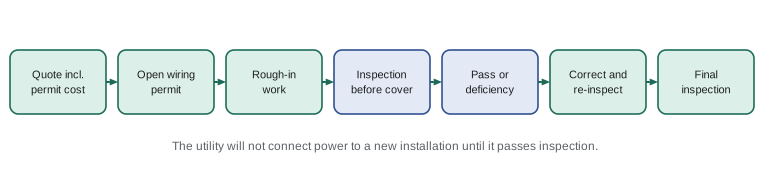
Inspection is the heart of the Nova Scotia system. A typical permitted job has at least two inspections.
- Rough-in. Before any wiring is concealed. The contractor books it through the inspection authority and keeps the work open until it passes.
- Final. When the work is complete. Nova Scotia Power's pages say the final may cover devices, lighting and panel labelling.
Larger jobs may need plan review before work starts. Nova Scotia Power's bulletin on plan review sets out when electrical plans must be submitted for acceptance, with separate forms for general and solar submittals. Temporary power on construction sites has its own bulletin. New services involve coordination between the inspection and the utility connection, because the Act forbids a utility from supplying power to a new installation that has not passed inspection.
Inspectors and utilities have broad rights of access. The Act lets them enter premises at reasonable times to examine installations, and requires consumers and contractors to give access. It also prohibits obstructing an inspector and covering work before it is inspected and approved.
When an installation fails
An inspection that finds a problem results in a deficiency the contractor must correct before the work is concealed or connected. Most deficiencies are small and fixed the same day. For serious or ignored problems, the Act gives utilities and the Chief Inspector strong tools.
- Refusal to connect. A utility must not connect or supply power to an installation that does not comply.
- Disconnection. After notice and a deadline, a utility must disconnect a non-compliant installation unless the Chief Inspector extends the deadline. Section 16 of the regulations also lets an inspection department or the Chief Inspector order or effect disconnection of a hazardous installation.
- Prosecution. Violating the Act or the regulations is an offence. The Act sets a maximum fine of 1,000 dollars on summary conviction. That figure is low compared with some provinces, but the practical costs of refused connection, rework and reputation are far higher.
Inspectors and utilities acting under the Act are not liable for losses caused by defects in installations or equipment. The responsibility for the work stays with the people who did it.
Fees
Permit and inspection fees in Nova Scotia are not set by the inspection authorities on their own. The Act gives the regulator of public utilities the power to set fees for inspections, permits and certificates, and the regulations refer to a fee scale approved by that board, now the Nova Scotia Energy Board. Nova Scotia Power publishes a schedule of fees and refers to its approved-fees regulation and a fee bulletin. Build the permit cost into every quote, and check the current schedule rather than reusing an old figure.
A worked example: the MacKenzie farmhouse
Worked problem
Permits and inspections on a service upgrade
Benoit Electric is upgrading the service at the MacKenzie farmhouse near Truro and adding circuits for a heat pump and a workshop. The homeowner offers to pull the permit himself to save money, and asks whether Aisha can drywall the workshop the same week she wires it. What should happen?
Show solution
- The farmhouse is in Nova Scotia Power's territory, so Nova Scotia Power is the inspection authority.
- The homeowner cannot obtain the permit; only a certified construction electrician, or a contractor employing one, can.
- Benoit Electric opens the wiring permit before any work starts.
- Aisha books the rough-in inspection and keeps the workshop walls open until it passes.
- After the work is complete she books the final inspection, and the service is energized only once it passes.
Answer: Benoit Electric takes out the permit, the walls stay open until the rough-in passes, and the new service is connected only after inspection.
Planning inspections into the schedule
Inspections are a predictable part of every job, so they belong in the schedule from the start. On a renovation, the rough-in inspection usually has to happen before insulation and drywall, which means it controls the other trades' start dates. On a service upgrade, the utility's disconnect and reconnect must be coordinated with the inspection, and the customer needs to know how long the power will be off.
Aisha keeps a simple rule: book the inspection when the work is ready, not when she hopes it will be. A failed inspection costs a second visit, delays the next trade and annoys the customer. Asking for an inspection a day later than planned, with the work actually finished, costs nothing.
Good records make inspections smoother. The permit number, the scope, any plans that were accepted, and notes on any questions already discussed with the inspector should be in the job file and on site. When the inspector arrives, the person on site should know the work well enough to answer questions and show anything the inspector wants to see.
Common mistakes
MistakeLetting a homeowner pull the permit to save the customer money.
InsteadNova Scotia has no homeowner permit route; only certified construction electricians or contractors employing them can obtain electrical permits.
MistakeTreating permit-exempt work as Code-exempt.
InsteadExempt work must still meet the Code, be done by a construction electrician, and be recorded.
MistakeClosing up walls while waiting for the inspector.
InsteadWiring must not be concealed before inspection; covering it is an offence under the Act.
MistakePhoning Nova Scotia Power about a job in Mahone Bay.
InsteadMahone Bay's municipal electric utility is the inspection authority in its own area.
Summary and key terms
- Seven utilities act as inspection authorities: Nova Scotia Power and the municipal utilities of Antigonish, Berwick, Canso, Lunenburg, Mahone Bay and Riverport.
- A permit is required before work starts; electrical permits go to contractors who are or employ construction electricians, and maintenance permits to establishments employing construction or industrial electricians.
- Minor work within set limits is exempt from permits if a construction electrician does it and keeps a record; the exemptions do not apply in hazardous locations.
- Work must be inspected before concealment and at completion; utilities may not connect non-compliant installations and may disconnect them after notice.
- Fees are set under authority of the public utilities regulator, now the Nova Scotia Energy Board.
- Rough-in inspection
- An inspection before wiring is concealed by insulation, boarding or other coverings.
- Maintenance permit
- A one-year permit for routine work at an establishment that employs a construction or industrial electrician.
- Permit exemption
- Minor work that needs no permit if done by a construction electrician and recorded.
- Deficiency
- A failure found at inspection that must be corrected before concealment or connection.
- Nova Scotia Energy Board
- The regulator whose approval sets inspection and permit fees.
Practice problems
Work each problem on paper first, then reveal the answer to check.
Who may obtain a maintenance permit?
Show answer
The owner or occupant of an establishment with frequent routine work that employs a construction electrician or an industrial electrician.
Is replacing a 240 volt, 40 ampere device exempt from a permit?
Show answer
Yes, if a construction electrician does it and keeps a record, and it is not in a Section 18 or 20 location.
What may a utility do if a non-compliant installation is not corrected after notice?
Show answer
Disconnect it, unless the Chief Inspector extends the deadline.
A homeowner in Truro wants to pull his own permit. What should he be told?
Show answer
He cannot; a certified construction electrician or a contractor employing one must take out the permit.
Lesson quiz · 5 questions
Score 60% or more to complete this lesson.
Create a free account to save your progress, take quizzes and earn a certificate.