
MELC-208 · Lesson 10 of 12 · 19 min
Occupational health and safety law for electrical contractors
▶ Video coming soon A video version of this lesson is on the way.
Electrical work is dangerous, and the law that governs workplace safety applies to an electrical contractor from the day it hires its first employee. In Nova Scotia that law is the Occupational Health and Safety Act and the regulations made under it, enforced by the Occupational Health and Safety Division of the Department of Labour, Skills and Immigration. Workers compensation, run by WCB Nova Scotia, is a separate system with its own reporting duties. This lesson covers the employer's duties, the thresholds for policies, programs and committees, injury reporting, and the hazards that matter most in electrical work.
The thresholds and deadlines here come from provincial and WCB sources and from small business guidance; regulations change, and some details depend on the size and type of workplace. Confirm current requirements with the OHS Division and WCB, and use Construction Safety Nova Scotia's resources, which are written for exactly this industry.
The internal responsibility system
Nova Scotia's OHS Act, like those in other provinces, is built on the idea that everyone at a workplace shares responsibility for safety, with the greatest share falling on those with the most authority. Employers must take every reasonable precaution to protect the health and safety of employees and others at or near the workplace. That includes providing safe equipment and procedures, information, instruction, training and supervision, and making sure workers know their rights. Supervisors must make sure workers follow safe procedures. Workers must take reasonable care for themselves and others, use the protective equipment provided, and report hazards. Contractors and constructors on multi-employer sites have their own duties to coordinate safety.
Workers have three basic rights: the right to know about hazards, the right to participate in safety through committees and representatives, and the right to refuse work they reasonably believe is dangerous. A contractor must not punish a worker for exercising those rights.
Policies, programs, committees and representatives
The duties grow with the size of the workplace. Small business guidance based on the Act sets out the main thresholds, which the province's own pages confirm for committees and representatives.
| Employees | Requirement |
|---|---|
| 5 or more | A written OHS policy, easily accessible to workers |
| 5 to 19 regularly employed at a workplace | A health and safety representative |
| 20 or more regularly employed at a workplace | A joint occupational health and safety committee |
| 20 or more regularly employed in the province | A written OHS program |
The province's page describes the committee threshold as workplaces with 20 or more employees who work more than four weeks in a row, and the representative threshold as 5 or more where no committee is required. Each work location may count as a separate workplace, which matters for contractors whose crews are spread across several sites.
Records matter too. Small business guidance says employers must keep detailed records of workplace injuries and keep them for five years. Aisha's company will start small, with three people, but Sam sets up the injury log and the policy template now, because the company will reach five employees within a year if its plan works.
# Which OHS requirements apply? (thresholds as summarized above; confirm)
def requirements(employees_at_site, employees_in_province):
    req = []
    if employees_in_province >= 5:
        req.append("written OHS policy")
    if employees_at_site >= 20:
        req.append("joint OHS committee")
    elif employees_at_site >= 5:
        req.append("health and safety representative")
    if employees_in_province >= 20:
        req.append("written OHS program")
    return req or ["general duties only (still apply in full)"]

for site, prov in [(3, 3), (6, 6), (12, 24), (22, 30)]:
print(f"{site:2d} at site, {prov:2d} in province ->", ", ".join(requirements(site, prov)))3 at site, 3 in province -> general duties only (still apply in full) 6 at site, 6 in province -> written OHS policy, health and safety representative 12 at site, 24 in province -> written OHS policy, health and safety representative, written OHS program 22 at site, 30 in province -> written OHS policy, joint OHS committee, written OHS program
Reporting injuries
Two reporting systems run side by side, and both have short deadlines.
- WCB Nova Scotia. WCB's guidance for employers says it must receive an injury report within 2 business days of the injury being reported to the employer, for any injury where the worker missed time or needed medical treatment. Reports can be made through MyAccount or on WCB's injury report form. Late reports can bring penalties.
- The OHS Division. Serious injuries must be reported to the Occupational Health and Safety Division as soon as possible, within 24 hours, and fatalities must be reported immediately. The scene of a serious accident generally must not be disturbed except to help injured people or prevent further harm, until the Division permits it.
Aisha posts both numbers in every truck and adds a one-page procedure to the company's safety binder: help the injured person, secure the scene, call the supervisor, report to the OHS Division if serious, report to WCB within two business days, and record everything in the injury log.
The hazards that matter most
Electrical contractors face the general hazards of construction, plus several that are particular to the trade. The OHS regulations, CSA standards and industry guidance address each.
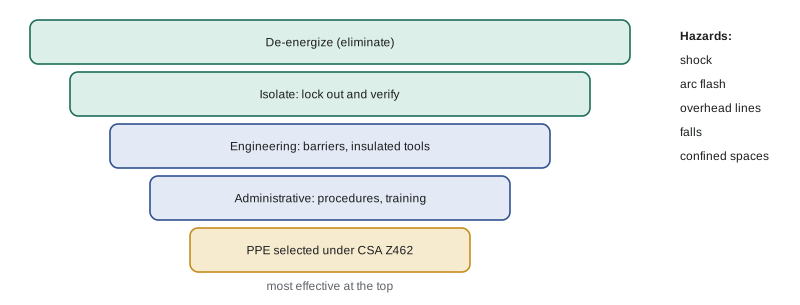
- Shock and electrocution. The most fundamental rule is to work de-energized whenever possible: isolate the circuit, lock it out, and verify absence of voltage before touching anything. Energized work should be the rare exception, justified, planned and done with the right controls.
- Arc flash. A fault during energized work can release a blast of heat and pressure. CSA Z462, the Canadian standard for workplace electrical safety, sets out how to assess arc flash risk, set boundaries and select protective equipment. Employers are expected to follow it.
- Overhead power lines. Contact with overhead lines kills workers every year, often when booms, ladders or long materials come too close. Keep required clearances, use spotters, and contact the utility when work must be near lines.
- Falls. Ladders, scaffolds, roofs and open floor edges. Fall protection is required above set heights.
- Confined spaces. Vaults, crawlspaces and tanks can trap bad air. Entry requires assessment, testing and procedures.
- Hazardous products. WHMIS training and safety data sheets for products such as cleaning solvents, firestop materials and lubricants.
- Working alone. Electricians often work alone in empty buildings. The employer needs a check-in system and a plan for getting help.
Lockout in practice
Lockout is the single most important safety procedure in the trade. A good procedure identifies every energy source, shuts each one off at its isolating device, applies a personal lock and tag, releases stored energy, and then verifies absence of voltage with a tested meter before work begins. Each worker applies their own lock; nobody removes another person's lock. Aisha writes a lockout procedure for Benoit Electric on day one, buys a personal lock and tag for each worker, and makes verification with a tested meter a non-negotiable rule.
Multi-employer sites
On a construction project with several trades, the constructor or prime contractor coordinates safety for the site, and each employer remains responsible for its own workers. A subcontractor should expect to attend site orientation, follow the site's rules, report hazards, and share its own hazard assessments with the constructor. Benoit Electric's crews follow Highland Construction's site rules on the Antigonish clinic, but Benoit remains responsible for its own lockout, its own ladders and its own workers' training.
Training and records
Training is where safety law meets daily practice. The employer must make sure each worker is trained for the hazards of their work and keep records showing what training was given. For an electrical contractor, that usually includes general orientation, WHMIS, fall protection, lockout, CSA Z462 electrical safety, first aid on larger crews, and site-specific orientation for each project. Construction Safety Nova Scotia offers courses and resources designed for the province's construction industry.
A worked example: a shock near miss
Worked problem
Owen's near miss in the Truro duplex
Owen, the apprentice, receives a minor shock while working on a circuit he believed was off. He is shaken but not injured and does not see a doctor. The circuit had been switched off at the panel, but the breaker was mislabelled, and nobody verified absence of voltage. What should Aisha do?
Show solution
- Stop work and make sure Owen is all right; offer medical assessment, because shocks can cause delayed effects.
- No WCB report is required if he missed no time and needed no medical treatment, but if he later sees a doctor, report within 2 business days.
- It is not a serious injury requiring a 24-hour report to the OHS Division, but record it in the company's injury and incident log.
- Investigate: the root cause is a failure to lock out and verify, made worse by a mislabelled panel.
- Correct the procedure, retrain the crew on verification, and correct the panel directory.
Answer: Look after Owen, record and investigate the near miss, and fix the real cause: lockout and verification were skipped.
Writing the OHS policy
A written OHS policy is short. It states the employer's commitment to health and safety, names who is responsible for what, and says how workers can raise concerns. It is signed by the person in charge and posted where workers can see it. Benoit Electric will not need one until it reaches five employees, but Aisha writes one in the first month anyway, because it costs an afternoon and tells every new worker how the company expects them to work.
Her policy covers six points: the company's commitment to preventing injuries; the employer's duties to provide safe equipment, training and supervision; supervisors' duties to enforce safe procedures; workers' duties to follow procedures, use protective equipment and report hazards; workers' right to refuse unsafe work without reprisal; and how to report an incident.
Hazard assessment before each job
A hazard assessment is a structured look at a job before it starts: what could hurt someone, how likely it is, and what controls will be used. For a small electrical contractor, it can be a short form filled in at the start of each job and reviewed when conditions change. Typical entries for a residential job include working near live parts in an existing panel, ladders on stairs, attics in summer heat, crawlspaces, asbestos or other hazardous materials in older homes, and customers' children or pets on site.
The form takes ten minutes. It makes the crew stop and think before they start, and it creates a record that the company took the hazards seriously. When Highland Construction asks for Benoit Electric's hazard assessments for the Antigonish clinic, Sam can send them the same day.
New workers and young workers
Injury statistics across Canada consistently show that new workers, of any age, are at higher risk in their first months on a job. Young workers are at particular risk, because they may not recognize hazards or feel able to speak up. A good orientation for a new worker covers the company's policy and procedures, the hazards of the work, the lockout procedure, protective equipment, how to report hazards and injuries, and the right to refuse unsafe work. It should be done before the worker starts, recorded and followed up after the first few weeks.
Owen, the apprentice, was nineteen when he joined. Aisha pairs him with a journeyperson on every job, and asks him at the end of each week what he found difficult or unclear. It is part supervision and part safety: an apprentice who feels free to ask questions is less likely to guess.
Inspections and orders
OHS officers can visit workplaces, including construction sites, to check compliance. They can issue orders requiring hazards to be corrected and, where there is an immediate danger, stop work. Penalties for serious breaches can be substantial. The best preparation is ordinary good practice: written procedures that are actually followed, training records, hazard assessments and an incident log, all kept current.
Common mistakes
MistakeWaiting until the company is large to think about OHS law.
InsteadThe general duties apply from the first employee; a written policy is required from five employees.
MistakeReporting injuries to WCB at the end of the month.
InsteadWCB must receive the report within 2 business days of the injury being reported to the employer.
MistakeTrusting a panel label instead of verifying absence of voltage.
InsteadLock out, then verify with a tested meter before every job.
MistakeAssuming the general contractor is responsible for the electrical crew's safety.
InsteadThe constructor coordinates the site, but each employer remains responsible for its own workers.
Summary and key terms
- The OHS Act places the greatest responsibility on employers, who must take every reasonable precaution to protect workers.
- A written OHS policy is required at 5 or more employees, a representative at 5 to 19 at a workplace, a committee at 20 or more, and a written program at 20 or more in the province.
- WCB must receive an injury report within 2 business days; serious injuries go to the OHS Division within 24 hours and fatalities immediately.
- Shock, arc flash, overhead lines, falls, confined spaces and working alone are the main electrical hazards; CSA Z462 guides electrical safety.
- Lockout with verification of absence of voltage is the most important daily safety procedure.
- Internal responsibility system
- The principle that everyone at a workplace shares responsibility for safety.
- CSA Z462
- The Canadian standard for workplace electrical safety, including arc flash.
- Lockout
- Isolating energy sources and applying personal locks before work begins.
- Joint occupational health and safety committee
- A committee of workers and management required at workplaces with 20 or more employees.
- Health and safety representative
- A worker representative required at workplaces with 5 to 19 employees.
Practice problems
Work each problem on paper first, then reveal the answer to check.
At how many employees does a Nova Scotia employer need a written OHS policy?
Show answer
5 or more.
How quickly must WCB receive an injury report?
Show answer
Within 2 business days of the injury being reported to the employer.
Within what time must a serious injury be reported to the OHS Division?
Show answer
As soon as possible, within 24 hours.
What step did the crew skip in Owen's near miss?
Show answer
Verifying absence of voltage after lockout.
Lesson quiz · 5 questions
Score 60% or more to complete this lesson.
Create a free account to save your progress, take quizzes and earn a certificate.