
MELC-208 · Lesson 7 of 12 · 19 min
Duties of the permit holder
▶ Video coming soon A video version of this lesson is on the way.
In provinces with a master electrician or qualifier, much of the law is written around that person's duties: what the certificate holder must supervise, what they answer for, and what happens when they fail. Nova Scotia's law is written differently. Its central figure is the permit holder, the contractor who is, or employs, a certified construction electrician, together with the certified electricians who actually do the work. This lesson gathers the duties that fall on them from the Electrical Installation and Inspection Act, the Electrical Code Regulations, the apprenticeship law and ordinary civil law, and shows how Aisha turns them into habits.
Duties from the installation law
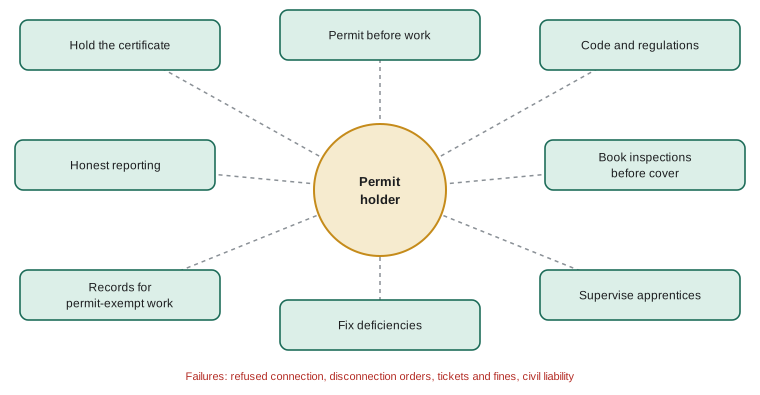
Reading the Act and the regulations together, the permit holder's core duties are these.
- Get the permit first. Section 7 of the regulations requires a permit before electrical work starts, unless the work is exempt. The permit must be held by someone section 8 allows.
- Make the work comply. Section 7 of the Act forbids any installation, alteration or addition that does not comply with the Act and the regulations, which adopt the Code.
- Tell the inspection authority. Section 10 of the Act requires a contractor to notify an inspector or the utility before altering an installation, and requires the work to be inspected during and after completion. Work may not be connected until it passes.
- Do not cover work before inspection. Section 14 of the Act prohibits covering or concealing work before it has been inspected and approved.
- Give access and do not obstruct. Sections 12 and 13 of the Act require contractors and consumers to give inspectors and utilities access, and prohibit obstructing them.
- Use approved equipment. Section 15 of the regulations requires equipment to be certified by an organization acceptable to the Chief Inspector.
- Keep records for exempt work. Section 12 of the regulations makes minor work exempt from permits only if a construction electrician does it and keeps a record.
- Correct deficiencies. An installation that fails inspection must be corrected, and the utility will not connect it until it passes.
Duties from the apprenticeship law
The apprenticeship law adds duties about people. Construction electrician is a compulsory certified trade, so the permit holder must make sure that everyone doing the work of the trade holds a certificate of qualification, is a registered apprentice, holds a temporary permit from the Agency, or holds a certificate the Agency recognizes. Apprentices must be supervised as the rules require, and their hours documented. Labourers and helpers without status may carry material and clean up, but may not do installation work.
Gerry tells Aisha that, in his experience, the supervision duty is the one most often broken by small contractors under time pressure. An apprentice sent alone to finish a job across town, or a helper asked to make up a few connections, is exactly the shortcut that leads to a compliance visit, an unsafe installation, or both.
Duties from civil law
Beyond the statutes, a contractor owes a duty of care to the people who will use and live with its work. If a fire or a shock injury is caused by work that was done carelessly, the injured person or their insurer can sue the contractor for negligence, and possibly for breach of contract. A passed inspection is good evidence that work met the Code, but it is not a shield: the Act states that inspectors and utilities are not liable for losses caused by defective installations, and a court will look at what the contractor actually did. Liability insurance, discussed in Lesson 8, exists because this duty never goes away.
Contracts add duties of their own: doing the work described, to the standard promised, by the dates agreed, and warranting it for the period the contract sets. Lesson 9 covers contracts in more detail.
Honesty with the inspection authority
Every duty above depends on honest dealing with the inspection authority. That means opening permits for work that needs them, describing the scope accurately, adding scope changes before doing the extra work, and booking inspections at the right stage rather than hoping nobody notices. It also means never asking an inspector to sign off on something that was not inspected. A contractor caught covering work, misdescribing a job or pretending exempt work was larger or smaller than it was risks prosecution under the Act and, more practically, the trust of the inspectors it works with every week.
The homeowner is entitled to know too. The province's guidance card for homeowners tells them to ask whether the contractor holds a wiring permit issued by the inspection authority, whether all required inspections are complete, and to ask for a copy of the inspection report. Aisha decides to give every residential customer a copy of the permit and the final inspection report as a matter of course. It costs nothing and it answers the questions the province tells homeowners to ask.
Shared sites and general contractors
On larger jobs, Benoit Electric will often be a subcontractor to a general contractor. The general contractor may control the schedule, the site and other trades, but the electrical permit and the duties that come with it stay with the electrical contractor. When a drywall crew wants to close a wall before the rough-in inspection, the electrical contractor must hold the line. When another trade damages a cable after inspection, the electrical contractor must repair it and, if necessary, arrange re-inspection. Aisha writes a short clause into her subcontracts requiring the general contractor to give her reasonable notice before any wall or ceiling is closed.
A deficiency log
Sam sets up a deficiency log so the company can learn from inspections instead of repeating mistakes. Each deficiency is recorded with the job, the Code rule cited and the date corrected. After a few months, the log shows which rules are causing trouble, and those become the topics for the company's monthly toolbox talk. The calculator below summarizes an illustrative log.
# Illustrative deficiency log summary for a small contractor.
from collections import Counter
log = [
    ("Okafor basement", "bonding", 1),
    ("MacKenzie farmhouse", "box fill", 0),
    ("Truro duplex", "bonding", 1),
    ("Antigonish clinic", "labelling", 0),
    ("Truro duplex", "GFCI location", 1),
    ("Bible Hill reno", "bonding", 2),
]
by_topic = Counter(topic for _, topic, _ in log)
print("deficiencies by topic:")
for topic, n in by_topic.most_common():
    print(f"  {topic:14s} {n}")
avg = sum(days for *_, days in log) / len(log)
print("average days to correct:", round(avg, 1))
print("toolbox talk topic this month:", by_topic.most_common(1)[0][0])deficiencies by topic: bonding 3 box fill 1 labelling 1 GFCI location 1 average days to correct: 0.8 toolbox talk topic this month: bonding
In this example, bonding comes up three times. Aisha books a toolbox talk on Section 10 and sends Owen through the bonding chapter of MELC-104. A pattern like this is exactly the kind of thing no external checkpoint will flag for a contractor until it becomes a real problem.
Consequences when duties are not met
| Failure | Likely consequence |
|---|---|
| Work started without a permit | Stop work, re-inspection, possible prosecution, unhappy customer |
| Wiring covered before inspection | Opening walls and ceilings at the contractor’s cost; offence under the Act |
| Deficiency not corrected | Refused connection, or disconnection after notice |
| Uncertified person doing trade work | Agency compliance action: stop work order, ticket, penalty or fine |
| Careless work causing loss | Negligence claim, insurance claim, damaged reputation |
| No record for exempt work | Cannot show the work was exempt; treated as unpermitted |
A worked example: a busy Friday
Worked problem
Pressure to cut corners
It is Friday afternoon. The general contractor on the Truro duplex wants to insulate on Monday, but the rough-in inspection is booked for Tuesday. Owen is finishing a job alone across town, and a labourer offers to make up the last few device boxes to save time. What should Aisha do?
Show solution
- The walls cannot be insulated before the rough-in inspection. Aisha tells the general contractor in writing and asks Nova Scotia Power whether an earlier inspection is available.
- Owen should not be working alone if the supervision rules require a journeyperson on site; Aisha sends Kayla to join him or reschedules the work.
- The labourer cannot make up device boxes; that is trade work. He can carry materials and clean up.
- Aisha records the conversation with the general contractor in the job file.
Answer: Hold the inspection sequence, fix the supervision problem, keep the labourer on non-trade tasks, and document it.
Turning duties into company procedures
Duties written in a statute are easy to agree with and easy to forget. The way a small contractor turns them into daily practice is through short, written procedures that everyone on the crew knows. Aisha writes five one-page procedures for Benoit Electric in its first month.
- Starting a job. Confirm the scope, check whether a permit is needed, open the permit with the right inspection authority before any work, and put the permit number in the job file.
- Changing a job. Write a change order for any added work, update the permit if the scope grows, and do not start the extra work until both are done.
- Inspections. Book the inspection when the work is ready, keep work open until it passes, correct deficiencies promptly, and record each deficiency in the log.
- Who does what. Confirm the status of every person on site, pair each apprentice with a journeyperson as the rules require, and keep labourers on non-trade tasks.
- Closing a job. Confirm the final inspection has passed, give the customer a copy of the permit and the inspection report, and file the job records.
Each procedure fits on a single page and is kept in every truck. When a new worker starts, Aisha walks through all five on the first day. When something goes wrong, the first question is which procedure was not followed, and whether the procedure itself needs to change.
Records that prove the duties were met
A duty that cannot be proved might as well not have been met. If a dispute, a complaint or an injury puts the company's work under scrutiny months or years later, the job file is what shows the company did things properly. For each job, Sam keeps the quote and contract, signed change orders, the permit and inspection reports, the deficiency log entries, photographs of the work before it was covered, daily records of who was on site, and any correspondence with the customer, the general contractor or the inspection authority.
Photographs taken before walls are closed are especially valuable. They show what was installed and how, they help future service calls, and they can settle arguments about whether a problem was the contractor's work or someone else's. Every crew member at Benoit Electric photographs each wall and ceiling before it is closed, and the photos are filed with the job.
When a duty conflicts with a customer's wishes
Customers sometimes ask a contractor to skip a duty: to do a small job without a permit to save the fee, to leave a deficiency uncorrected because it seems minor, or to let a relative do part of the work. The contractor's answer has to be no, politely and firmly. The permit and the duties that come with it belong to the contractor, and the consequences of breaking them fall on the contractor, not the customer. Aisha explains this the same way each time: the permit and inspection are the customer's protection as much as the law's requirement, and she is not willing to put her certificate or her company at risk for a small saving.
Common mistakes
MistakeLetting the general contractor decide when walls are closed.
InsteadThe electrical contractor holds the permit; wiring must not be concealed before inspection.
MistakeAssuming a passed inspection ends the contractor's responsibility.
InsteadInspectors and utilities are not liable for defects; the contractor's duty of care continues.
MistakeSending an apprentice alone to finish work to save a day.
InsteadApprentices must be supervised as the apprenticeship rules require.
MistakeTreating paperwork for exempt work as optional.
InsteadThe record is a condition of the exemption.
Summary and key terms
- The permit holder must get the permit first, make the work comply, notify the inspection authority, keep work open until inspected, give access, use approved equipment, keep records for exempt work and correct deficiencies.
- The apprenticeship law requires everyone doing trade work to be certified, a registered apprentice, a temporary permit holder or a recognized certificate holder, with apprentices properly supervised.
- Civil law adds a duty of care; inspectors and utilities are not liable for defective installations.
- Give homeowners copies of the permit and inspection report, as the province tells them to ask.
- A deficiency log turns inspection results into training.
- Permit holder
- The contractor, being or employing a certified construction electrician, who holds the wiring permit.
- Duty of care
- The legal duty to take reasonable care so that work does not cause foreseeable harm.
- Negligence
- A failure to take reasonable care that causes loss, for which the careless party can be sued.
- Deficiency log
- A record of inspection deficiencies used to find patterns and plan training.
Practice problems
Work each problem on paper first, then reveal the answer to check.
Which section of the Act prohibits covering work before inspection?
Show answer
Section 14.
A general contractor wants to insulate before the rough-in inspection. What should the electrical contractor do?
Show answer
Refuse, notify the general contractor in writing, and try to move the inspection earlier.
Is a contractor protected from a negligence claim because the work passed inspection?
Show answer
No; a passed inspection is evidence, but the contractor's duty of care remains.
What should a homeowner be given at the end of a permitted job?
Show answer
A copy of the permit and the inspection report.
Lesson quiz · 5 questions
Score 60% or more to complete this lesson.
Create a free account to save your progress, take quizzes and earn a certificate.