
MELC-208 · Lesson 8 of 12 · 19 min
Insurance, bonding and business registration
▶ Video coming soon A video version of this lesson is on the way.
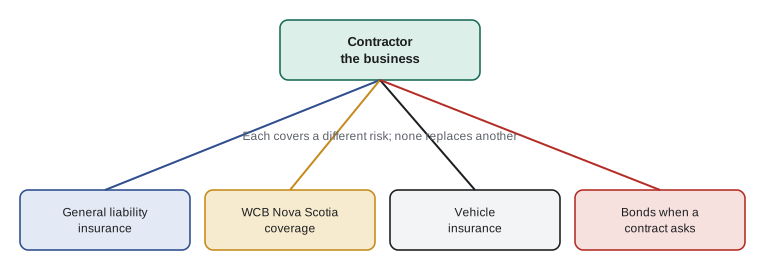
Some provinces build insurance and bonding into their contractor licensing: to hold a licence you must post a bond of a set amount, and sometimes carry a minimum amount of liability insurance. Nova Scotia has no electrical contractor licence, so the law sets no such minimums for electrical contractors. That does not make insurance or bonds optional in practice. Customers, general contractors, property managers and public owners require them, and a business without them can lose everything on a single bad day. This lesson explains the main kinds of insurance and coverage, how bonds work and when they are needed, and how to keep the business's registrations in good standing.
None of this is legal or insurance advice. The right coverage depends on the work the business does, and Aisha builds her program with a broker who specializes in contractors. What follows is the knowledge she needs to ask good questions.
Commercial general liability insurance
Commercial general liability insurance, usually called CGL, pays claims made against the business by third parties for bodily injury or property damage caused by its operations or its completed work, up to the policy limits, together with the cost of defending those claims. For an electrical contractor, the classic claim is a fire traced to a connection or a circuit the contractor installed.
Several features of CGL matter in contracting.
- Limits. The amount the policy will pay per occurrence and in total for the policy period. General contractors and institutions often require a minimum limit, commonly in the millions of dollars, and require certificates of insurance proving it.
- Completed operations. Coverage for claims arising after the work is finished, which for electrical work is where most serious claims arise. A policy that covers only work in progress is not enough.
- Additional insureds. Many contracts require the contractor to name the owner or general contractor as an additional insured on its policy, so that they are protected for claims arising from the contractor's work.
- Exclusions. Every policy excludes some risks. Common exclusions include the cost of redoing the contractor's own faulty work, professional design errors, and pollution. Read them with the broker.
Aisha's broker recommends a CGL policy with completed operations coverage and a limit that satisfies the general contractors she expects to work for. She also asks the broker to explain exactly what is excluded, because the gap between what a contractor thinks is covered and what is actually covered is where businesses get hurt.
Other coverage a contractor needs
- Commercial vehicle insurance. Work trucks must be insured for business use. A personal policy may not respond to a claim that arises while the truck is used for work.
- Tools and equipment. Contractor's equipment coverage protects tools and test equipment against theft and damage, on the truck, on site and in storage.
- Property. Coverage for the shop, office and inventory, if the business has them.
- Professional liability. If the business does design work, such as preparing electrical drawings for permits, it may need errors and omissions coverage, because CGL usually excludes professional errors.
- Cyber and data. A small but growing risk for any business that stores customer information and takes payments online.
WCB Nova Scotia
Workers compensation is a separate system, run by WCB Nova Scotia, that replaces the right of injured workers to sue their employer with a no-fault insurance scheme. WCB says that, under the law, most employers must register for coverage and pay premiums. Electrical contracting is a construction industry, and a contractor with employees should expect mandatory coverage.
Premiums, called assessments, are based on the employer's industry classification and its assessable payroll, with adjustments for the employer's own claims experience. A contractor that keeps injuries down pays less over time. WCB also requires injury reports within a short deadline, which Lesson 10 covers.
Two practical points matter most to a new contractor. First, general contractors and many owners will not let a subcontractor on site, or will hold back payment, without a clearance letter showing the subcontractor is registered and in good standing; under workers compensation law, a principal can become responsible for a subcontractor's unpaid assessments. Second, owners who work in their own businesses should confirm with WCB whether they are covered. Depending on the structure and industry, an owner may need to apply for personal coverage, and an uninsured owner injured on the job may have no benefits at all.
How bonds work
A surety bond is not insurance for the contractor. It is a guarantee, given by a surety company, that the contractor will meet its obligations to someone else, called the obligee. If the contractor fails, the obligee can claim on the bond up to its amount, and the surety pays. The surety then expects the contractor, the principal, to repay it in full, usually under an indemnity agreement the contractor and often its owners personally signed. A bond protects the obligee. It does not protect the contractor.
Nova Scotia does not require electrical contractors to post a licensing bond with the province, because there is no contractor licence. Bonds appear instead when a contract requires them, which is common on public sector and larger private projects.
| Bond | What it guarantees | When it appears |
|---|---|---|
| Bid bond | That the bidder will enter the contract and provide the required bonds if its bid is accepted | Tendered public and large private projects |
| Performance bond | That the contractor will complete the work according to the contract | Projects where the owner wants completion guaranteed |
| Labour and material payment bond | That the contractor will pay its subcontractors, workers and suppliers | Public projects, and private projects where liens may be limited |
To get bonding capacity, a contractor must satisfy a surety that it has the experience, financial strength and management to complete the work. That usually means reviewed or audited financial statements, a track record, and a relationship built up over time. Aisha does not need bonds for her first residential jobs, but she wants to bid on school and municipal work within three years, so she starts that relationship early.
What a bond costs
The premium for a performance or payment bond is a small share of the bond amount, set by the surety according to the contractor's strength and the project's risk. The real cost is the obligation behind it: if the surety pays a claim, the contractor owes the full amount back. The calculator shows how premiums scale with the contract price, using an illustrative rate.
# Illustrative bond premium for a subcontract. Rates vary by surety and contractor.
contract_price = 180_000          # dollars
bond_share = 1.0                  # bond equal to the full contract price
rate_per_thousand = 12            # illustrative premium rate, dollars per 1,000 of bond
bond_amount = contract_price * bond_share
premium = bond_amount / 1000 * rate_per_thousand
print("bond amount:", f"{bond_amount:,.0f}")
print("premium at", rate_per_thousand, "per thousand:", f"{premium:,.0f}")
print("amount the contractor must repay if the surety pays a full claim:", f"{bond_amount:,.0f}")bond amount: 180,000 premium at 12 per thousand: 2,160 amount the contractor must repay if the surety pays a full claim: 180,000
Keeping registrations in good standing
Lesson 3 covered the registrations a new business needs. Keeping them current is an ongoing duty, and a lapse in any one of them can cost work or create liability.
- Business registration. Registrations with the Registry of Joint Stock Companies generally renew every year. A corporation that misses renewal can lose its good standing.
- HST. Returns must be filed on time, and tax collected on invoices must be remitted.
- Payroll. Source deductions must be remitted on schedule; directors can become personally liable for unremitted amounts.
- WCB. Payroll must be reported and assessments paid, so that clearance letters can be issued when customers ask.
- Insurance. Policies must be renewed before they lapse, and certificates updated for customers who require them.
- Certificates of qualification. Since October 7, 2025, these no longer expire, but the business should still keep proof on file for every worker.
Sam builds a compliance calendar with every renewal and filing date in it, and a reminder thirty days before each one. It is dull, and it is one of the most valuable things a small contractor can do.
A worked example: a general contractor's paperwork
Worked problem
Getting onto the Antigonish clinic job
Highland Construction has awarded Benoit Electric the electrical subcontract on a dental clinic fit-out in Antigonish. Before Benoit can start, Highland asks for a certificate of insurance naming Highland as an additional insured with a stated liability limit, a WCB clearance letter, and proof that the electricians on site are certified. The contract does not ask for a bond. What does Aisha send, and who issues the wiring permit?
Show solution
- A certificate of insurance from her broker, showing the CGL limit and Highland as an additional insured.
- A current WCB clearance letter showing Benoit Electric is registered and in good standing.
- Copies of the certificates of qualification for Aisha and Kayla, and Owen's apprentice registration.
- No bond is required because the contract does not call for one.
- The wiring permit comes from the Town of Antigonish's electric utility, the inspection authority in that area, not Nova Scotia Power.
Answer: Send the insurance certificate, WCB clearance and proof of certification, and open the permit with Antigonish's own utility.
Working with a broker
A broker who works with contractors is worth finding before the business opens. A good broker asks detailed questions about the work the company does, the size of its jobs, the customers it works for and the contracts it signs, and then shops the coverage among insurers. The broker can also review insurance clauses in contracts before they are signed, which is often where a small contractor discovers it has agreed to provide coverage it does not have.
The questions Aisha brings to her first meeting are practical ones. What limit do the general contractors in the area usually ask for? Does the policy cover completed operations, and for how long? What happens if a customer claims that a fire was caused by work done two years ago? Are tools covered when they are left in a locked truck overnight? Does the policy respond if an apprentice damages a customer's property? What exclusions should she know about? The broker answers each one and puts the important answers in writing.
Certificates of insurance
A certificate of insurance is a short document, issued by the broker or insurer, that summarizes the contractor's coverage: the insurer, the policy number, the policy period, the types of coverage and the limits, and any additional insureds. General contractors, property managers and institutions ask for one before work starts. A certificate is evidence of coverage at the date it was issued, not a promise that the coverage will continue, so many customers ask for an updated certificate at each renewal.
Sam keeps a list of every customer who has asked for a certificate, so that new ones can be sent automatically when the policies renew. This small habit avoids a common problem: a general contractor holding back payment because its file shows an expired certificate.
Claims and the contractor's own behaviour
What a contractor does after an incident affects how a claim turns out. If something goes wrong on a job, such as a water line damaged while drilling, a fire after a service upgrade, or a customer injured by a tool left out, the contractor should make the scene safe, record what happened with photographs and notes, notify the broker promptly, and avoid admitting liability or promising to pay before speaking to the insurer. Most policies require prompt notice of claims, and late notice can jeopardize coverage.
Prevention matters even more. A contractor's claims history affects its insurance premiums, its WCB assessments and its standing with sureties. The same habits that keep inspections clean and workers safe also keep insurance affordable.
Common mistakes
MistakeThinking a surety bond protects the contractor if a job goes wrong.
InsteadA bond protects the obligee; the contractor must repay the surety for any claim it pays.
MistakeAssuming Nova Scotia law sets the minimum insurance an electrical contractor must carry.
InsteadThere is no contractor licence to attach a statutory minimum to; contracts and customers set the requirements.
MistakeBuying a liability policy without completed operations coverage.
InsteadMost serious electrical claims arise after the work is finished.
MistakeLetting the WCB account fall behind.
InsteadWithout a clearance letter, general contractors may refuse access or hold back payment.
Summary and key terms
- Nova Scotia sets no licensing bond or statutory insurance minimum for electrical contractors, but customers and contracts require coverage.
- Commercial general liability insurance with completed operations coverage is the core protection against claims from the contractor's work.
- WCB coverage is mandatory for most employers; clearance letters prove good standing and owners should confirm their own coverage.
- Surety bonds guarantee the contractor's obligations to an obligee; bid, performance and payment bonds are required by contract.
- A compliance calendar keeps business registration, tax, payroll, WCB and insurance current.
- CGL
- Commercial general liability insurance, covering third-party injury and property damage claims.
- Completed operations
- Coverage for claims arising after the contractor’s work is finished.
- Additional insured
- A party, such as an owner or general contractor, added to the contractor’s liability policy.
- Surety
- The company that issues a bond and guarantees the contractor’s obligations.
- Obligee
- The party protected by a bond.
- Indemnity agreement
- The contractor’s promise to repay the surety for claims it pays.
Practice problems
Work each problem on paper first, then reveal the answer to check.
Who does a performance bond protect?
Show answer
The obligee, usually the owner; the contractor must repay the surety for any claim.
Why is completed operations coverage important for electrical contractors?
Show answer
Because most serious claims, such as fires, arise after the work is finished.
What does a WCB clearance letter show?
Show answer
That the business is registered with WCB and in good standing.
Does Nova Scotia require electrical contractors to post a licensing bond?
Show answer
No; bonds are required by contracts, not by a contractor licence.
Lesson quiz · 5 questions
Score 60% or more to complete this lesson.
Create a free account to save your progress, take quizzes and earn a certificate.