
MELC-208 · Lesson 5 of 12 · 18 min
The Canadian Electrical Code as adopted in Nova Scotia
▶ Video coming soon A video version of this lesson is on the way.
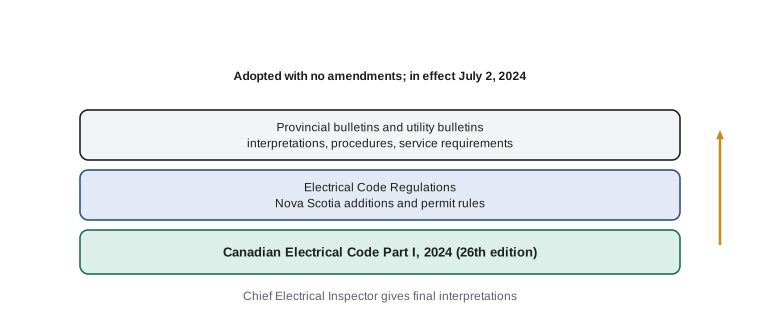
Every province builds its electrical rules on the Canadian Electrical Code, Part I, published by CSA Group as CSA C22.1. What differs is how each province adopts it, what it adds or changes, and who interprets it. In some provinces the adopted code comes wrapped in a thick book of local amendments. Nova Scotia's approach is lighter. This lesson explains how the Code becomes law here, how the 2024 edition was adopted and with what transition rules, what Nova Scotia's own regulations add, and who has the final word when a rule is unclear.
As everywhere in this series, the Code itself is never reproduced. Rule numbers are cited so you can find them in your own copy, and every explanation is in our own words. If you do not yet own the 2024 edition, buy it before you take on your first permitted job.
How the Code becomes law
The Electrical Installation and Inspection Act allows regulations to adopt existing codes and standards, with or without changes. The Electrical Code Regulations use that power. In section 2 they define the Code as the Canadian Electrical Code, Part I, together with CSA's supplements and amendments, and in section 3 they adopt the Code and constitute it as regulations, subject to the regulations themselves and to the Act. In other words, a Code rule in Nova Scotia is not just a recommendation from a standards body. It has the force of a provincial regulation.
Section 3 also contains a timing rule: the Code and its amendments come into force on the first clear day of the fourth month after publication, unless the province sets something else. That gives contractors, designers and inspectors a predictable window between the publication of a new edition and the date it becomes enforceable.
One practical caution. The online consolidation of the Electrical Code Regulations still names an earlier issue of the Code in its definition, even though the province adopted the 2024 edition in 2024. Consolidations lag behind. When the regulation text and a current provincial bulletin seem to disagree about which edition applies, read the bulletin and, if in doubt, ask the Chief Electrical Inspector's office.
The 2024 edition: Bulletin 2024-35
On July 5, 2024, the Provincial Chief Electrical Inspector issued Bulletin 2024-35, Adoption of the 2024 Canadian Electrical Code, Part 1, 26th Edition. Its main points are clear and worth knowing by heart.
- The 2024 Code, CSA C22.1:24, is adopted in Nova Scotia with no amendments.
- It took effect on July 2, 2024.
- Work started and permitted before July 2, 2024 may be inspected under the 2021 Code, provided the permit was obtained before that date and, where plans had to be accepted, the plans were accepted before that date.
- Work started or plans submitted on or after July 2, 2024 must be designed, reviewed and inspected under the 2024 Code, regardless of when the permit was issued.
- The electrical inspection authority decides whether work had started before July 2, 2024 when that is in dispute.
The phrase no amendments is the headline. Unlike provinces that publish long lists of local changes, Nova Scotia applies the national Code as written, with its own additions living in the Electrical Code Regulations rather than in a separate amendment document.
Applying the transition rule
Transition rules sound simple until a real job straddles the line. The calculator below applies the Bulletin 2024-35 logic to a few situations. It is a study aid only; the inspection authority decides real cases.
# Which Code edition applies under the Bulletin 2024-35 transition rule?
from datetime import date
EFFECTIVE = date(2024, 7, 2)

def edition(permit_date, work_start, plans_needed=False, plans_accepted=None):
    if work_start >= EFFECTIVE:
        return "2024 Code"
    if permit_date >= EFFECTIVE:
        return "2024 Code"
    if plans_needed and (plans_accepted is None or plans_accepted >= EFFECTIVE):
        return "2024 Code"
    return "2021 Code may be used"

jobs = [
    ("house, permit June 20, started June 24", date(2024, 6, 20), date(2024, 6, 24), False, None),
    ("house, permit June 20, started July 8", date(2024, 6, 20), date(2024, 7, 8), False, None),
    ("store, permit June 10, plans accepted July 3", date(2024, 6, 10), date(2024, 6, 28), True, date(2024, 7, 3)),
    ("store, permit June 10, plans accepted June 14", date(2024, 6, 10), date(2024, 6, 28), True, date(2024, 6, 14)),
]
for name, p, w, need, acc in jobs:
print(f"{name:46s} -> {edition(p, w, need, acc)}")house, permit June 20, started June 24 -> 2021 Code may be used house, permit June 20, started July 8 -> 2024 Code store, permit June 10, plans accepted July 3 -> 2024 Code store, permit June 10, plans accepted June 14 -> 2021 Code may be used
Look at what the third case shows: a permit and a start date before July 2 were not enough when plan acceptance was required and came after the effective date. A contractor bidding work near a Code changeover should ask, in writing, which edition the design was done to.
Nova Scotia's own additions
Although the 2024 Code was adopted with no amendments, the Electrical Code Regulations themselves add requirements and procedures that sit alongside the Code. The most important for a contractor are these.
- Permits. Section 7 requires a permit before electrical or communications work begins, and section 8 limits who may hold an electrical permit. Lesson 6 covers permits in detail.
- Permit exemptions. Section 12 exempts certain minor electrical work from permits, provided a construction electrician does it and keeps a record; section 13 does the same for small communications jobs; section 14 exempts some installations, such as security and intrusion alarm systems, entirely.
- Inspections and reports. Section 7 requires a final inspection report and an annual limited inspection where a maintenance permit is used.
- Approved equipment. Section 15 requires electrical equipment to be certified by an organization acceptable to the Chief Inspector, and gives the Chief Inspector power to order disconnection and recall of uncertified equipment.
- Special permission. Section 17 lets the Chief Inspector grant written special permission to deviate from or postpone a requirement.
- Disconnection. Section 16 lets an inspection department or the Chief Inspector order or effect the disconnection of a hazardous installation.
The regulations also contain a few specific technical additions that do not appear in the national Code, such as a latching requirement for certain rated fire doors in section 4. These are rarely the subject of small residential work, but a contractor doing institutional or commercial jobs should read the regulations once in full.
Bulletins: provincial and utility
Two kinds of bulletins shape day-to-day work. The Chief Electrical Inspector issues provincial electrical bulletins on Code adoption, interpretations and safety alerts. The inspection authorities issue their own bulletins on procedures: how permits are issued and billed, plan review, temporary installations, service upgrades and meter equipment.
| Bulletin | Issued by | Subject |
|---|---|---|
| 2024-35 (July 5, 2024) | Chief Electrical Inspector | Adoption of the 2024 Code, effective July 2, 2024 |
| 2024-37 (reissued July 15, 2025) | Chief Electrical Inspector | Compliance with Rule 10-210 of the 2024 Code |
| B-2-014 (June 14, 2022) | Nova Scotia Power | Submittal of electrical plans for acceptance |
| B-02-022 (July 5, 2024) | Nova Scotia Power | Minimum requirements for upgrading services for single dwellings |
| B-76-000 (October 15, 2017) | Nova Scotia Power | Temporary electrical installations |
Bulletin 2024-37 is a good example of how a bulletin manages a change. It concerns Rule 10-210 of the 2024 Code. A transition period began on October 2, 2024; until December 31, 2025, either that bulletin or the older 2018 bulletin on the same rule could be used; from January 1, 2026, only the 2024 rule is enforced. A contractor who learned the older practice and has not read the new bulletin would now be working to a superseded requirement.
Who interprets the Code
The province's electrical safety page is explicit: the Chief Electrical Inspector provides Code interpretations and is the person responsible for the final interpretation. In practice, most questions are settled with the local inspector from the inspection authority. When a contractor and an inspector disagree about what a rule requires, the contractor can ask for the issue to go to the Chief Electrical Inspector, and for unusual installations the contractor or designer can apply for special permission under section 17.
Gerry's advice to Aisha is to raise questions before the work is done, not after. A phone call or email to the inspector at the planning stage, with the rule number and a sketch, costs ten minutes. A disagreement discovered at rough-in costs a day of rework.
What changed in 2024
Every Code edition changes rules that small contractors use every week. CSA's own description of the 2024 edition highlights, among others, revised requirements for electric vehicle supply equipment in Section 86 and related load calculation changes in Section 8, new and revised requirements for energy storage systems in Section 64, conductive pool infrastructure in Section 68, revised sealing requirements for hazardous locations in Section 18, and ground fault protection for temporary installations in Section 66. MELC-101 and MELC-105 cover these in depth. The point here is that a Nova Scotia contractor who has not studied the 2024 changes is working to the wrong book, because the province applies the national edition as written.
A worked example: an inspector's question
Worked problem
The heat pump on the MacKenzie farmhouse
Benoit Electric is installing a heat pump circuit at the MacKenzie farmhouse, a job permitted in August 2024. The homeowner's brother, an electrician from another province, says Nova Scotia must have a local amendment changing the disconnect rule he is used to. How should Aisha approach the question?
Show solution
- The job was permitted and started after July 2, 2024, so the 2024 Code applies.
- Nova Scotia adopted the 2024 Code with no amendments, so there is no provincial amendment to the disconnect rule.
- Nova Scotia's own additions are in the Electrical Code Regulations and the bulletins; Aisha checks both for anything relevant.
- If the rule is unclear, she asks the Nova Scotia Power inspector before installing, citing the rule number.
Answer: Apply the 2024 Code as written, check the regulations and bulletins for Nova Scotia additions, and settle any doubt with the inspector before the work is done.
Owning and using the Code
Owning the Code is a basic tool of the trade, as essential as a meter. A new contractor should keep a current copy in the office and make sure every crew can reach one on the job, whether printed or in an electronic version. Older editions are worth keeping for reference when working on existing installations, but the current edition is the one that governs new work.
Using the Code well is a skill that grows with practice. The rules are organized by section, with general rules first and specific installations later, and the appendices contain explanatory notes that often clarify what a rule is meant to achieve. A good habit is to read the scope and the general rules of a section before looking up a specific rule, because the general rules often set conditions that change how the specific rule applies.
When the answer still is not clear, the right step is to ask the inspection authority before the work is done. Aisha makes a habit of writing down the rule number, the question and the inspector's answer in the job file, so that the same question never has to be asked twice and the crew learns from every interpretation.
Common mistakes
MistakeAssuming Nova Scotia has a book of local Code amendments like some other provinces.
InsteadThe 2024 Code was adopted with no amendments; Nova Scotia's additions are in the Electrical Code Regulations and bulletins.
MistakeUsing the 2021 Code for any job permitted before July 2, 2024.
InsteadThe 2021 Code may be used only if the permit was obtained, and any required plans accepted, before July 2, 2024, and work started before then.
MistakeIgnoring bulletins because they are not part of the Code.
InsteadBulletins explain how rules are applied and enforced, and can set transition dates, as Bulletin 2024-37 did for Rule 10-210.
MistakeArguing a Code interpretation with the inspector at rough-in.
InsteadRaise questions early, citing the rule; the Chief Electrical Inspector has the final interpretation.
Summary and key terms
- The Electrical Code Regulations adopt the Canadian Electrical Code, Part I, as regulations; new editions take effect on the first clear day of the fourth month after publication unless set otherwise.
- Bulletin 2024-35 adopted the 2024 Code with no amendments, effective July 2, 2024, with transition rules for earlier permits and plans.
- Nova Scotia's additions, including permits, exemptions, approved equipment and special permission, are in the Electrical Code Regulations.
- Provincial and utility bulletins govern interpretation and procedure; Bulletin 2024-37 set January 1, 2026 for full enforcement of the 2024 Rule 10-210.
- The Chief Electrical Inspector is responsible for final Code interpretations.
- CSA C22.1
- The Canadian Electrical Code, Part I, published by CSA Group.
- Adopted with no amendments
- Applied in the province as published, without local changes to its rules.
- Transition rule
- A rule deciding which Code edition applies to work that straddles an effective date.
- Special permission
- Written permission from the Chief Inspector to deviate from or postpone a requirement.
- Bulletin
- A notice from the Chief Electrical Inspector or an inspection authority explaining rules or procedures.
Practice problems
Work each problem on paper first, then reveal the answer to check.
On what date did the 2024 Code take effect in Nova Scotia?
Show answer
July 2, 2024.
A job was permitted on June 25, 2024 but work began on July 10, 2024. Which edition applies?
Show answer
The 2024 Code, because work started on or after July 2, 2024.
Who gives the final interpretation of the Code in Nova Scotia?
Show answer
The Provincial Chief Electrical Inspector.
From what date is only the 2024 version of Rule 10-210 enforced?
Show answer
January 1, 2026, under Bulletin 2024-37.
Lesson quiz · 5 questions
Score 60% or more to complete this lesson.
Create a free account to save your progress, take quizzes and earn a certificate.