
MELC-208 · Lesson 4 of 12 · 19 min
How competence is checked without a contractor exam
▶ Video coming soon A video version of this lesson is on the way.
Provinces that have a master electrician or contractor exam use it as a gate: before you can take responsibility for permits, you prove that you know the Code, the regulations and the business side well enough to be trusted with them. Nova Scotia has no such gate. Does that mean competence is never checked? Not at all. It is checked in different places and at different times. This lesson identifies those checkpoints, explains what each one tests and what it misses, and helps you assess your own readiness in the areas no exam will ever check for you.
Four checkpoints instead of one exam
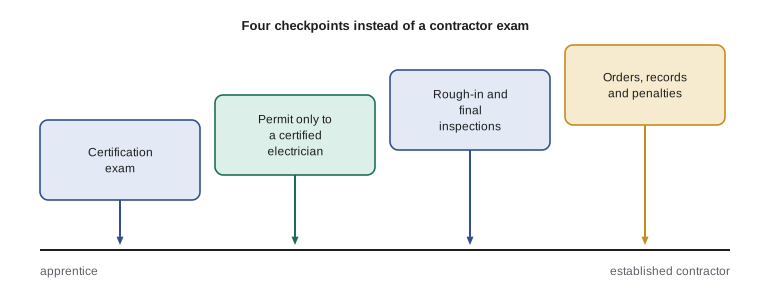
Gerry describes Nova Scotia's system to Aisha as four checkpoints spread across a career rather than one exam at the start of contracting.
- The certification exam. Every certified construction electrician has passed the trade certification exam, the Red Seal exam for this trade. It tests the full scope of the trade, including a large share of Code questions, and it is the reason the permit rule can rely on the certificate.
- The permit rule. Under section 8 of the Electrical Code Regulations, a wiring permit may be issued only to a contractor who is, or employs, a certified construction electrician. That limits permitted work to businesses that have passed the first checkpoint.
- Inspection of every permitted job. The inspection authority inspects permitted installations, generally before wiring is concealed and again at the end, and the utility will not connect a new installation that has not passed. Mistakes that slip past the first two checkpoints are supposed to be caught here, job by job.
- Enforcement after the fact. The Act makes it an offence to violate the Act or the regulations, to obstruct an inspector or to cover work before inspection. Utilities can refuse to connect or can disconnect non-compliant installations. The Agency can stop uncertified people working in the trade.
What each checkpoint tests, and what it misses
Each checkpoint is strong in some areas and weak in others. A contractor who understands the gaps can fill them deliberately.
| Checkpoint | Tests well | Misses |
|---|---|---|
| Certification exam | Trade knowledge, Code navigation, calculations, safe work | Business, contracts, liens, regulations beyond the Code, later Code editions |
| Permit rule | That a certified person is responsible | Whether that person is current or careful |
| Inspection | Whether a particular installation meets the Code | Work never permitted, and paperwork, estimating, safety culture |
| Enforcement | Serious and repeated problems | Small habits that never quite reach an order or a ticket |
The pattern is clear. The checkpoints are good at catching technical errors on permitted jobs. They are weak on everything around those jobs: running a business, writing contracts, protecting payment, managing safety, and keeping up with Code changes after certification. A master exam in another province would test some of those areas once. In Nova Scotia, nobody tests them at all. That is why the rest of this master electrician program, and this course, matter here even without an exam at the end.
The areas no one tests
Gerry gives Aisha a list of the areas where he saw new contractors get into trouble, none of which an inspector or the Agency will check before something goes wrong.
- Code changes since certification. A journeyperson certified on the 2018 Code who has not studied the 2021 and 2024 editions may be working from rules that have changed. Lesson 5 covers how Nova Scotia adopts each edition.
- Permit discipline. Opening a permit for every job that needs one, adding scope changes, booking inspections before work is concealed, and keeping records for permit-exempt work.
- Contracts and change orders. Written scopes, clear prices, signed changes, and payment terms that the business can live with.
- Liens and holdback. Knowing the deadlines that protect payment, and keeping the records that prove the last day of work.
- Safety management. A written policy once the business reaches five employees, hazard assessment, lockout, arc flash practices under CSA Z462, and injury reporting deadlines.
- Supervision. Making sure apprentices are supervised as the rules require and that uncertified helpers never do trade work.
- Estimating and cash flow. Pricing jobs to cover overhead, permits, insurance and risk, and managing the gap between paying for materials and being paid.
A readiness self-assessment
Because no exam will tell you whether you are ready to run a contracting business, it helps to test yourself. Aisha scores herself from 0 to 4 in each area, where 0 means she has never thought about it and 4 means she could teach it, and Gerry has her weight the scores by how much damage a gap could cause. The calculator below does the arithmetic. Change the scores to your own.
# Readiness self-assessment: score 0 to 4 in each area; weights reflect risk.
areas = [
    # (area, weight, score)
    ("Code changes since certification", 3, 2),
    ("Permit and inspection procedures", 3, 3),
    ("Contracts and change orders", 2, 1),
    ("Liens and holdback deadlines", 2, 1),
    ("Safety program and reporting", 3, 2),
    ("Supervision of apprentices", 2, 3),
    ("Estimating and cash flow", 2, 2),
]
total = sum(w * s for _, w, s in areas)
best = sum(w * 4 for _, w, _ in areas)
print("weighted score:", total, "of", best)
print("readiness:", round(total / best * 100), "in 100")
gaps = sorted(areas, key=lambda a: (a[2], -a[1]))[:3]
print("work on first:")
for name, w, s in gaps:
print(" -", name, "(score", s, ")")weighted score: 35 of 68 readiness: 51 in 100 work on first: - Contracts and change orders (score 1 ) - Liens and holdback deadlines (score 1 ) - Code changes since certification (score 2 )
Aisha's result tells her what to study first: contracts and change orders, liens, and Code changes. None of those would have stopped her from opening her first permit. All three could cost her money or her reputation within her first year.
Using the rest of the program
The core courses of this master electrician program, MELC-101 to MELC-106, were written for provinces with master exams, but their content is exactly what fills Nova Scotia's gaps.
| Course | Fills which gap |
|---|---|
| MELC-101 Navigating the Code | Fast, accurate Code lookups and the structure of the 2024 edition |
| MELC-102 Electrical calculations | Demand loads, service and feeder sizing, voltage drop |
| MELC-103 Wiring methods and protection | Conductors, raceways, overcurrent protection |
| MELC-104 Grounding and bonding | Section 10 in depth, the most common source of deficiencies |
| MELC-105 Motors and special installations | Motors, hazardous locations, generators, EV and solar |
| MELC-106 Contracting business and exam strategy | Contracts, liens, insurance, safety and running the business |
Gerry's advice is to treat the core courses as the exam Nova Scotia doesn't set. Work through them, keep the notes, and use the practice questions to find weak spots. A contractor who does that will be better prepared than many who passed a master exam elsewhere years ago and never studied again.
A worked example: the gap an inspector found
Worked problem
A deficiency that no exam would have caught
On Benoit Electric's third job, a basement renovation, the inspector writes a deficiency for a bonding detail that changed between the Code edition Aisha learned on and the 2024 edition now in force. She fixes it the same day. What does the incident show about Nova Scotia's checkpoints?
Show solution
- The certification exam tested the rule as it stood when Aisha was certified, not the current version.
- The permit rule did its job: the work was done by a certified electrician under a permit.
- The inspection caught the error before the installation was concealed or energized, which is what inspection is for.
- The gap was Aisha's knowledge of Code changes since certification, which no checkpoint tests in advance.
Answer: Inspection caught the error, but the real fix is a habit of studying each new Code edition, because nothing else in the system forces it.
Why the system still works
None of this is a criticism of Nova Scotia's approach. Inspection of every permitted job is a strong safeguard, arguably stronger than a one-time exam, because it checks real work rather than answers on paper. The permit rule ensures someone with proven trade competence is responsible. The removal of certificate renewals in 2025 cut paperwork that tested nothing. What the system asks in return is that contractors take responsibility for the areas it leaves to them. This course, and the readiness review in Lesson 12, are built to help with exactly that.
What other provinces test, and why it matters here
It helps to know what the exams in other provinces cover, because those topics are a good guide to what a Nova Scotia contractor should know even without an exam. Where provinces examine contractors or master electricians, the tests usually include some mix of the following: the provincial electrical safety statute and regulations, permit and inspection procedures, Code rules that cause the most trouble in practice, business and contract law, lien and holdback rules, workers compensation and occupational health and safety, and basic business management such as estimating and record keeping.
Every one of those subjects matters to Benoit Electric. The only difference in Nova Scotia is that nobody checks them before the first permit is opened. The checking happens later and indirectly: an inspector finds a deficiency, a customer refuses to pay for unapproved extra work, a lawyer explains that a lien deadline has passed, or WCB sends a penalty for a late report. Each of those is an expensive way to learn.
Building your own checkpoint
The practical answer is to build a checkpoint of your own. Lesson 12 gives a full readiness review, but the idea can start now. Gerry suggests that Aisha keep a short list of questions she could not answer confidently, and add to it as the course goes on. By the end of the course, that list becomes her personal study plan.
Aisha's first list has six items: whether her Red Seal is enough to pull permits in every part of the province; which utilities are inspection authorities; what the holdback is and when it is released; what the lien deadlines are; at what size the company needs a written safety policy; and whether her personal vehicle insurance covers the work truck. Each of these is answered somewhere in this course. The point of the list is not the questions themselves. It is the habit of noticing what you do not know before it costs money.
Mentors and peer networks
A mentor is one of the most valuable checkpoints a new contractor can have. Gerry MacIsaac spent thirty years running a contracting business in Antigonish, and he has seen most of the mistakes a new business can make. He does not tell Aisha what to do. He asks questions until she finds the gap in her own plan.
Industry associations offer a wider network. The Electrical Contractors Association of Nova Scotia, Construction Safety Nova Scotia and the Construction Association of Nova Scotia run courses, publish updates and give small contractors a way to meet peers who face the same problems. Membership is voluntary, but for a new business it is often one of the cheapest ways to learn what an exam would otherwise have tested.
A third source is the inspectors themselves. Inspection authorities generally prefer to answer a question before a job starts rather than write a deficiency after it is finished. A short call to ask how an inspector wants to see a particular installation is not a sign of weakness. It is the kind of habit that builds trust and saves rework.
Common mistakes
MistakeThinking that because there is no contractor exam, nothing about contracting is checked.
InsteadCompetence is checked through certification, the permit rule, inspection of every permitted job, and enforcement.
MistakeRelying on inspection to catch every mistake.
InsteadInspection checks permitted installations; it does not check contracts, safety programs, cash flow or unpermitted work.
MistakeAssuming the Code you learned as an apprentice is still current.
InsteadThe Code changes every three years; Nova Scotia adopted the 2024 edition from July 2, 2024.
MistakeSkipping the core courses because there is no exam at the end.
InsteadThe core courses fill exactly the gaps the Nova Scotia checkpoints leave open.
Summary and key terms
- Nova Scotia checks competence through four checkpoints: the certification exam, the permit rule, inspection of permitted work, and enforcement.
- The checkpoints are strong on technical work and weak on business, contracts, liens, safety management and Code changes after certification.
- A weighted self-assessment helps a new contractor find and prioritize gaps.
- The core courses MELC-101 to MELC-106 fill the gaps that no Nova Scotia checkpoint tests.
- Checkpoint
- A point in a career where competence is checked, such as an exam, a permit rule or an inspection.
- Deficiency
- A failure to meet the Code or regulations found during inspection, which must be corrected.
- Self-assessment
- A structured review of your own readiness in each area of running a contracting business.
- Enforcement
- Actions such as refused connection, disconnection, tickets, fines and stop work orders.
Practice problems
Work each problem on paper first, then reveal the answer to check.
Name the four checkpoints that stand in for a contractor exam in Nova Scotia.
Show answer
The certification exam, the permit rule, inspection of permitted work, and enforcement.
Which areas do the checkpoints test poorly?
Show answer
Business, contracts, liens, safety management, supervision, estimating, and Code changes since certification.
Aisha scores 1 out of 4 on liens and holdback. What should she do?
Show answer
Study the lien and holdback rules first, using Lesson 9 and MELC-106.
Why might inspection be a stronger safeguard than a one-time exam?
Show answer
It checks real installations on every permitted job, not just knowledge at one point in time.
Lesson quiz · 5 questions
Score 60% or more to complete this lesson.
Create a free account to save your progress, take quizzes and earn a certificate.