
MELC-208 · Lesson 12 of 12 · 18 min
Readiness review: a practice test for new contractors
▶ Video coming soon A video version of this lesson is on the way.
In provinces with a master electrician or contractor exam, the last lesson of a course like this one is about test day: timing, permitted references and strategy. Nova Scotia has no contractor exam, so this lesson does something different. It gives you a structured readiness review: a practice test on the material no one examines before a Nova Scotia contractor opens its first permit, a map from each kind of question to the document that answers it, and a final checklist to work through before the business takes its first job.
Treat the review as seriously as an exam. Set aside a quiet evening, close the course notes, and answer from the documents you would actually use on the job: the 2024 Code, the Electrical Code Regulations, the provincial and utility bulletins, the inspection authority's permit pages, the apprenticeship rules, the Builders' Lien Act and its legal summaries, WCB's employer guidance, the OHS Act and your own company procedures. Then check your answers against the lessons. A sensible personal standard is at least 70 out of 100 on each part, with no part below 60, the kind of standard provinces with exams use.
Aisha's dry run
A month before Benoit Electric opens its first permit, Gerry sets Aisha a test. He has written forty questions on index cards, in four piles: who may work, permits and the Code, contracts and money, and safety and the business. He gives her an evening, a pot of tea and the same documents she will keep in her truck. She scores 33 out of 40, with most of her misses in the contracts and money pile, where she had assumed Nova Scotia's prompt payment rules worked like Ontario's. She spends the next week on Lesson 9 and the business core courses, and Gerry gives her a fresh pile of contracts questions. This time she gets nine of ten.
Gerry's point is not the score. It is that she found her weak area at the kitchen table, before a general contractor or a customer found it for her.
Part 1: Who may work
These questions test Lessons 1 to 3. Answer each in a sentence or two.
- Does Nova Scotia issue an electrical contractor licence or set a contractor exam? What takes its place?
- Which statute makes construction electrician a compulsory certified trade, and which body administers it?
- Name the four kinds of status that allow a person to do the work of a compulsory trade.
- How many documented hours does the apprenticeship term require, and how many hours in the trade does a trade qualifier need?
- What changed for certificates of qualification on October 7, 2025?
- May a labourer pull and secure cable on a job? Why or why not?
- Which business structure limits the owners' personal liability, and what does it not protect them from?
- Which registry registers corporations and business names?
- Who may hold an electrical wiring permit for a contracting business?
- Does a municipal building permit replace an electrical wiring permit?
Part 2: Permits and the Code
These questions test Lessons 5 to 7, and assume you have the 2024 Code and the regulations open.
- Which bulletin adopted the 2024 Code, on what date did it take effect, and were there Nova Scotia amendments?
- Under the transition rule, which edition applies to a house permitted in June 2024 but started in July 2024?
- Which organizations are the inspection authorities, and how do you know which one to use for a job?
- Name three kinds of minor work that are exempt from a permit, and the conditions that make them exempt.
- What must happen before wiring is concealed?
- What can a utility do about an installation that does not comply?
- What does the Act say about the liability of inspectors and utilities for defective installations?
- Which section of the regulations requires certified equipment, and who decides which certification bodies are acceptable?
- What should a contractor do when a customer adds work partway through a job?
- What should a homeowner receive at the end of a permitted job?
Part 3: Contracts and money
These questions test Lessons 8 and 9.
- Does Nova Scotia law set a licensing bond or minimum insurance for electrical contractors? Who sets the requirements in practice?
- What does completed operations coverage do, and why does it matter for electrical work?
- What are the three parties to a surety bond, and who ultimately pays a valid claim?
- Why might a general contractor ask for a WCB clearance letter?
- What is the holdback under the Builders' Lien Act?
- Using the commonly applied periods, how long after the last day of work does a contractor have to register a lien, and to start an action?
- Are Nova Scotia's prompt payment and adjudication amendments in force?
- Why must a contractor be able to prove the last day of work?
- What should a written electrical contract always cover?
- Why is extra work on a verbal request a risk?
Part 4: Safety and the business
These questions test Lessons 10 and 11.
- What are workers' three basic rights under the OHS Act?
- At what number of employees is a written OHS policy required? A representative? A joint committee?
- How quickly must WCB receive an injury report?
- Where and how quickly must a serious injury be reported, and what about a fatality?
- What is the most important daily electrical safety procedure, and what step is most often skipped?
- Which standard guides arc flash risk assessment and protective equipment?
- On a shared site, who coordinates safety and who remains responsible for the electrical crew?
- How often is a new Code edition published, and how does Nova Scotia adopt it?
- How should a contractor keep up with provincial and utility bulletins?
- What belongs in a compliance calendar?
Answer key
Check your answers against these summaries. If you missed a question, return to the lesson listed.
| Question area | Short answer | Lesson |
|---|---|---|
| Contractor licence | None, and no exam; a permit holder must be or employ a certified construction electrician | 1 |
| Trade status | Certificate of qualification, registered apprentice, temporary permit or recognized certificate | 2 |
| Hours | 7,200 apprentice hours; 10,800 hours for a trade qualifier | 2 |
| Renewals | Certificates of qualification no longer renewed since October 7, 2025 | 2, 11 |
| Labourers | Non-trade tasks only; pulling and securing cable is trade work | 2, 7 |
| Permit holder | A contractor who is, or employs, a construction electrician | 3, 6 |
| Code adoption | Bulletin 2024-35; 2024 Code effective July 2, 2024, no amendments | 5 |
| Transition | Work started on or after July 2, 2024 follows the 2024 Code | 5 |
| Inspection authorities | Nova Scotia Power and six municipal utilities, by service area | 1, 6 |
| Concealment | Not before inspection and approval | 6, 7 |
| Bonds and insurance | Set by contracts and customers, not by a provincial licence | 8 |
| Holdback and liens | 10 in 100; commonly cited 60 days to register, 105 days to start an action; confirm the Act | 9 |
| Prompt payment | Passed in 2019 and 2022, not yet in force | 9 |
| OHS thresholds | Policy at 5; representative 5 to 19; committee at 20 or more | 10 |
| Reporting | WCB within 2 business days; serious injury to OHS within 24 hours; fatality immediately | 10 |
| Code cycle | New edition every three years, adopted by provincial bulletin | 11 |
Scoring yourself
Give yourself one point for each question you answered correctly from the documents, and no points for a guess, even a correct one. A guess that happens to be right on a review becomes a wrong answer on a job. The script below scores the four parts against the personal standard and tells you where to focus.
scores = {"who may work": (9, 10), "permits and Code": (9, 10),
          "contracts and money": (5, 10), "safety and business": (10, 10)}
target_each, floor = 70, 60
total_right = sum(r for r, n in scores.values())
total_q = sum(n for r, n in scores.values())
for part, (right, n) in scores.items():
    pct = right / n * 100
    note = "review this part" if pct < target_each else "ok"
    if pct < floor:
        note = "below the floor: study before taking work"
    print(f"{part:20s} {right:2d}/{n}  {pct:5.1f} of 100  {note}")
print(f"overall {total_right}/{total_q}")who may work 9/10 90.0 of 100 ok permits and Code 9/10 90.0 of 100 ok contracts and money 5/10 50.0 of 100 below the floor: study before taking work safety and business 10/10 100.0 of 100 ok overall 33/40
In this example the contracts part is below the floor, which is exactly Aisha's first result. The fix is the same as hers: go back to Lesson 9, then retest on fresh questions.
Using the map
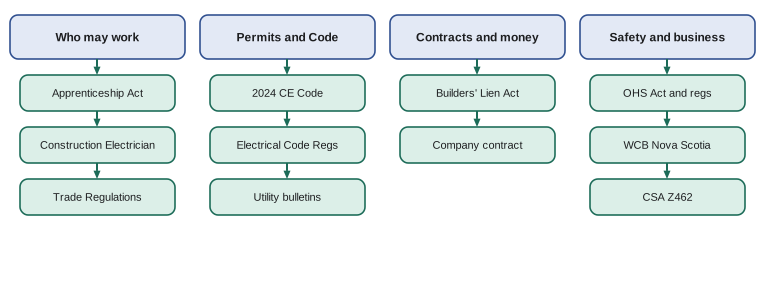
The map is the most useful thing in this lesson, because on a real job no one gives you a multiple-choice list. When a question comes up, first decide which column it belongs to, then go to the document in that column, not to memory, a forum post or what a contractor in another province does. Many of the costliest mistakes new Nova Scotia contractors make come from importing rules from somewhere else: assuming a contractor licence is needed, assuming a provincial bond is required, or assuming statutory prompt payment deadlines that are not yet in force here.
The first-job checklist
Before Benoit Electric takes its first paid job, Aisha works through this list and ticks each item only when she can show the document.
- Certificate of qualification on file for every certified worker; apprentice registrations current and hours logged.
- Business registered with the Registry of Joint Stock Companies; business name registered if one is used.
- HST, payroll and WCB accounts open; WCB clearance letter available.
- Commercial general liability with completed operations, vehicle and tools coverage in place; certificates of insurance ready.
- Account set up with the inspection authority for the service areas where the company will work.
- 2024 Code, regulations and current bulletins in every truck or on every tablet.
- Written quote and contract templates, with a change order form that includes a permit update line.
- Written lockout procedure, personal locks and tags, tested meters, and an incident procedure posted in each truck.
- Compliance calendar built, with an owner and a reminder for every renewal and filing.
- A plan for the next Code edition and a monthly bulletin check.
Only when every box is ticked does Benoit Electric open its first permit for the MacKenzie farmhouse. Aisha keeps the list and reruns it every year as part of the annual review.
A worked example: three questions on a single job
Worked problem
Three questions on the Antigonish clinic
During the Antigonish clinic job, three questions come up in one day: Highland Construction asks for a payment bond; a new hire from Alberta asks whether his Alberta certificate is enough; and the drywall crew asks to close a ceiling before inspection. Use the map to answer each.
Show solution
- Payment bond: a contracts question. Look at the subcontract. If it does not require a bond, none is owed; if Highland wants one now, it is a change to negotiate.
- Alberta certificate: a who-may-work question. Check with the Nova Scotia Apprenticeship Agency; an interprovincial Red Seal is generally recognized, but confirm before he does trade work.
- Ceiling: a permits question. The Act prohibits concealing work before inspection; book the inspection and keep the ceiling open.
Answer: Sort each question to its column, then answer from the document, not from memory or another province's rules.
After the review
Passing the readiness review is a starting point, not a finish line. The first year in business will raise questions no review can anticipate. Aisha keeps a notebook in her truck for those questions, and works through them with Gerry every couple of weeks. By the end of the first year, the notebook has become a set of company procedures and a list of topics for crew training.
Common mistakes
MistakeTreating the lack of a contractor exam as a lack of standards.
InsteadThe standards are spread across certification, permits, inspections, contracts and safety law; this review tests all of them.
MistakeAnswering from memory or another province's rules.
InsteadUse the question-to-document map and answer from the Nova Scotia source.
MistakeCounting lucky guesses as correct.
InsteadScore only answers you can support from a document.
MistakeTicking the first-job checklist on intention.
InsteadTick an item only when you can show the document.
Summary and key terms
- Nova Scotia has no contractor exam, so a structured readiness review takes its place.
- The review covers four areas: who may work, permits and the Code, contracts and money, and safety and the business.
- A sensible personal standard is at least 70 on each part and no part below 60.
- Use the question-to-document map to answer real questions from Nova Scotia sources.
- Work through the first-job checklist before opening the first permit, and rerun it every year.
- Readiness review
- A structured self-test on the knowledge a new contractor needs but no exam checks.
- Question-to-document map
- A guide showing which document answers each kind of question.
- First-job checklist
- A list of documents and systems a new contractor should have in place before its first job.
Practice problems
Work each problem on paper first, then reveal the answer to check.
What score on each part is a sensible personal standard?
Show answer
At least 70 out of 100, with no part below 60.
Which column of the map does a question about lien deadlines belong to?
Show answer
Contracts and money.
A new hire asks whether his out-of-province certificate is enough. Who decides?
Show answer
The Nova Scotia Apprenticeship Agency.
When should the first-job checklist be rerun?
Show answer
Every year, as part of the annual review.
Lesson quiz · 5 questions
Score 60% or more to complete this lesson.
Create a free account to save your progress, take quizzes and earn a certificate.