
MELC-208 · Lesson 2 of 12 · 20 min
The construction electrician certificate of qualification
▶ Video coming soon A video version of this lesson is on the way.
In provinces with a master electrician licence, the most important credential for a contractor is the one earned by passing the master exam. In Nova Scotia, the most important credential is the one most electricians already hold: the construction electrician certificate of qualification. It is what lets a person work independently in a compulsory certified trade, and it is what lets an inspection authority issue an electrical wiring permit. This lesson explains how the certificate is earned, what it permits, who else may legally do electrical work, and what changed in October 2025.
A compulsory certified trade
Under the Apprenticeship and Trades Qualifications Act, the province designates certain trades as compulsory certified trades. Construction electrician is one of them, and the Construction Electrician Trade Regulations confirm the designation. In a compulsory trade, the Nova Scotia Apprenticeship Agency says a person must hold one of the following to perform the work of that trade:
- a certificate of qualification in the trade;
- registered apprentice status in the trade;
- a temporary permit issued by the Agency; or
- a certificate recognized by the Director of the Agency.
Working in a compulsory trade without one of these is non-compliant. The Agency lists the consequences it can use: a stop work order, a summary offence ticket, an administrative penalty, or a fine. Its published figures are up to 5,000 dollars for a first offence and up to 10,000 dollars for a second. Those numbers can change, so check the Agency's current page before you quote them to anyone, but the message for a contractor is simple: every person you send to do electrical work must fall into one of the four categories, and you should be able to prove it.
The trade regulations also contain a useful clarification. A person who does not hold a construction electrician certificate may still do work within the trade if they hold a certificate in another designated trade and the work falls within the scope of that other trade. For example, a certified refrigeration and air conditioning mechanic doing work that is part of their own trade is not breaking the construction electrician rules simply because some of it is electrical. The scope of each trade is set by its own regulations.
What the trade covers
The Construction Electrician Trade Regulations define the trade broadly. In our own words, the construction electrician installs, repairs and alters the wires, conduits, apparatus, fixtures and other appliances that carry or use electricity for light, heat or power, in all types of construction: dwellings, commercial and industrial establishments and public buildings. That breadth matters to a contractor, because it means almost any job a small electrical company takes on is construction electrician work, and so falls inside the compulsory certification rules.
Communications cabling is handled differently. The Electrical Code Regulations give communications permits to communications technicians and construction electricians, and Nova Scotia Power's inspection pages refer to certified communications cabling specialists. A contractor that also does data and low-voltage cabling should check which credentials each kind of work needs.
Two paths to the certificate
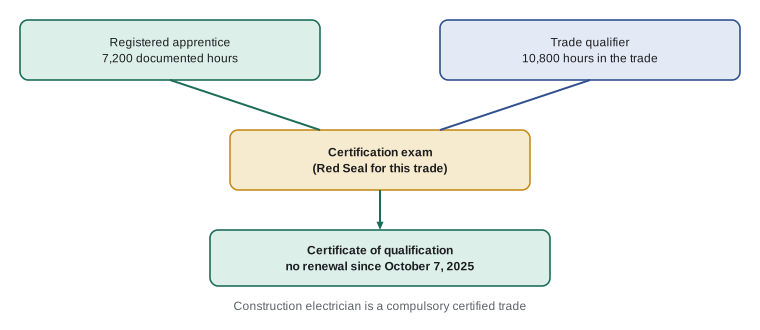
The certificate is earned by passing the certification examination for the trade after meeting the experience requirements. The trade regulations set out two routes.
- Apprenticeship. The term of apprenticeship is 7,200 documented hours of practical experience and technical training, together with the related technical training and the certification examination. A probationary period, if any, may be no longer than three months. Apprentices are paid at least a set share of the journeyperson wage that rises through the levels, from 45 in 100 to 80 in 100, and never below the general minimum wage.
- Trade qualifier. A person who has not completed an apprenticeship needs 10,800 hours of employment in the trade before applying to challenge the certification examination.
Construction electrician is a Red Seal trade, so the certification examination for it is the interprovincial Red Seal examination, and passing it earns the Red Seal endorsement along with the Nova Scotia certificate. Chapter by chapter, that exam tests the full scope of the trade, including heavy use of the Canadian Electrical Code. The Agency announced in October 2025 that the fee for experienced workers challenging their certification exam dropped from 644.15 dollars to 350 dollars. Fees change; confirm the current amount with the Agency.
| Route | Hours required | Then |
|---|---|---|
| Apprenticeship | 7,200 documented hours of practical experience and technical training | Certification examination |
| Trade qualifier | 10,800 hours of employment in the trade | Certification examination |
| Out-of-province certificate | Recognized certificate, such as a Red Seal endorsement | Recognition by the Agency |
October 7, 2025: no more renewals
For many years, a Nova Scotia certificate of qualification and the identification card that goes with it had to be renewed every five years, at a cost of 73.53 dollars. On October 7, 2025, the province announced that renewal was no longer required for journeypersons in most compulsory trades, including construction electrician, with immediate effect. The Agency's forms page now says credentials remain valid with no expiry date, and that it will reissue them without an expiry date at no cost. Renewal continues only for the blaster trade, where re-certification training is required.
The province said the Agency had processed 11,829 renewals between 2019 and 2024, which shows how much paperwork the change removed. For a contractor, it also removes a reminder. Under the old system, a renewal date was at least a prompt to look at the certificate. Under the new one, nothing external forces a certified electrician to keep up with Code changes. Lesson 11 returns to what that means for a responsible business.
Gerry's advice to Aisha is practical. Keep a copy of every worker's certificate or apprentice registration on file. If anyone on the crew still carries an old card with an expiry date, the Agency will reissue it without one; it is worth doing, so that a customer, a general contractor or an inspector who asks to see a card is not confused by a date in the past.
Identity cards and proof on site
The General Regulations under the apprenticeship Act require tradespeople in compulsory trades to carry identification, and the Construction Electrician Trade Regulations explain when a person is considered to be practising the trade for that purpose. On a job site, the practical effect is that a certified electrician or registered apprentice should be able to show proof of status when an Agency compliance officer asks. A contractor that keeps copies in the truck and in the office can answer a compliance check in minutes instead of days.
Worked problem
A compliance visit on the Truro job
An Agency compliance officer visits Benoit Electric's job at a new duplex in Truro. On site are Aisha, Owen the apprentice, and a labourer named Tyler who has been pulling cable through the framing and stapling it. What should the officer find, and is there a problem?
Show solution
- Aisha shows her certificate of qualification. She is certified.
- Owen shows his apprentice registration. He is permitted to work as a registered apprentice under supervision.
- Tyler has no certificate, no apprentice registration, no temporary permit and no recognized certificate. Pulling and securing cable is installation work within the trade.
- Aisha should stop Tyler doing trade work, or register him as an apprentice if he wants to enter the trade.
Answer: Tyler doing installation work without a recognized status is the problem. Labourers may carry materials and clean up, but not do the work of the trade.
Apprentices on a small crew
Registered apprentices are the future of every small contracting business, and they are the people most likely to be asked to do work they are not yet ready for. The trade regulations set the apprenticeship term and wage minimums; the General Regulations and Agency policies set out how apprentices must be supervised and the ratio of journeypersons to apprentices. A contractor taking on apprentices should read the current supervision rules before the first day, register each apprentice with the Agency, and make sure training hours are documented, because documented hours are what the apprentice needs to reach the certification examination.
Aisha plans to keep Owen with her on every job until he is further along, and to log his hours each week. Sam builds a small tracker so that nobody has to guess how close he is to the next level.
# Illustrative apprentice hours tracker toward the 7,200-hour term.
term = 7200
logged = [
    ("level 1", 1650),
    ("level 2", 1580),
    ("current level, this year", 940),
]
total = 0
for level, hours in logged:
    total += hours
    print(f"{level:28s} {hours:5d}  running total {total:5d}")
remaining = term - total
print("hours remaining to the term:", remaining)
print("share of the term complete:", round(total / term * 100), "in 100")level 1 1650 running total 1650 level 2 1580 running total 3230 current level, this year 940 running total 4170 hours remaining to the term: 3030 share of the term complete: 58 in 100
Workers from other provinces
Nova Scotia recognizes the Red Seal, and the Agency can recognize certificates from other jurisdictions. A journeyperson moving to Nova Scotia with a Red Seal endorsement in the construction electrician trade can normally have that certificate recognized; one with a provincial certificate but no Red Seal should contact the Agency first. Labour mobility rules within Canada make this easier than it once was, but recognition is still a decision by the Agency, not something a contractor can assume. Keep proof of recognition on file just as you would a Nova Scotia certificate.
Why this matters for permits
The certificate is the link between the two sets of law from Lesson 1. The apprenticeship law decides who may do the work; the Electrical Code Regulations then use that status to decide who may hold a permit. A contractor whose only certified electrician leaves the business cannot open new wiring permits until another certified construction electrician is running or employed by the business. Aisha writes that scenario into her business plan: if she is ever unable to work, the company needs a second certified electrician, or it stops taking permitted work.
A note on the Red Seal and mobility
Because construction electrician is a Red Seal trade, a Nova Scotia certificate earned through the interprovincial examination carries the Red Seal endorsement, and that endorsement is widely recognized in the other provinces and territories. The reverse is also true: an electrician who earned a Red Seal elsewhere can usually have that certification recognized here. The details, including any paperwork the Agency needs and how long recognition takes, are set by the Agency, so a contractor hiring from outside the province should check with the Agency before the new hire starts trade work rather than after.
Mobility matters most to contractors in two situations. The first is hiring: an experienced electrician moving from Alberta or Ontario may be ready to work on the first day, provided the paperwork is in order. The second is out-of-province work: a Nova Scotia contractor that bids on a job in New Brunswick or Prince Edward Island must meet that province's rules, which may include a contractor licence or registration that Nova Scotia does not require. Priya Raman, a contractor Aisha met on a Red Seal course, runs a business in Alberta, where the rules on who may pull permits are quite different. Comparing notes with her is a useful reminder that each province's system must be learned on its own terms.
Keeping the apprentice pipeline healthy
For a small contractor, apprentices are both an obligation and an investment. The obligation is supervision, proper documentation of hours and release for technical training. The investment is a future journeyperson who already knows the company's methods and customers. Aisha plans to register a second apprentice once the company has steady work for two certified electricians, so that every apprentice can always be paired with a journeyperson on site. She also budgets for the weeks each apprentice will spend in technical training, because those weeks reduce the crew's capacity and must be planned around the schedule.
Common mistakes
MistakeSending an uncertified helper to rough in a basement because the job is simple.
InsteadInstallation work in the construction electrician trade must be done by a certified journeyperson, a registered apprentice or another permitted person.
MistakeTelling a customer that an expired date on an old card means the electrician is uncertified.
InsteadSince October 7, 2025, certificates no longer expire; the Agency reissues cards without an expiry date.
MistakeAssuming a Red Seal from another province is automatically valid in Nova Scotia.
InsteadRecognition is a decision by the Agency; confirm and keep proof on file.
MistakeLetting the business keep opening permits after its only certified electrician leaves.
InsteadPermits may be issued only to a contractor who is, or employs, a certified construction electrician.
Summary and key terms
- Construction electrician is a compulsory certified trade; only certificate holders, registered apprentices, temporary permit holders and holders of recognized certificates may do its work.
- The apprenticeship term is 7,200 documented hours plus technical training and the certification exam; trade qualifiers need 10,800 hours in the trade.
- The certification exam for construction electricians is the Red Seal exam.
- Since October 7, 2025, certificates of qualification and ID cards no longer need renewal, except for blasters.
- The certificate is what links the apprenticeship law to the permit rule in the Electrical Code Regulations.
- Compulsory certified trade
- A trade in which only certified journeypersons, registered apprentices and other permitted people may work.
- Trade qualifier
- An experienced worker who challenges the certification exam without completing an apprenticeship.
- Temporary permit
- A permit issued by the Agency allowing someone to work in a compulsory trade for a limited time.
- Red Seal
- The interprovincial endorsement earned by passing the Red Seal exam in a designated trade.
- Documented hours
- Recorded hours of practical experience and training that count toward an apprenticeship.
Practice problems
Work each problem on paper first, then reveal the answer to check.
How many documented hours make up the construction electrician apprenticeship term?
Show answer
7,200 hours, together with technical training and the certification examination.
How many hours of employment does a trade qualifier need before challenging the exam?
Show answer
10,800 hours in the trade.
A customer points to the expiry date on Kayla's 2019 card. What should Aisha tell them?
Show answer
Since October 7, 2025, certificates no longer expire; the Agency reissues cards without an expiry date at no cost.
Can a certified refrigeration mechanic do electrical work that is part of their own trade?
Show answer
Yes, if the work falls within the scope of their own designated trade.
Lesson quiz · 5 questions
Score 60% or more to complete this lesson.
Create a free account to save your progress, take quizzes and earn a certificate.