
MELC-203 · Lesson 9 of 12 · 19 min
Contracts and builders' liens in Saskatchewan
▶ Video coming soon A video version of this lesson is on the way.
Getting paid is not a technical skill, but it decides whether a contracting business survives. Saskatchewan gives contractors three tools for it. The first is the contract itself: a clear written agreement on scope, price, schedule, changes and payment. The second is The Builders' Lien Act, which lets unpaid contractors, subcontractors and suppliers register a lien against the land they improved and requires owners to hold back part of each payment. The third, added in 2022, is prompt payment and adjudication: statutory deadlines for paying proper invoices, and a fast process for resolving payment disputes.
Saskatchewan was the first province in Western Canada to bring prompt payment and adjudication into force. This lesson explains how those rules work for a small electrical contractor, using Kowalchuk Electric's first commercial subcontract. The deadlines below come from the Act as amended and from recognized legal summaries, checked in late 2026. Lien law is technical and the consequences of missing a deadline are severe, so confirm the details in the current Act and regulations and get legal advice when a real lien or adjudication is in play. This lesson is not legal advice.
The dental office job
In its fourth month, Kowalchuk Electric wins its first commercial subcontract: the electrical work for a new dental office in a strip mall in Saskatoon. The general contractor is Prairie Ridge Construction. The owner is a numbered company that owns the building. The subcontract price is 48,000 dollars plus GST, billed monthly.
Ron reads the subcontract before Ellie signs it. He finds three things to fix. The payment clause says Prairie Ridge will pay within 60 days of being paid by the owner, which conflicts with the prompt payment rules. The change order clause says no extra will be paid unless approved in writing in advance, but does not say who at Prairie Ridge can approve. And the scope says supply and install all electrical without referring to the drawings or excluding the dental equipment connections the owner's equipment supplier will handle. Ellie negotiates all three before signing.
The contract comes first
Most payment disputes start with a vague contract. Before any job, residential or commercial, Ellie makes sure the written agreement covers the essentials.
- Scope: what is included, by reference to drawings and specifications, and what is excluded.
- Price and payment terms: the price or rates, when invoices are issued, and when they are due, consistent with the prompt payment rules where they apply.
- Changes: how changes are requested, priced, approved and documented, and who may approve them.
- Schedule: start and completion dates, and what happens if the customer or another trade delays the work.
- Holdback: how the statutory holdback is handled and when it is released.
- Permits, inspections and warranty: who buys the permit, who requests inspections, and what warranty the contractor gives.
For homeowners, she uses a short, plain-language contract. For commercial work, she reads every clause of the general contractor's subcontract, because those documents are written to protect the general contractor.
Prompt payment
Saskatchewan's prompt payment rules came from The Builders' Lien (Prompt Payment) Amendment Act, 2019 and The Builders' Lien Amendment Regulations, 2020, and came into force on March 1, 2022. Contracts entered into before that date generally remain under the earlier rules; the prompt payment and adjudication provisions apply to contracts made on or after that date and to subcontracts under them.
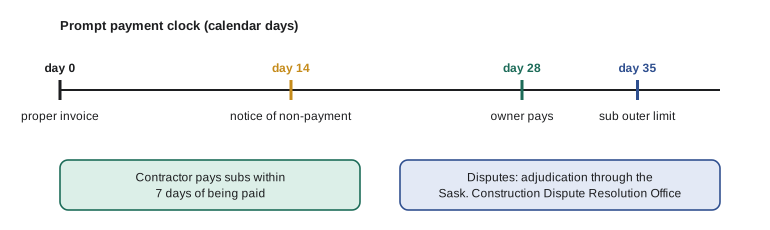
The rules are built around the proper invoice: an invoice that meets the requirements of the Act, submitted monthly or as the contract provides. Once a proper invoice is given, the clock starts. All counts are in calendar days.
- Owner to contractor: the owner must pay the contractor within 28 days of receiving a proper invoice.
- Owner's notice of non-payment: if the owner disputes all or part of the invoice, it must give a notice of non-payment within 14 days of receiving the proper invoice, in the prescribed form and by a permitted method of service.
- Contractor to subcontractor: within 7 days of receiving payment, the contractor must pay the subcontractors whose work was included in the invoice. If the owner does not pay in full, the rules set a longer outer limit for paying subcontractors, which legal summaries describe as 35 days after the proper invoice was given to the owner.
- Flow-down: a contractor that receives a notice of non-payment must pass it on to affected subcontractors without delay, and a contractor that issues a notice to a subcontractor because the owner did not pay must undertake to refer the dispute with the owner to adjudication within 21 days.
- Subcontractor to sub-subcontractor: the same 7-day rule applies one level down, triggered by payment from above.
For Kowalchuk Electric as a subcontractor, the key dates are: Prairie Ridge invoices the owner; the owner has 28 days to pay or 14 days to dispute; once Prairie Ridge is paid, it has 7 days to pay Kowalchuk Electric for the work included. That is why the original 60-day clause in Prairie Ridge's subcontract had to go.
Adjudication
Prompt payment would mean little without a fast way to resolve disputes. Saskatchewan's answer is adjudication. The Minister designated the Saskatchewan Construction Dispute Resolution Office (SCDRO), a not-for-profit corporation, as the authority that trains and regulates adjudicators, working with the ADR Institute of Saskatchewan to provide them.
Adjudication is designed to be quick. Legal summaries of the process describe the main steps: once an adjudicator agrees to hear a matter, the parties produce their documents within 5 days; the adjudicator's decision is due within 30 days after that, extendable by 14 days; the adjudicator's fees are generally split between the parties; and a determination can be appealed to the court within 30 days. A determination can be filed and enforced like a court order if it is filed within two years, and if payment still is not made, the contractor or subcontractor may suspend work and recover the reasonable costs of resuming.
Adjudication decides payment disputes on an interim basis; the parties can still go to court or arbitration later. Its value is that a small subcontractor can get a binding decision in weeks, not years, without the cost of a lawsuit.
Holdback
The Builders' Lien Act requires an owner to hold back part of each payment to the contractor, and each contractor to hold back from its subcontractors. The holdback is security for the lien claimants further down the chain. The standard holdback in Saskatchewan is 10 in 100, often described as ten per hundred of the value of the work done and materials supplied. The holdback is released after the lien period has passed with no liens registered, and in Saskatchewan the release conditions include the passing of a period after the certification of substantial performance; one legal summary describes the requirement that forty clear days pass after that certification, with no claims of lien registered. Check the Act for the exact conditions on each project.
Ellie's dental office subcontract is worth 48,000 dollars. A holdback of 10 in 100 on that is 4,800 dollars that she will not see until after substantial performance and the lien period. Dev plans the company's cash flow around it.
| Item | Rule | Source |
|---|---|---|
| Owner pays contractor | Within 28 days of a proper invoice | Builders' Lien Act, prompt payment provisions |
| Owner disputes invoice | A notice of non-payment within 14 days | Builders' Lien Act and regulations |
| Contractor pays subcontractor | Within 7 days of being paid | Builders' Lien Act, prompt payment provisions |
| Adjudication authority | Saskatchewan Construction Dispute Resolution Office | Ministerial designation |
| Holdback | 10 in 100 of the value of work and materials | Builders' Lien Act |
| Holdback release | After the period following substantial performance, with no liens registered | Builders' Lien Act; confirm the exact conditions |
Liens
If Kowalchuk Electric is not paid for work it did, it may be able to register a claim of lien against the owner's interest in the land. The lien gives it security for the amount owed, and if the lien is not resolved, the Act lets it enforce the lien through the courts. Liens are powerful because they attach to the land: an owner cannot easily sell or refinance a property with a registered lien.
Lien rights are also fragile. A claim of lien must be registered within a short period set by the Act, measured from events such as the completion or abandonment of the contract or the last supply of services or materials, and a registered lien must be followed by court proceedings within the time the Act allows or it can expire. Ron tells Ellie that the most common way subcontractors lose their lien rights is by waiting too long while being promised the cheque is coming. When payment is overdue and the lien period is running, call a lawyer.
Contractors working on some public projects may not be able to lien public land and may need to rely instead on payment bonds, contract terms and prompt payment and adjudication. On larger private projects, a labour and material payment bond may also be available.
Worked example: the payment dates
Worked problem
When should Kowalchuk Electric be paid?
Prairie Ridge gives the owner a proper invoice on March 3 that includes 12,000 dollars of Kowalchuk Electric's work. The owner does not dispute it and pays on March 27. When must Prairie Ridge pay Kowalchuk Electric, and how much, if the holdback is 10 in 100?
Show solution
- The owner's deadline was 28 days after March 3, which is March 31. The owner paid on March 27, within the deadline.
- Prairie Ridge must pay its subcontractors within 7 days of receiving payment: by April 3.
- Holdback: 12,000 x 10 / 100 = 1,200 dollars.
- Amount due to Kowalchuk Electric by April 3: 12,000 - 1,200 = 10,800 dollars, plus GST as the contract provides.
Answer: 10,800 dollars plus GST, due by April 3. The 1,200 dollar holdback is released later under the Act.
from datetime import date, timedelta

proper_invoice = date(2027, 3, 3)
owner_paid = date(2027, 3, 27)
work_value = 12_000
holdback = work_value * 10 // 100

print("owner may dispute until:", proper_invoice + timedelta(days=14))
print("owner must pay by:     ", proper_invoice + timedelta(days=28))
print("sub must be paid by:   ", owner_paid + timedelta(days=7))
print("holdback retained:      ", holdback)
print("payment due to sub: ", work_value - holdback)owner may dispute until: 2027-03-17 owner must pay by: 2027-03-31 sub must be paid by: 2027-04-03 holdback retained: 1200 payment due to sub: 10800
Change orders and documentation
Many payment disputes are really disputes about changes. Ellie's change order process is short: a written description of the change, the price or the method of pricing it, any effect on the schedule, and a signature from someone with authority to approve it, before the work is done. On the dental office job, the subcontract names Prairie Ridge's project manager as the person who can approve changes, and Ellie sends every change order to her by email for a reply before starting the work.
Good records support everything else in this lesson. A proper invoice is easier to prepare, a notice of non-payment is easier to answer, an adjudication is easier to win and a lien claim is easier to prove when the contractor has daily records, photos, signed change orders and copies of every invoice and payment.
Ellie also keeps a calendar of each project's key payment and lien dates, so that no deadline passes because everyone was busy on site. The calendar takes minutes to maintain and protects money the company has already earned.
Common mistakes
MistakeAccepting a pay-when-paid clause with a 60-day delay on a contract covered by prompt payment.
InsteadOn contracts made on or after March 1, 2022, the Act's deadlines apply: 28 days from owner to contractor and 7 days from contractor to subcontractor after payment.
MistakeTreating the holdback as lost money.
InsteadThe holdback is security that is released after substantial performance and the lien period, if no liens are registered.
MistakeWaiting on promises while the lien period runs.
InsteadLien periods are short and strict. When payment is overdue, get legal advice before the period ends.
MistakeAssuming adjudication takes as long as a lawsuit.
InsteadAdjudication is designed to produce a binding interim decision in weeks.
Summary and key terms
- Clear written contracts on scope, price, changes, schedule and payment prevent most disputes.
- Saskatchewan's prompt payment rules have applied since March 1, 2022: 28 days from owner to contractor after a proper invoice, a 14-day window for a notice of non-payment, and 7 days from contractor to subcontractor after payment.
- The Saskatchewan Construction Dispute Resolution Office oversees adjudication, which produces quick, enforceable interim decisions.
- Owners hold back 10 in 100 of the value of work, released after substantial performance and the lien period if no liens are registered.
- Lien rights attach to the land but are lost if deadlines are missed; get legal advice early.
- Proper invoice
- An invoice that meets the Act's requirements and starts the prompt payment deadlines.
- Non-payment notice
- The prescribed notice an owner or contractor gives to dispute all or part of a proper invoice.
- Adjudication
- A fast statutory process for deciding construction payment disputes on an interim basis.
- Holdback
- The share of each payment, 10 in 100, that the Act requires to be withheld as security for lien claimants.
- Claim of lien
- A registered claim against land by an unpaid contractor, subcontractor or supplier.
Practice problems
Work each problem on paper first, then reveal the answer to check.
An owner receives a proper invoice on June 2. By what date must it pay, if it does not dispute the invoice?
Show answer
June 30, which is 28 days later.
A general contractor is paid on September 10. By when must it pay its subcontractors for the work included?
Show answer
By September 17, within 7 days.
What is the holdback on a 30,000 dollar progress claim?
Show answer
30,000 x 10 / 100 = 3,000 dollars.
Which organization oversees construction adjudication in Saskatchewan?
Show answer
The Saskatchewan Construction Dispute Resolution Office (SCDRO).
Lesson quiz · 5 questions
Score 60% or more to complete this lesson.
Create a free account to save your progress, take quizzes and earn a certificate.