
MELC-203 · Lesson 1 of 12 · 21 min
How electrical licensing works in Saskatchewan
▶ Video coming soon A video version of this lesson is on the way.
Every province regulates electrical work, and no two provinces do it the same way. Saskatchewan's system is built around three statutes and one organization. The statutes decide who may do electrical work, which code the work must meet, and how permits and inspections operate. The organization, the Technical Safety Authority of Saskatchewan (TSASK), runs almost all of it day to day: it issues licences, sells permits, inspects installations and publishes the Saskatchewan interpretations of the Canadian Electrical Code.
The most important fact about Saskatchewan for anyone coming to this course from the rest of the master electrician program is this: Saskatchewan does not issue a master electrician licence, and it has no master electrician exam. In Alberta, permits go to holders of a Master Electrician Certificate, earned by passing a two-part provincial exam. In Ontario, every licensed electrical contractor must employ a designated master electrician who has passed an ESA exam. Saskatchewan takes a different route. It licenses the electrical contracting business, and it requires that business to have a qualifying journeyperson: a licensed Saskatchewan electrical journeyperson who has held a Red Seal for at least two years. The competence test is the trade certification the qualifier already holds, not a separate master exam.
This course is therefore not an exam cram. It prepares a journeyperson to become the qualifying journeyperson of a licensed Saskatchewan electrical contractor and to run that business legally: which licence class fits, how to apply and bond the company, how the Code is adopted and interpreted in Saskatchewan, how permits and inspections work through TSASK, what the qualifier answers for, and the contract, lien, safety and workers compensation law that surrounds every job. Lesson 12 closes with a readiness review in place of the exam practice found in the provincial courses that do have exams.
A word on sources. Everything in this course was checked against TSASK's own pages and publications, government sources and recognized legal summaries in late 2026, and the notes in each lesson say where a detail is likely to change. Fees, forms and online systems change often. Before you apply for a licence or rely on any deadline, confirm the current requirements with TSASK and the Government of Saskatchewan. As in the rest of the series, this course never reproduces the text or tables of the Canadian Electrical Code. Rule numbers are cited and explained in our own words.
Ellie decides to go out on her own
Ellie Kowalchuk has been a Red Seal construction electrician for seven years. She apprenticed in Prince Albert, earned her journeyperson certificate and Red Seal endorsement in her fourth year, and has spent the last five years as a lead hand for Northgate Electrical, a mid-size contractor in Saskatoon. Her crews wire houses, renovate small commercial spaces and do service upgrades on acreages outside the city. She is good at it, and for two years her customers have been asking whether she could take their jobs directly.
This spring she decides to start her own company, Kowalchuk Electric Ltd. Her partner, Dev Sandhu, keeps the books for two small businesses already and will handle invoicing and payroll. Her uncle, Ron Kowalchuk, ran a two-truck electrical contracting company in Prince Albert for thirty years before retiring, and he has promised to answer every question she brings him. A second-year apprentice from Northgate, Jayden Morin, has asked to come with her.
Ellie's cousin Priya Raman lives in Red Deer and has just written the Alberta Master Electrician Certificate exam. When Ellie mentions her plans on a family call, Priya assumes Ellie will have to write the same kind of exam. Ellie isn't sure. Ron laughs. In Saskatchewan, he tells them, there is no master electrician exam. What matters is the contractor licence, the bond, and a qualifying journeyperson with a Red Seal held for at least two years. Ellie has held hers for more than six. The licence is within reach. Running the business properly is the hard part.
The three statutes
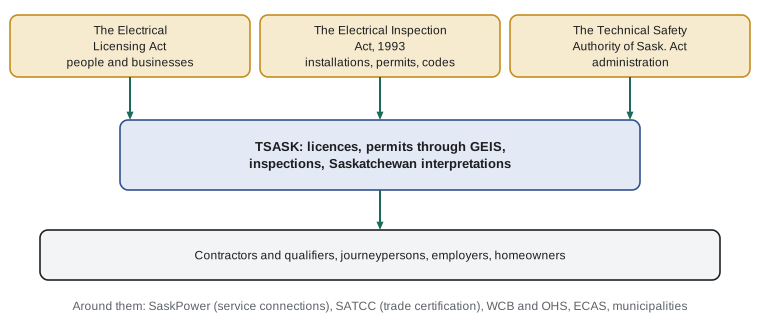
Ron draws three boxes on the back of a work order. Each statute has its own job, and each one shows up in different parts of a contractor's day.
- The Electrical Licensing Act. This statute governs who may do electrical work and who may run an electrical contracting business. It establishes the licence classes for contractors, employers, journeypersons and others, the qualifications for each, and the offences for working without a licence. Its regulations set the details, including the restricted categories and the requirements for employers. TSASK's own scope of authority document refers to particular sections of this Act, for example the section dealing with limited licences and the section dealing with employer licences.
- The Electrical Inspection Act, 1993. This statute governs electrical installations themselves: permits, inspections, the adoption of codes and standards, and the powers of inspectors. The Saskatchewan interpretations of the Code are issued under section 5 of this Act and are adopted as requirements under it.
- The Technical Safety Authority of Saskatchewan Act. This statute establishes TSASK and allows the province to assign the administration of safety legislation to it. TSASK is an independent, not-for-profit authority that administers several safety programs, including electrical, gas, plumbing, boilers and pressure vessels, elevating devices and amusement rides.
Ron's point is that the first statute is about people and businesses, the second is about installations, and the third is about who administers the other two. When a question begins with who may do something, start with the Licensing Act. When it begins with what an installation must meet or when it must be inspected, start with the Inspection Act and the interpretations.
How TSASK came to run electrical safety
Saskatchewan's arrangement is newer than many contractors realize, which explains why older guides and some job-site conversations still mention SaskPower inspectors or the provincial government's licensing office.
- TSASK was created in 2010 as an independent body, following a 2009 review that recommended a single organization, a one-stop shop, for safety regulatory services in the province.
- Electrical and gas licensing moved to TSASK from the Ministry of Government Relations on August 4, 2020.
- Electrical and gas inspections and permitting moved to TSASK from SaskPower on February 1, 2021. More than ninety SaskPower inspection employees moved to TSASK as part of the transfer.
Before 2021, SaskPower, the provincial utility, carried out electrical inspections and sold permits, while licensing sat with a government ministry. Today one organization handles licensing, permits and inspections, and the provincial government keeps responsibility for the legislation itself. SaskPower is still part of every service job, because the utility connects services and sets its own service requirements, but it is no longer the inspection authority.
| Date | Change |
|---|---|
| 2009 | Provincial review recommends a single safety regulatory body |
| 2010 | TSASK established as an independent safety authority |
| August 4, 2020 | Electrical and gas licensing transfer to TSASK from the Ministry of Government Relations |
| February 1, 2021 | Electrical and gas inspections and permitting transfer to TSASK from SaskPower |
| March 1, 2025 | The 2024 Canadian Electrical Code and the 2024 Saskatchewan interpretations take effect |
| June 1, 2025 | TSASK begins enforcing the 2024 codes |
Who does what
Several organizations touch an electrical contractor's work. Ellie writes them down as a set, because she knows she will be dealing with all of them in her first year.
- TSASK. Issues electrical contractor, employer, journeyperson and other licences; sells electrical permits through its online system, GEIS; carries out inspections; and publishes the Saskatchewan interpretations, bulletins and information papers.
- The Government of Saskatchewan. Owns the legislation. Changes to the Acts and regulations come from government, and government ministries handle related areas such as labour standards and occupational health and safety.
- SaskPower. The provincial utility. It connects and disconnects services and sets service and metering requirements in its own territory, coordinating with the inspection authority before energizing a new service. Some cities have their own utilities for parts of their areas, and their service requirements apply there.
- The Saskatchewan Apprenticeship and Trade Certification Commission (SATCC). Runs apprenticeship and trade certification in the province, including the journeyperson certification and Red Seal examinations that a qualifier's credentials rest on.
- The Workers' Compensation Board (WCB) and the provincial occupational health and safety division. WCB provides compensation coverage and requires injury reports. OHS law sets workplace safety duties. Together they run the WorkSafe Saskatchewan prevention partnership.
- The Electrical Contractors Association of Saskatchewan (ECAS). A voluntary industry association. It runs the continuing education program that TSASK's Registered Electrical Contractors Program relies on, which Lesson 11 covers.
- Municipalities. Cities and towns issue building permits, development permits and business licences. A municipal building permit does not replace an electrical permit from TSASK.
Licensing the business, not a master
Ellie's first instinct, after years of working for someone else, is to think of a licence as something that belongs to a person. In Saskatchewan, two kinds of licence are involved, and the distinction matters.
Her journeyperson licence is a personal licence. TSASK issues full and restricted electrical journeyperson licences on proof of trade certification. It shows that she is qualified and licensed to do electrical work in the province. She already holds one, through her employment with Northgate.
The contractor licence belongs to the business. It is what allows Kowalchuk Electric Ltd. to sell its services to the public and to buy electrical permits through GEIS. TSASK describes the contractor licence as the licence that lets a business pull permits. To hold one, the business needs a qualifying journeyperson and a surety bond, and it needs to be registered as a business. Ellie will be the qualifier for her own company.
| Licence | Held by | What it allows |
|---|---|---|
| Electrical journeyperson (full or restricted) | An individual with the required trade certification | Doing electrical work within the licence scope |
| Electrical contractor (general or full, limited, restricted) | A registered business with a qualifier and a bond | Offering electrical work to the public and buying permits |
| Electrical employer | A business doing electrical work on its own premises with its own licensed staff | Maintenance work on its own premises under an annual permit |
| Electrical supply house | A business selling electrical equipment | Licensed supply activity, not installation work |
Compare that with Alberta, where Priya's certificate is a personal credential that allows her to take out permits, and with Ontario, where the contractor licence and the master electrician licence are separate but linked. Saskatchewan combines the two ideas: the business holds the licence, and the qualifying journeyperson gives it the competence to hold it.
A worked example: who needs what
Worked problem
Matching people to licences
Kowalchuk Electric will have three people doing electrical work in its first month: Ellie, Jayden the second-year apprentice, and a part-time journeyperson named Curtis Lafond who also works weekends for a sign company. What does each person need, and can Curtis be the company's qualifier instead of Ellie?
Show solution
- Ellie needs a valid Saskatchewan electrical journeyperson licence, and as the qualifier she must have held her Red Seal for at least two years. She meets both requirements.
- Jayden works as a registered apprentice under supervision. He is not the qualifier and cannot work on his own as a contractor.
- Curtis needs his own journeyperson licence to do electrical work for Kowalchuk Electric.
- Curtis cannot be the qualifier if he is employed by another licensed electrical contractor, such as the sign company. TSASK does not allow a qualifier to work for another licensed contractor while listed as a qualifier.
Answer: Ellie is the natural qualifier. Curtis can work as a licensed journeyperson for the company, but not as its qualifier while he works for another contractor.
A first look at the costs of compliance
Dev wants to know what the licensing side will cost before the company earns a cent. Ron tells him the fixed items are modest compared with trucks and tools, but they recur every year and every job. The calculator below adds up a first-year compliance budget from figures Dev can replace with current quotes and TSASK's fee schedule. The amounts are illustrative only.
# Illustrative first-year compliance budget for a new contractor.
# Replace every figure with a current quote or TSASK's current fee schedule.
items = {
    "contractor licence (illustrative)": 300,
    "surety bond premium (illustrative)": 250,
    "business registration (illustrative)": 100,
    "liability insurance (illustrative)": 2400,
    "WCB premium estimate (illustrative)": 1800,
    "permits for 60 jobs at about 120 each (illustrative)": 60 * 120,
}
for name, amount in items.items():
    print(f"{name:52s} {amount:7,d}")
print(f"{'total':52s} {sum(items.values()):7,d}")contractor licence (illustrative) 300 surety bond premium (illustrative) 250 business registration (illustrative) 100 liability insurance (illustrative) 2,400 WCB premium estimate (illustrative) 1,800 permits for 60 jobs at about 120 each (illustrative) 7,200 total 12,050
The permit line is the largest because it scales with work. That is why Lesson 11's Registered Electrical Contractors Program, which reduces permit costs for contractors with good inspection records, is worth planning for from the start.
Why this structure matters
Most of the problems new Saskatchewan contractors run into are not technical. They are administrative and legal: starting work before buying a permit, letting a bond lapse, listing a qualifier who works for another contractor, assuming a homeowner can pull a permit for work the rules reserve for licensed contractors, or not knowing that the Saskatchewan interpretations change how a Code rule applies. Every one of those problems is easier to avoid if you can picture the three statutes and the role of TSASK in the middle.
The rest of the course builds that picture. Lesson 2 covers the licence classes and the qualifier. Lesson 3 is the application. Lesson 4 explains how competence is checked when there is no licensing exam. Lessons 5 and 6 cover the Code as adopted, permits and inspections. Lesson 7 sets out the qualifier's duties. Lessons 8 to 10 cover the business, contract, lien and safety law. Lesson 11 covers renewal and registered contractor status, and Lesson 12 is a readiness review.
Common mistakes
MistakeLooking for a Saskatchewan master electrician exam.
InsteadSaskatchewan has no master electrician licence or exam. It licenses the contracting business, which needs a qualifying journeyperson with a Red Seal held for at least two years.
MistakeCalling SaskPower to book an electrical inspection.
InsteadSince February 1, 2021, electrical permits and inspections are handled by TSASK. SaskPower connects services as the utility.
MistakeTreating a municipal building permit as covering the electrical work.
InsteadElectrical work needs an electrical permit from TSASK; municipal building permits are separate.
MistakeAssuming a journeyperson licence lets you contract with the public.
InsteadOffering electrical work to the public and buying permits require a contractor licence held by the business.
Summary and key terms
- Saskatchewan electrical safety rests on The Electrical Licensing Act (people and businesses), The Electrical Inspection Act, 1993 (installations, permits, codes) and The Technical Safety Authority of Saskatchewan Act (administration).
- TSASK issues licences, sells permits through GEIS, inspects, and publishes the Saskatchewan interpretations of the Code.
- Licensing moved to TSASK on August 4, 2020, and inspections and permitting moved from SaskPower on February 1, 2021.
- Saskatchewan has no master electrician licence; the business holds a contractor licence and needs a qualifying journeyperson and a bond.
- SaskPower, SATCC, WCB, the OHS division, ECAS and municipalities each play a separate role around the contractor.
- TSASK
- The Technical Safety Authority of Saskatchewan, which administers electrical licensing, permits and inspections.
- The Electrical Licensing Act
- The statute that governs electrical licences for contractors, employers, journeypersons and others.
- The Electrical Inspection Act, 1993
- The statute that governs electrical installations, permits, inspections and code adoption.
- Qualifying journeyperson
- The licensed journeyperson, with a Red Seal held at least two years, who qualifies a business for a full contractor licence.
- GEIS
- TSASK's online system for buying electrical permits.
- Contractor licence
- The licence that allows a registered, bonded business to offer electrical work and buy permits.
Practice problems
Work each problem on paper first, then reveal the answer to check.
Which organization issues electrical contractor licences in Saskatchewan today?
Show answer
TSASK, the Technical Safety Authority of Saskatchewan.
Which statute would you look in to find out what an inspector may require of an installation?
Show answer
The Electrical Inspection Act, 1993, together with the Saskatchewan interpretations issued under it.
Ellie's cousin says Ellie must pass a master electrician exam before she can pull permits. Is that right?
Show answer
No. Saskatchewan has no master electrician exam. Ellie's company needs a contractor licence, a bond and a qualifying journeyperson.
Who carried out electrical inspections before February 1, 2021?
Show answer
SaskPower, the provincial utility.
Lesson quiz · 5 questions
Score 60% or more to complete this lesson.
Create a free account to save your progress, take quizzes and earn a certificate.