
MELC-203 · Lesson 6 of 12 · 19 min
Permits, inspections and the inspection authority
▶ Video coming soon A video version of this lesson is on the way.
The permit is where licensing, the Code and the business meet. In Saskatchewan, an electrical permit is required for electrical installation work, and permitted work is subject to inspection by TSASK. The permit tells the inspection authority that work is happening, starts the inspection process, records who did the work, and in many cases is the document a customer, insurer or buyer will later ask to see. A contractor who skips permits risks penalties for unreported work, problems with the bond, loss of registered contractor status and liability if something goes wrong.
This lesson covers who may buy a permit, how contractors buy them through GEIS, the special rules for homeowners, the annual permits used by electrical employers, how inspections work, and what happens when an inspector finds a defect. TSASK changed its permit fee structure in 2024 and continues to develop its online systems, so check the current fee schedule and procedures before you quote a job.
The first permit
Kowalchuk Electric's licence arrives on a Thursday. Its first job, the following Monday, is a basement development for a couple named Okafor in Saskatoon's Stonebridge neighbourhood: a new subpanel, twelve branch circuits, smoke alarms and a bathroom fan. Ellie logs into GEIS on Friday afternoon and buys the permit. Ron, who used to fill in paper forms and mail them to SaskPower, is impressed that she has the permit number before her coffee is cold.
Ellie is careful about two things. She buys the permit before any work starts, not after the first day. And she writes the permit number on the job folder and on the panel schedule she will leave at the panel, so the inspector, the Okafors and anyone who works on the house later can match the work to the permit.
When a permit is needed
TSASK's position is direct: a permit is required to perform electrical installation work. Its homeowner page puts it this way for homes and farms, and the same principle applies to contractors' work everywhere else. The Saskatchewan interpretations deal with the administrative details connected to Rule 2-004 of the Code, such as when work must begin after a permit is bought and when a permit expires.
There are some activities that inspectors do not treat as installation work, such as replacing a like-for-like device in certain cases, but the boundaries are set by the legislation and the interpretations, not by convenience. Ellie's rule for the company is simple: if in doubt, buy the permit or ask TSASK. The cost of a permit is small; the cost of unreported work is not.
Who may buy a permit
TSASK's rules give three main routes to a permit.
- Licensed electrical contractors buy permits through GEIS for work they are hired to do. A contractor licence is required: TSASK says plainly that a bond alone does not allow a business to pull permits or work as a contractor.
- Homeowners and farm owners may buy a homeowner permit for electrical installation work in their own home or on their own farm, subject to limits.
- Electrical employers buy annual permits for maintenance work on their own premises by their own licensed staff.
A licensed contractor can only buy permits within the scope of its licence. A limited contractor cannot buy a permit for a 400 ampere service, and a restricted sign contractor cannot buy a permit to wire a house.
Homeowner permits and their limits
Homeowner permits are where Ellie expects most of her customer conversations about permits to happen. Many rural customers wire their own outbuildings, and some city customers want to do part of a renovation themselves and hire her for the rest. TSASK's homeowner page sets out the main limits.
- A homeowner permit covers electrical installation work in the owner's own home or farm.
- If the work involves installing an electrical service, the owner or an immediate family member must hold a Saskatchewan electrical journeyperson licence. A Red Seal or another province's licence on its own is not accepted; the licence number is needed.
- Solar installations, electric vehicle chargers and backup generators require a licensed electrical contractor.
- Electrical services, hot tubs, pools and generator interlock devices are homeowner-permittable only if the owner or a qualifying family member is a licensed journeyperson doing the work.
Ellie tells customers the truth: if they want to install their own EV charger, they cannot do it under a homeowner permit, and if they want her to finish work they started without a permit, she will need to buy a permit and the existing work will be inspected along with hers.
| Work | Homeowner permit? | Who may do it |
|---|---|---|
| Branch circuits in own home or farm | Yes | The owner, under a homeowner permit |
| New electrical service | Only if the owner or an immediate family member is a Saskatchewan-licensed journeyperson | That licensed journeyperson, or a contractor |
| Hot tub, pool or generator interlock | Only if a qualifying licensed journeyperson does the work | That journeyperson, or a contractor |
| Solar installation | No | A licensed electrical contractor |
| EV charger | No | A licensed electrical contractor |
| Backup generator | No | A licensed electrical contractor |
Buying permits through GEIS
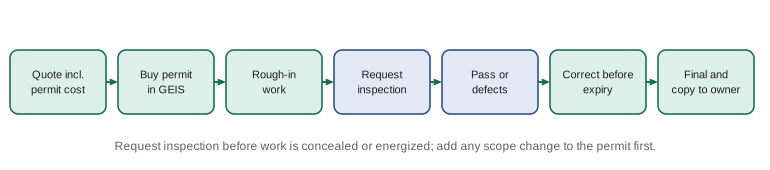
GEIS is TSASK's online system for electrical permits. Contractors buy permits there when hired for electrical work, and TSASK also operates an electrical plans submission portal for installations that need plans. Permits can also be obtained by phone. Ellie prefers GEIS, partly because it is quick and partly because the Registered Electrical Contractors Program, covered in Lesson 11, requires contractors to take out online permits only and applies its discount to online permits.
A new permit fee structure took effect on August 7, 2024, and TSASK provides an online permit fee calculator and fee schedule. Ellie builds the permit cost into every quote, and she checks the calculator rather than reusing old numbers.
Customers can ask for a copy of any permit for work done on their property. TSASK's homeowner page tells owners that if a contractor will not provide one, they can call TSASK. Ellie gives every customer a copy without being asked.
Inspections
Inspections are carried out by TSASK electrical inspectors. The Saskatchewan interpretations deal with inspection requests connected to Rule 2-012 of the Code: the contractor must request an inspection before work is concealed or energized. TSASK's homeowner material defines a rough-in inspection as one carried out on wiring before walls are finished, before drywall goes up.
For the Okafor basement, Ellie requests the rough-in inspection when the boxes, cables and subpanel are in and before the insulation and vapour barrier are covered. The inspector, Lorraine Dubois, arrives two days later. She checks box fill, cable support, the subpanel feeder and bonding, and the bathroom circuit. She passes the rough-in with one defect: a cable run through a joist too close to the edge, where a drywall screw could reach it. Ellie fixes it the same afternoon with a protective plate, confirms with Lorraine how she wants the correction verified, and the drywall goes up on schedule.
How and when TSASK inspects a given permit is up to TSASK, and inspection practices can change. Ellie does not assume any job will go uninspected. She builds every job as if Lorraine will see every box.
Defects and corrections
When an inspector records a defect, the contractor must correct it. TSASK's Registered Electrical Contractors Program requires contractors to correct defects before the permit expiry date, and the interpretations deal with permit expiry. A contractor who leaves defects uncorrected risks enforcement, the loss of registered status and, in the worst cases, action on the bond.
Defects also go into the contractor's record. Lesson 4 showed how the defect ratio is calculated and why a new company's first permits matter so much.
Some defects are urgent. If an inspector finds a hazard, the inspector can require the installation to be disconnected or not energized until it is corrected. The interpretations' front matter also deals with energization stickers, which relate to when a new service can be connected.
Annual permits for electrical employers
Electrical employers, the plants, mines and institutions that do electrical work on their own premises with their own licensed staff, use annual permits. TSASK's information paper on annual permits explains how they work.
- Under the Electrical Licensing Act, an employer licence requires that the employer employ at least one licensed journeyperson, and an employer holding the licence must obtain an annual permit.
- Where an employer has more than one premises with journeypersons working full time, a separate permit is needed for each. For rural service addresses, a location is defined by the meter: three oil wells served by one meter count as one location.
- Annual permits are intended for regular maintenance work only. New installations, major repairs and service connections need separate permits.
- Every journeyperson and apprentice who may work at the locations must be registered on the permit before working under it. The information paper's example uses fees of 450 dollars per journeyperson electrician, 300 per apprentice and 300 per restricted journeyperson, with no fee per location.
- The employer must keep logbooks, work orders and other documentation of all work at each location during the permit year, and the inspector reviews that documentation.
- External contractors cannot work under the employer's annual permit; they must buy their own permits.
Worked problem
Pricing an annual permit
A small food plant in Swift Current has two electrical journeypersons and three apprentices on staff, working at one location. Using the example fees in TSASK's information paper, what would the annual permit cost?
Show solution
- Journeypersons: 2 x 450 = 900.
- Apprentices: 3 x 300 = 900.
- No fee per location in the example structure.
- Total: 900 + 900 = 1,800 dollars.
Answer: 1,800 dollars, using the information paper's example figures. Check TSASK's current fee schedule for real quotes.
# Annual permit estimate using the example fees in TSASK's information paper.
# Replace the fees with the current fee schedule.
FEES = {"journeyperson": 450, "apprentice": 300, "restricted journeyperson": 300}
staff = {"journeyperson": 2, "apprentice": 3, "restricted journeyperson": 0}
total = 0
for role, n in staff.items():
    cost = n * FEES[role]
    total += cost
    print(f"{role:26s} {n} x {FEES[role]:3d} = {cost:5,d}")
print(f"{'annual permit total':26s} {total:13,d}")journeyperson 2 x 450 = 900 apprentice 3 x 300 = 900 restricted journeyperson 0 x 300 = 0 annual permit total 1,800
Unreported work
The Saskatchewan interpretations' front matter deals with penalties for unreported work, and the Registered Electrical Contractors Program requires contractors to have no incidents of unreported work. Unreported work is electrical installation work done without the required permit. It happens most often when a contractor adds work to a job after the permit was bought, finishes a homeowner's unpermitted work without saying so, or does a small job for a friend as a favour.
Ellie's rule is that every change in scope gets a permit check. When the Okafors ask her to add a circuit for a garage heater halfway through the basement job, she adds it to the permit before she pulls the cable.
Talking to customers about permits
Many customers see the permit as a fee the contractor adds to the bill. Ellie explains it in terms they care about: the permit means the work is inspected, the inspection record protects them when they sell or insure the house, and a contractor who offers to skip it is asking them to take a risk. She has never lost a job by explaining the permit clearly, and she has avoided several customers who wanted the work done off the books.
She also keeps every permit, inspection result and correction in the job file, so that years later she can show a buyer, an insurer or TSASK exactly what was done and when it was inspected.
Common mistakes
MistakeBuying the permit after the work has started.
InsteadBuy the permit before work starts. Work done without the required permit is unreported work.
MistakeTelling a customer they can install their own EV charger under a homeowner permit.
InsteadSolar installations, EV chargers and backup generators require a licensed electrical contractor.
MistakeWorking at a plant under the plant's annual permit.
InsteadExternal contractors must buy their own permits; annual permits cover only the employer's own licensed staff and maintenance work.
MistakeCovering wiring before the rough-in inspection.
InsteadRequest inspection before work is concealed or energized.
Summary and key terms
- A permit is required for electrical installation work, and the interpretations deal with permit timing and expiry.
- Licensed contractors buy permits through GEIS; a bond alone does not allow a business to pull permits.
- Homeowner permits cover work in the owner's own home or farm, with limits on services, hot tubs and pools, and no homeowner permits for solar, EV chargers or backup generators.
- Contractors must request inspections before work is concealed or energized and correct defects before the permit expires.
- Electrical employers use annual permits for maintenance on their own premises, registering every journeyperson and apprentice; outside contractors buy their own permits.
- Electrical permit
- The authorization required before electrical installation work, bought from TSASK.
- Homeowner permit
- A permit for electrical installation work in the owner's own home or farm, subject to limits.
- Annual permit
- A yearly permit for an electrical employer's maintenance work on its own premises.
- Rough-in inspection
- An inspection of wiring before walls and ceilings are finished.
- Unreported work
- Electrical installation work done without the required permit.
Practice problems
Work each problem on paper first, then reveal the answer to check.
Can a homeowner install a backup generator under a homeowner permit?
Show answer
No. Backup generators, solar installations and EV chargers require a licensed electrical contractor.
When must a contractor request an inspection?
Show answer
Before the work is concealed or energized.
A mine with an employer licence has four journeypersons and two apprentices at one location. Using the information paper's example fees, what is the annual permit cost?
Show answer
4 x 450 + 2 x 300 = 1,800 + 600 = 2,400 dollars.
The Okafors add a garage heater circuit mid-job. What should Ellie do before pulling cable?
Show answer
Add the work to the permit, so it is not unreported work.
Lesson quiz · 5 questions
Score 60% or more to complete this lesson.
Create a free account to save your progress, take quizzes and earn a certificate.