
MELC-203 · Lesson 5 of 12 · 18 min
The Canadian Electrical Code as adopted in Saskatchewan
▶ Video coming soon A video version of this lesson is on the way.
The Canadian Electrical Code Part I is a national standard, written by a CSA committee and published every three years. On its own, it binds no one. It becomes law in Saskatchewan because provincial legislation adopts it, and when it is adopted it comes with Saskatchewan's own interpretations, which add requirements, clarify how rules apply in the province, and in some places differ from what the national Code alone would say. A contractor who knows the Code well but ignores the interpretations will still fail inspections.
This lesson explains how the Code is adopted in Saskatchewan, what the current editions and effective dates are, how the Saskatchewan interpretations document is organized, and which kinds of rules it most often affects. As in the rest of the series, the Code is cited by rule number and section and explained in our own words. Nothing here reproduces Code text or tables. Keep your own copy of the 2024 Code and the current Saskatchewan interpretations open while you study.
Jayden asks why the book is not enough
Jayden Morin, the second-year apprentice who followed Ellie to Kowalchuk Electric, has spent his technical training learning the 2024 Code. On his first week with the new company, Ellie hands him a second document, the 2024 Electrical Inspections Saskatchewan Interpretations, and tells him to tab it the same way he tabbed his Code book.
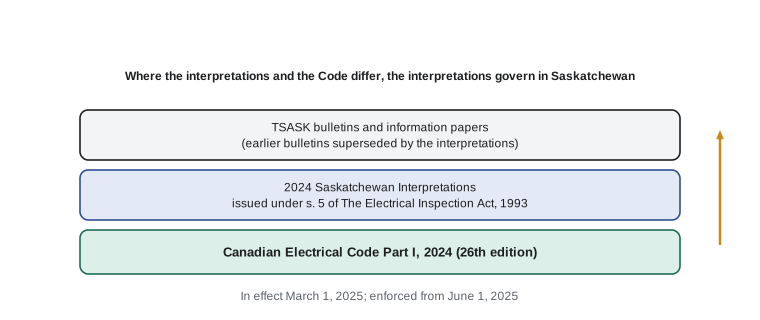
Jayden is puzzled. If the Code is the law, why does Saskatchewan need a second book? Ellie explains that the Code is written for the whole country. Each province adopts it through its own legislation, and each province can add rules for its own conditions, clarify rules that inspectors interpret differently, and set administrative requirements such as when a permit expires. In Saskatchewan, those additions and clarifications are in the interpretations. When the two documents differ, the interpretations govern in Saskatchewan.
How the Code becomes law in Saskatchewan
The legal chain is short. The Electrical Inspection Act, 1993 and its regulations provide for the adoption of codes and standards for electrical installations. Under that authority, the Canadian Electrical Code Part I is adopted, together with other standards such as the CSA standard for the use of electricity in mines. The Saskatchewan interpretations are issued under section 5 of the Act and adopted as requirements under it.
Two consequences follow. First, the Code applies in Saskatchewan as adopted, with whatever provincial requirements accompany it. Second, the interpretations are not optional guidance. They carry the force of the Act. When an inspector cites an interpretation, the contractor must comply with it in the same way as with a Code rule.
The current editions and dates
TSASK's electrical page sets out the current arrangements, and the dates are worth memorizing because older documents are still in circulation.
- Effective March 1, 2025: the 2024 Canadian Electrical Code Part I (the 26th edition) and the 2023 edition of the CSA mining standard, M421:23, Use of Electricity in Mines, were adopted.
- Effective March 1, 2025: the 2024 Oilfield Code and the 2024 Electrical Inspections Saskatchewan Interpretations took effect.
- TSASK began enforcing the new codes on June 1, 2025, after a transition period.
The transition period meant that for three months, contractors could still work to the 2021 Code and its interpretations while moving to the new editions. That kind of transition is common when a new edition is adopted. Ellie notes that the next national edition is due in 2027, and that Saskatchewan's adoption date and transition will be announced by TSASK when the time comes. She will not assume the date.
| Document | Edition | Effective in Saskatchewan |
|---|---|---|
| Canadian Electrical Code Part I | 2024 (26th edition) | March 1, 2025, enforced from June 1, 2025 |
| CSA M421, Use of Electricity in Mines | 2023 | March 1, 2025 |
| Saskatchewan Oilfield Code | 2024 | March 1, 2025 |
| Electrical Inspections Saskatchewan Interpretations | 2024 | March 1, 2025 |
Inside the interpretations document
The 2024 Saskatchewan Interpretations is a substantial document. Ellie walks Jayden through its structure so he can find things quickly.
- Front matter. Scope, accident reporting and site preservation requirements, contact information, and administrative items such as bond matters, penalties for unreported work, energization stickers, the registered contractor program and licensing.
- Rule-by-rule interpretations. Organized by Code section in the same order as the Code, from Section 2, general rules, through Section 84, interconnection of electric power production sources, with additional material for oil and gas, mining and the application of standards.
- Appendices and reference material. Items such as dust-free rooms, marking and warning requirements for renewable energy systems, an amendment request form, an appendix listing what changed from the previous edition, and metric to imperial conversions.
New or changed material is marked so that experienced contractors can see what moved from one edition to the next, and the interpretations state that they supersede all previously issued bulletins. That last point matters: an old bulletin pinned to a shop wall may no longer reflect the requirement.
Where the interpretations matter most
The interpretations touch almost every section of the Code, but some areas come up again and again in a small contractor's work. Ellie marks these for Jayden. The descriptions below are summaries of the topics the interpretations address, not quotations of either document.
- Section 2, general rules. The interpretations deal with permit requirements, including when work must start after a permit is bought and when a permit expires (connected to Rule 2-004), requests for inspection before work is concealed or energized (Rule 2-012), the submission of plans and specifications for larger or complex installations (Rule 2-014), reconnecting and renovating installations after fire, flood or lightning damage (Rule 2-022), and the use of approved equipment, including how deviations are handled (Rule 2-024).
- Section 6, services. The interpretations address service equipment inspection, the support of service masts, and where services may be located (Rules 6-112, 6-200 and 6-206, among others). Service work is also where SaskPower's own service requirements meet the Code, so Ellie always checks both.
- Section 10, grounding and bonding. Practical points on grounding and bonding methods that inspectors see often.
- Sections 18, 20 and 22, hazardous locations and special occupancies. Saskatchewan has grain elevators, oil and gas facilities and other locations where hazardous location rules apply. The interpretations address several of these.
- Section 64, renewable energy and storage. With more solar and battery installations, this area changes quickly, and the interpretations include marking and warning requirements in an appendix.
- Section 68, pools, hot tubs and spas.
The point is not to memorize what each interpretation says. It is to build the habit of checking the interpretations every time you look up a Code rule, especially in Sections 2, 6 and 64, where Saskatchewan's requirements most often shape the job.
A worked example: tabbing for speed
Worked problem
Planning Jayden's tabs
Jayden has 40 tabs for the interpretations document. Ellie suggests he put most of them where Kowalchuk Electric works most: house wiring, renovations, service upgrades and the occasional solar or hot tub job. How might he allocate them?
Show solution
- Front matter: 4 tabs (accident reporting, unreported work, energization, licensing).
- Section 2, general rules: 8 tabs, because permit and inspection timing applies to every job.
- Section 6, services: 6 tabs, for service upgrades and masts.
- Sections 8, 10, 12 and 26: 10 tabs, for loads, grounding, wiring methods and installation rules.
- Sections 64 and 68: 6 tabs, for solar, storage and hot tubs.
- Appendices, conversions and the list of changes: 6 tabs.
Answer: 8 + 6 + 10 + 6 + 6 + 4 = 40. The allocation follows the work, not the page count.
The calculator below checks that a tab plan uses the tabs available and shows the share of tabs for each area, so Jayden can adjust as the company's work changes.
plan = {
    "front matter": 4,
    "Section 2 general rules": 8,
    "Section 6 services": 6,
    "Sections 8, 10, 12, 26": 10,
    "Sections 64 and 68": 6,
    "appendices and changes": 6,
}
available = 40
used = sum(plan.values())
for area, n in plan.items():
    print(f"{area:26s} {n:3d}  ({n / used * 100:4.1f} of every 100 tabs)")
print("used", used, "of", available, "-> OK" if used <= available else "-> too many")front matter 4 (10.0 of every 100 tabs) Section 2 general rules 8 (20.0 of every 100 tabs) Section 6 services 6 (15.0 of every 100 tabs) Sections 8, 10, 12, 26 10 (25.0 of every 100 tabs) Sections 64 and 68 6 (15.0 of every 100 tabs) appendices and changes 6 (15.0 of every 100 tabs) used 40 of 40 -> OK
Which documents rank where
Jayden asks what happens when the Code says one thing, the interpretations say another, a TSASK bulletin says a third and a manufacturer's instructions say a fourth. Ellie lays out how she approaches it.
- The legislation comes first: the Act and regulations decide which code applies and what the interpretations are.
- Where an interpretation adopted under the Act differs from the Code rule, the interpretation governs in Saskatchewan.
- Bulletins and information papers explain and give notice of requirements, but the current interpretations state that they supersede earlier bulletins, so always check dates.
- Equipment must be approved, and manufacturers' installation instructions that form part of the approval matter, but they do not override the Code or the interpretations.
- When in doubt, ask the inspector before the work is done, not after it fails.
Staying current
The Code changes every three years, the interpretations change with it, and TSASK publishes bulletins and information papers between editions. Ellie sets up three habits for the company: everyone checks TSASK's electrical page at the start of each quarter, the shop keeps one current copy of the interpretations in print and one bookmarked online, and any change that affects common work is discussed at the next Monday morning meeting. Lesson 11 returns to continuing education.
Reading an interpretation alongside the rule
Ellie shows Jayden the method she uses every time. First, read the Code rule in full, including any appendix note for it. Second, look up the same rule number in the Saskatchewan interpretations and read the interpretation for it, if there is one. Third, check the front matter and the appendix of amendments for anything that changes how the rule is administered. Fourth, if the job involves a service, check the utility's service requirements as well. Only then decide what the installation needs.
The method takes a few extra minutes on each lookup at first. After a few months it becomes automatic, and it prevents the most common failed inspection Ellie saw as a lead hand: work that met the national Code but not the Saskatchewan interpretation.
Jayden also learns to recognize when an interpretation is administrative rather than technical. An interpretation about permit expiry or energization stickers does not change how a circuit is wired, but it changes what has to happen before the work is finished. Both kinds matter, and a failed administrative requirement can stop a job as surely as a wiring defect.
Finally, Ellie reminds him that the interpretations are written for the whole province. Where a utility, a municipality or a customer's own specification adds requirements, those apply as well, as long as they do not conflict with the legislation. The interpretations set the provincial floor, not the ceiling.
When Jayden finds a rule he does not understand even after reading both documents, Ellie tells him to write the question down and bring it to the Monday meeting, or to ask the inspector on the next visit. Guessing at the meaning of a rule is how small misunderstandings become company habits. A written question, answered once and shared with the crew, becomes a company standard instead.
Common mistakes
MistakeTreating the Saskatchewan interpretations as optional guidance.
InsteadThey are issued under section 5 of The Electrical Inspection Act, 1993 and adopted as requirements.
MistakeRelying on an old bulletin pinned to the shop wall.
InsteadThe current interpretations supersede previously issued bulletins; check dates and the current documents.
MistakeAssuming the 2024 Code took effect the day it was published.
InsteadSaskatchewan adopted it effective March 1, 2025, and TSASK began enforcing it on June 1, 2025.
MistakeChecking only the Code for service work.
InsteadCheck the Code, the Saskatchewan interpretations for Section 6 and the utility's service requirements.
Summary and key terms
- The Code becomes law in Saskatchewan through The Electrical Inspection Act, 1993 and its regulations.
- The 2024 Code, the 2024 Oilfield Code, CSA M421:23 and the 2024 Saskatchewan Interpretations took effect March 1, 2025, with enforcement from June 1, 2025.
- The interpretations are issued under section 5 of the Act, carry its force and supersede earlier bulletins.
- They are organized by Code section, with front matter on administrative requirements and appendices.
- Sections 2, 6, 10, 18 to 22, 64 and 68 are areas where the interpretations often shape a small contractor's work.
- Adoption
- The legal act that makes a code enforceable in a province.
- Saskatchewan Interpretations
- Requirements issued under section 5 of The Electrical Inspection Act, 1993 that clarify and add to the Code in Saskatchewan.
- Transition period
- A period after adoption during which the previous edition may still be used.
- Bulletin
- A notice from the inspection authority; superseded where the current interpretations say so.
- Oilfield Code
- Saskatchewan's code for electrical installations at oil and gas facilities.
Practice problems
Work each problem on paper first, then reveal the answer to check.
When did the 2024 Code take effect in Saskatchewan, and when did TSASK begin enforcing it?
Show answer
It took effect March 1, 2025; enforcement began June 1, 2025.
Under which section of which Act are the Saskatchewan interpretations issued?
Show answer
Section 5 of The Electrical Inspection Act, 1993.
Name three Code sections where the Saskatchewan interpretations often affect residential and small commercial work.
Show answer
Any three of Sections 2, 6, 10, 64 and 68, among others.
A 2019 bulletin conflicts with the current interpretations. Which applies?
Show answer
The current interpretations, which supersede previously issued bulletins.
Lesson quiz · 5 questions
Score 60% or more to complete this lesson.
Create a free account to save your progress, take quizzes and earn a certificate.