
MELC-203 · Lesson 11 of 12 · 18 min
Renewal, registered contractor status and continuing education
▶ Video coming soon A video version of this lesson is on the way.
A contractor licence is not a certificate you earn once and frame. It has to be renewed, the bond behind it has to be kept in force, the qualifier's own licence has to stay current, and the Code and interpretations the company works to change every few years. Saskatchewan also offers contractors a reward for doing all of this well: the Registered Electrical Contractors Program, which reduces permit costs for contractors with good inspection records who take part in continuing education.
This lesson covers licence renewal and closure, the registered contractor program in detail, and how a small contractor keeps its knowledge current through the Code cycle. TSASK's requirements were checked against its published pages in late 2026; confirm current details with TSASK before relying on them.
The first anniversary
A year after the licence arrived, Dev's spreadsheet shows four renewals due within three months: the contractor licence, the surety bond, Curtis's journeyperson licence and the liability insurance. He also has a note from Ellie: find out whether we qualify for registered contractor status. Kowalchuk Electric has taken out 61 permits in its first year, and Ellie wants to know whether its inspection record is good enough.
Renewing licences
TSASK handles renewals online. Its pages set out the rules that matter most.
- A contractor licence that is not renewed by its expiry date is closed, and the company cannot buy permits.
- If the bond expires, the licence is also closed.
- A closed licence can be reopened without additional fees if it has not passed its expiry date and a new or renewed bond is provided.
- Journeyperson licences are renewed online, and a closed journeyperson licence can be reopened without additional fees if it has not passed its expiry date.
The renewal itself is simple. What goes wrong is timing. The licence renewal, the bond renewal and the qualifier's journeyperson licence renewal may fall on different dates, and missing any one of them can stop the company. Dev keeps all three on the same calendar with reminders 60 and 30 days ahead, and he asks the broker to confirm when the renewed bond has been sent to TSASK.
The renewal is also a good moment to check that the company's records match reality: the right qualifier, every journeyperson listed, nobody listed who has left, and the registered business details unchanged. If anything has changed during the year, such as a new qualifier or a change of business name, Ellie tells TSASK when it happens, not at renewal.
The Registered Electrical Contractors Program
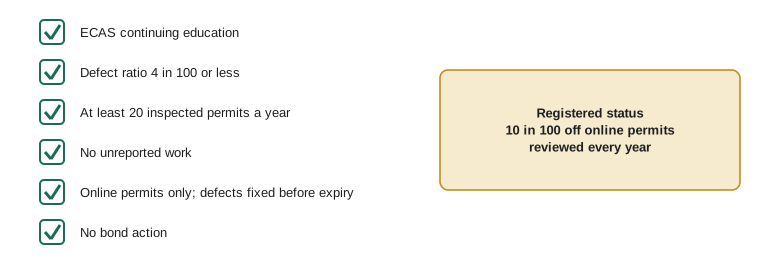
TSASK's Registered Electrical Contractor Program aims to improve and maintain the safety and consistency of electrical installations in Saskatchewan. Participating contractors receive a reduction of 10 in 100 on electrical permits; TSASK describes the benefit as both a discount and a rebate, applied automatically to online permits once a contractor has registered status.
To qualify, a contractor must meet every one of these requirements, as TSASK lists them.
- Take part in a continuing education program run under the Electrical Contractors Association of Saskatchewan.
- Maintain a defect ratio of four in 100 or less on all inspected permits, with at least 20 inspected permits per year.
- Have no incidents of unreported work, and disclose all information about the electrical installation or permit.
- Take out online permits only.
- Correct any defects before the permit expiry date.
- Have no bond action. An incident of bond action causes immediate loss of status.
TSASK tracks each contractor's history every year to confirm that the requirements are met, notifies contractors that qualify, and requires them to meet the standards every year to keep their status.
| Requirement | Standard | What breaks it |
|---|---|---|
| Continuing education | Participation in the ECAS program | Not participating |
| Defect ratio | Four in 100 or less on inspected permits | Too many permits with recorded defects |
| Volume | At least 20 inspected permits a year | Too few inspected permits |
| Unreported work | No incidents | Any work done without the required permit |
| Permits | Online permits only | Buying permits by other means |
| Corrections | Defects corrected before permit expiry | Defects left open past expiry |
| Bond | No bond action | Any bond action: immediate loss of status |
Does Kowalchuk Electric qualify?
Worked problem
The year-one check
In its first year, Kowalchuk Electric took out 61 permits, all online. Of those, 44 were inspected, and inspectors recorded defects on 2. All defects were corrected before the permits expired. The company had no unreported work and no bond action, and Ellie enrolled in the ECAS continuing education program in month three. Does it qualify for registered status?
Show solution
- Inspected permits: 44, which meets the minimum of 20.
- Defect ratio: 2 / 44 = 0.045, or about 4.5 in 100.
- The standard is four in 100 or less, so 4.5 is above it.
- Every other requirement is met.
Answer: Not yet. The defect ratio of about 4.5 in 100 is just above the limit. One fewer defective permit, or more clean inspected permits, would have qualified it.
The near miss shows how strongly a small number of defects affects a young company. Ellie looks at the two defects. Both were on bathroom fan circuits, both on rough-ins Jayden had wired, and both involved the same detail. She adds a check for it to the company's pre-inspection walk-through.
def registered_check(inspected, defective, ecas=True, unreported=0,
                     online_only=True, open_defects=0, bond_action=False):
    ratio = defective / inspected * 100 if inspected else 0
    checks = {
        "ECAS continuing education": ecas,
        "at least 20 inspected permits": inspected >= 20,
        "defect ratio 4 in 100 or less": ratio <= 4,
        "no unreported work": unreported == 0,
        "online permits only": online_only,
        "defects corrected before expiry": open_defects == 0,
        "no bond action": not bond_action,
    }
    for name, ok in checks.items():
        print(f"  {name:34s} {'yes' if ok else 'NO'}")
    print(f"  defect ratio {ratio:.1f} in 100 ->",
          "QUALIFIES" if all(checks.values()) else "does not qualify")

print("Year one:")
registered_check(44, 2)
print("Year two:")
registered_check(58, 2)Year one: ECAS continuing education yes at least 20 inspected permits yes defect ratio 4 in 100 or less NO no unreported work yes online permits only yes defects corrected before expiry yes no bond action yes defect ratio 4.5 in 100 -> does not qualify Year two: ECAS continuing education yes at least 20 inspected permits yes defect ratio 4 in 100 or less yes no unreported work yes online permits only yes defects corrected before expiry yes no bond action yes defect ratio 3.4 in 100 -> QUALIFIES
With the same two defects on 58 inspected permits in year two, the ratio would fall to about 3.4 in 100, and the company would qualify. The discount then applies to every online permit, which for a busy small contractor can add up to a meaningful saving over a year.
Continuing education and the Code cycle
TSASK's licensing pages, as checked for this course, do not list a continuing education requirement for renewing a contractor or journeyperson licence, unlike some provinces' master electrician certificates; confirm the current rules with TSASK. The registered contractor program builds continuing education in for those who want registered status, through the ECAS program. Ellie treats continuing education as part of the business whether or not it is required, for three reasons.
- The Code changes every three years. The 2024 Code took effect in Saskatchewan on March 1, 2025, and the next national edition is due in 2027. Each edition brings changes in areas a small contractor works in every day, such as GFCI and AFCI protection, EV charging, solar and storage.
- The Saskatchewan interpretations change with each Code edition, and TSASK publishes bulletins and information papers in between.
- The business rules change too: fee schedules, permit systems, prompt payment and OHS requirements.
Her plan for the company is practical: one formal course a year for each journeyperson, a review session when each new Code edition and its interpretations are adopted, a quarterly check of TSASK's electrical page, and five minutes at every Monday meeting on something that changed or something an inspector pointed out. Jayden's apprenticeship training counts as his formal training while he is an apprentice.
| Item | Frequency | Who |
|---|---|---|
| Contractor licence renewal | By expiry | Dev, with Ellie as qualifier |
| Bond renewal, sent to TSASK | By expiry | Broker, confirmed by Dev |
| Journeyperson licence renewals | By each expiry | Each journeyperson; Dev tracks |
| ECAS continuing education | As the program requires | Ellie and the journeypersons |
| New Code edition and interpretations review | Every adoption cycle | Whole crew |
| TSASK page check | Quarterly | Ellie |
| Defect review | After every defect | Ellie and the worker involved |
Keeping status once you have it
Registered status is reviewed every year, and some events end it at once. Bond action causes immediate loss of status. Unreported work disqualifies a contractor. A busy season with sloppy rough-ins can push the defect ratio over the limit. Ellie tells the crew that the discount is not the point. The discount is a scorecard, and the scorecard measures whether the company's work is right the first time.
Learning from inspectors
Ellie's best source of continuing education turns out to be the inspections themselves. Every time an inspector records a defect or makes a suggestion, she writes it in the company's defect log with the rule or interpretation involved. Once a quarter she reviews the log with the crew. In the first year, the log shows three patterns: bathroom fan circuits, box fill in renovation work, and labelling of panels. Each becomes a five-minute topic at a Monday meeting and a line on the pre-inspection checklist.
She also asks inspectors questions when they visit, politely and at the right time. Most inspectors are glad to explain what they are looking for. A contractor who asks before the work is done, rather than arguing after it fails, builds a relationship that makes every later inspection smoother.
Training the next qualifier
Continuing education is also how a company produces its next qualifier. Curtis will reach two years with his Red Seal in September 2027, and Ellie wants him ready to qualify the company if she ever cannot. She has him sit in on permit purchases, inspection requests, renewals and one or two contract negotiations, and she asks him to work through this course and the readiness review in Lesson 12. Jayden, still an apprentice, is years away, but Ron's advice applies to him too: start the folder now.
Ron points out that the same habits that keep the licence current also keep the company sellable. A buyer, or a family member taking over, looks for clean licensing records, a good inspection history and a crew that knows the rules. Registered contractor status is one of the clearest signals of all three.
When the 2027 Code edition arrives, Kowalchuk Electric will run the same cycle again: read TSASK's adoption notice, note the effective and enforcement dates, get the new Code and interpretations, review the changes that affect the company's work, and update the checklists before the old edition stops being accepted.
Budgeting for learning
Continuing education costs money and time, so Ellie budgets for it like any other business expense. Each journeyperson has a yearly training allowance and paid time for one formal course. New Code editions get an extra allowance in the adoption year, because every journeyperson needs the new book and the changes course. Dev records the spending, and at the end of the year Ellie compares it with the defect log. In the first year, the two defects that cost registered status would have paid for a full course on their own, once the re-inspection time and the lost permit discount are counted. Learning, she tells Curtis, is cheaper than fixing.
Common mistakes
MistakeRenewing the licence but forgetting the bond.
InsteadA bond expiry closes the licence even if the licence itself is current.
MistakeAssuming registered status lasts once earned.
InsteadTSASK reviews it every year, and bond action ends it immediately.
MistakeBuying a permit by phone as a registered contractor.
InsteadThe program requires online permits only, and the discount applies to online permits.
MistakeTreating the Code as settled once learned.
InsteadThe Code and the Saskatchewan interpretations change with each three-year edition, and bulletins appear in between.
Summary and key terms
- Licences are renewed online; a licence closes if not renewed by expiry or if the bond expires, and can be reopened without extra fees before expiry with a new bond.
- The Registered Electrical Contractor Program gives 10 in 100 off online permits to contractors that meet its standards.
- The standards are ECAS continuing education, a defect ratio of four in 100 or less with at least 20 inspected permits a year, no unreported work, online permits only, defects corrected before expiry and no bond action.
- TSASK reviews status every year, and bond action causes immediate loss of status.
- Continuing education keeps the company current through the three-year Code cycle and the changes to the interpretations.
- Registered Electrical Contractor Program
- A TSASK program giving a permit discount to contractors that meet quality and education standards.
- Defect ratio
- Permits with recorded defects divided by inspected permits.
- ECAS
- The Electrical Contractors Association of Saskatchewan, which runs the continuing education program the registered contractor program relies on.
- Code cycle
- The three-year cycle of national Code editions and provincial adoption.
Practice problems
Work each problem on paper first, then reveal the answer to check.
What discount do registered contractors receive, and on which permits?
Show answer
10 in 100, applied to online permits.
A contractor has 30 inspected permits with 1 defect and meets every other requirement. Does it qualify?
Show answer
Yes. 1 / 30 is about 3.3 in 100, below the limit of four, and it has at least 20 inspected permits.
What causes immediate loss of registered status?
Show answer
An incident of bond action.
Name two events that close a contractor licence.
Show answer
Not renewing by the expiry date, and the bond expiring.
Lesson quiz · 5 questions
Score 60% or more to complete this lesson.
Create a free account to save your progress, take quizzes and earn a certificate.