
MELC-203 · Lesson 4 of 12 · 19 min
How competence is checked without a licensing exam
▶ Video coming soon A video version of this lesson is on the way.
In the provincial courses that sit beside this one, Lesson 4 describes an exam: how many questions, how long, which books are allowed and what score passes. Saskatchewan has no such exam for contractors or qualifiers. That raises a fair question. If no one tests a new contractor on the Code, the legislation and the business rules before issuing a licence, how does the province know the contractor is competent?
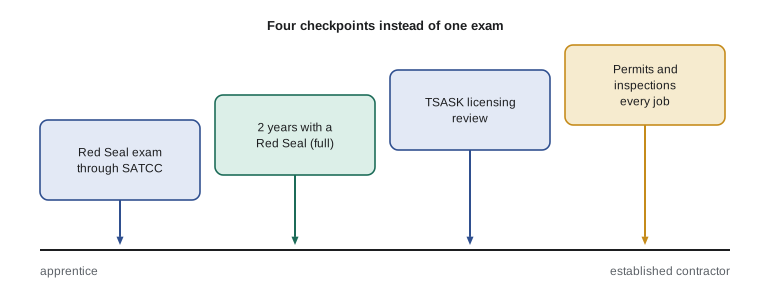
The answer is that Saskatchewan checks competence at several points instead of one. The trade certification process tests the qualifier's knowledge before the licence. The two-year Red Seal requirement adds experience. TSASK's licensing checks confirm credentials. And every permit and inspection after that is a continuing test, with consequences for contractors whose work fails. This lesson looks at each of those checks, at what they do not cover, and at how a new contractor can test themselves on the material that no one else will examine.
Ellie meets the question head on
When Ellie tells her friends at Northgate that she is starting her own company, one of the older journeypersons, Walt Hrycan, raises an eyebrow. In Alberta, he says, his brother had to write a seven-hour exam to get the right to pull permits. In Saskatchewan, Ellie only needs a bond and a Red Seal. Isn't that too easy?
Ellie has thought about it. The licence is easier to get, she agrees, but it is not easier to keep. The bond can be called. Inspectors see every job. TSASK tracks defects. And her customers, the general contractors she subcontracts to, and her own conscience will expect her to know the Code, the legislation and the business law whether or not anyone tests her on them first. That is why she is working through the whole master electrician program, including the six core courses, even though Saskatchewan does not require it.
Check 1: Trade certification and the Red Seal
The qualifier's credentials rest on trade certification. In Saskatchewan, the Saskatchewan Apprenticeship and Trade Certification Commission (SATCC) runs apprenticeship and certification. A construction electrician apprentice completes the required periods of technical training and on-the-job hours, then writes the interprovincial Red Seal examination for the trade. Passing earns the journeyperson certificate with the Red Seal endorsement, which is recognized across Canada.
The Red Seal exam is a demanding test of the trade. It covers the Canadian Electrical Code, calculations, wiring methods, motors and controls, grounding and bonding, and the work an electrician does across residential, commercial and industrial settings. SATCC publishes examination information for the trade that sets out the exam's structure and the share of questions in each area. What it does not test is the contractor's side of the business: permits, licensing law, liens, prompt payment, workers compensation and running a company. That is the gap this course and the MELC-106 core course fill.
TSASK's journeyperson licence is issued on proof of that certification. The journeyperson page asks for proof of the journeyperson certificate, including the seal with its interprovincial number. For a qualifier, TSASK also needs proof that the Red Seal has been held long enough.
Check 2: Experience
The two-year rule for a full contractor qualifier is an experience requirement. It does not test anything directly, but it means the person qualifying a company has spent at least two years working as a certified journeyperson after the Red Seal exam. In those two years most journeypersons see a wide range of work, work alongside inspectors, and learn the practical meaning of the rules they studied.
The limited licence recognizes that new journeypersons may want to start contracting sooner, but it limits them to smaller installations near home, 200 amperes and 240 volts within 80 kilometres, until they have the experience.
Check 3: Licensing review
TSASK's licensing staff check the application: the qualifier's licence and Red Seal date, the business registration, the bond and the list of employed journeypersons. They also check that the qualifier is not listed with another contractor. The licensing review is administrative, not technical, but it catches the most common ways people try to get around the rules: borrowed qualifiers, out-of-province credentials presented as Saskatchewan licences, and businesses that are not registered.
Check 4: Permits and inspections
The most important competence check in Saskatchewan happens on the job. Every installation needs a permit, and permitted work is subject to inspection. Inspectors from TSASK look at rough-in wiring before it is concealed, at services before they are energized, and at completed work, and they record defects that the contractor must correct.
That record follows the contractor. TSASK's Registered Electrical Contractors Program, which Lesson 11 covers in detail, uses it directly: one requirement for registered status is a defect ratio of four in 100 or less on all inspected permits, with at least 20 inspected permits a year. Contractors who meet the standard receive a reduction on online permit fees. A contractor whose work regularly fails inspection does not qualify, and more serious problems, such as unreported work or bond action, have their own consequences.
Inspection is therefore a test that never ends. A contractor that does sloppy work pays for it in re-inspections, delays, unhappy customers, lost permit discounts and, in serious cases, bond claims and enforcement.
What no one checks before the licence
Ellie's list of what the system does not test before she is licensed is long, and it is the reason she is taking this course.
- The Saskatchewan interpretations of the Code, and how they change specific rules.
- The permit rules: when a permit is needed, who may buy one, and when to request inspections.
- The licensing rules: the qualifier's duties, the single-employer rule, licence classes and renewals.
- Contract and lien law, including Saskatchewan's prompt payment rules and adjudication.
- Occupational health and safety law for an employer, including duties to workers and reporting.
- Workers compensation registration and injury reporting.
- Business basics: estimating, pricing, insurance, bonding and records.
None of that is optional knowledge. A contractor who does not know the prompt payment deadlines loses money. A contractor who does not report an injury on time breaks the law. A contractor who starts a job before buying a permit risks penalties for unreported work. The difference in Saskatchewan is that you find out you did not know when something goes wrong, not on an exam.
Testing yourself
Ron's advice is to treat the material as if there were an exam, because studying for a test is the most reliable way to learn it. Ellie sets up a self-assessment plan with three parts.
- Code: the six MELC core courses, with their quizzes and exams, and the Saskatchewan interpretations alongside the 2024 Code.
- Legislation and TSASK rules: this course, with the Acts, regulations and TSASK information papers open beside it.
- Business and law: the MELC-106 core course and Lessons 8 to 10 of this course.
She sets herself the same kind of target that provinces with exams use: at least 70 on each part of her own practice tests, and no part below 60. If she misses the target on a part, she reviews that part before taking on work that depends on it. Lesson 12 gives a readiness review she can use as a final check.
| Area | Where competence is checked | Who checks it | When |
|---|---|---|---|
| Trade knowledge and the Code | Red Seal examination | SATCC | Before journeyperson certification |
| Experience | Two years with a Red Seal for a full qualifier | TSASK licensing | At application |
| Credentials and registration | Licence application | TSASK licensing | At application and renewal |
| Quality of installations | Permits and inspections | TSASK inspectors | Every job |
| Legislation, contracts, safety law, business | Not examined before licensing | The contractor, through study | Before taking on work |
Worked example: a defect ratio
Worked problem
Is Kowalchuk Electric on track?
In its first eight months, Kowalchuk Electric has 23 permits that have been inspected. Inspectors recorded defects on 2 of them, both corrected before the permits expired. What is the company's defect ratio, and does it meet the registered contractor standard?
Show solution
- Defect ratio = permits with defects / inspected permits = 2 / 23.
- 2 / 23 = 0.087, or about 8.7 in 100.
- The registered contractor standard is four in 100 or less, with at least 20 inspected permits a year.
- Kowalchuk Electric has enough inspected permits but is above the defect limit.
Answer: About 8.7 in 100: above the four in 100 limit. Ellie needs to find out what caused the two defects and fix the cause.
TSASK tracks the ratio its own way, and the exact method can change, so treat the calculation as a planning tool. The code below computes the ratio and the largest number of defective permits that would still meet a limit of four in 100 for a given number of inspected permits.
import math

def defect_ratio(defective, inspected):
    return defective / inspected

def max_defective(inspected, limit_in_100=4):
    return math.floor(inspected * limit_in_100 / 100)

for inspected, defective in [(23, 2), (40, 1), (60, 3)]:
    r = defect_ratio(defective, inspected) * 100
    allowed = max_defective(inspected)
    ok = "meets" if defective <= allowed else "above"
    print(f"{inspected} inspected, {defective} with defects: {r:.1f} in 100,"
f" up to {allowed} allowed -> {ok} the standard")23 inspected, 2 with defects: 8.7 in 100, up to 0 allowed -> above the standard 40 inspected, 1 with defects: 2.5 in 100, up to 1 allowed -> meets the standard 60 inspected, 3 with defects: 5.0 in 100, up to 2 allowed -> above the standard
Two defects on 23 permits fails the standard; the same two defects on 60 permits would pass. Early in a company's life, every defect counts heavily. That is one more reason to get the first jobs exactly right.
Is Saskatchewan's approach better or worse?
People argue about this. Supporters of an exam say it ensures every contractor knows the legislation and business law before they start, which protects customers and workers. Supporters of Saskatchewan's approach say the Red Seal exam already tests the trade thoroughly, that experience matters more than a second exam, and that inspection and enforcement catch the contractors who cut corners. Both sides agree on one point: a contractor who does not know the rules eventually pays for it. This course takes no side in the debate. It simply makes sure you know the rules.
Building your own study plan
Ellie turns the gap list into a twelve-week study plan that fits around work. Each week has one topic, a reading, and a short self-test she writes for herself.
- Weeks 1 to 3: the Saskatchewan interpretations alongside the Code sections she uses most, Sections 2, 6, 8, 10 and 26.
- Weeks 4 and 5: permits, inspections and licensing, using TSASK's pages and this course.
- Weeks 6 and 7: contracts, prompt payment, adjudication and liens.
- Weeks 8 and 9: OHS duties, WCB registration and reporting, and the company's safety program.
- Weeks 10 and 11: estimating, insurance, bonding and taxes, with Dev.
- Week 12: the readiness review in Lesson 12.
She keeps the plan realistic, about three hours a week, because a plan she abandons by week four is worse than a modest plan she finishes. Ron adds one more piece of advice: whenever an inspector points something out, add it to the plan, because inspectors see the mistakes contractors actually make.
Ellie also tests herself the way inspectors test her: by looking at finished work. Once a month she picks one completed job, opens the photos and the panel schedule, and asks what an inspector would ask about it. It takes half an hour, and it has caught two small labelling problems before an inspector did.
Common mistakes
MistakeThinking that no exam means no need to know the legislation.
InsteadThe legislation, permit rules and business law apply in full; the difference is that no one tests them before licensing.
MistakeTreating inspection as the contractor's quality control.
InsteadInspection is a check. Defects count against the contractor, and corrections cost time and money.
MistakeAssuming the Red Seal exam covers contracting.
InsteadThe Red Seal exam tests the trade, not licensing law, liens, prompt payment or business management.
MistakeIgnoring early defects because the numbers are small.
InsteadWith few inspected permits, each defect weighs heavily in the defect ratio used for registered contractor status.
Summary and key terms
- Saskatchewan has no exam for contractors or qualifiers; competence is checked at several points instead.
- The Red Seal examination, run in Saskatchewan through SATCC, tests the trade before journeyperson certification.
- The two-year Red Seal rule for full qualifiers adds experience, and TSASK checks credentials at application.
- Permits and inspections test every job, and the defect ratio feeds the Registered Electrical Contractors Program.
- Legislation, contracts, safety law and business management are not examined before licensing, so contractors must study them themselves.
- SATCC
- The Saskatchewan Apprenticeship and Trade Certification Commission, which runs apprenticeship and trade certification.
- Red Seal examination
- The interprovincial exam for a trade; passing it earns the Red Seal endorsement on a journeyperson certificate.
- Defect ratio
- The share of a contractor's inspected permits on which inspectors recorded defects.
- Self-assessment
- Testing your own knowledge against set targets in areas no licensing exam covers.
Practice problems
Work each problem on paper first, then reveal the answer to check.
Which organization runs apprenticeship and trade certification for electricians in Saskatchewan?
Show answer
The Saskatchewan Apprenticeship and Trade Certification Commission (SATCC).
A contractor had defects on 3 of 50 inspected permits. Does it meet a four in 100 standard?
Show answer
No. 3 / 50 = 0.06, or 6 in 100, which is above the limit of four in 100.
Name two areas of knowledge that are not examined before a Saskatchewan contractor licence is issued.
Show answer
Any two of: Saskatchewan interpretations, permit rules, licensing rules, lien and prompt payment law, OHS employer duties, WCB reporting, business management.
What does the two-year Red Seal rule add to the system?
Show answer
Experience: the full qualifier has worked at least two years as a certified journeyperson.
Lesson quiz · 5 questions
Score 60% or more to complete this lesson.
Create a free account to save your progress, take quizzes and earn a certificate.