
MELC-203 · Lesson 12 of 12 · 17 min
Readiness review: a practice test for new contractors
▶ Video coming soon A video version of this lesson is on the way.
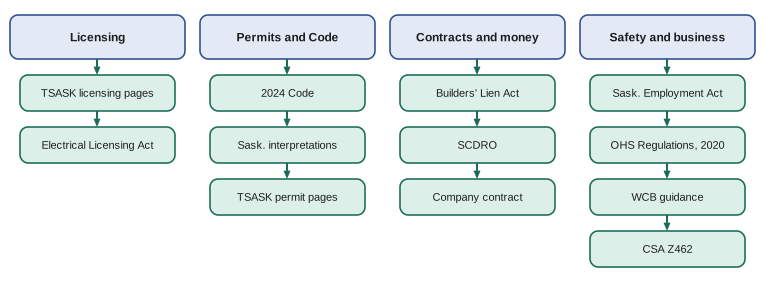
In provinces with a master electrician exam, the final lesson of the provincial course is about test day: timing, references and strategy. Saskatchewan has no such exam, so this lesson does something different. It gives you a structured readiness review: a practice test on the material that no one examines before a Saskatchewan contractor licence is issued, a map from each kind of question to the document that answers it, and a final checklist to work through before your company takes its first job.
Treat the review as seriously as an exam. Set aside time, close the course notes, and answer from the documents you would actually use on the job: the 2024 Code, the 2024 Saskatchewan interpretations, TSASK's licensing and permit pages, The Builders' Lien Act summaries, WCB's employer guidance and your own company procedures. Then check your answers against the lessons. Lesson 4 suggested a target of at least 70 on each part and no part below 60, the same kind of standard provinces with exams use.
Ellie's dry run
Two weeks before Kowalchuk Electric's licence application goes in, Ron sets Ellie a test. He has written forty questions on index cards, in four piles: licensing, permits and the Code, contracts and money, and safety and the business. He gives her an evening, a pot of coffee and the same documents she will have in her truck. She scores 34 out of 40, with every miss in the contracts and money pile. She spends the next week on Lesson 9 and the MELC-106 core course, and Ron gives her a fresh pile of contracts questions. This time she gets nine of ten.
Ron's point is not the score. It is that she found her weak area before a customer or a general contractor found it for her.
Part 1: Licensing
These questions test Lessons 1 to 3, 7 and 11. Answer each in a sentence or two.
- Which organization issues electrical contractor licences in Saskatchewan, and under which statute?
- What must a business have to hold a general or full electrical contractor licence?
- How long must a full contractor's qualifier have held a Red Seal?
- What are the limits of a limited contractor licence?
- Can a qualifier work weekends for another licensed contractor?
- What two events close a contractor licence, and when can it be reopened without additional fees?
- How does the insurer send the surety bond to TSASK?
- Does an Alberta Master Electrician Certificate allow a business to buy permits in Saskatchewan?
- What are the requirements for registered contractor status?
- What causes immediate loss of registered status?
Part 2: Permits and the Code
These questions test Lessons 5 and 6, and assume you have the 2024 Code and the Saskatchewan interpretations open.
- When did the 2024 Code take effect in Saskatchewan, and when did enforcement begin?
- Under which statute and section are the Saskatchewan interpretations issued, and what do they supersede?
- Where in the interpretations would you look for permit expiry and inspection request requirements?
- Which installations require a licensed contractor rather than a homeowner permit?
- When may a homeowner install an electrical service under a homeowner permit?
- When must a contractor request an inspection?
- Can an outside contractor work under a plant's annual permit?
- What is unreported work, and how does it affect a contractor?
- What should a contractor do when a customer adds work partway through a job?
- How do you calculate a defect ratio, and what is the registered contractor limit?
Part 3: Contracts and money
These questions test Lessons 8 and 9.
- When did Saskatchewan's prompt payment rules come into force, and which contracts do they apply to?
- How many days does an owner have to pay a proper invoice, and to give a notice of non-payment?
- How many days does a contractor have to pay a subcontractor after being paid?
- Which organization oversees construction adjudication?
- What is the standard holdback, and when is it released?
- Why should a subcontractor not wait on promises while the lien period runs?
- What are the three parties to a surety bond, and who ultimately pays a valid claim?
- Does TSASK list liability insurance as a licensing requirement? Why do contractors carry it anyway?
- Why might a general contractor ask for a WCB clearance letter?
- What does incorporation protect an owner from, and what does it not?
Part 4: Safety and the business
These questions test Lessons 7 and 10.
- Which Act contains most of Saskatchewan's OHS law, and what are workers' three basic rights?
- Within how many days must an employer report an injury to WCB, and does lost time matter?
- Where must serious incidents and electrical accidents be reported, and what must happen to the scene?
- What is the role of a prime contractor on a shared site, and what does each employer remain responsible for?
- What comes first in controlling an electrical hazard?
- Which standard guides arc flash risk assessment and protective equipment?
- What should a new worker's orientation cover?
- Who answers for an apprentice's work?
- Name three consequences a contractor can face for failing its duties.
- What should a company's incident procedure in each truck say?
Answer key
Check your answers against these summaries. If you missed a question, return to the lesson listed.
| Question area | Short answer | Lesson |
|---|---|---|
| Who licenses contractors | TSASK, under The Electrical Licensing Act | 1 |
| Full licence requirements | Registered business, bond of at least 10,000 dollars, TSASK licence, qualifier with Red Seal held two years | 2 |
| Limited licence limits | 200 A, 240 V, 80 km radius | 2 |
| Qualifier second job | Not with another licensed contractor or employer | 2, 7 |
| Licence closure | Not renewed by expiry, or bond expires; reopen free before expiry with a new bond | 3, 11 |
| Code dates | 2024 Code effective March 1, 2025; enforced from June 1, 2025 | 5 |
| Interpretations | Section 5 of The Electrical Inspection Act, 1993; supersede earlier bulletins | 5 |
| Contractor-only installations | Solar, EV chargers, backup generators | 6 |
| Inspection timing | Before work is concealed or energized | 6 |
| Prompt payment | 28 days to pay, 14 days to dispute, 7 days to pay subs; in force March 1, 2022 | 9 |
| Adjudication | Saskatchewan Construction Dispute Resolution Office | 9 |
| Holdback | 10 in 100, released after substantial performance and the lien period with no liens | 9 |
| WCB report | Within five days of learning of the injury, lost time or not | 10 |
| Registered status | ECAS education, defect ratio 4 in 100 or less with 20+ inspected permits, no unreported work, online permits, defects fixed before expiry, no bond action | 11 |
Scoring yourself
Give yourself one point for each question you answered correctly from the documents, and no points for a guess, even a correct one. A guess that happens to be right on a review becomes a wrong answer on a job. The script below scores the four parts against the targets from Lesson 4 and tells you where to focus.
scores = {"licensing": (9, 10), "permits and Code": (8, 10),
          "contracts and money": (5, 10), "safety and business": (9, 10)}
target_each, floor = 70, 60
total_right = sum(r for r, n in scores.values())
total_q = sum(n for r, n in scores.values())
for part, (right, n) in scores.items():
    pct = right / n * 100
    note = "review this part" if pct < target_each else "ok"
    if pct < floor:
        note = "below the floor: study before taking work"
    print(f"{part:22s} {right:2d}/{n}  {pct:5.1f} of 100  {note}")
print(f"overall {total_right}/{total_q}")licensing 9/10 90.0 of 100 ok permits and Code 8/10 80.0 of 100 ok contracts and money 5/10 50.0 of 100 below the floor: study before taking work safety and business 9/10 90.0 of 100 ok overall 31/40
Before the first job: a final checklist
Passing the review is not the finish line. Before Kowalchuk Electric takes its first job, Ellie works through this checklist with Dev and Ron.
- Licences: contractor licence issued; qualifier's journeyperson licence current; every journeyperson listed; apprentice registered.
- Bond and insurance: bond in force and confirmed with TSASK; liability insurance in place at the limits contracts will require; certificates ready to send.
- Accounts: WCB registration before any worker starts; GST and PST registrations as the accountant advises; municipal business licence where required.
- Permits: GEIS account set up; permit cost built into the quoting template; process for adding scope changes.
- Documents: current Code and Saskatchewan interpretations in the shop and trucks; TSASK's electrical page bookmarked.
- Contracts: residential contract template; process for reading commercial subcontracts; change order form; invoice template that meets the proper invoice requirements.
- Safety: written safety policy; lockout procedure; arc flash rules under CSA Z462; orientation checklist; incident procedure in every truck; first aid kits and training.
- Records: licensing folder; job files with permit numbers; training files; defect log.
When every line is checked, the company is ready. Ellie's first job is the Okafor basement, and the permit is bought the Friday before.
Where to go from here
The master electrician program's core courses gave you the Code; this course gave you Saskatchewan's licensing, permits and business law. The best continuing education from here is the work itself, done carefully, inspected, reviewed and improved. Keep the readiness review and repeat it each time a new Code edition is adopted, each time TSASK changes its programs, and each time you hire someone who will one day qualify a company of their own.
Using the review as a hiring tool
When Kowalchuk Electric hires its next journeyperson, Ellie plans to use parts of the readiness review in the interview. She will not expect a new hire to know prompt payment law, but she will ask about permits, inspection timing, lockout, the right to refuse and injury reporting. A journeyperson who answers those questions well is likely to protect the company's record. One who does not can learn, but needs training before working alone.
She also plans to repeat the review with Curtis before he becomes the company's backup qualifier, focusing on the licensing and business parts he has had less exposure to.
Common gaps the review reveals
Ron has given versions of this review to several young contractors over the years. The same gaps appear again and again, and they are worth checking first.
- Not knowing that bond expiry closes a licence on its own.
- Confusing the limited licence's limits, especially the 80 kilometre radius.
- Assuming homeowners can install EV chargers or solar under a homeowner permit.
- Missing the 14-day window for a notice of non-payment and the 7-day rule for paying subcontractors.
- Reporting only lost-time injuries to WCB.
- Not knowing that registered contractor status requires online permits only.
If any of those gaps appear in your own review, start there. Each one has cost real contractors real money, and each one takes only a few minutes to fix with the right document open.
A last word from Ron
On the evening Ellie's licence arrives, Ron tells her the thing he wishes someone had told him in his first year. The licence is not permission to stop learning. The best contractors he knew read every bulletin, asked every inspector one good question, and treated every defect as free advice. The worst assumed that being licensed meant they already knew enough. Ellie writes it on the inside cover of her Code book.
Ellie keeps the completed review in the licensing folder with the date and her scores, and she repeats it a year later. The second time, her contracts score is nine out of ten and her weakest part is the safety rules for working alone, which had not come up in the first year. Each repetition finds something new, which is exactly the point.
Common mistakes
MistakeSkipping the review because Saskatchewan has no exam.
InsteadThe material applies in full; a self-test finds weak areas before a customer, inspector or general contractor does.
MistakeScoring guesses as correct answers.
InsteadScore only answers you found in the documents; a lucky guess is a future mistake.
MistakeTreating the checklist as a one-time exercise.
InsteadRepeat the review and checklist with each Code adoption, program change or new qualifier.
MistakeStudying only the Code.
InsteadContracts, liens, prompt payment, OHS and WCB rules are where new contractors most often lose money or break the law.
Summary and key terms
- Saskatchewan has no contractor or master exam, so a structured self-review takes its place.
- The review covers four parts: licensing, permits and the Code, contracts and money, and safety and the business.
- Score only answers found in the documents, with a target of 70 on each part and no part below 60.
- A question-to-document map shows where each kind of question is answered.
- A final checklist covers licences, bond and insurance, accounts, permits, documents, contracts, safety and records before the first job.
- Readiness review
- A structured self-test on the material no one examines before a Saskatchewan contractor licence is issued.
- Question-to-document map
- A guide linking each kind of question to the document that answers it.
- Floor
- The lowest acceptable score on any part of the review.
Practice problems
Work each problem on paper first, then reveal the answer to check.
Ellie scores 5 out of 10 on contracts and money. What should she do?
Show answer
It is below the floor of 60; study Lesson 9 and the MELC-106 core course before taking on work that depends on it, then retest.
Where would you look to answer a question about permit expiry?
Show answer
The Section 2 interpretations in the 2024 Saskatchewan interpretations, connected to Rule 2-004, and TSASK's permit pages.
Name four items on the before-the-first-job checklist.
Show answer
Any four of: licences, bond and insurance, WCB and tax accounts, GEIS account, current documents, contract templates, safety program, records.
When should the readiness review be repeated?
Show answer
With each new Code adoption, each change to TSASK's programs and each new qualifier.
Lesson quiz · 5 questions
Score 60% or more to complete this lesson.
Create a free account to save your progress, take quizzes and earn a certificate.